Every year, May-June is the golden window to start preparing for the AMC10. But many families new to AMC competitions get stuck on the same question: Where do I start? What problems should I practice? How do I plan my time?
This guide is designed for AMC10 beginners: a preparation timeline, high-frequency topic checklist, and study strategy to help you score 90+.
What Is the AMC10?
The AMC10 is a mathematics competition organized by the Mathematical Association of America (MAA) for students in grade 10 and below. Participants must be under 17.5 years old on the competition day.
The exam format:
- 25 multiple-choice questions
- 75 minutes total time
- Scoring: +6 for correct answers, +1.5 for unanswered, 0 for wrong answers
- Maximum score: 150 points
The scoring system has an important strategic implication: leaving a question blank (1.5 points) is better than random guessing (expected value of 1.2 points). If you can eliminate at least 2 wrong options, guessing becomes worthwhile.
AMC10 Preparation Timeline
Phase 1: Foundation Building (Now - June 2026)
Core task: Build the framework, fill knowledge gaps.
Focus on number theory and combinatorics — areas rarely covered in standard school curricula but frequently tested on the AMC10. Ensure 100% mastery of algebra and geometry fundamentals. Take weekly mini-quizzes to mark error patterns and address knowledge gaps promptly.
Phase 2: Intensive Improvement (July - September 2026)
Core task: Cross-topic comprehensive speed improvement.
Practice past papers by topic category. For weak areas, do targeted training. Complete 2 full past papers per week under timed conditions. Learn time allocation strategies — for example, complete the first 10 questions within 25 minutes and skip questions that are stumping you.
Phase 3: Sprint & Mock Exams (October - November 2026)
Core task: Full mock exams, mindset preparation.
Take 2-3 past papers from the last 5 years each week under strict 75-minute exam conditions. Track accuracy by topic area to identify remaining weak spots.
Key AMC10 Timeline
- Registration: September - October
- Exam date: Mid-November (A and B papers, one week apart)
- Results announced: December
- AIME exam: February of the following year
AMC10 High-Frequency Topics
1. Algebra (~35-40%, 8-10 questions)
Core topics: quadratic equations, higher-order equations, absolute value inequalities, quadratic function graphs and vertices, sequences (arithmetic/geometric/recursive).
2. Geometry (~25-30%, 6-8 questions)
Common topics: similar and congruent triangles, Pythagorean theorem, circle properties (inscribed angles, power of a point), irregular area calculations. Geometry saw a significant increase in difficulty in 2025 — this must be a focus area.
3. Number Theory (~15-20%, 4-6 questions)
Core topics: primes and composites, prime factorization, GCD/LCM, divisibility, congruences and modular arithmetic. Number theory and combinatorics are the weakest areas for most students but are key differentiators.
4. Combinatorics & Probability (~15%, 5-6 questions)
Common topics: permutations and combinations (addition/multiplication principles, inclusion-exclusion), probability models (classical probability, independent events), recursive sequences and logical reasoning.
Study Tips
- Focus on understanding concepts, not memorizing formulas
- Practice explaining your solutions out loud — this builds clarity of thought
- Review every mistake thoroughly — understanding why you got a question wrong is more valuable than getting a new one right
- Build speed through timed practice, but never sacrifice accuracy for speed on early questions
Competition for AMC10 has entered a new era of "quality-focused intensity." Starting early and following a structured plan is the key to success.
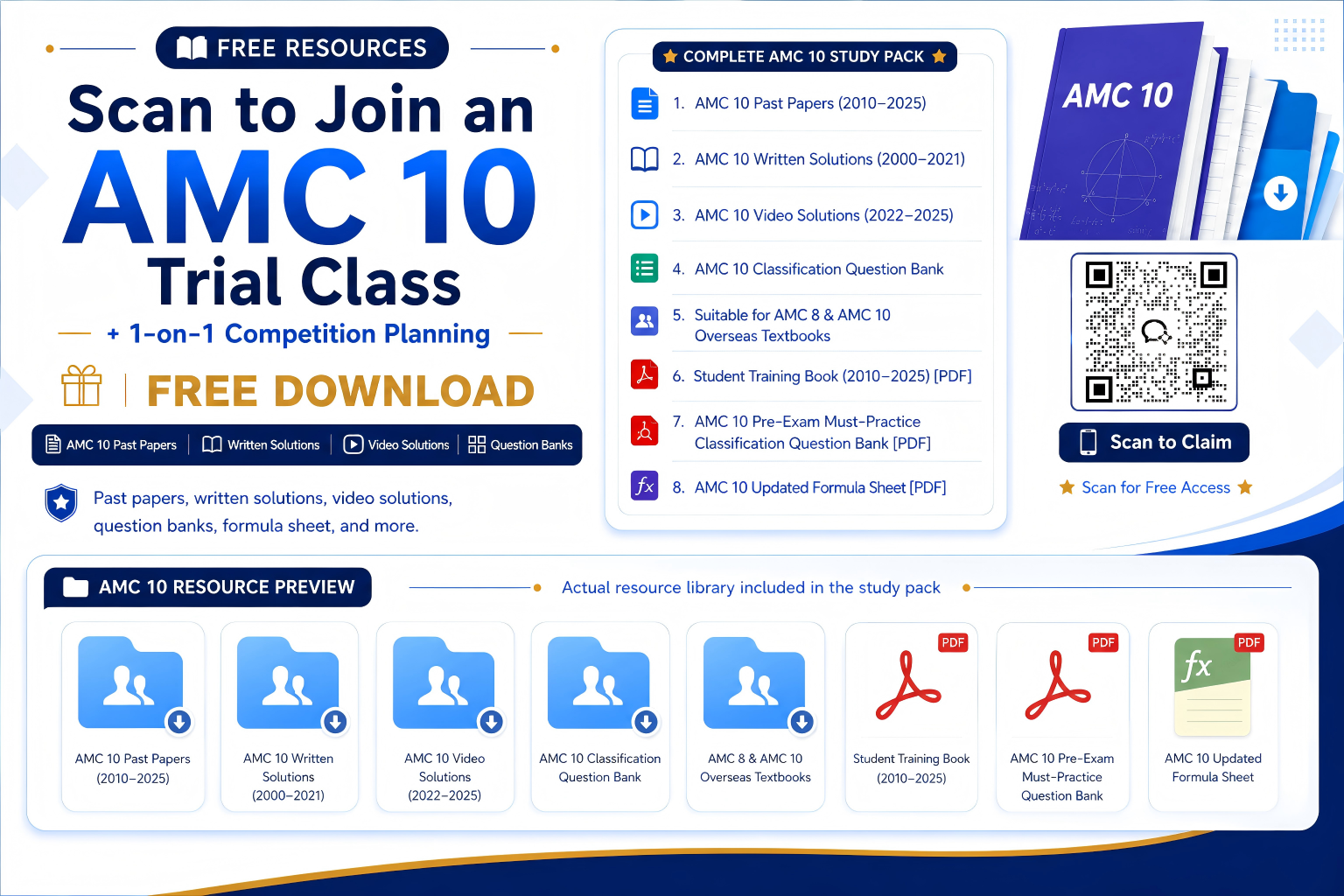
📱 Scan the QR code below to claim your FREE AMC10 preparation materials!
Practice papers, formula sheets, and study guides — all available for free. Start preparing today!