Parents’ Guide: The Ultimate 2027 AMC 8 Math Competition Preparation Strategy from Beginner to Advanced

Attention parents and students planning to participate in the AMC 8 Math Competition! The 2027 AMC 8 season is now officially underway. If you are unsure how to start preparing, wonder which grades are suitable, or seek reliable AMC 8 study resources, this guide covers everything. From competition value and content to registration procedures and grade-based preparation plans, parents can gain a complete understanding and start preparation immediately.

推荐

What is AMC 8?

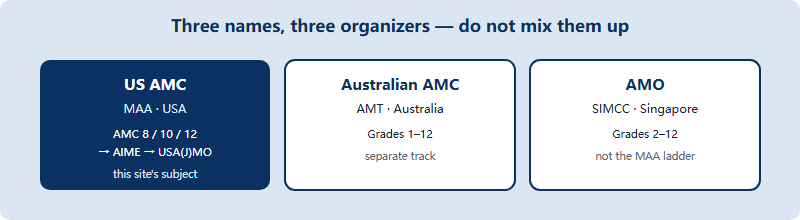
The AMC 8 Math Competition, organized by the Mathematical Association of America (MAA), is an international competition designed for students in Grade 8 and below. Due to the competition’s high reliability and validity, AMC 8 results are widely used to assess applicants’ mathematical achievements.

The AMC series includes AMC 8, AMC 10, AMC 12, AIME, USJMO, and USAMO. AMC 8 is considered the entry-level stage and is particularly popular among elementary school students. In China, top schools in Shanghai and Beijing have integrated AMC 8 performance into student evaluation, leading more Grade 4–6 students to participate. Participation numbers are approaching those of previous national math contests.

AMC 8 Competition Rules

  • Eligibility: Grade 8 and below; students must not exceed 14.5 years of age on the exam day

  • Exam Language: English and Chinese

  • Registration Deadline: China region – January 13, 2026, 20:00; US region – January 15, 2026 (late registration)

  • Exam Date: China region – January 23, 2026, 17:00–17:40; US region – January 22–28, 2026

  • Duration: 40 minutes

  • Scoring: 1 point per correct answer; no penalty for incorrect or unanswered questions; maximum score 25

  • Allowed Materials: Pen, eraser, and blank scratch paper only; calculators, protractors, or compasses are prohibited. All questions are solvable manually, emphasizing problem-solving rather than speed of calculation.

AMC 8 Awards

  • Perfect Score Award: Full score of 25 points (approximately 0.1% of students globally)

  • Honor Roll of Distinction: Top 1% worldwide; 2025 cutoff was 23 points

  • Honor Roll: Top 5% worldwide; 2025 cutoff was 19 points

  • Achievement Roll (Global Honor): 15 points or above (for Grade 6 and below students)

  • School Awards:

    • School Honor Roll: Top 3 students in a school achieving a combined score of 66 or higher

    • School Merit Roll: Top 3 students with a combined score between 50–65

AMC 8 Exam Content

Core Modules

AMC 8 questions are drawn from elementary and early middle school mathematics, including four main topics:

  • Algebra (35–52%): Integer, fraction, and percentage operations; ratios; linear equation solving; arithmetic and geometric sequences; quadratic function modeling; basic complex numbers. This is the exam’s key focus area.

  • Geometry (20–32%): Plane geometry (triangles, Pythagorean theorem, similarity), area calculations for circles and quadrilaterals, volume calculations for solids, 3D nets analysis, irregular shapes.

  • Number Theory (12–20%): Primes, divisibility, remainders, prime factorization, modular arithmetic, short division for GCD and LCM.

  • Combinatorics (12–28%): Basic counting, permutations, probability, logical reasoning, data analysis, sets, and Venn diagrams.

Difficulty Levels

  • Questions 1–15 (Basic): Aligned with Grade 4–6 classroom knowledge, e.g., fraction operations and simple geometry

  • Questions 16–20 (Intermediate): Require cross-topic integration, such as combining algebraic equations with geometric symmetry

  • Questions 21–25 (Advanced): Test abstract thinking and multi-step modeling, e.g., recursive sequences, multi-step probability, or challenging final problems

New Exam Topics for 2026–2027

  • Quadratic function modeling

  • Probability combined with real-world statistics

  • Dynamic analysis of 3D nets

  • Area calculation of irregular shapes

  • Short division for GCD and LCM

  • Summation of geometric sequences

How to Register for AMC 8 2027

AMC 8 does not allow individual registration. Registration must be completed through one of the following official channels:

  1. School Registration: If the student’s school is an authorized AMC center, registration is done through the school.

  2. Authorized Agency Registration: Parents can register through authorized organizations.

In China, official registration websites include:

Parents are advised to ensure registration through legitimate channels to avoid fraud.

AMC 8 Preparation Guide

Effective preparation should consider the student’s grade, foundation, and target level, and follow a phased approach:

  • Grade 1–2 (Introduction Stage): Focus on cultivating mathematical thinking, not directly preparing for AMC 8. Competitions like the Kangaroo Math Contest can be used to build interest and foundational skills.

  • Grade 3–4 (Transition Stage): Begin Pre-AMC 8 courses to familiarize students with competition problems and strategies. Students with solid foundations can start AMC 8 coursework to build confidence.

  • Grade 5–6 (Golden Start Stage): Aligns with school curriculum; students have basic calculation, logic, and spatial skills. Focus on problem practice and systematic AMC 8 study for optimal results.

  • Grade 7–8 (Competition Stage): Key period to target awards. Strengthen knowledge integration, increase problem-solving speed and accuracy, and conduct a diagnostic test with practice exams to identify weaknesses. Focus on reading questions quickly, eliminating distractors, and time management.

AMC 8 is more than an exam; it is a growth journey. Early planning, steady progress, and strategic methods help turn potential into achievement. With proper preparation, students can confidently enter the 2027 AMC 8 exam and achieve recognition.

推荐

AMC 10 Mathematics Competition Explained: A Complete Guide to Early Preparation

As one of the most influential mathematics competitions for undergraduate admissions, AMC 10 is widely recognized by top universities such as MIT, Stanford, and Caltech as strong evidence of academic excellence. Each year, more than 200,000 students worldwide participate in the AMC 10.

Achieving a Top 1% or Top 5% global ranking in AMC 10 is not only a direct demonstration of a student’s mathematical ability, but also a critical stepping stone to AIME qualification and prestigious summer programs such as ROSS. Early and strategic preparation is essential for students who aim to stand out.

推荐

Introduction to the AMC 10 Mathematics Competition

The AMC 10 (American Mathematics Competition 10) is part of the AMC competition series organized in the United States. It is designed for students in Grade 10 and below, with a difficulty level comparable to advanced middle school and introductory high school mathematics competitions.

AMC 10 also serves as a qualifying exam for AIME (American Invitational Mathematics Examination). Students who achieve the cutoff score are invited to advance to AIME.

Key Information at a Glance

  • Eligibility: Grade 10 and below; not older than 17.5 years on the exam day

  • Language: Bilingual (English and Chinese)

  • Exam Time: Annually in November

  • Paper Types: AMC 10A and AMC 10B (held about one week apart)

  • Exam Format: In-person (fully restored as of 2025)

  • Duration: 75 minutes

  • Questions: 25 multiple-choice questions

  • Scoring:

    • Correct answer: 6 points

    • Blank answer: 1.5 points

    • Incorrect answer: 0 points

  • Maximum Score: 150 points

AMC 10 Exam Schedule and Registration Timeline

The AMC 10 is held every November. Registration typically opens in the second half of the year. Students planning to participate should closely monitor official announcements, as exam schedules may differ between ASDAN and the China organizing committee.

Key AMC 10 Dates (2025 Reference)

  • Registration Deadline

    • AMC 10A: October 27, 2025

    • AMC 10B: November 3, 2025

  • Online Mock Exam

    • AMC 10A: November 2, 2024 (12:00) – November 7, 2024 (12:00)

    • AMC 10B: November 9, 2024 (12:00) – November 13, 2024 (12:00)

  • Admission Ticket Download & Exam Info

    • AMC 10A: November 2, 2024, 12:00

    • AMC 10B: November 9, 2024, 12:00

  • Official Exam Dates

    • AMC 10A: November 6, 2025 (Thursday), 17:00–18:15

    • AMC 10B: November 12, 2025 (Wednesday), 17:00–18:15

  • Score Release & Digital Certificates

    • Approximately 6–8 weeks after the exam

Preparation and Planning Notes

  • Recommended preparation time: 6–12 months

  • Expected registration opening: July–August

  • Registration deadline: Around 10 days before the exam
    (Students using third-party registration should plan at least two weeks earlier)

  • Important reminders:

    • Online mock exam window

    • Admission ticket download time

AMC 10 Exam Content and Topic Distribution

AMC 10 covers a broad range of mathematics topics typically taught from Grade 9 through early Grade 10, with extensions into competition-level material. The content is generally divided into four main areas.

Algebra (Approximately 35%)

  • Linear, inverse, quadratic, exponential, power, and logarithmic functions

  • Polynomials, domains, and ranges

  • Vieta’s formulas and relationships between roots and coefficients

  • Remainder theorem (competition-level extension)

  • Trigonometric basics: sine, cosine, tangent

  • Inequalities, including AM-GM inequality

  • Sequences and series (arithmetic and geometric)

  • Advanced algebraic manipulation techniques

Number Theory (Approximately 20%)

  • Integers, fractions, and decimals

  • Divisibility and number bases

  • Modular arithmetic and congruences

  • Diophantine equations (introductory)

  • Advanced number theory strategies beyond standard curriculum

Geometry (Approximately 25%)

  • Circles and quadrilaterals

  • Cyclic quadrilaterals and tangential quadrilaterals

  • Advanced triangle geometry

  • Regular polygons, incircles, and circumcircles

  • Law of Sines and Law of Cosines

  • Angle measures from elementary to arbitrary angles

  • Perimeter and area (increasing depth across grades)

  • Stewart’s Theorem (derivable via trigonometric laws)

  • Concurrency and collinearity

  • Introductory coordinate geometry

Combinatorics (Approximately 20%)

  • Binomial theorem

  • Permutations and combinations

  • Probability and expected value

  • Recursion, binary methods

  • Principle of Inclusion–Exclusion

  • Advanced counting techniques

AMC 10 Awards and Distinctions

Students are encouraged to set clear goals based on award thresholds—whether aiming for Top 1%, Top 5%, or starting with a Grade-Level Honor Award before advancing further.

AMC 10 Award Categories

  • Perfect Score Award
    Score of 150 points

  • Distinguished Honor Roll (Top 1%)
    Approximately 120+ points

  • Honor Roll (Top 5%)
    Approximately 100+ points

  • Achievement Roll
    Grade 8 and below scoring 90+ points

Historical AMC 10 Cutoff Scores and AIME Qualification

Year Test Top 1% Top 5% AIME Cutoff
2024 A 132 105 94.5
2024 B 138 114 105
2023 A 136.5 112.5 103.5
2023 B 135 111 105
2022 A 121.5 100.5 94.5
2022 B 114 100.5 93
2021 (Fall) A 117 100.5 96
2021 (Fall) B 120 100.5 96
2021 (Spring) A 132 112.5 103.5
2021 (Spring) B 126 108 102
2020 A 124.5 105 103.5
2020 B 120 103.5 102
2019 A 121.5 102 103.5
2019 B 123 96 108
2018 A 127.5 100.5 111
2018 B 123 97.5 108
2017 A 127.5 112.5 112.5
2017 B 136.5 102 120
推荐

AMC 8 vs. AMC 10: Key Differences, Syllabus Comparison, and Preparation Guidance

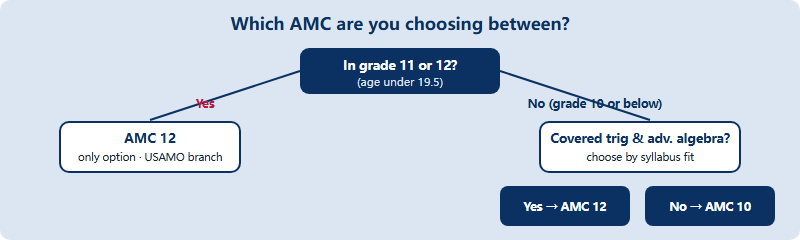
As two major competitions in the American Mathematics Competitions (AMC) series, AMC 8 and AMC 10 often cause confusion among Grade 7–8 students and parents.
What are the key differences between AMC 8 and AMC 10?
How should students in Grades 7–8 decide which competition is more suitable?

This article provides a detailed comparison of AMC 8 and AMC 10, including exam structure, content scope, difficulty level, awards, advancement pathways, and selection strategies.

推荐

Differences Between AMC 8 and AMC 10

Overview Comparison

Category AMC 8 AMC 10
Target Students Grade 8 and below Grade 10 and below
Exam Time Usually January November (A and B versions)
Exam Duration 40 minutes 75 minutes
Number of Questions 25 multiple-choice questions 25 multiple-choice questions
Scoring Maximum 25 points, 1 point per correct answer Maximum 150 points, 6 points per correct answer, 1.5 points for unanswered questions, no penalty for incorrect answers
Content Scope Integers, fractions, decimals, percentages, ratios, number theory, basic geometry, area and volume, probability, statistics, logical reasoning Elementary algebra, foundational geometry (e.g., Pythagorean theorem, area and volume formulas), elementary number theory, combinatorics, with broader and deeper coverage
Difficulty Level Moderate; focuses on foundational math thinking and logical reasoning, comparable to advanced elementary or early middle school competition level Significantly more challenging; requires strong integration of mathematical concepts and flexible problem-solving, comparable to advanced middle school or early high school level
Academic Value Helpful for middle school advancement and international school applications Highly recognized for domestic and international high school and university applications

AMC 8 vs. AMC 10: Topic Coverage Comparison

AMC 8 Core Topics

  • Basic Algebra: integers, rational and irrational numbers, real numbers, number lines, coordinate systems; linear equations, simple quadratic equations, basic inequalities; introductory sequences; fundamental algebraic techniques

  • Basic Geometry: elementary constructions; Euclidean plane geometry involving points, lines, triangles, special quadrilaterals, and circles; perimeter and area of regular figures; basic solid geometry

  • Solid Geometry: relationships between points, lines, and planes; three-dimensional coordinate systems; regular polyhedra; Euler’s formula

  • Basic Number Theory: parity analysis, divisibility rules, greatest common divisor (GCD), least common multiple (LCM), basic congruences

  • Basic Combinatorics: Venn diagrams; introductory permutations, combinations, and probability; factorials, binomial coefficients, Pascal’s triangle

AMC 10 Advanced Topics

  • Advanced Algebra: polynomials, Remainder Theorem, Vieta’s formulas, relationships between roots and coefficients, special higher-degree equations; advanced inequalities and mean inequalities; introduction to functions including domain and range, quadratic, exponential, logarithmic, and basic trigonometric functions; advanced sequences and algebraic techniques

  • Advanced Geometry: advanced constructions; triangle theorems, Law of Sines, Law of Cosines, incircles and circumcircles, Stewart’s Theorem, concurrency and collinearity; cyclic quadrilaterals and tangential quadrilaterals; regular polygons; introductory analytic geometry

  • Advanced Number Theory: modular arithmetic, complex congruences, number bases and conversions, basic Diophantine equations

  • Advanced Combinatorics: inclusion–exclusion principle, binomial theorem and related results, advanced permutations, combinations, probability, recursion, binary methods, and advanced counting techniques

Newly Added Topics from AMC 8 to AMC 10

Sequences

  • Arithmetic and geometric sequences; explicit formulas, recursive formulas, summation methods; applications of complex sequences; non-arithmetic and non-geometric sequences

Linear Functions

  • Graphs and properties of linear functions; linear inequalities and applications; coordinate geometry involving lines; word problems solved using systems of linear equations

Permutations, Combinations, and Probability

  • Fundamental counting principles (addition and multiplication rules); permutation and combination methods; probability rules and applied problems

Integrated Operations

  • Applications of GCD and LCM; sums and products of consecutive integers, odd and even numbers; advanced factorization techniques; exponent rules and equation solving

AMC 8 and AMC 10 Awards

AMC 8 Awards

  • Perfect Score Award (25 points)

  • Distinguished Honor Roll (Top 1% worldwide)

  • Honor Roll (Top 5% worldwide)

  • Achievement Roll (Grade 6 and below with a score of 15 or higher)

AMC 10 Awards

  • Distinguished Honor Roll (Top 1% worldwide)

  • Honor Roll (Top 5% worldwide)

  • Achievement Roll (Grade 8 and below with a score of 90 or higher)

  • AIME Qualification Certificate (awarded to students who meet the AIME cutoff score)

AMC 8 and AMC 10 Advancement Pathways

  • AMC 8 has no direct advancement pathway; however, a Top 1% score provides a strong advantage for middle school advancement and international school applications.

  • AMC 10: Approximately the top 2.5% of participants qualify for AIME, which is a required step toward USAMO (USA Mathematical Olympiad). AMC 10 performance is an important academic reference for applications to top universities such as Yale and Stanford.

How Should Grade 7–8 Students Choose Between AMC 8 and AMC 10?

1. Clarify Goals and Academic Foundation

Preparation Goals

  • For middle school advancement or international school applications, AMC 8 Top 1% results are often more immediately competitive.

  • For overseas high school or university applications, AMC 10 qualification for AIME carries higher academic value.

  • Students seeking early exposure and confidence-building may prioritize AMC 8, while those interested in high-level mathematical challenges may attempt AMC 10 directly.

Academic Readiness

  • AMC 8 readiness: Solid mastery of elementary competition math (e.g., rate problems, geometric area calculations) and basic middle school algebra (equations and inequalities).

  • AMC 10 readiness: In addition to AMC 8 knowledge, students should understand arithmetic sequences, quadratic functions, solid geometry, probability, and demonstrate strong problem-solving speed.

2. Grade-Specific Recommendations

Grade 7 Students

  • Weaker foundation: Focus on AMC 8, aiming for Top 5% or Top 1%, then transition to AMC 10 the following year.

  • Moderate foundation: Prepare for both AMC 8 (Top 1%) and AMC 10 (Achievement Roll), supplementing AMC 10-specific topics such as combinatorics and number theory.

  • Strong foundation: Directly attempt AMC 10 with goals of Top 5% or AIME qualification.

Grade 8 Students

  • Average foundation: Prioritize AMC 8 Top 1% while building AMC 10 fundamentals (functions, solid geometry) for future competition.

  • Strong foundation: Fully commit to AMC 10, targeting Top 1% or AIME qualification, with AMC 8 used as additional practice if desired.

3. Key Factors to Consider

  • Time Commitment: AMC 8 preparation typically requires 3–6 months, while AMC 10 often requires 6–12 months.

  • Problem Style Fit: AMC 8 emphasizes logical reasoning and accurate calculation, while AMC 10 requires flexible thinking, especially in the final problems.

  • Awards and Long-Term Planning: For short-term recognition, AMC 8 is more accessible; for long-term competition goals such as USAMO, early exposure to AMC 10 is essential.

To help students make informed decisions and prepare effectively, instructors have compiled official AMC 8 and AMC 10 past problems. By practicing with real competition questions, students can better understand the difficulty level and determine whether AMC 8 or AMC 10 is the right fit.

推荐

What Is the AMC 8 Math Competition Level? Can Elementary School Students Participate?

A Complete and Clear Guide

Many parents who are learning about the AMC 8 Math Competition often ask the same questions:
What academic level does the AMC 8 correspond to? Is it too challenging for elementary school students?

This article provides a clear explanation of the AMC 8’s difficulty level, its knowledge scope, and whether it is suitable for younger students. We will also help parents and students better understand what to expect when preparing for the AMC 8.

推荐

What Is the Academic Level of the AMC 8 Math Competition?

The AMC 8 Math Competition is generally equivalent to domestic elementary-level math competitions or fifth-grade Olympiad math. Its overall difficulty is higher than standard elementary school math curricula, with a strong emphasis on mathematical logic and creative problem-solving, but it remains less difficult than advanced Olympiad programs such as “Thinking Mathematics 100.”

In terms of content coverage, AMC 8 problems fall into three main categories:

  1. All core elementary school mathematics concepts

  2. Selected foundational middle school mathematics topics

  3. A small number of competition-style extension problems

Specifically, the exam includes fundamental operations with integers, fractions, decimals, percentages, and ratios. It also covers more advanced topics such as number theory, common geometric figures, area and volume calculations, probability and statistics, and logical reasoning. Students preparing for the AMC 8 are expected to thoroughly master these concepts.

How Is AMC 8 Different from School Math Exams?

School math exams primarily focus on testing basic knowledge and procedural accuracy. In contrast, the AMC 8 places much greater emphasis on mathematical thinking, reasoning skills, and problem-solving ability.

Compared with traditional math Olympiads, AMC 8 not only develops logical reasoning, problem-solving strategies, and mathematical depth, but also helps students improve their English reading skills, real-world application ability, and international academic perspective.

AMC 8 Topic Distribution and Recommended Grade Levels

Logic

  • Topic: Logical reasoning

  • Proportion: 5%

  • Recommended grades: 4–6

Algebra I

  • Topics: Basic operations, fractions, ratios, proportions, advanced calculations, rate and distance problems

  • Proportion: 20%

  • Recommended grades: 3–7

Number Theory

  • Topics: Odd and even numbers, divisibility, prime numbers, prime factorization, greatest common divisor, least common multiple, remainders

  • Proportion: 15%

  • Recommended grades: 2–7

Counting and Probability

  • Topics: Permutations, combinations, probability, counting techniques, sets and Venn diagrams, data representation

  • Proportion: 20%

  • Recommended grades: 3–8

Algebra II

  • Topics: Arithmetic sequences, geometric and recursive sequences, solving equations, systems of equations, Diophantine equations

  • Proportion: 15%

  • Recommended grades: 3–6

Geometry

  • Topics: Angles and lines, triangles, quadrilaterals and polygons, circles, equations of lines and circles, coordinate geometry, solid geometry

  • Proportion: 25%

  • Recommended grades: 3–7

Unique Advantages for Younger Students Participating in AMC 8

Younger students can gain two major benefits by participating in the AMC 8:

  1. Earning Global Recognition Awards More Easily
    Students in Grade 6 or below who score 15 points or higher can receive an age-specific global honor award, adding a strong academic highlight to their profile.

  2. Smooth Transition to Middle School Mathematics
    AMC 8 preparation introduces students to foundational middle school math topics in advance, helping them avoid learning gaps during the elementary-to-middle school transition and making academic progression more seamless.

Final Recommendation

Overall, if a student has a solid math foundation and a strong interest in STEM subjects, Grades 4–6 represent the optimal period to challenge the AMC 8. At this stage, students can balance school learning with competition preparation while laying an early foundation for future academic advancement.

推荐

A Comprehensive Guide to the AMC 10 Math Competition: Academic Value, Difficulty, Awards, Scoring, and Curriculum

The AMC 10 (American Mathematics Competition 10) is a globally recognized mathematics competition with a large international participant base and strong relevance for university applications. Whether students are enrolled in a domestic curriculum, AP/IB/A-Level programs, or overseas secondary schools, AMC 10 is widely regarded as a key academic enrichment activity for those aiming for top universities worldwide.

推荐

Academic Value of the AMC 10 Competition

A Strong Academic Credential Recognized by Top Universities

Organized by the Mathematical Association of America (MAA), AMC 10 is one of the most influential mathematics competitions for middle school and early high school students. Its results are an important reference for evaluating mathematical ability at elite universities such as MIT and Stanford, and some application systems even provide dedicated fields for reporting AMC scores.

A Key Step Toward Higher-Level Academic Competitions

Students who achieve strong results in AMC 10 are eligible to advance to the AIME (American Invitational Mathematics Examination), making AMC 10 a critical stepping stone to more advanced mathematics competitions.

Comprehensive Evidence of Student Ability

AMC 10 is not merely a mathematics test. It assesses students’ logical reasoning, problem-solving skills, and time management under pressure. Earning awards in AMC 10 provides strong academic evidence for applicants pursuing STEM-related majors.

AMC 10 Rules and Award Structure

Competition Rules

  • Eligibility: Grade 10 and below; age not exceeding 17.5 years

  • Exam Date: Annually in November

  • Format: 25 multiple-choice questions, bilingual (English and Chinese)

  • Duration: 75 minutes

  • Scoring System:

    • Maximum score: 150

    • Correct answer: 6 points

    • Unanswered: 1.5 points

    • Incorrect answer: 0 points

AMC 10 Awards

  • Perfect Score Award: 150 points

  • Honor Roll of Distinction: Top 1% worldwide

  • Distinction: Top 5% worldwide

  • Top 10% Honor Roll: Top 10% worldwide

  • Top 25% Honor Roll: Top 25% worldwide

  • Achievement Roll: Students in Grade 8 or below scoring 90 or above

  • AIME Qualification Certificate: Achieving the AIME cutoff score for the season (typically around the top 2.5% globally)

Historical AMC 10 / AMC 12 Score Cutoffs (2022–2025)

Year Exam Honor Roll of Distinction (1%) Distinction Achievement Roll AIME Cutoff
2025 AMC10A 136.5 112.5 90 105
2025 AMC10B 133.5 105 90 99
2025 AMC12A 150 127.5 90 96
2025 AMC12B 145.5 127.5 90 100.5
2024 AMC10A 132 105 90 94.5
2024 AMC10B 135 112.5 90 105
2024 AMC12A 135 111 90 85.5
2024 AMC12B 139.5 114 90 88.5
2023 AMC10A 136.5 111 90 103.5
2023 AMC10B 135 112.5 90 105
2023 AMC12A 136.5 112.5 90 85.5
2023 AMC12B 139.5 115.5 90 88.5
2022 AMC10A 121.5 100.5 90 93
2022 AMC10B 114 100.5 90 94.5
2022 AMC12A 126 106.5 90 81
2022 AMC12B 129 105 90

AMC 10 Exam Content

Core Topics

Algebra and Equations
Polynomials, rational expressions, radicals, linear and quadratic equations, sequences, basic functions, and inequalities, with an emphasis on computation and algebraic manipulation.

Geometry
Plane geometry (triangles, circles, similarity, congruence, area, and length) and introductory solid geometry (volume and surface area), with a strong focus on diagram analysis.

Number Theory
Divisibility, prime factorization, greatest common divisor and least common multiple, modular arithmetic, and digit problems, requiring strong problem-solving techniques.

Combinatorics and Probability
Counting principles, permutations and combinations, probability, and logical reasoning, emphasizing strategy over heavy computation.

Advanced Topics

Advanced Algebra
Polynomials, the Remainder Theorem, Vieta’s formulas, relationships between roots and coefficients, special higher-degree equations; advanced inequalities and mean inequalities; introductory functions including domains and ranges, quadratic, exponential, logarithmic, and basic trigonometric functions; advanced sequences and algebraic techniques.

Advanced Geometry
Advanced geometric constructions; triangle geometry including the Law of Sines, Law of Cosines, incircles, circumcircles, and Stewart’s Theorem; concurrency and collinearity; circles and quadrilaterals, cyclic quadrilaterals, tangential quadrilaterals; regular polygons; and introductory coordinate geometry.

Solid Geometry
Relationships between points, lines, and planes; three-dimensional coordinate systems; solid geometry constructions; regular polyhedra, Euler’s formula, and specialized spatial problem-solving techniques.

Advanced Number Theory
Numbers, arrays, and sequences; modular arithmetic and advanced congruence problems; integers, fractions, decimals, and base conversion; basic Diophantine equations and advanced number theory strategies.

Advanced Combinatorics and Probability
The inclusion–exclusion principle; the binomial theorem and related results; advanced permutations and combinations; recursion, binary methods, and higher-level counting strategies.

AMC 10 Difficulty Analysis

Overall Positioning

AMC 10 aligns with advanced middle school mathematics and introductory high school mathematics. It does not test advanced calculus or out-of-syllabus material, instead emphasizing flexible thinking and elegant problem-solving methods.

Difficulty Distribution (25 Questions)

  • Questions 1–10: Foundational problems; students with solid classroom knowledge can solve these reliably and secure most of the points

  • Questions 11–20: Intermediate problems requiring techniques, models, and multi-step reasoning

  • Questions 21–25: High-difficulty problems designed to differentiate top scorers, testing comprehensive ability and competition-level thinking

Key Difficulty Characteristics

  • Limited computation but a high conceptual threshold

  • Flexible problem types emphasizing logic, construction, and case analysis rather than formula memorization

  • Tight time constraints (75 minutes for 25 questions), making both speed and accuracy critical

推荐

The Ultimate 2027 AMC 8 Preparation Guide: From Beginner to High Scorer — A Must-Read for Parents

Recently, many parents have been asking similar questions:
“Is the AMC 8 worth taking?”
“My child is only in Grade 3—can they start preparing now?”
“How does the registration process work? I’m afraid of missing the deadline.”

As one of the most widely recognized international mathematics competitions for elementary and middle school students, AMC 8 is often the very first step for families planning a long-term math competition pathway.

This guide provides a complete and practical overview of the 2027 AMC 8, covering everything from what the competition is, to how to prepare effectively, and common pitfalls to avoid. After reading, parents will be able to build a clear preparation plan with confidence—even if they are completely new to math competitions.

推荐

What Is AMC 8? Essential Basics Every Parent Should Know

The AMC 8 (American Mathematics Competition 8) is organized by the Mathematical Association of America (MAA). It is designed for upper-elementary and middle school students, focusing on mathematical reasoning, logical thinking, and real-world problem solving, rather than advanced computation.

AMC 8 is widely regarded as the ideal entry-level competition within the U.S. math competition system and serves as a strong foundation for future participation in AMC 10 and AMC 12.

Overview of the U.S. Mathematics Competition System

  • IMO (International Mathematical Olympiad)
    The world’s top mathematics competition, where national teams compete globally.

  • USAMO (USA Mathematical Olympiad)
    Equivalent to a national team selection event in the U.S.; high scorers may qualify for IMO and gain strong credentials for top universities.

  • AIME (American Invitational Mathematics Examination)
    Held in February each year; top performers from AMC 10/12 qualify. Scores of 7–10 are highly competitive for Top 30 U.S. universities.

  • AMC 10 / AMC 12
    National-level competitions for middle and high school students, held annually in January.

  • AMC 8
    An introductory competition focused on interest-building and foundational thinking, comparable to advanced elementary math contests.

Key Information About AMC 8

Eligibility

  • Students in Grade 8 or below

  • Must be 14.5 years old or younger on the day of the exam

  • Students in Grades 3–8 are eligible

  • Younger students may qualify for Low-Grade Honor Awards

Exam Format

  • 25 multiple-choice questions

  • 40 minutes

  • Bilingual paper (English & Chinese available in some regions)

  • 1 point per correct answer, no penalty for wrong or blank answers

  • Maximum score: 25

Exam Date

  • Held annually in January

  • Registration usually opens 2–3 months in advance

  • Scores released 6–8 weeks after the exam

  • Official 2027 dates will be announced by MAA

Awards and Recognition

  • Top 1% worldwide: Distinguished Honor Roll

  • Top 5% worldwide: Honor Roll

  • Grade 6 and below with 15+ points: Achievement Roll

These awards are valuable for middle school admissions, international school applications, and confidence building.

AMC 8 Exam Content Overview

AMC 8 covers mathematics from elementary to early middle school, focusing on four main areas:

Algebra

  • Operations with integers, fractions, decimals, and percentages

  • Solving basic equations and inequalities

  • Number sequences and simple models

  • Ratios and proportional reasoning

Geometry

  • Properties of triangles, quadrilaterals, and circles

  • Perimeter and area

  • Similar figures

  • Coordinate geometry basics

Number Theory

  • Greatest common divisor (GCD) and least common multiple (LCM)

  • Odd and even numbers

  • Divisibility rules

  • Introductory modular arithmetic

Counting & Probability

  • Counting principles and basic permutations

  • Probability and statistics

  • Simple combinatorics and selection problems

Allowed Materials

  • No calculators

  • No rulers, protractors, or compasses

  • Only pencils, erasers, and blank scratch paper

AMC 8 emphasizes thinking efficiency, not complex calculations.

How to Register for the 2027 AMC 8

Important Notice:
AMC 8 does not allow individual registration. Students must register through authorized channels only.

Option 1: School-Based Registration (Recommended)

  • International schools or authorized partner schools may serve as official test centers

  • Parents register through the school or via the ASDAN academic competition platform

  • Exam is taken on campus

  • Registration fee: approximately RMB 120

Option 2: Authorized Institutions

  • If the school is not a test center, students may register through officially authorized AMC organizations

  • Parents should always verify authorization to avoid invalid registrations

Registration Deadline:
Usually one month before the exam. For AMC 8 2027, parents should begin monitoring official announcements from November 2026.

AMC 8 Preparation Strategies by Grade Level

Preparation should never be “one-size-fits-all.” Students in Grades 3–5 and Grades 6–8 have different goals and strategies.

Grades 3–5: Build Foundations and Aim for 15 Points

At this stage, the focus should be interest and fundamentals, not difficult problems.

  • Strengthen School Math
    Master arithmetic, basic geometry formulas, and simple equations. Programs like Singapore Math are highly effective.

  • Develop Interest
    Use math games, puzzles, and real-life applications (shopping calculations, logic games) to reduce anxiety.

  • Light Practice
    Work on the first 15 questions of past AMC 8 papers without time pressure. Focus on understanding solutions.

  • Math Vocabulary
    Learn essential English math terms such as prime number, area, and perimeter.

Grades 6–8: Target Top 5% or Top 1%

Students at this level should focus on advanced topics, speed, and accuracy, while preparing for AMC 10.

  • Expand Knowledge Scope
    Study number theory, probability, combinatorics, and introductory coordinate geometry.
    Art of Problem Solving (AoPS) resources are highly recommended.

  • Systematic Past Paper Practice
    Complete 10 years of AMC 8 papers under timed conditions.

    • Questions 1–10: zero mistakes

    • Questions 11–20: selective problem solving

    • Questions 21–25: attempt only strengths

  • Error Analysis
    Categorize mistakes by concept, logic, or calculation. Review weekly.

  • Mock Exams
    One full mock exam per week during the final month to train time management and exam rhythm.

High-Scoring Strategies for the AMC 8

  • Time Allocation

    • First 10 questions: ~12 minutes

    • Questions 11–20: ~20 minutes

    • Questions 21–25: ~5 minutes

    • Final check: ~3 minutes

  • Efficient Techniques

    • Plug answer choices into equations

    • Draw diagrams for geometry

    • Eliminate impossible probability options

  • Avoid Common Mistakes

    • Highlight keywords such as “at least” or “not”

    • Keep units consistent

    • Do not confuse similar concepts (area vs. perimeter, prime vs. composite)

Common Parent Mistakes to Avoid

  1. Last-minute cramming
    AMC 8 requires long-term thinking practice; 3–6 months of preparation is ideal.

  2. Chasing full marks
    Skipping extremely difficult questions can lead to a higher overall score.

  3. Using unauthorized registration channels
    Always verify official authorization.

  4. Practicing without review
    Reviewing mistakes is more valuable than doing more new problems.

Suggested AMC 8 Preparation Timeline

  • June–August 2026: Strengthen fundamentals and explore competition topics

  • September–November 2026: Past papers and targeted improvement

  • December 2026: Registration + weekly mock exams

  • January 2027: Final review, mindset adjustment, exam day

Final Thoughts

AMC 8 is not only for “math prodigies.” With the right planning, students of different ages and abilities can all benefit—whether building logical thinking at a young age or earning competitive awards in later grades.

Steady progress, not blind drilling, is the key to long-term success.

推荐

AMC 8 vs. AMC 10: Key Differences, Competition Pathways, and Preparation Resources

As two core competitions in the AMC (American Mathematics Competitions) series, AMC 8 and AMC 10 often leave parents and students in Grades 7–8 uncertain about which contest to choose.
What are the key differences between AMC 8 and AMC 10?
How should Grade 7–8 students decide between AMC 8 and AMC 10?

This article provides a comprehensive comparison and practical guidance.

推荐

Key Differences Between AMC 8 and AMC 10

Overview Comparison

Target Participants

  • AMC 8: Students in Grade 8 and below

  • AMC 10: Students in Grade 10 and below

Exam Schedule

  • AMC 8: Usually held in January

  • AMC 10: Held annually in November (A and B versions)

Exam Duration

  • AMC 8: 40 minutes

  • AMC 10: 75 minutes

Number of Questions

  • Both competitions consist of 25 multiple-choice questions

Scoring System

  • AMC 8: Maximum score of 25; 1 point per correct answer

  • AMC 10: Maximum score of 150;

    • 6 points for each correct answer

    • 1.5 points for unanswered questions

    • No penalty for incorrect answers

Content Scope

  • AMC 8 focuses on integers, fractions, decimals, percentages, ratios, number theory, basic geometry (area and volume), probability, statistics, and logical reasoning.

  • AMC 10 covers a broader and deeper range of topics, including elementary algebra, advanced geometry (such as the Pythagorean theorem), number theory, and combinatorics.

Difficulty Level

  • AMC 8: Moderate difficulty, emphasizing foundational math thinking and logical reasoning. The level is comparable to advanced elementary or early middle school math competitions.

  • AMC 10: Significantly more challenging, requiring strong problem-solving skills and flexible application of mathematical concepts. The difficulty is comparable to advanced middle school or early high school math competitions.

Academic Value

  • AMC 8: Helpful for middle school advancement and international school applications as a demonstration of mathematical ability.

  • AMC 10: Highly recognized in both domestic and international high school and university applications, serving as an important academic credential.

AMC 8 vs. AMC 10: Topic Coverage Comparison

AMC 8 Core Topics

  • Basic algebra: integers, rational and irrational numbers, real numbers, number lines, coordinate systems

  • Linear equations, simple quadratic equations, inequalities

  • Introductory sequences and basic algebraic techniques

  • Euclidean plane geometry: points, lines, triangles, quadrilaterals, circles

  • Perimeter, area, and volume of regular figures

  • Introductory solid geometry

  • Elementary number theory: parity, divisibility, GCD and LCM, basic modular arithmetic

  • Introductory combinatorics and probability, Venn diagrams, permutations, combinations, factorials, Pascal’s triangle

AMC 10 Advanced Topics

  • Polynomial algebra, Remainder Theorem, Vieta’s formulas, higher-degree equations

  • Advanced inequalities and mean inequalities

  • Functions: domain and range, quadratic, exponential, logarithmic, and basic trigonometric functions

  • Advanced geometry: sine and cosine laws, incircles and circumcircles, Stewart’s Theorem, concurrency and collinearity

  • Introductory analytic geometry

  • Advanced number theory: modular arithmetic, Diophantine equations, base conversions

  • Advanced combinatorics: inclusion–exclusion principle, binomial theorem, recursion, advanced counting techniques

Newly Introduced Topics from AMC 8 to AMC 10

Sequences

  • Arithmetic and geometric sequences, explicit formulas, recursive formulas, summation techniques, and complex applications

Linear Functions

  • Graphs and properties of linear functions, linear inequalities, coordinate geometry, and word problems involving linear systems

Permutations, Combinations, and Probability

  • Fundamental counting principles, permutations, combinations, probability rules, and applied problem solving

Advanced Operations

  • GCD and LCM applications, sums and products of consecutive integers, advanced factorization techniques, exponent rules, and equation solving

AMC 8 and AMC 10 Awards

AMC 8 Awards

  • Perfect Score Award (25 points)

  • Distinguished Honor Roll (Top 1% worldwide)

  • Honor Roll (Top 5% worldwide)

  • Achievement Roll (Grade 6 and below with a score of 15 or higher)

AMC 10 Awards

  • Distinguished Honor Roll (Top 1% worldwide)

  • Honor Roll (Top 5% worldwide)

  • Achievement Roll (Grade 8 and below with a score of 90 or higher)

  • AIME Qualification Certificate (for students who reach the AIME cutoff score)

AMC 8 and AMC 10 Advancement Pathways

  • AMC 8 does not lead directly to higher competitions, but a Top 1% score provides a strong advantage for middle school advancement and school applications.

  • AMC 10: Approximately the top 2.5% qualify for AIME, which is a required step toward USAMO, the U.S. national mathematics olympiad selection process. AMC 10 performance is highly valued by top universities such as Yale and Stanford.

How Should Grade 7–8 Students Choose Between AMC 8 and AMC 10?

1. Clarify Goals and Academic Foundation

Competition Goals

  • For middle school advancement or international school applications, AMC 8 Top 1% results are highly effective.

  • For overseas high school or university applications, AMC 10 qualification for AIME carries greater academic weight.

  • Students seeking confidence-building and early competition exposure may prefer AMC 8, while those interested in high-level challenges may attempt AMC 10.

Academic Readiness

  • AMC 8 readiness: Strong mastery of elementary olympiad math and basic middle school algebra.

  • AMC 10 readiness: Solid AMC 8 foundation plus knowledge of sequences, quadratic functions, solid geometry, and probability, along with fast problem-solving skills.

2. Grade-Specific Recommendations

Grade 7 Students

  • Weaker foundation: Focus on AMC 8, aiming for Top 5% or Top 1%, then transition to AMC 10 the following year.

  • Moderate foundation: Prepare for both AMC 8 (Top 1%) and AMC 10 (Achievement Roll), supplementing advanced topics.

  • Strong foundation: Directly challenge AMC 10 with goals of Top 5% or AIME qualification.

Grade 8 Students

  • Average foundation: Prioritize AMC 8 Top 1% while building AMC 10 fundamentals for future competition.

  • Strong foundation: Fully commit to AMC 10 with goals of Top 1% or AIME qualification, using AMC 8 as additional practice if desired.

3. Key Factors to Consider

  • Time Commitment: AMC 8 preparation typically requires 3–6 months, while AMC 10 often requires 6–12 months.

  • Problem-Solving Style: AMC 8 favors steady logic and calculation; AMC 10 rewards creative and flexible thinking, especially in the final problems.

  • Long-Term Planning: Short-term awards favor AMC 8, while long-term olympiad pathways require early AMC 10 exposure.

To support informed decision-making and effective preparation, teachers have compiled official AMC 8 and AMC 10 past problems. Practicing these materials allows students to accurately assess difficulty levels and determine which competition best suits their abilities.

推荐

AMC 10 Math Competition Explained: How to Win Awards and Qualify for AIME

Complete Guide with AMC 10 Preparation Resources

Pre-registration for the 2026 AMC 10/12 is now open. Hanlin is an officially authorized AMC-China test center.

The AMC 10 is one of the most prestigious and widely recognized mathematics competitions for middle school students. As an intermediate-level math contest, it attracts a large number of students worldwide and is especially popular among international school students. It is also a key stepping stone for students aiming to qualify for AIME.

For many students preparing for AMC 10, the most common and unavoidable questions are:

  • What score is required to qualify for AIME?

  • How many questions do you need to answer correctly to reach the top 5% or top 1%?

This article provides a comprehensive overview of the AMC 10, scoring strategies, recent score cutoffs, and a practical preparation roadmap.

推荐

Understanding the AMC 10 Competition

1. Scoring Rules

The AMC 10 consists of 25 multiple-choice questions with a total testing time of 75 minutes.

  • Questions 1–10: Basic level

  • Questions 11–20: Medium difficulty

  • Questions 21–25: High difficulty, significant score separators

Scoring system:

  • Correct answer: 6 points

  • Unanswered question: 1.5 points

  • Incorrect answer: 0 points

  • Maximum score: 150 points

There are two critical takeaways from this scoring rule:

  1. Leaving a question blank is better than guessing incorrectly.
    Skipping a question earns 1.5 points, while an incorrect answer earns zero.

  2. Total score is determined by the combination of correct and unanswered questions, not simply by how many questions you attempt.

2. Recent AMC 10 Score Cutoffs

AMC 10A

  • AIME Qualification Cutoff

    • 2025: 105

    • 2024: 94.5

    • Change: +10.5

  • Honor Roll (Top 1%)

    • 2025: 136.5

    • 2024: 132

    • Change: +4.5

  • Distinction

    • 2025: 112.5

    • 2024: 105

    • Change: +7.5

AMC 10B

  • AIME Qualification Cutoff

    • 2025: 99

    • 2024: 105

    • Change: −6

  • Honor Roll (Top 1%)

    • 2025: 133.5

    • 2024: 135

    • Change: −1.5

  • Distinction

    • 2025: 105

    • 2024: 112.5

Score Strategies for Different Goals

Goal 1: Qualify for AIME

Target score: 100+

A highly reliable strategy is:

  • 15 correct answers + 10 unanswered

  • Score calculation: 6 × 15 + 1.5 × 10 = 105 points

This score comfortably exceeds the AIME qualification cutoff for most years.

Key strategy:
Focus on ensuring high accuracy in the first 15 questions, which are mostly foundational and manageable with solid preparation. Even answering just 1–2 additional questions correctly in the remaining section can boost the score by another 6–12 points.

Goal 2: Reach the Top 5%

Target score: 110+

Recommended strategy:

  • 18 correct answers + 7 unanswered

  • Score calculation: 6 × 18 + 1.5 × 7 = 118.5 points

This score meets the top 5% cutoff for most AMC 10 exams in the past three years.

Key strategy:
Success at this level depends heavily on Questions 16–20, which typically require combining two or three concepts. During preparation, students should aim to answer at least 3 of these 5 questions correctly, in addition to getting the first 15 questions right.

Goal 3: Reach the Top 1%

Target score: 130+

Recommended strategy:

  • 21 correct answers + 4 unanswered

  • Score calculation: 6 × 21 + 1.5 × 4 = 132 points

This score satisfies the Top 1% requirement for recent AMC 10A exams.

Key strategy:
The main challenge lies in Questions 21–25, which are designed as high-difficulty differentiators. These problems often involve creative reasoning and are not limited to a single topic. Advanced problem-solving skills and deep conceptual understanding are essential.

AMC 10 Preparation Plan by Grade Level

Grades 6–7

At this stage, the primary goal is to build interest and strengthen mathematical foundations. Unless students have already mastered advanced high school–level content, AMC 10 is generally a more appropriate and cost-effective choice than AMC 12.

Grades 8–10

If the goal is AIME qualification, AMC 10 is often the safer and more strategic option. The syllabus is more focused, and with systematic training, students are more likely to achieve a high score efficiently.

Pre-registration for the 2026 AMC 10/12 is now open. Hanlin is an officially authorized AMC-China test center.

推荐

AMC 10 Math Competition: Real Difficulty Level & Award Rate Analysis (With Official Problem Insights)

How difficult is the AMC 10 Math Competition, really? Is it hard to win awards? And for students with little or no prior competition background, is six months of preparation enough to significantly improve mathematical ability and reach award-level performance in the November AMC 10?

This article provides a comprehensive analysis of the AMC 10 competition difficulty, examining its exam content, difficulty structure, participant demographics, and award rates, helping students and parents clearly understand what AMC 10 demands—and what it takes to succeed.

推荐

Difficulty Positioning of AMC 10

Within the ecosystem of international mathematics competitions, AMC 10 is positioned as an entry-to-intermediate level contest. It bridges advanced middle school mathematics and foundational high school mathematics, making it one of the most popular international competitions for students beginning their journey into math contests.

Below, we analyze the AMC 10 from four key dimensions: exam content, core difficulty, suitable grade levels, and participation & award rates, to clearly define its true difficulty range.

I. Exam Content Overview

The AMC 10 strictly limits its scope to mathematics taught in Grade 10 or below in the U.S. system, roughly equivalent to all middle school math plus introductory high school math in other education systems. While the syllabus avoids advanced or abstract topics, it emphasizes broad coverage and cross-topic integration.

Topic Distribution

  • Algebra (38%) – 8–10 questions

  • Geometry (29%) – 6–8 questions

  • Number Theory (19%) – 4–6 questions

  • Combinatorics (14%) – 3–5 questions

There are no advanced proofs or calculus-based topics, but many problems require flexible thinking and multi-step reasoning across different areas.

Core Knowledge Areas

Algebra
Linear and quadratic equations, inequalities, sequences (arithmetic and geometric), absolute value, ratios, systems of equations, averages (mean, median, mode), polynomial operations, and word problems.

Number Theory
Greatest common divisors, least common multiples, primes and composites, divisibility, modular arithmetic, remainders, base systems, Diophantine equations, and mixed number theory problems.

Geometry
Plane geometry dominates (about 80%), including triangles, circles, polygons, similarity, area and length calculations. Solid geometry is limited to basic prisms and pyramids, focusing on volume and surface area. Coordinate geometry is tested at a basic level only.

Combinatorics
Basic counting, permutations and combinations, probability, casework, inclusion–exclusion, complementary counting, recursive reasoning, and elementary geometric probability.

Key Content Characteristics

  • Clear difficulty progression

  • Emphasis on logical reasoning and flexible application, not advanced theory

  • No trick questions, excessive computation, or obscure topics

  • Focus on integrating multiple concepts, such as algebra with geometry or number theory with combinatorics

This approach differs from some domestic math contests that focus heavily on deep exploration of a single topic.

II. Overall Difficulty Structure

The AMC 10 consists of 25 multiple-choice questions, worth 6 points each, for a total of 150 points. Unanswered questions receive 1.5 points, while incorrect answers receive 0 points. The difficulty increases steadily from Question 1 to Question 25, with a very clear gradient.

Difficulty Breakdown

Questions 1–10: Foundation Level
These are straightforward, single-concept problems involving basic algebra, geometry, or number theory. Strong middle school students can usually solve these with little or no competition training. Accuracy rates often exceed 95%.

Questions 11–20: Intermediate Level
These problems involve cross-topic integration and require familiarity with basic competition techniques such as construction, case analysis, or number–shape reasoning. Students with 1–2 years of middle school Olympiad training or targeted AMC practice can typically solve about 70–80% of these correctly.

Questions 21–25: Advanced Level
This section strongly differentiates high scorers. The problems often combine multiple concepts and require competition-specific thinking. Some questions are comparable in difficulty to the first 20 problems of AMC 12 and approach AIME entry-level difficulty. Systematic training is usually essential to perform well here.

Overall Assessment

AMC 10 is best described as easy to start, but difficult to score highly. While participation is accessible to most students, achieving scores above 120+ (roughly 20 correct answers) requires substantial preparation. In comparison, AMC 10 is slightly more challenging than preliminary domestic junior competitions and aligns with the foundational stage of advanced rounds.

III. Participation Scale & Award Rates

AMC 10 is one of the most widely participated mathematics competitions in the world. The AMC series (AMC 8, 10, and 12) attracts over 300,000 students annually across 100+ countries and regions.

In recent years:

  • Annual participation in China alone exceeds 100,000 students

  • Approximately 70% of AMC 10 participants are in Grades 8–9

Global Award Structure

AMC awards are global and standardized, with no regional quotas.

Individual Global Awards

  • Perfect Score: 150 points

  • Honor Roll of Distinction: Top 1% worldwide

  • Distinction: High-performing global award

  • Achievement Roll: Recognition for solid performance

School Awards (China Region)

  • School Honor Roll: Top 3 students with a combined score of 400+

  • School Merit Roll: Top 3 students with a combined score of 300–399

AMC 10 and AMC 12 share the same evaluation framework, and AIME qualification cutoffs vary by year and exam version, typically ranging between 94 and 105 points for AMC 10.

Final Conclusion

Overall, AMC 10 is a low-barrier, well-structured, thinking-oriented international mathematics competition. It offers clear difficulty progression, strong differentiation at the top end, and accessible entry for motivated students.

However, while participation is easy, earning high-level awards is not. For students aiming for Distinction-level scores or AIME qualification, at least six months of focused preparation is strongly recommended. With systematic training and consistent practice, AMC 10 can significantly enhance mathematical reasoning and competition readiness.

推荐

Taught by Officially Certified AMC Coaches: Full Preparation Plan for the New Season — Step-by-Step Guidance to Reach the Top 1%

As one of the most challenging competitions in the U.S. mathematics contest system, AMC 10 and AMC 12 assess not only students’ mathematical foundations but also their problem-solving strategies, logical reasoning, and psychological resilience under pressure.

The Hanlin Instructor Team has undergone a major upgrade: officially certified AMC coaches now teach the courses directly, providing structured guidance even for students with no prior competition experience. From fundamentals to advanced techniques, this program is designed to lead students step by step toward the Top 1%.

推荐

Limited-Time Resources Giveaway

Students who enroll will receive a comprehensive set of official and analytical materials, including:

  • 2024 AMC 10 & 12A English Exam Papers with Answers (PDF)

  • 2024 AMC 10 & 12A Bilingual Exam Papers (PDF)

  • 2024 AMC 10 & 12B English Exam Papers with Answers (PDF)

  • 2024 AMC 10B English Exam Paper (PDF)

  • 2024 AMC 10A Video Solutions (MP4)

  • 2024 AMC 10A Bilingual Video Solutions (MP4)

  • 2024 AMC 10B Video Solutions (MP4)

  • 2024 AMC 12B English Exam Paper (PDF)

Core Preparation Materials

Topic-Based Question Banks

  • Mathematics Competition Topic Bank Series V1.0 (AMC 10)

  • Intermediate-Level Topic Bank (AMC 12)

Key Formula Sheets

  • AMC 10: Key Strategies and Formulas

  • AMC 12: Key Strategies and Formulas

Essential Topics by Module

I. Geometry

  • Intercept Theorem for Parallel Lines

  • Projection Theorem

  • Angle Bisector Theorem

  • Triangle Area Using Sine

  • Stewart’s Theorem

II. Algebra

  • Vieta’s Formulas

  • Binomial Theorem:

    (a+b)n=∑k=0n(nk)akbn−k(a+b)^n = \sum_{k=0}^{n} \binom{n}{k} a^k b^{n-k}

  • Compound Ratio Theorem

  • Arithmetic Mean–Geometric Mean Inequality (AM–GM)

  • Sum of Cubes Formula:

    a3+b3=(a+b)(a2−ab+b2)a^3 + b^3 = (a+b)(a^2 - ab + b^2)

  • Remainder Theorem

III. Number Theory

  • Greatest Common Divisor (GCD)

  • Euclidean Algorithm

  • Chinese Remainder Theorem

  • Fermat’s Little Theorem

  • Wilson’s Theorem

  • Euler’s Theorem

IV. Advanced AMC 12 Concepts

  • Logarithmic Identities

  • Euler’s Formula:

    eix=cos⁡x+isin⁡xe^{ix} = \cos x + i \sin x

2026 AMC 10/12 Registration Information

Eligible Students

Students who register for the 2026 AMC 10/12 through Hanlin and attend all scheduled exam sessions without absence.

Registration Benefits

Performance Level Reward
Top 5% 2 hours of official AIME group classes (worth ¥1500)
Top 1% 2 hours of one-on-one coaching (AIME preparation or summer school application guidance, worth ¥3000)

Important Notes

  • Hanlin is an officially authorized AMC-China test center

  • Registration cancellation with full refund is allowed before October 10, 2026

  • After seat confirmation, refunds are not available for withdrawal or absence

  • Eligible students may contact Hanlin advisors to claim rewards after score release

  • Final interpretation rights belong to Hanlin

2026 AMC 10/12 Trial Classes

Target Students

Students of any grade preparing for AMC 10 or AMC 12 who wish to understand exam structure, question styles, and core topics.

Trial Class Schedule

Course Topic Time
AMC 10 Prime Factorization and Divisibility Feb 8, 2026, 10:00–11:00
AMC 12 Common Problems in Triangles Feb 8, 2026, 19:00–20:00

Course Highlights

  • Instruction by elite university mentors at a highly accessible price

  • Carefully selected topics with real AMC problems and interactive Q&A

  • Live sessions with full recorded replays for review

Instructor Profiles

AMC 12 – Dr. Zhuang
PhD in Mathematics (Mathematical Logic), University of Denver; Bachelor’s degree in Applied Mathematics from Southeast University. Associate editor of International Mathematics Competition Coaching (Elementary Level) published with Tsinghua University Press. In the 2025 AMC 10/12 season, Dr. Zhuang coached 10 students to AIME qualification, including 3 in the Top 5% and 1 in the Top 1%, achieving a 53% advancement rate.

AMC 10 – Mr. Xu
Bachelor’s and Master’s degrees in Mathematics from the University of Cambridge. Officially certified AP teacher by the College Board. His students have repeatedly achieved Top 1% and Top 5% global rankings in AMC 8/10, with an AP Calculus 5-score rate exceeding 80%.

Course Pricing

  • Standard Price: ¥581

  • Limited-Time Offer: ¥9.9
推荐