The AMC 10 is one of the most widely recognized mathematics competitions for middle and high school students. Understanding the difficulty distribution of its 25 questions, the exam syllabus, and key knowledge areas is essential for efficient preparation and high performance.
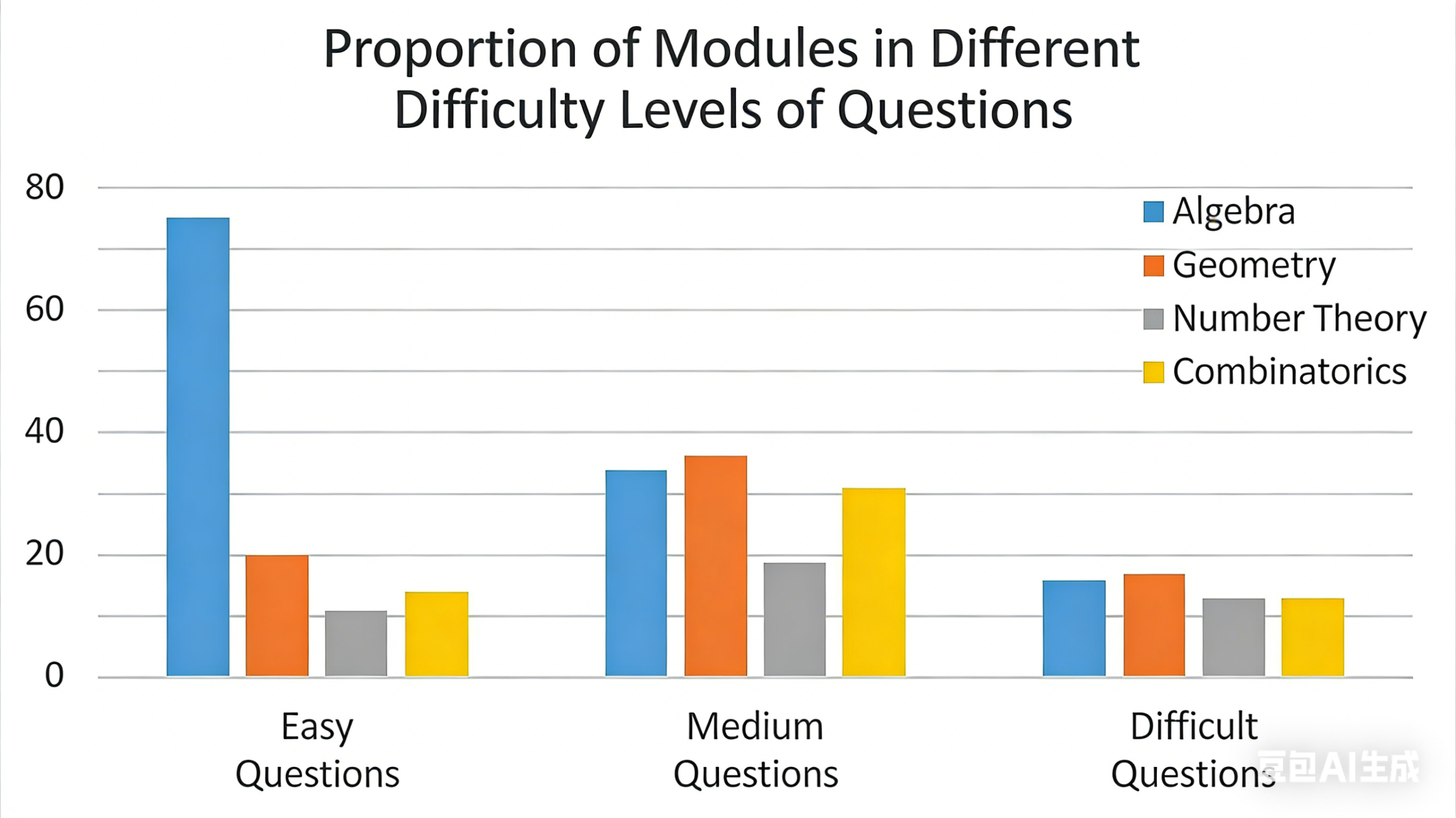
AMC 10 Question Difficulty Distribution
The 25 AMC 10 questions are divided into three main difficulty tiers, which helps students allocate time effectively during the exam:
1. Basic Questions (1–10)
These questions are relatively easy and mainly test foundational algebra, geometry, and number theory concepts. Topics include integer operations, fractions, decimals, percentages, ratios, simple equations, and basic properties of plane geometry.
Students who have systematically studied AMC 10 foundational topics can usually solve these questions with confidence. However, due to limited exam time, students must apply efficient problem-solving techniques to answer accurately and quickly.
2. Medium Difficulty Questions (11–20)
The difficulty gradually increases, requiring stronger reasoning and analytical skills. These questions may eliminate a portion of candidates.
In addition to testing basic skills, medium questions introduce advanced concepts such as quadratic functions, triangle similarity, probability, and statistics. Solving these problems often requires integrating multiple knowledge areas and multi-step logical reasoning.
3. High Difficulty Questions (21–25)
These are the most challenging problems on the exam and are critical for distinguishing top performers. They may involve complex sequences, advanced combinatorics, applications of higher-level geometry theorems, or multi-step calculations.
Success on these questions requires deep mathematical knowledge, strong problem-solving intuition, and extensive experience with competition-style questions. Top students must flexibly apply various mathematical methods and strategies to solve these problems.
AMC 10 Exam Syllabus
The AMC 10 syllabus covers algebra, geometry, number theory, combinatorics, and probability/statistics. Calculus is not included.
| No. | Phase | Chapters | Topics | Notes / Description | Lecture |
|---|---|---|---|---|---|
| 1 | Phase I | Algebra | Polynomials and their Zeros | Multiple forms and zeros, auxiliary methods | L1 |
| 2 | Phase I | Algebra | Exponentials and Radicals | Exponents and roots | L2 |
| 3 | Phase I | Algebra | Equations and Inequalities | Equations and inequalities | L3 |
| 4 | Phase I | Algebra | Vieta’s Theorem | Introduction to Vieta’s Theorem | L4 |
| 5 | Phase I | Algebra | Defined Operations and Functions | Function definitions, operation definitions | L5 |
| 6 | Phase I | Geometry | Triangles dealt with Traditions | Classical methods for triangles | L6 |
| 7 | Phase I | Geometry | Triangles dealt with Laws of Cosines and Sines | Law of cosines and sines for triangles | L7 |
| 8 | Phase I | Geometry | Quadrilaterals and Polygons | Quadrilaterals and polygons | L8 |
| 9 | Phase I | Geometry | Circle Geometry | Circle properties | L8 |
| 10 | Phase I | Geometry | Solid Geometry | Solid geometry | L8 |
| 11 | Phase I | Trigonometry | Basics | Basic trigonometry | L9 |
| 12 | Phase I | Counting | Combinations and Permutations | Counting and permutations | L10 |
| 13 | Phase I | Counting | Tables, Forms and Matrix | Tables and matrices | L11 |
| 14 | Phase I | Counting | Probability 1 – Traditional | Classical probability | L12 |
| 15 | Phase I | Counting | Probability 2 – Geometric | Geometric probability | L13 |
| 16 | Phase I | Number Theory | GCD and LCM, Prime Factors and Factorization | Greatest common divisor, least common multiple, factorization | L14 |
| 17 | Phase I | Number Theory | Place Value and Digits | Number digits | L14 |
| 18 | Phase I | Number Theory | Modular Arithmetic and Divisibility | Modular arithmetic applications | L15 |
| 19 | Phase I | Number Theory | Diophantine Equations | Indeterminate equations | L16 |
| 20 | Phase II | Algebra | Absolute Value, Functions, Gaussian Functions, Fractional Functions | Absolute value functions, advanced functions | L17 |
| 21 | Phase II | Algebra | Functional Equations | Functional equations | L18 |
| 23 | Phase II | Algebra | Vieta’s Theorem Further | Advanced Vieta’s theorem | L19 |
| 24 | Phase II | Geometry | 7 Area Methods | 7 methods for area calculation | L20 |
| 25 | Phase II | Geometry | 8 Methods to Draw Auxiliary Line | 8 auxiliary line construction methods | L21 |
| 26 | Phase II | Geometry | Theorems | Ceva, Stewart, Menelaus theorems, others | L22 |
| 27 | Phase II | Geometry | Geometry Parallelograms | Parallelograms | L23 |
| 28 | Phase II | Geometry | Trapezoids | Trapezoid geometry | L24 |
| 29 | Phase II | Geometry | Rotation, Symmetry and Extension | Rotations, symmetry, transformations | L25 |
| 30 | Phase II | Methods | Quantity → Spatial Forms | Quantity to spatial forms | L26 |
| 31 | Phase II | Methods | Optimal Method | Optimal methods | L27 |
| 32 | Phase II | Methods | Transformation | Transformations | L28 |
| 33 | Phase II | Methods | Mock Test 1: Pace | Mock test – pacing | L29 |
| 34 | Phase II | Methods | Mock Test 2: Calculation | Mock test – calculations | L30 |
Key Knowledge Areas:
Algebra:
-
Advanced polynomials, remainder theorem, Vieta’s formulas, root-coefficient relationships, special higher-degree equations
-
Advanced inequalities and mean inequalities
-
Functions: domain and range, quadratic, exponential, logarithmic, and basic trigonometric functions
-
Sequences and series, algebraic problem-solving techniques
Geometry:
-
Advanced plane geometry: triangle and polygon constructions, similarity and congruence, area and perimeter calculation
-
Circles: incircle, circumcircle, cyclic quadrilaterals, Stewart’s theorem, co-linear and concurrent points
-
Solid geometry: 3D shapes, Euler’s formula, polyhedra, volume and surface area calculations
-
Analytic geometry: basic coordinate geometry
Number Theory:
-
Prime factorization, divisibility, congruences
-
Modular arithmetic, complex congruence problems
-
Integers, fractions, decimals, base conversions
-
Diophantine equations and advanced number theory techniques
Combinatorics and Probability:
-
Counting principles, permutations, combinations, inclusion-exclusion
-
Recurrence relations and advanced combinatorial methods
-
Classical probability and geometric probability problems
AMC 10 Key Knowledge Points by Category
Algebra
-
Sequences, quadratic functions, equations, inequalities, multiplication formulas
-
Focus: ability to simplify problems, factorization, divisibility of roots
Functions
-
Coordinate systems, transformations, linear functions, equations of circles
-
Focus: understanding problem statements and flexible application of formulas
-
Challenge: computing areas of polygons using Pick’s theorem or shoelace formula
Geometry – Triangles, Quadrilaterals, Polygons
-
Trigonometric concepts, similarity and congruence, area computation
-
Challenge: irregular shapes, area decomposition/replacement methods
Geometry – Circles and Solid Geometry
-
Circle properties, 3D shape volume and surface area, Euler’s formula
-
Challenge: circle theorems, spatial visualization, auxiliary constructions
Combinatorics
-
Addition and multiplication principles, tournament scheduling, complex permutations and combinations
-
Focus: analyzing scenarios, avoiding double counting
Probability and Statistics
-
Measures of central tendency, classical probability, geometric probability
-
Challenge: conditional probability analysis
Number Theory
-
Factors, multiples, digit analysis, primes and composites
-
Challenge: parity analysis, modular arithmetic, defining new operations
-
Typically tested in the later questions (high difficulty tier)
AMC 10 Must-Know and Recommended Knowledge Points
Essential (High Priority):
-
Algebra: factorization, substitution, expansions, quadratic functions, absolute value functions, sequences, summation, lines and circles
-
Geometry: transformations, circle properties
-
Number Theory: modular arithmetic, congruences, integer equations, position principles, base conversions
Recommended (Master for Better Performance):
-
Algebra: polynomials, inequalities, optimization problems
-
Geometry: angle calculations, triangle centers
-
Combinatorics: advanced counting methods (recursion, PIE, bijections), extreme values, geometric probability
Common Pitfalls by Module:
-
Algebra: word problems, absolute value equations, exponent and logarithm calculations
-
Geometry: congruence/similarity, auxiliary constructions, spatial visualization
-
Counting: distinguishing permutations vs. combinations, avoiding double counting
-
Number Theory: prime factorization, last-digit problems, modular arithmetic
-
Probability: discrete vs. geometric probability