Looking at the difficulty of the AMC8 competition over the past two years, the overall difficulty of the 2026 exam has increased significantly! The questions are more comprehensive, and the depth of cognitive assessment has noticeably improved. By analyzing the difficulty breakdown of the 2026 AMC8 exam, we can predict the overall difficulty and question-setting direction for the new 2027 season. To successfully aim for awards and maintain high scores in the new season, it is crucial to understand the exam changes in advance and prepare scientifically!
2026 AMC8 Exam: Question-by-Question Knowledge Point Analysis
The AMC8 math competition consists of 25 questions covering five core mathematical modules: algebraic operations, geometry, word problems, combinatorial counting, and number theory. Each question is labeled with its corresponding knowledge point and difficulty level, categorized into four tiers: Easy, Medium, Harder, and Hardest.
01 Difficulty Distribution and Gradient Characteristics of AMC8 Questions
Overall Difficulty Distribution of AMC8 Questions
- Easy questions: 11, accounting for 44%
- Medium questions: 7, accounting for 28%
- Harder questions: 5, accounting for 20%
- Hardest questions: 2, accounting for 8%
02 Difficulty Gradient Pattern of AMC8 Questions
The difficulty of AMC8 questions increases significantly with the question number, following a strict "easy first, hard later" logic:
- Questions 1-11: All are easy questions, with no medium or higher difficulty questions.
- Questions 12-20: Primarily medium questions, with only one harder question interspersed (Question 16).
- Questions 21-25: Enter the high-difficulty zone. These 5 questions include 3 harder questions and 2 hardest questions, serving as the core scoring differentiator for the entire exam.
Algebraic operations account for the highest proportion of the exam and form the foundational core of the AMC8.
Geometry and combinatorial counting have equal proportions and serve as the core carriers for medium and higher difficulty questions.
Word problems have the lowest proportion and only appear in basic and medium difficulty questions.
03 High-Frequency Core Knowledge Points in the 2026 AMC8 Exam
The knowledge points that repeatedly appear and are tested most frequently across the entire AMC8 exam are concentrated in three main areas:
- Basic Operations: Basic arithmetic and percentage applications each appear twice, serving as the core testing points for basic questions.
- Number Theory: Factor applications, prime numbers + divisibility, pure number theory, and number theory + counting combinations appear a total of 4 times, forming the core testing points for medium-to-high difficulty questions.
- Counting & Probability: Basic counting, circular permutations, classical probability, and probability + counting combinations appear a total of 4 times, acting as the core comprehensive carriers for high-difficulty questions.
- Plane Geometry: Ranging from basic triangle and rectangle areas to advanced comprehensive plane geometry, butterfly models + Pythagorean theorem, appearing a total of 5 times. This is the most comprehensively covered knowledge module in the exam, spanning from basic to hardest questions.
04 AMC8 Math Competition Exam Content (Standard Version)
05 Don't Blindly Chase "Hard Questions": The Core to Winning Awards is Securing the Points You Should Get
The 2026 AMC8 exam has already shown us: the first 11 basic questions and the 12-20 medium questions are the foundation for winning awards.
- Zero errors on the first 10 questions (easy) is the baseline for winning an award.
- Stably solving 6-7 questions from 12-20 (medium/harder) determines whether you can enter the top 5%.
- Questions 21-25 (harder/hardest): Prioritize tackling 1-2 questions. Strategically skip the rest to avoid wasting time and making mistakes on the first 20 questions.
AMC8 Math Competition Award Target Reference Table
AMC8 Global Top 1% (Honor Roll)
Target Score: 23-25 points
How many questions need to be answered correctly?
Answer all of the first 20 questions correctly, and get 3-4 correct from questions 21-25. Requires systematic training in number theory, combinatorics, and comprehensive geometry hard problems.
AMC8 Global Top 10% (Distinguished Honor Roll):
Target Score: 19-22 points
How many questions need to be answered correctly?
Answer all of the first 15 questions correctly, get 3-4 correct from questions 16-20, and get 1 correct from questions 21-25.
AMC8 Global Top 25% (Achievement Roll):
Target Score: 15-18 points
How many questions need to be answered correctly?
Answer all of the first 10 questions correctly, get 3-4 correct from questions 11-15, and strategically skip the harder questions after question 16.
Phased High-Efficiency AMC8 Preparation Plan: Follow It Directly!
01 AMC8 Foundation Building Phase: Complete the Knowledge System
Master elementary to middle school foundational knowledge points and eliminate knowledge gaps.
Clear blind spots by module, aligning with the testing points from the 2026 past papers to fill gaps.
- Algebraic Operations: Basic arithmetic, percentage/fraction applications, factors/primes/divisibility, mean/median, radical calculations.
- Geometry: Triangle properties, rectangle/circle areas, arc length, 3D geometry surface area, Pythagorean theorem.
- Word Problems: Distance/speed/time, drainage/work problems, meeting problems.
- Combinatorial Counting: Basic counting, logical reasoning, classical probability.
Practice the first 15 questions from the past 10 years of AMC8 exams without a time limit. The goal is an accuracy rate of 95% or higher.
02 AMC8 Topic Breakthrough Phase: Conquer Medium Questions
Target high-frequency difficult modules and resolve point-loss areas in questions 12-20.
Focus on modules where difficulty increased in 2026:
- Number Theory: Prime factorization, GCD/LCM, integer properties, number theory + counting combinations.
- Combinatorial Counting: Circular permutations, probability + counting combinations, number theory + counting.
- Comprehensive Geometry: Plane geometry figure relationships, 3D geometry nets/surface area, butterfly model + Pythagorean theorem.
Practice questions 11-20 from the past 10 years of exams by module, under timed conditions.
03 AMC8 Sprint & Mock Exam Phase: Adjust Answering Strategies
Full-scale mock exams to optimize question order and time allocation.
Use the past 5 years of real exams, strictly limiting yourself to 40 minutes to simulate the actual exam environment completely.
Goal: Complete the first 10 questions within 10 minutes, questions 11-20 within 20 minutes, and leave 10 minutes to check and tackle the 1-2 most confident questions from 21-25.
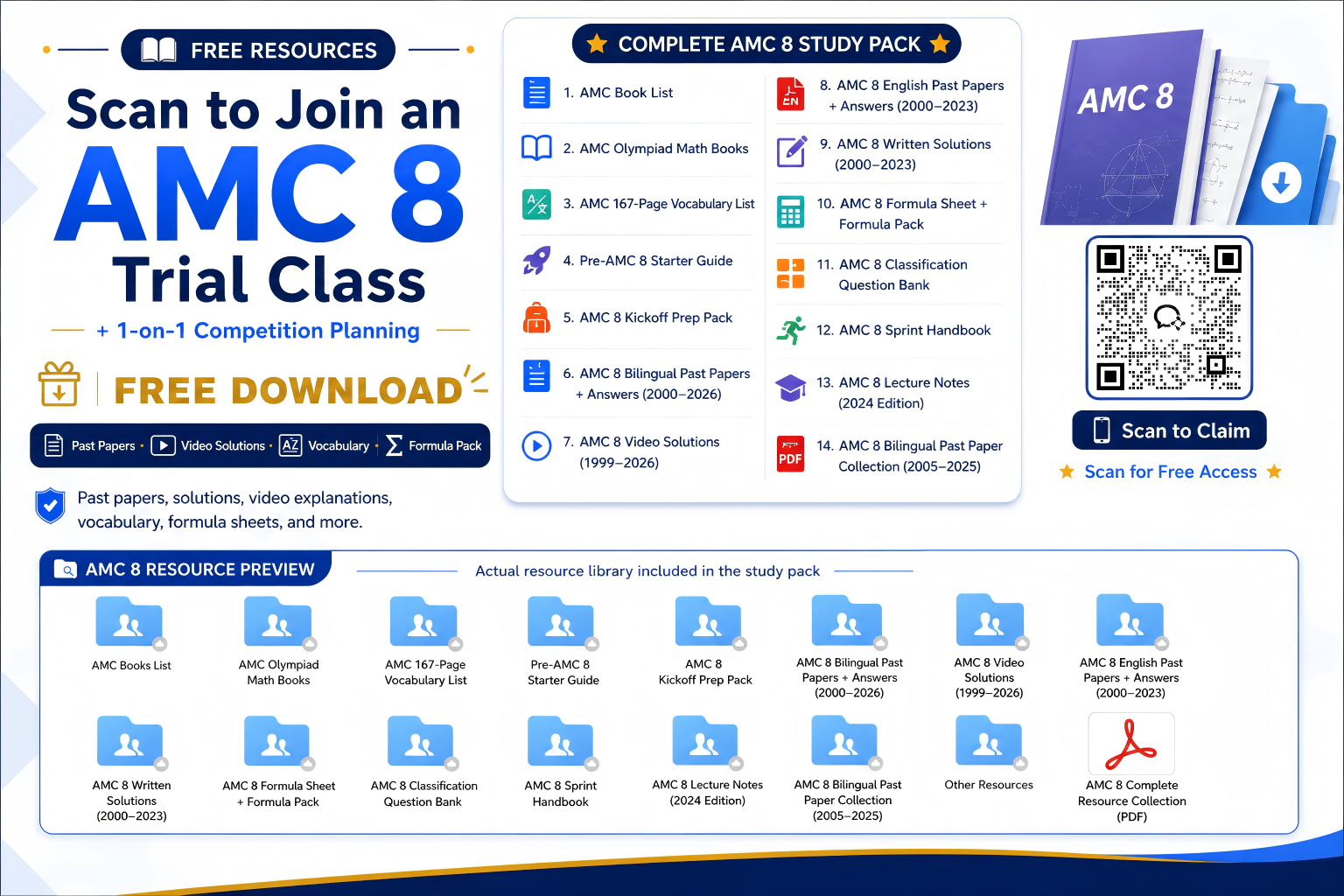
Get FREE AMC 8 Preparation Materials
Scan the QR code below to access free practice papers, study guides, and past competition materials. Start preparing today!