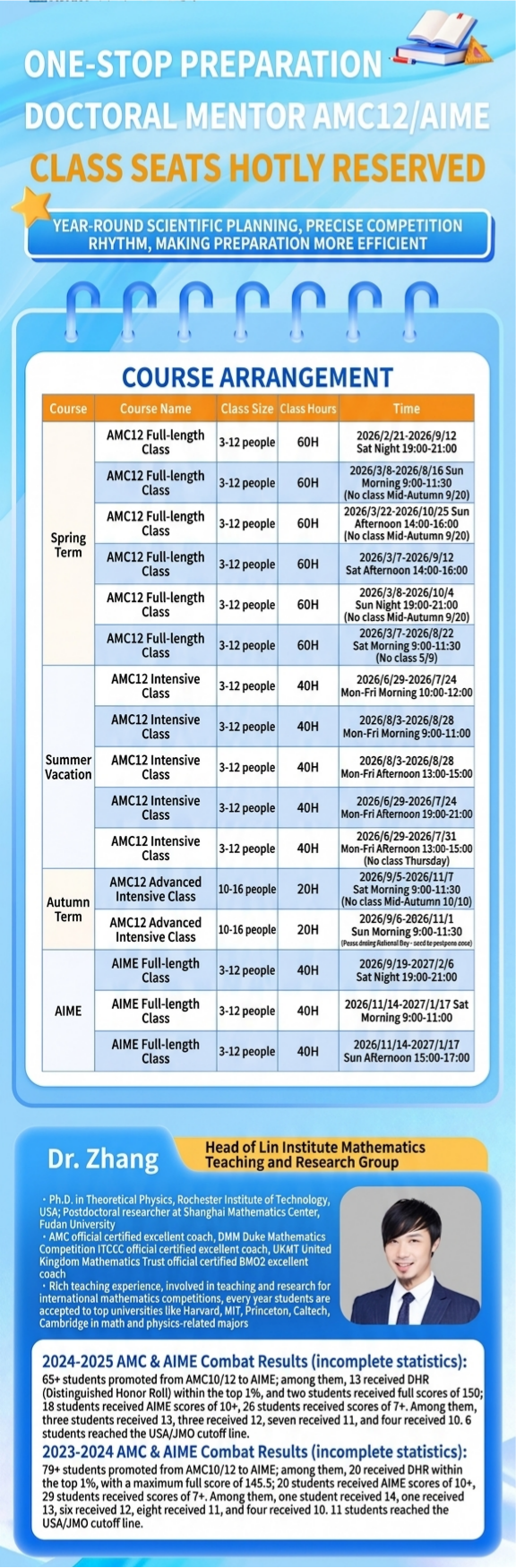
Preparing for the AMC 8 means facing a strict time limit: 25 multiple-choice questions in 40 minutes. To aim for the global top 1%, students must systematically master the core knowledge areas and apply problem-solving techniques flexibly.
This article explains the difficulty of the AMC 8 and breaks down the five key knowledge areas students should focus on during preparation.
Part 1: Why Is the AMC 8 Challenging?
The difficulty of the AMC 8 comes from three dimensions: knowledge coverage, mathematical thinking, and time pressure. Its unique challenge goes far beyond regular school math exams.
Broad Knowledge Coverage Beyond School Curriculum
The AMC 8 tests a wider range of topics than most standard school curricula. Some areas, such as introductory number theory, basic combinatorics, and integrated geometry applications, may be taught only briefly in school or not covered at all.
The competition covers four major modules: algebra, geometry, number theory, and combinatorics.
| Module |
Approximate Percentage |
| Algebra |
35%–45% |
| Geometry |
20%–30% |
| Number Theory |
10%–15% |
| Combinatorics |
10%–15% |
Higher-Level Mathematical Thinking
Compared with regular math tests, the AMC 8 places greater emphasis on mathematical insight, creativity, multi-step reasoning, and mathematical modeling.
Many questions require flexible thinking and unique problem-solving perspectives. Pure formula-based questions are becoming less common.
Strong Time Pressure
Students need to complete 25 questions in 40 minutes, which means they have only about 1.6 minutes per question on average.
This requires not only strong mathematical ability, but also excellent time management, emotional stability, and problem-solving fluency.
Clear Difficulty Progression
The AMC 8 questions are arranged with a clear difficulty gradient.
| Question Range |
Difficulty Level |
Role in Scoring |
| Questions 1–10 |
Basic |
Direct extension of school knowledge |
| Questions 11–15 |
Medium |
Tests flexible use of core concepts |
| Questions 16–20 |
Difficult |
Key section for students aiming for the global top 5% |
| Questions 21–25 |
Very difficult |
Key section for students aiming for the global top 1% |
In recent years, the AMC 8 has shown an upward trend in difficulty. In the 2026 paper, question 25 reportedly combined three-dimensional geometry with number theory, requiring stronger spatial imagination and algebraic transformation skills.
The score cutoffs have also risen. In the 2026 China Committee version, the Distinguished Honor Roll, or top 1%, required 22 points, while the Honor Roll, or top 5%, required 18 points.
Part 2: Five Core AMC 8 Knowledge Areas
1. Algebra
Algebra usually appears most frequently in the AMC 8, accounting for about 35%–45% of the test, or around 8–11 questions.
Main topics include fractions, percentages, ratios, word problems, linear equations, systems of simple equations, and sequences such as arithmetic sequences.
In recent years, algebra questions have become more application-based, with longer problem statements. Students need stronger reading comprehension and mathematical modeling ability.
| Preparation Focus |
Details |
| Fast Calculation |
Improve fluency with fractions, percentages, ratios, and equations |
| Number Relationships |
Understand how quantities relate to one another |
| Symbolic Thinking |
Build confidence in algebraic expressions and transformations |
| Modeling Ability |
Convert word problems into equations or structured steps |
2. Geometry
Geometry is the second-largest topic area in the AMC 8. It usually includes 6–8 questions, accounting for about 20%–30% of the test.
Core topics include triangle properties, the Pythagorean theorem, quadrilateral properties, area calculation, circles, and basic three-dimensional geometry.
In recent years, geometry questions have become more frequent, and solid geometry has appeared more often. Problems involving cube nets, surface paths, and shortest routes on three-dimensional figures are often used to distinguish higher-level students.
| Preparation Focus |
Details |
| Geometry Theorems |
Memorize and understand common formulas and properties |
| Spatial Imagination |
Practice cube nets, 3D shapes, and surface paths |
| Area Strategies |
Master decomposition, recombination, and translation methods |
| Similar Triangles |
Understand angle-angle similarity and the relationship between similarity ratio and area ratio |
3. Number Theory
Number theory usually accounts for about 3–5 questions.
Main topics include prime numbers, composite numbers, prime factorization, divisibility, parity, remainders, greatest common divisor, and least common multiple.
Although number theory concepts are not always difficult to understand, the questions can be flexible and require careful reasoning.
| Preparation Focus |
Details |
| Divisibility Rules |
Master common divisibility tests |
| Factors and Multiples |
Understand factorization, GCD, and LCM |
| Remainder Problems |
Practice modular thinking and remainder patterns |
| Number Properties |
Learn prime numbers, composite numbers, parity, and perfect squares |
4. Combinatorics
Combinatorics also usually accounts for about 3–5 questions.
This area focuses more on logic than calculation. Common topics include counting principles, basic permutations and combinations, probability, logical reasoning, truth-telling problems, table reasoning, number puzzles, inclusion-exclusion, and the pigeonhole principle.
| Preparation Focus |
Details |
| Addition and Multiplication Principles |
Learn when to classify cases and when to count step by step |
| Basic Counting |
Practice simple arrangements and combinations without relying on complex formulas |
| Probability |
Master classical probability and learn how to list all possible outcomes |
| Logical Reasoning |
Build structured thinking for tables, statements, and pattern-based problems |
5. Word Problems and Integrated Applications
Word problems take up a significant portion of the AMC 8. In recent years, quantity-based application problems have appeared frequently.
These questions often appear in the more difficult sections of the paper and deserve special attention during preparation. They usually combine multiple topics, such as algebra and geometry, or number theory and combinatorics.
| Preparation Focus |
Details |
| Fast Reading |
Identify key information quickly |
| Problem Translation |
Convert complex wording into equations, diagrams, or cases |
| Modular Thinking |
Break a complex problem into smaller basic concepts |
| Integrated Solving |
Combine results from different steps to reach the final answer |
Final Thoughts
The AMC 8 is not only a test of mathematical knowledge, but also a test of reasoning, flexibility, speed, and accuracy.
Students aiming for high scores should not rely only on school math. They need systematic training in algebra, geometry, number theory, combinatorics, and integrated word problems.
For students targeting the Honor Roll or Distinguished Honor Roll, past paper practice is essential. They should use timed mock tests, analyze mistakes carefully, and focus especially on questions 16–25, where the real score gap is created.