Many advanced students approach USAMO past papers with the intention of mastering proof writing. They attempt a problem, fail to find a complete solution, and then read the official or community-provided answer key. The experience can be deceptive: while reading the solution, every step seems logical and inevitable. When they close the book and try to write the proof again from scratch, the structure collapses. They remember the final result but not the path. This gap is not a sign that they lack ability; it is a sign that passive reading has not built the active retrieval pathways required for contest mathematics.
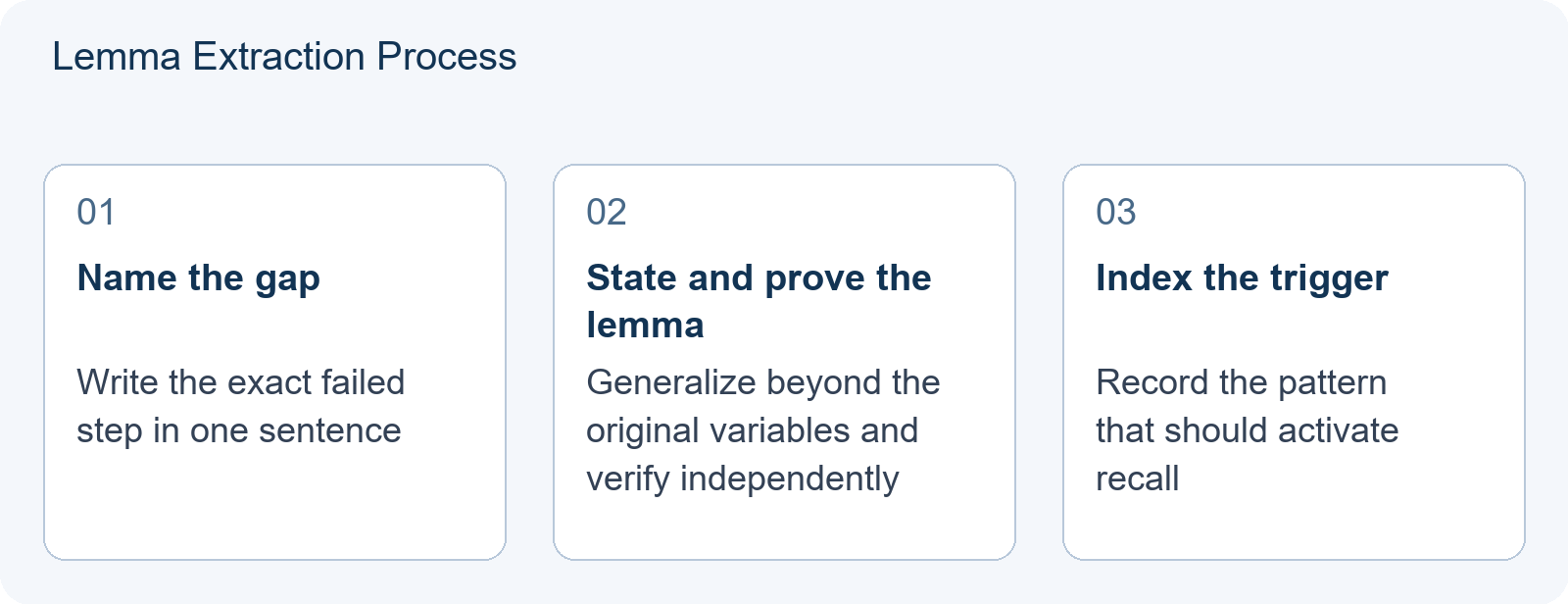
The core issue is that standard review methods treat past papers as tests rather than raw material. If you simply check whether your answer matches the solution, you gain little insight into why certain moves were necessary. To transform practice into skill, you need a systematic method for extracting reusable components from failure. The lemma-bank protocol asks you to do four things after a failed proof attempt: identify the specific gap in logic, formulate a general lemma that bridges it, prove that lemma independently, and index it by its trigger condition. This shifts the focus from solving one problem to building a toolkit for many.
Why Rereading Solutions Leaves No Reusable Skill
Rereading a solution provides narrative coherence but lacks structural retention. When you follow a proof line by line, you are verifying local correctness. You see that Step B follows from Step A, and Step C follows from Step B. However, you do not necessarily see why Step A was chosen over alternatives X, Y, or Z. Olympiad-style proof problems often have a narrow intended path, and the solution writer may present that path as if it were the only natural one. Without understanding the selection criteria for each step, you cannot replicate the decision-making process under time pressure.
Furthermore, solutions are often optimized for brevity. They skip intermediate algebraic manipulations or assume certain inequalities are well known. For a student still developing intuition, these gaps create cognitive load. Instead of learning the technique, you spend mental energy reconstructing trivial details. This leads to a false sense of competence. You feel you understood the problem because you followed the text, but you did not internalize the strategic move. The next time you encounter a similar structure, you will likely miss it again because you never isolated the pattern from the specific numbers of the original problem.
The Lemma-Bank Page: Gap, Lemma, Proof, Trigger
A lemma bank is a personal notebook where you store generalized truths derived from your mistakes. Each entry consists of four distinct parts. First, the Gap: describe exactly where your initial attempt stalled. Was it an inability to bound a term? A missing symmetry argument? A failure to construct a counterexample? Second, the Lemma: state a general mathematical statement that resolves this type of gap. It should be independent of the specific problem variables. Third, the Proof: provide a short, rigorous proof of the lemma itself. This ensures you can verify its validity without relying on external sources. Fourth, the Trigger Condition: define the visual or structural cues in a problem that suggest applying this lemma.
This structure forces abstraction. By separating the lemma from the problem, you prevent overfitting. You learn that if a cyclic sum has mixed degrees, you should consider homogenization, rather than learning that you should use homogenization for Problem 4 from 2019. The trigger condition is crucial for recall. In a timed exam, you do not have time to search through all known theorems; you must match patterns quickly. A well-indexed lemma bank acts as a lookup table for your brain.
A useful entry might look like this. Entry 12. Gap: I tried to prove that a region could not be tiled by dominoes, but checking the area was not enough. Lemma: If a grid region is colored like a chessboard and can be tiled by dominoes, then it must contain equal numbers of black and white cells. Proof: Every domino covers exactly one black cell and one white cell. Therefore, any tileable region must have equal counts. Trigger: An impossibility-of-tiling problem where area alone does not rule out a tiling; check the color balance first.
This last entry is short, but it is reusable across many polyomino, chessboard, and matching problems. The student has converted one failed attempt into a permanent tool. The proof is one sentence, so it is easy to review. The trigger is specific enough to be recalled when a new problem has the same structure.
Teaching Illustration: An Invariant-Coloring Lemma
To demonstrate the protocol, consider a hypothetical tiling problem often seen in combinatorics training. Suppose we want to tile a rectangular board with dominoes, but some cells are forbidden. A student might attempt induction and get stuck because the boundary conditions change unpredictably. The gap is the lack of a global constraint that survives local modifications.
Note: This is a teaching illustration, not an actual USAMO problem.
We extract the checkerboard lemma: if a region of a square grid is colored in the usual alternating black-and-white pattern, then any domino tiling of that region must cover equal numbers of black and white cells. The proof is immediate: each domino covers one black and one white cell. Therefore, if the region has unequal numbers of black and white cells, it cannot be tiled by dominoes. The trigger condition is: when asked to prove impossibility of a domino tiling, check the color balance before attempting a longer argument.
This lemma is reusable across many problems involving polyominoes, chessboards, and graph matchings. By writing it down, the student transforms a single failed attempt into a permanent tool. It also illustrates an important principle: many failed proofs fail not because the student lacks advanced theory, but because the student did not check a simple invariant first.
Indexing Lemmas by Trigger, Not Year
A common mistake is organizing notes by problem source, such as USAMO 2023 Problem 1. This is inefficient because future problems will not share the same year label. Instead, organize by technique or trigger. Create sections like Parity Arguments, Extremal Principle, Double Counting, Inequality Homogenization, Invariants, Modular Arithmetic, Graph Theory, and Polynomial Roots.
Within each section, list lemmas with their triggers. For example, under Extremal Principle, you might have a lemma: if a configuration minimizes or maximizes a quantity, then no local modification can improve it. The trigger is: the problem asks for existence of a best arrangement or proves uniqueness under optimization. Under Double Counting, you might have a lemma: if two different ways of counting the same set produce two expressions, those expressions are equal. The trigger is: a problem gives two descriptions of the same collection or asks for an identity that resists direct algebra.
This cross-referencing allows you to scan your bank based on what you see in the new problem, not what you solved in the past. It builds a network of ideas rather than a linear history of events. When you review before a contest, you can read only the trigger column. That is much faster than rereading full solutions.
From Lemma Bank to Timed Proof Attempts
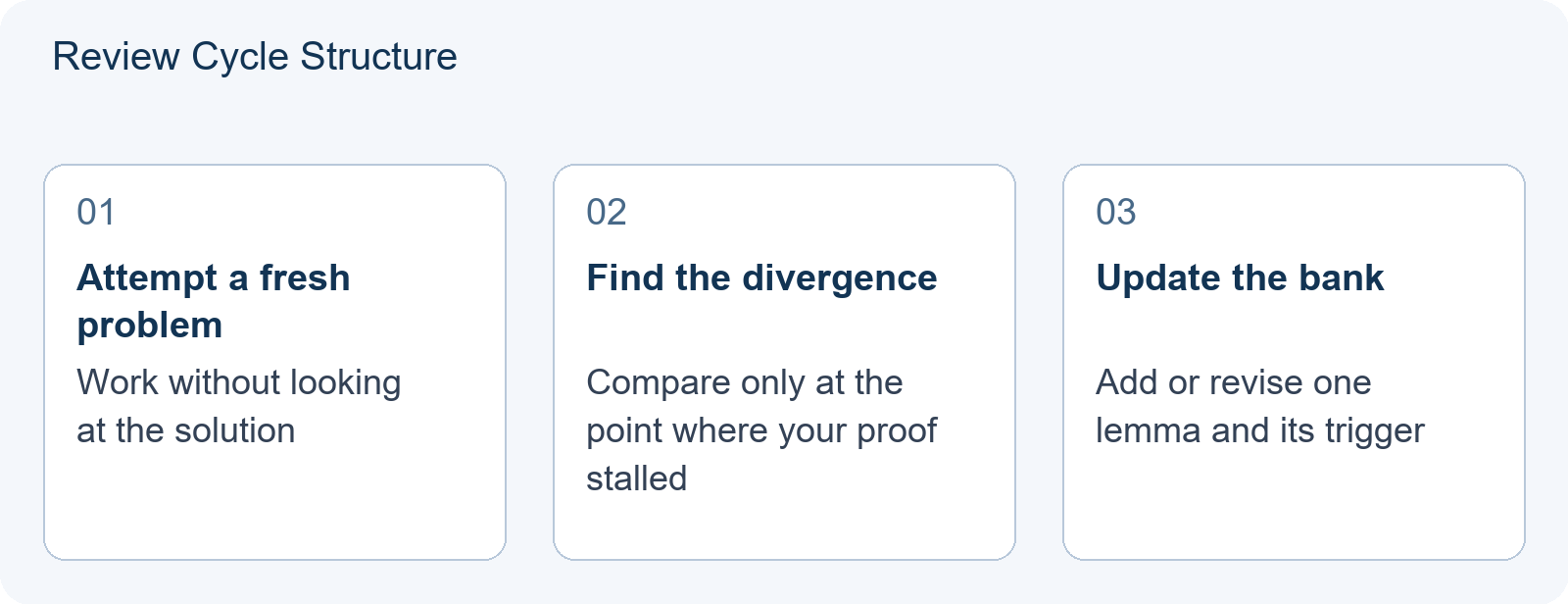
Once you have populated your lemma bank with 10 to 20 high-quality entries, you can begin timed practice. Select a new problem from USAMO past papers. Spend five minutes analyzing it. Do not solve it yet. Instead, ask: which trigger conditions apply? List two or three candidate lemmas from your bank. Then attempt the proof using those tools. If you succeed, great. If you fail, analyze why the chosen lemma was insufficient. Did you misidentify the trigger? Or was the lemma too weak?
This meta-cognitive step is vital. It trains you to evaluate the applicability of your tools. Over time, your ability to select the right lemma improves. You stop guessing and start matching. This reduces the cognitive load during the actual exam, allowing you to focus on execution rather than strategy discovery.
After each timed attempt, update the bank immediately. Do not wait until the end of the week. The memory of the failure is freshest in the first ten minutes after you stop writing. Write the gap in one sentence, state the lemma in one or two sentences, prove it in no more than five lines if possible, and write the trigger as a short instruction to your future self.
Avoiding the Trap of Memorizing Full Solutions
Memorizing full solutions is counterproductive for USAMO preparation. The problems are too complex and varied for rote recall to work. Moreover, memorization creates fragility. If a problem changes slightly, such as an exponent increasing by one, a memorized solution may break completely, leaving you stranded. A lemma bank, however, is robust. The underlying principles remain true even if the specifics change.
Focus on understanding the why behind each major step. Why did the solver introduce this auxiliary variable? Why did they split the case at this specific threshold? These decisions are the essence of mathematical creativity. Capture them as lemmas about strategy, not just facts. For instance, instead of memorizing a specific inequality, note that symmetric expressions often benefit from substitution as a strategic lemma. Instead of memorizing a particular construction, note that proving two sets have equal size can sometimes be done by finding a bijection.
The lemma bank also protects you from the illusion of understanding. If you cannot state the lemma without looking at the original problem, you do not yet own it. If you cannot prove the lemma from scratch, you do not yet trust it. If you cannot name a trigger condition, you will not use it under pressure. These three tests are a quick quality-control routine for every entry.
When to Seek Instruction Rather Than More Papers
Building a lemma bank requires discipline and feedback. If you struggle to abstract the lemma from the solution, or if your trigger conditions are vague, you may need external guidance. At this stage, continuing to grind through USAMO past papers alone yields diminishing returns. You need a mentor who can help you refine your categorization and validate your proofs.
Consider seeking specialized instruction if you find yourself repeatedly making the same type of error despite having a bank. This indicates a deeper conceptual gap that self-study cannot easily resolve. Instruction can help you form accurate triggers and ensure your lemmas are rigorously proven. For students transitioning from AIME-style calculation to USAMO-style argumentation, structured support is often the bridge between effort and results.
For further context on whether proof-based practice is the right next step after AIME, see USAMO Past Papers: Is Proof-Based Practice the Right Next Step After AIME?. For a method of choosing practice sets and checking solution coverage, see AIME Past Papers: Choosing a Practice Set and Checking Solution Coverage. For the transition from multiple-choice pacing to answer-free calculation, see Training for the AIME, Not the AMC: What Changes When the Answer Choices Disappear.
Frequently Asked Questions
How many lemmas should I aim to collect?
Quality matters more than quantity. Start with 5 to 10 high-frequency triggers such as parity, extremal principle, double counting, or invariants. Expand only when you encounter a new structural pattern.
Can I use online solution databases directly?
Yes, but do not copy them verbatim. Use them to verify your extracted lemma proof. Ensure the lemma is stated generally enough to apply to other problems, and write the trigger condition in your own words.
Is this method suitable for beginners?
This method is best for students already comfortable with AIME-level difficulty who are struggling with the transition to formal proof writing. Beginners should focus on foundational concepts and shorter proof exercises first.