Students searching for AIME past papers often seek more practice problems, but the exam’s integer-answer format creates a blind spot that volume alone cannot fix. Since public answer keys usually provide only the final integer, a missed question leaves you knowing you were wrong, but not why. Did you model the problem incorrectly? Make an arithmetic slip? Or skip verifying the result against constraints?
If you discard your scratch work after grading an AIME paper, you lose the diagnostic data needed to improve. You might redo the same paper next month and repeat the identical error because you never identified which stage of the process broke. This article outlines a structured audit method for reviewing your own work on AIME past papers, turning a simple score into a targeted practice plan.
Why Final-Answer Checking Is Not Enough
The AMC 10/12 offers multiple-choice options, which can sometimes mask a flawed setup if a lucky guess aligns with the correct choice. The AIME removes this safety net. Every problem requires a derivation leading to an integer, so a wrong answer is rarely just a knowledge gap. It is usually a breakdown in one of three distinct cognitive phases: modeling the problem, executing the calculation, or validating the result.
Without separating these phases, feedback remains vague. Saying “I need to be more careful” is not actionable. Saying “I consistently drop terms when expanding binomials in geometry contexts” is actionable. The audit protocol below forces this specificity.
Another reason final-answer checking is weak is that it rewards accidental correctness and punishes harmless process variation. A student who reaches the right integer through a shaky method learns the wrong lesson: keep doing what worked. A student who reaches the wrong integer through a mostly sound method learns an equally wrong lesson: abandon the method. The audit separates the quality of the reasoning from the accident of the final digit.
The Three-Column Scratch-Work Audit
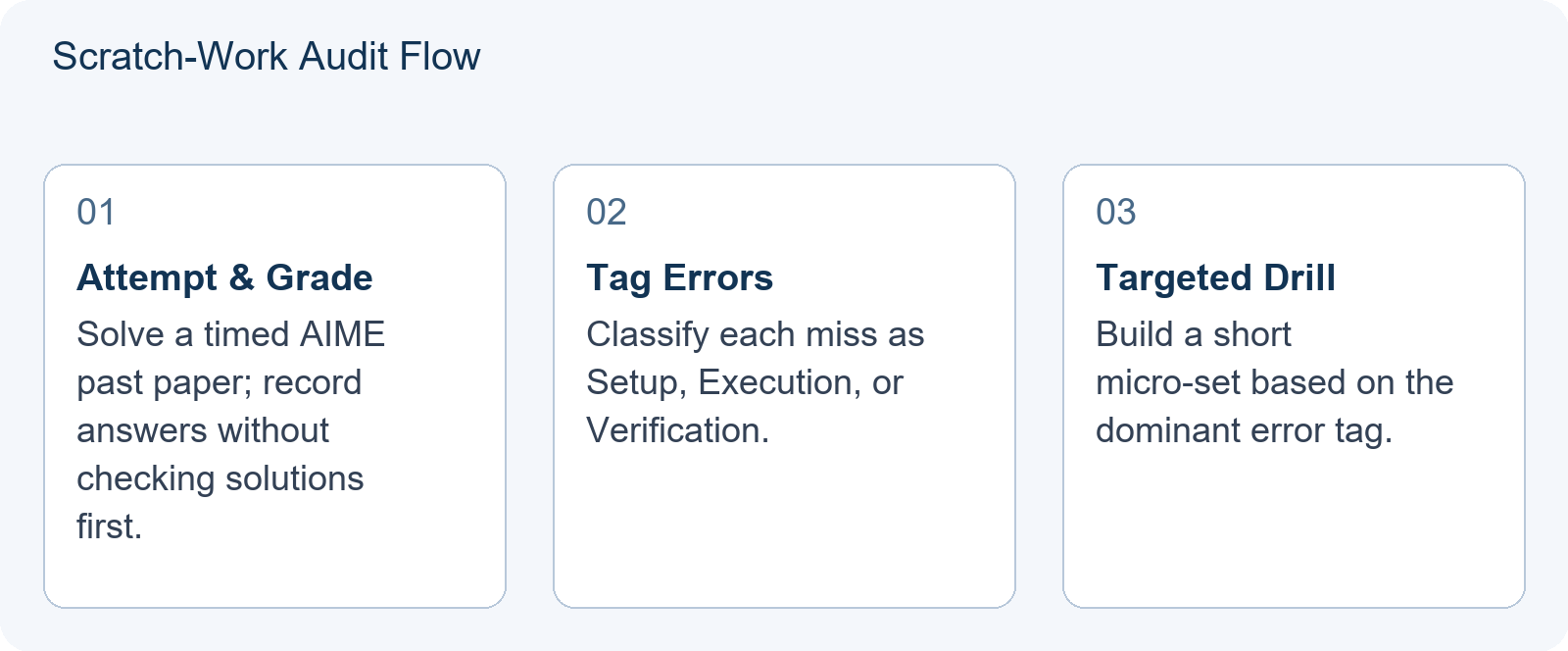
After completing a timed AIME session, do not immediately look at the official solutions. Instead, take your physical scratch paper and create a log for each problem you missed or guessed. Divide your review into three columns: Setup, Execution, and Verification.
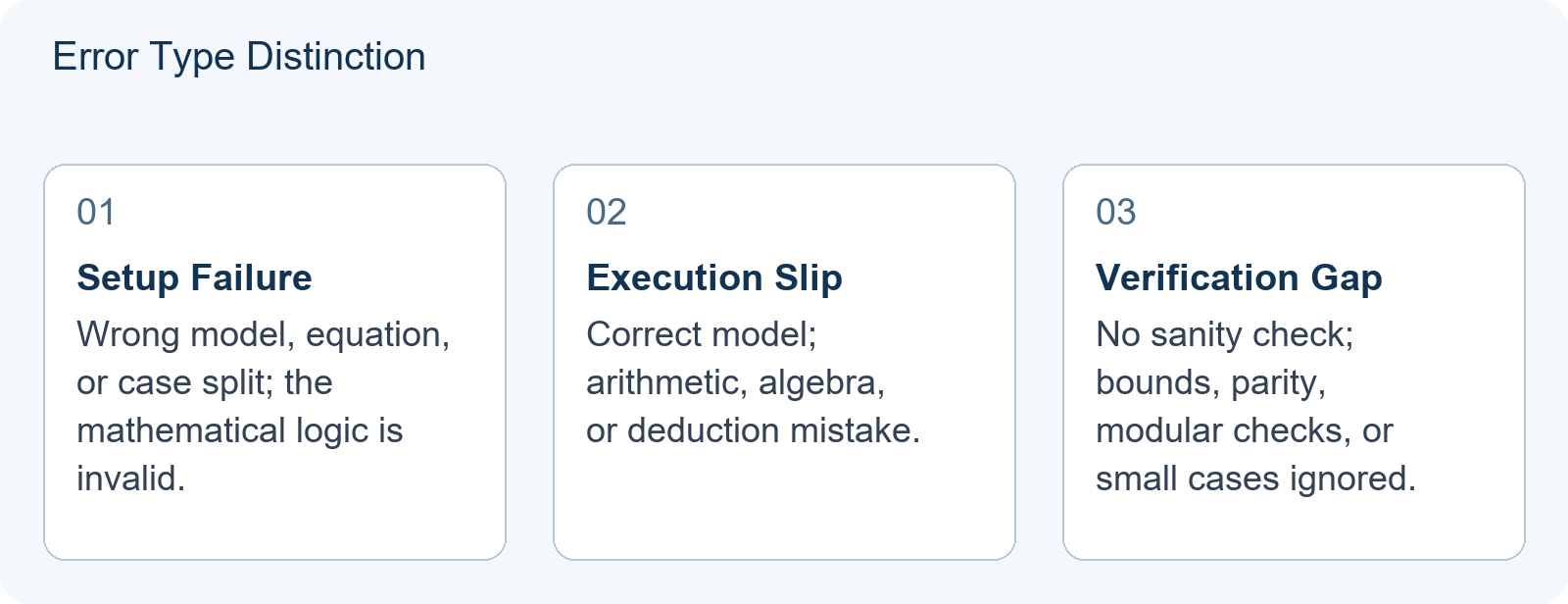
- Setup: Did you correctly translate the text into mathematical relationships? Did you identify the right variables, geometric properties, or combinatorial cases? If you solved the wrong problem, the error is here.
- Execution: Assuming the setup was correct, did the algebra, arithmetic, or logical deduction proceed without slip-ups? Look for sign errors, dropped factors, or misapplied formulas.
- Verification: Did you check the answer against constraints? For example, does a probability lie between 0 and 1? Is a length positive? Did you test a small case or check a modular condition?
Tag each error with the column where it originated. If a problem had a correct setup but failed due to a calculation mistake, tag it “Execution.” If you got the right number by accident but never checked whether it made sense, tag it “Verification.” If you could not even begin the right model, tag it “Setup.” This tagging system reveals patterns across different topics.
Keep the log short. You are not rewriting full solutions. For each missed problem, write the problem number, your final answer, the correct answer, and one tag. If you are unsure between two tags, choose the earlier stage. A problem with a wrong setup cannot be saved by perfect execution. A problem with a right setup and wrong execution is a different training target from a problem with no verification habit.
Labelled Teaching Illustration: Units Digit Cycles
To demonstrate how these tags differ, consider a hypothetical AIME-style question: What is the units digit of 72026? This is a teaching illustration, not an actual contest problem.
A student writes down the cycle of powers of 7: 71 = 7, 72 = 49, so the units digit is 9; 73 = 343, so the units digit is 3; 74 = 2401, so the units digit is 1. The cycle length is 4. They calculate 2026 ÷ 4. Since 2026 = 4 × 506 + 2, the remainder is 2. The second term in the cycle is 9, so the units digit is 9. This is correct.
Now imagine two common errors:
- Setup Error: The student assumes the cycle length is 5 instead of 4. They divide 2026 by 5, get remainder 1, and answer 7. The logic of using cycles was applied, but the foundational property, the cycle length, was modeled incorrectly.
- Execution Error: The student knows the cycle is 4. They perform the division 2026 ÷ 4 but mistakenly calculate the remainder as 3 instead of 2. They answer 3. The concept was sound; the arithmetic slipped.
Both students get the answer wrong. Without auditing the scratch work, both might think “I am bad at modular arithmetic.” In reality, one needs to study number theory properties, while the other needs to drill basic division accuracy. The tags turn a vague frustration into a specific next action.
Marking Time to First Correct Setup
Beyond categorizing errors, track the time elapsed until you wrote the first valid equation or diagram. On AIME past papers, many students spend five minutes staring at a problem before committing to a path. If you mark the timestamp when your setup finally clicked, you can distinguish between slow processing and wrong approach.
If you spent ten minutes trying to force a coordinate geometry solution onto a pure number theory problem, your issue is strategic selection, not calculation speed. Conversely, if you set up the problem correctly in thirty seconds but took four minutes to solve it, your bottleneck is computational fluency. This timing data helps decide whether to practice recognizing problem types or practicing algebraic manipulation.
Do not turn timing into a rigid rule. Some AIME problems are designed to reward a longer setup phase. The useful signal is not “I must set up every problem in one minute.” The useful signal is “I often spend several minutes on the wrong model, then abandon it.” That pattern calls for a pre-solve checklist: restate the goal, name the topic family, and choose one representation before calculating.
Verification Habits That Catch Execution Errors
Many execution errors are caught by low-cost verification steps that students skip under time pressure. Incorporate these checks into your audit routine:
- Modular Checks: If solving for an integer, verify the last digit or modulo 9 consistency. If two expressions should be equal, they should also be equal modulo a small number such as 3, 9, or 11.
- Bounds Analysis: Does the answer make physical sense? Lengths must be positive; probabilities must be at most 1; angles in a triangle must have a plausible sum. If the problem has a natural upper or lower bound, check it.
- Parity Arguments: If the problem involves counting paths or combinations, check whether the parity of the answer matches the structure of the problem. An odd count cannot equal an even expression.
- Small Cases: Test the formula on n = 1 or n = 2 to see if it holds before trusting it for n = 2026. A formula that fails at n = 1 is unlikely to be correct for a large case.
In your audit log, note whether you performed any of these checks. If you skipped them, tag the error as “Verification Gap.” Over time, you will see that certain topics, such as combinatorics, require small-case testing, while others, such as geometry, benefit from bounds analysis. The goal is not to run every check on every problem. The goal is to build a shortlist of checks that match your most common slip patterns.
Turning Tags Into a Short Practice Set
Once you have audited three or four AIME past papers, aggregate your tags. Do not simply redo full exams. Instead, build a micro-set targeting your dominant error type.
If 60% of your errors are tagged “Execution,” select ten problems from previous years that involve heavy algebraic manipulation or multi-step arithmetic. Solve them slowly, focusing entirely on clean writing and checking each step. If 50% of your errors are “Setup,” choose problems where you struggle to start. Spend ten minutes per problem just writing the equations, then compare with solutions. Do not solve them fully. This isolates the skill deficit.
If the dominant tag is “Verification,” do the opposite. Choose ten problems you can already solve. Solve them quickly, then force yourself to run one verification check before recording the answer. The drill is not to learn new mathematics. The drill is to make checking automatic. This approach transforms AIME Past Papers: Choosing a Practice Set and Checking Solution Coverage from a passive activity into an active diagnostic tool. You are no longer just consuming content; you are treating your own performance as data.
Keep the micro-set small. Ten problems solved with full attention and a clear diagnostic purpose are more useful than thirty problems solved in the same old rush. After the micro-set, return to a full timed paper and compare the tag distribution. If the dominant tag changes, your training worked. If the same tag appears again, your practice set was too broad or your check was too easy to skip.
When to Move From AIME Past Papers to Proof-Based Work
The audit method works best when you are consistently scoring in the middle-to-high range on AIME past papers, roughly 6–10 out of 15. If you are scoring very low, around 0–3, the issue may be fundamental knowledge gaps rather than process errors. In this case, focus on Training for the AIME, Not the AMC: What Changes When the Answer Choices Disappear by mastering core concepts before worrying about scratch-work audits. The audit will still help, but the setup column will dominate because too many underlying tools are missing.
Conversely, if you are consistently scoring 12+ and making few execution errors, the AIME integer-answer format may no longer challenge your reasoning depth. At this stage, consider transitioning to proof-based competitions such as the USAMO. The skills required there, rigorous justification and structural clarity, differ significantly from the rapid-fire calculation of the AIME. Understanding Eight Questions, Then Seven: How the AIME’s Two-Part Session Changes the Way You Prepare is useful before making this leap, because the stamina requirements shift from short bursts to sustained logical construction.
These score bands are teaching guides, not official thresholds. The real signal is the tag distribution. If your log shows almost no setup errors and almost no verification gaps, but repeated execution slips under time, you may need a different kind of practice: slow, error-free computation followed by timed retrieval. If your log shows correct execution but weak setup, more proof-based work may not help yet. You first need to broaden your modeling repertoire.
Frequently Asked Questions
Do I need to keep all my scratch paper?
Yes, for the purpose of auditing. Digital notes are fine, but you must preserve the sequence of thoughts to identify where the logic broke down versus where the calculation failed. If you cannot keep every sheet, photograph the relevant pages before discarding them.
Can this method apply to AMC 10/12 practice?
It can, but the multiple-choice format masks some setup errors because a guess can be correct for the wrong reason. The audit is most powerful for AIME past papers because every point lost is more directly attributable to a specific reasoning, calculation, or checking failure.
How many papers should I audit before changing strategy?
Audit at least three full sessions. Patterns often emerge after consistent tagging. If you change methods after one paper, you may overreact to random variance. After three papers, look for a repeated tag rather than a single dramatic miss.