After qualifying for AIME, many students ask whether proof-based competition is the logical next step—and where to find USAMO past papers to prepare. The reality is that accessible USAMO materials are often harder to locate than the more abundant AMC and AIME archives. Understanding why this gap exists, and how to train effectively without relying on unofficial collections, helps families make a concrete plan.
Why USAMO Past Papers Are Harder to Find
AMC 10/12 and AIME materials are widely circulated in training communities. By contrast, USAMO preparation often relies on smaller, proof-based resources, and the competition’s proof-based format makes problems harder to self-grade without expert feedback.
Additionally, the transition from AIME to USAMO is not merely a difficulty increase but a format shift. AIME-style problems often require concise answers, while USAMO-style problems demand rigorous written proofs. This structural difference means that simply having problems is insufficient—students need model solutions, grading guidance, and practice in mathematical exposition.
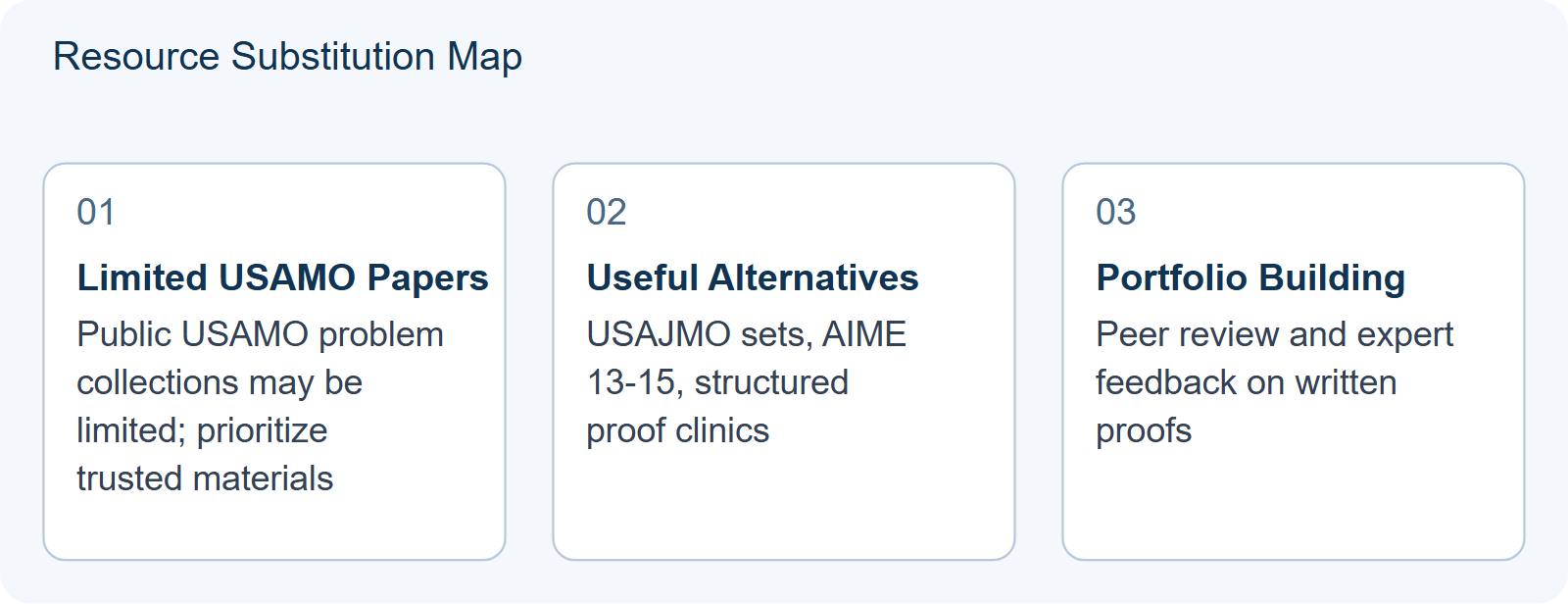
The scarcity of USAMO past papers also reflects how proof-based competition materials are distributed. Compared with the large AMC ecosystem, fewer community-archived collections are available. Families searching for “USAMO past papers” often encounter fragmented results, paywalled resources, or unofficial collections of uncertain quality.
Alternative Resources for Proof Training
When USAMO past papers are scarce, families can build comparable proof-based skills through useful alternatives:
- AIME Problems 13–15: These late AIME problems require multi-step reasoning and creative constructions that approach proof-level thinking, even within the concise-answer format. Working these problems with full written solutions—not just final answers—develops the logical sequencing essential for olympiad proofs.
- USAJMO Overlap Sets: The USAJMO (USA Junior Mathematical Olympiad) covers similar proof-based territory with overlapping content areas. Problems from this parallel competition can provide useful practice in the same format, and any official or instructor-provided solutions can support self-study.
- Structured Proof Clinics: Guided sessions that walk through proof construction, common logical errors, and writing conventions help students develop the exposition skills that past papers alone cannot teach. These clinics address the gap between solving a problem and writing a solution that would be judged complete by an instructor or grader.
These substitutes share the essential feature of requiring students to produce full arguments rather than select or compute answers. The discipline of writing complete solutions, justifying every claim, and organizing logical flow transfers directly to USAMO preparation regardless of the specific problem source.
How Hanlin’s Curriculum Bridges the Resource Gap
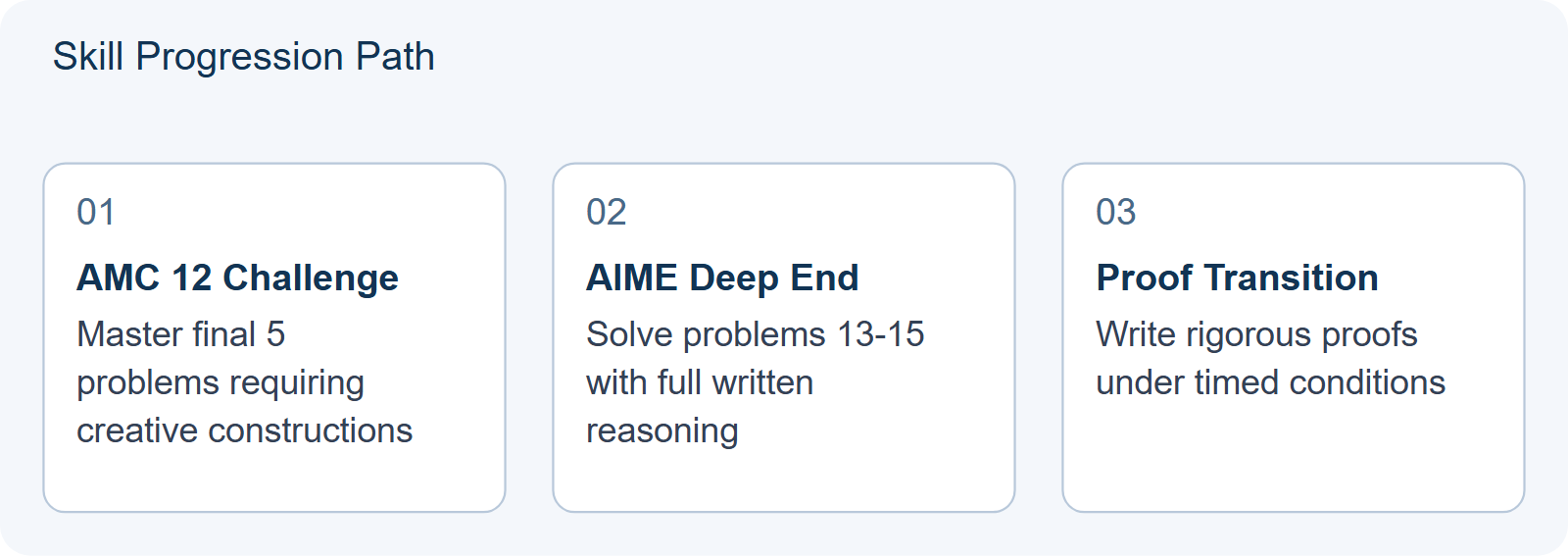
Hanlin’s educational framework addresses the transition from AIME-style problem-solving to USAMO proof-based competition through structured coursework rather than reliance on unofficial paper collections.
According to Hanlin’s course materials, “AMC12 difficult problem training matches the first half of AIME in difficulty and serves as a critical bridge to higher-level competitions including AIME and USAMO” (Hanlin AMC preparation notes, June 2026). This progression—AMC 12 challenge problems to AIME to proof-based work—mirrors the skill development needed for olympiad mathematics.
For students already at an AIME performance threshold, Hanlin offers the Advanced Intensive Class. The course description notes this option “suits students who have completed systematic study, correctly solve 18+ problems on past papers, possess AIME qualification level, and aim to break into the global top 1% and achieve top scores” (Hanlin AMC preparation notes, August 2026). While this class targets AMC 12 top-percentile performance, the problem-solving depth required aligns with the foundational skills for subsequent proof-based training.
The pedagogical value of such structured progression lies in its respect for cognitive load. Students who attempt proof-based competition before mastering the construction techniques embedded in late AMC 12 and AIME problems often struggle to identify promising approaches. The Advanced Intensive Class builds the pattern-matching and technique fluency that make proof-based problems tractable.
Building a Proof Portfolio Without Full USAMO Problem Sets
Students can prepare strong proof-writing habits through deliberate practice standards:
| Practice Element | Implementation |
|---|---|
| Proof writing | Take AIME-level problems and write full solutions with justification for every step |
| Peer review | Exchange proofs with study partners to identify logical gaps |
| Expert feedback | Submit written solutions to instructors for critique of rigor and clarity |
| Timed simulation | Practice extended proof sessions to build endurance for competition conditions |
This portfolio approach develops the habits that USAMO past papers would ideally reinforce—rigorous logic, clear exposition, and sustained concentration—without requiring access to the full historical problem set. The key insight is that proof-writing is a transferable skill: practicing on USAJMO problems, late AIME problems with written solutions, or even carefully selected textbook exercises builds comparable competencies to practicing on USAMO problems specifically.
Families should also consider the role of mathematical reading in proof development. Studying published solutions to competition problems, attending to both the logical structure and the presentation conventions, provides models for the student’s own writing. This active reading—annotating why each sentence follows from what preceded it, identifying where the author chose a particular technique—accelerates proof-writing development beyond what problem-solving alone achieves.
Timeline Reality: When to Begin USAMO-Targeted Training
From an educational planning perspective, the transition to proof-based work should follow solid AIME performance, not precede it. Students who rush to USAMO preparation before mastering AIME-level techniques often struggle with the foundational constructions that olympiad problems extend.
A reasonable framework: use AMC 12 challenge problems and AIME 13–15 to confirm readiness, then introduce proof-based training once consistent AIME performance is established. This sequencing respects the skill hierarchy rather than treating USAMO as a parallel track. Specifically, students should aim for comfortable AIME performance before allocating significant time to proof-based preparation. Premature transition risks diluting attention from the prerequisite skill development.
This sequencing supports practical preparation. Because AIME and USAMO occur at different stages of the competition year, students reaching this level for the first time may have a limited window for dedicated proof training before their first USAMO attempt. Rather than cramming proof techniques in this compressed period, students who begin proof-oriented work during their AIME preparation year build more robust foundations.
Preparing for a Course-Fit Consultation
If your family is evaluating structured support for the AIME-to-USAMO transition, preparing specific information helps advisors recommend appropriately:
- Current AMC 10/12 and AIME scores or practice test performance
- Prior experience with proof-based mathematics (geometry proofs, number theory arguments)
- Availability for intensive coursework versus self-paced study
- Target timeline for competition participation
With this context, a consultation can determine whether Hanlin’s AIME advanced offerings align with the student’s preparation level.
For broader context on competition pathways, see an overview of USAMO and USAJMO. Students still building toward AIME may find AMC 10/12 preparation strategies more immediately relevant.
Frequently Asked Questions
Can I prepare for USAMO without access to many published past papers?
Yes. The key is developing proof-writing skills through alternative substitutes: USAJMO problems, late AIME problems with full written solutions, and structured proof clinics. The skill of rigorous mathematical exposition matters more than the specific problem source.
How do I know if I'm ready to start proof-based training?
A practical indicator is consistent performance on AIME problems 13-15 with correct answers and clear reasoning. If you can explain your solution method to another student without gaps, you likely have the foundational maturity for proof-based work.
What should I ask in a consultation about USAMO transition courses?
Ask about the instructor's approach to teaching proof construction, how student work is reviewed and feedback is provided, and how the course bridges from AIME-style problem-solving to olympiad proof writing. Bring your recent competition scores for accurate placement.