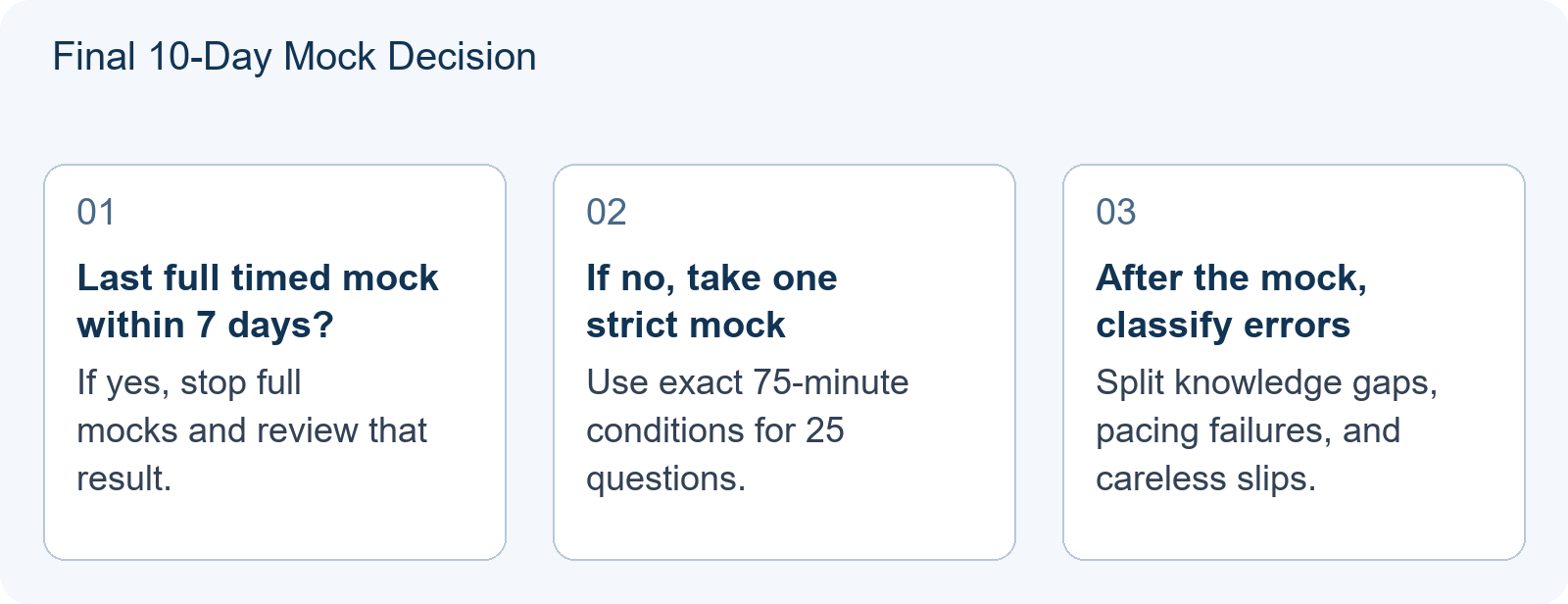
For China-based AMC 10/12 candidates in the 2026-27 season, the final ten days are a calibration window, not a broad content-acquisition window. The direct answer: inside the final ten days before your China sitting date, take one more full timed mock only if your last strict 75-minute mock was more than seven days ago. If you have already completed a full timed mock in the last seven days, stop testing and review that result. Use the result to classify errors as knowledge gaps, pacing failures, or careless slips, then spend the remaining hours on targeted drills. The China dates are A-paper on 6 November 2026 and B-paper on 14 November 2026, both offline, reported by Hanlin Courses in the 19 October 2026 article “AMC10/12 Registration Restrictions? What If ASDAN Won’t Let You Register?” (Chinese title translated). The US/Canada MAA dates are 5 November and 13 November 2026, so do not mix the calendars.
This article is strategic coaching guidance, not an official MAA rule. The seven-day threshold is a teaching judgment to avoid over-testing and under-reviewing. Official dates and scoring rules are cited where used.
China sitting dates vs US/Canada dates
China-based families should plan from the local offline sitting dates, not from the US/Canada MAA dates. Hanlin Courses reported on 19 October 2026 that the 2026 China season has the following schedule.
| Paper | China sitting date and time | US/Canada MAA date | China registration deadline |
|---|---|---|---|
| AMC 10/12 A | 6 November 2026, 17:00–18:15, offline | 5 November 2026 | 25 October 2026 (already passed as of 26 October 2026) |
| AMC 10/12 B | 14 November 2026, 17:00–18:15, offline | 13 November 2026 | 3 November 2026 |
Source: Hanlin Courses WeChat article “AMC10/12 Registration Restrictions? What If ASDAN Won’t Let You Register?” (19 October 2026; Chinese title translated). US/Canada dates: MAA American Mathematics Competitions page, checked 26 October 2026.
On 26 October 2026, the A-paper is 11 days away and the B-paper is 19 days away. The final ten-day window for the A-paper begins on 27 October 2026; for the B-paper it begins on 4 November 2026. If you are sitting only the B-paper, you still have more runway. Apply the same decision rule when you enter your final ten days.
Should you take another timed mock?
A common final-week mistake is either over-testing without analysis or analyzing passively without checking pacing under timed conditions. The rule of thumb here is: take one final timed mock only if you have not completed a full, strict-timing simulation in the last seven days. This is a coaching judgment, not an official MAA mandate.
If you took a full timed mock within the last week, do not take another. Spend those 75 minutes plus review time dissecting the recent result instead. Hanlin Courses argued in its 9 October 2026 article “One Mock Test Shows How Far You Are from AIME…” (Chinese title translated) that untimed practice can create false confidence because it removes the 75-minute constraint. The same article notes that timed mocks reveal pacing failures, especially when students stall on mid-range questions or run out of time on the final five. That is exactly the information you need in the final ten days.
Why not multiple mocks? Each full mock costs at least two hours when you include review. Multiple mocks in the last ten days usually replace error repair with fatigue. One calibration mock is enough to check pacing, stamina, and decision-making. The remaining hours should go to the errors already identified.
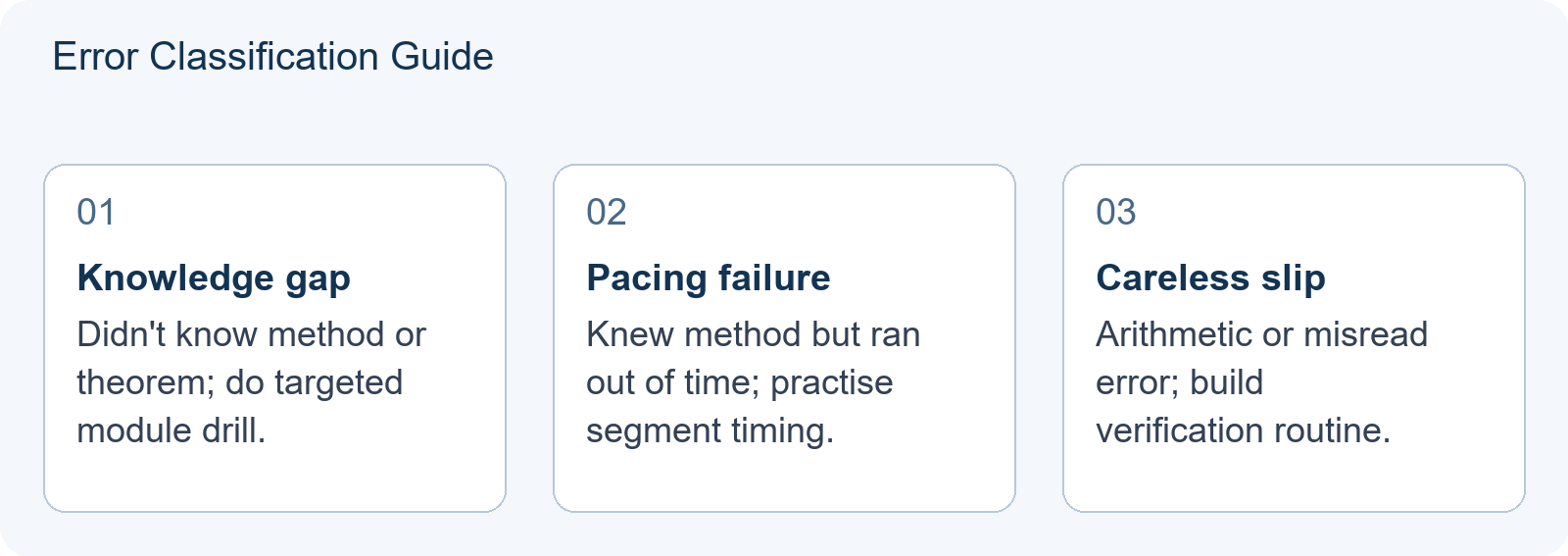
Three error classes from the last timed mock
Do not treat every wrong answer the same. The appropriate final-week action depends on why the answer was wrong.
| Error type | Symptom | Action in the final ten days |
|---|---|---|
| Knowledge gap | You did not know the theorem, formula, or concept needed to solve the problem. | Targeted drill on that specific module. Do not re-solve the whole paper. For example, if combinatorics counting principles are weak, practise 8–10 problems on that family only. |
| Pacing failure | You knew how to solve it but ran out of time, spent too long on an early question, or froze after a hard problem. | Practise segment timing and skipping. Drill questions 11–20 with a realistic segment budget, not a random full paper. |
| Careless slip | Arithmetic error, misreading the question, or bubbling the wrong answer. | Review scratch-work habits. Practise verification using a second method, such as plugging answer choices back into the equation. |
For a deeper method of separating knowledge gaps from pacing failures, see AMC Mock Test Review: Separate a Knowledge Gap From a Pacing Failure.
Timing readout, not just score
The score alone does not tell you what to do next. Look at where the time went. A practical coaching rule for a 75-minute AMC paper is to check three segments:
- Questions 1–10: aim to finish in roughly 15–20 minutes. If you spend more than 20 minutes here, you are borrowing time from harder questions later.
- Questions 11–20: budget about 25–30 minutes. This is the middle segment where many students stall. If you regularly exceed 30 minutes, practise skipping one or two stubborn problems.
- Questions 21–25: reserve about 25–30 minutes. If you leave less than 20 minutes for these, you may never give yourself a real chance at the hardest questions.
These segment budgets are teaching suggestions, not official scoring rules. The total should stay close to 75 minutes. Adjust slightly for your own strengths, but keep the structure.
Worked hypothetical: 12 hours left after an eight-day-old mock
Teaching illustration. This is not a real student case, an official score rule, or a promise of results. It shows how one plausible final-week split can work.
Suppose a student sits the A-paper in ten days. Their last full timed mock was eight days ago, so they are due one final calibration mock under the seven-day rule. They scored 90/150. Their error log shows: two knowledge gaps in combinatorics, three pacing failures on mid-range geometry, and one careless algebra slip. They have 12 hours of dedicated study time left.
| Hours | Focus | Detail |
|---|---|---|
| 1–2 | Combinatorics concept repair | Solve 8 targeted counting problems untimed. Write the rule or setup behind each one. |
| 3–4 | Combinatorics timed mini-set | Do 6 problems in 12 minutes, then review. The goal is to convert a knowledge gap into a reliable method. |
| 5–6 | Pacing segment drill | Take questions 11–20 from a past paper in 25 minutes. Review every skip decision. Repeat one short geometry segment if time permits. |
| 7–8 | Geometry pacing and verification | Do 8 mid-range geometry problems in 20 minutes. Spend the rest checking diagrams, labels, and arithmetic. |
| 9–10 | Final full calibration mock | Sit one strict 75-minute mock. Spend 45 minutes reviewing time distribution and error type, not just score. |
| 11–12 | Light review and logistics | Read compact error notes. Confirm test-centre details and permitted materials through your registration channel. Stop new topics. |
This plan prioritizes the diagnosed weaknesses. It does not attempt to learn a new module from scratch. It also respects the seven-day rule: the last full timed mock was eight days old, so one final calibration mock is allowed.
How to use the final calibration mock
Treat the final mock as a diagnostic, not a score prediction. After the 75 minutes, do not obsess over the raw score. Instead, inspect time distribution. How long did you spend on questions 1–10? If more than 20 minutes, you are wasting buffer time. Did you leave at least 20 minutes for questions 21–25? If not, your pacing plan needs adjustment before exam day.
Also practise the blank-versus-guess decision under official AMC scoring. According to the Hanlin Courses 19 October 2026 article, the AMC 10/12 scoring is: correct answer +6 points, blank answer +1.5 points, wrong answer 0 points. That means a blank has real value. A random guess among 5 choices has expected value 6 × 0.2 = 1.2 points, which is less than the 1.5 points from leaving it blank. If you can eliminate one choice, leaving 4 choices, the expected value is 6 × 0.25 = 1.5 points, equal to a blank. If you can eliminate two choices, leaving 3 choices, the expected value is 6 × 1/3 = 2 points, which is better than a blank. So a simple final-week rule is: if you can narrow a question to three or fewer plausible choices, guessing has positive expected value; if you cannot eliminate at least two choices, a blank may be the better scoring choice. This is a mathematical consequence of the stated scoring, not an official strategy guarantee.
For more on why a correct guess still deserves review, see AMC 10/12 Confidence Calibration: Why a Correct Guess Still Needs Review.
Last 48 hours: review, sleep, logistics
In the final two days, reduce cognitive load. Stop solving hard number theory or combinatorics problems that you have not already practised. Your goal is to enter the exam alert and calm, not to learn a new technique.
Sleep timing matters. The China exams are held in the evening, 17:00–18:15, according to the Hanlin Courses 19 October 2026 report. If possible, adjust your daily rhythm so you are awake and focused during those hours. Do not stay up late two nights before the exam to finish practice sets.
Logistics are part of performance. Confirm your test-centre address and arrival time. Follow the permitted-materials instructions from your registration channel, whether that is ASDAN or AMC-China. Do not assume US/Canada venue rules apply. Prepare your bag the night before and check the latest notice from your registration channel. For the distinction between MAA dates and your China test-centre sitting date, see Two Calendars, One AMC Season: MAA Dates, Your Test Centre Sitting Date, and the October Deadlines (2026).
Conclusion: refine, do not revolutionise
The final ten days are about refinement. You cannot learn a full new module in this window, but you can improve pacing, reduce careless slips, and repair one or two diagnosed knowledge gaps. Use one final timed mock only if your last strict mock is more than seven days old. If you have a recent timed result, review it instead. Classify errors, drill the weak family, and protect your sleep and logistics. That is a more reliable final-week plan than adding another full paper for its own sake.
General event background is available at Event background.
This is an independent preparation guide, not affiliated with, endorsed by, or sponsored by the Mathematical Association of America.
Frequently Asked Questions
Should I take a mock test the day before the AMC 10/12?
No. A full mock the day before usually adds fatigue and anxiety without giving you time to repair errors. Use the last 24 hours for light review of compact error notes and logistics.
What if my last mock score was low?
A low timed-mock score does not automatically mean you need new content. Classify the errors first. Many low scores come from pacing failures on mid-range questions, which require skipping and segment-timing practice rather than broad re-learning.
Are the China AMC dates the same as the US dates?
No. For 2026, the China A-paper is 6 November and the B-paper is 14 November, both offline. The US/Canada MAA dates are 5 November and 13 November. Plan from your China sitting date.