A three-set counting question on the AMC 10 or AMC 12 rarely fails because a student has never heard of inclusion–exclusion. It fails because “exactly one” and “at least one” select different parts of the same diagram, and both computations can be made to look plausible. The reliable fix is to label all seven regions before touching a formula: exactly-one is the sum of the three single-only regions, while at-least-one is the whole union — exactly-one plus exactly-two plus all-three. The numbers below are a teaching illustration written to exercise the method, not a past contest problem, and the study advice reflects Hanlin’s preparation perspective rather than official scoring guidance.
Label the Seven Regions Before Choosing a Formula
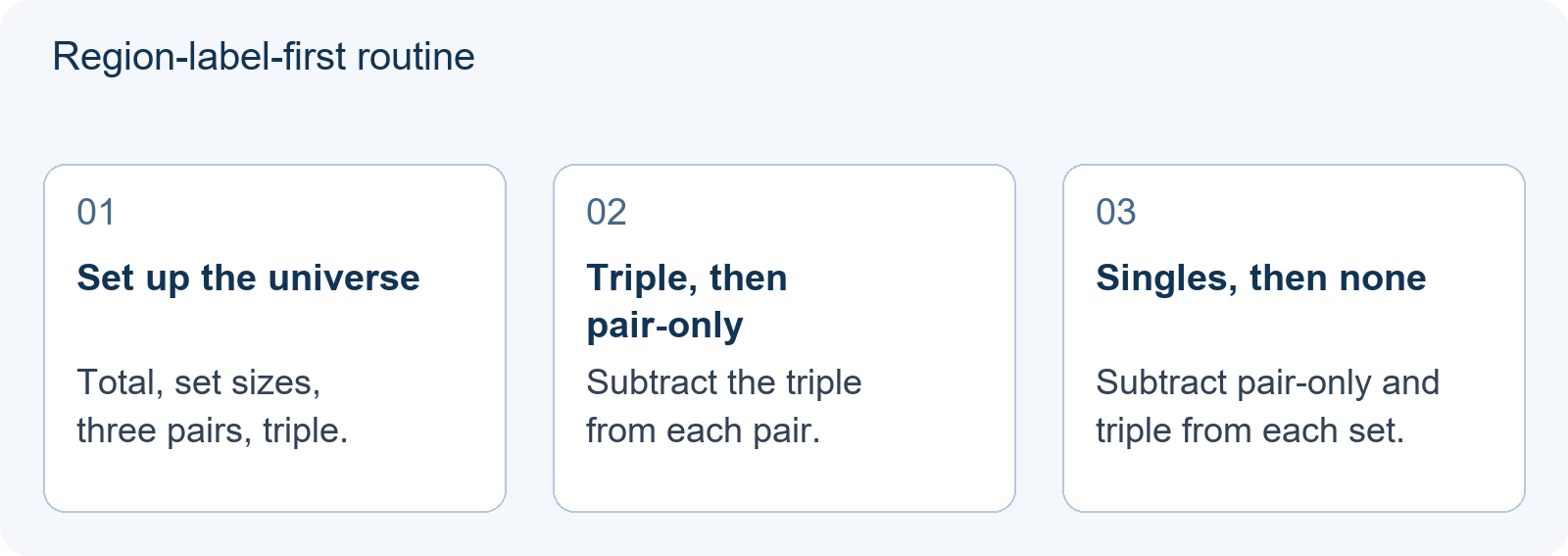
Write the universe down first. Call the total |U|, the three sets A, B and C, and the triple intersection |A∩B∩C| = t. The seven regions inside the sets are A only, B only, C only, A∩B only, A∩C only, B∩C only, and all three. Add the outside region and the diagram has eight pieces that cover the universe exactly once.
A common reading error is treating |A∩B| as “A and B but not C.” It is not; the standard notation includes the triple. Before anything else, convert every pairwise figure the prompt supplies into a pair-only figure by subtracting t. That single subtraction prevents many of the mistakes that follow, because every later region depends on it.
Two conventions make the remaining work mechanical. Write regions in lowercase and set sizes in bars, so that a is the size of A-only while |A| is the size of the whole set. And never compute “at least one” as |A|+|B|+|C|: that sum counts an element in exactly two sets twice and an element in all three sets three times, which is precisely the overcount that the audit later will catch.
A Fully Checked Teaching Illustration
Here is a hypothetical survey problem, written for this article to exercise the routine. Forty students are asked which of three clubs, A, B and C, they joined. The reported totals are |U| = 40, |A| = 20, |B| = 18, |C| = 16, |A∩B| = 8, |A∩C| = 6, |B∩C| = 5 and |A∩B∩C| = 3. None of it is taken from a past paper.
Start at the triple and work outward. The pair-only regions are 8 − 3 = 5, 6 − 3 = 3 and 5 − 3 = 2. The single-only regions follow: A only is 20 − 5 − 3 − 3 = 9, B only is 18 − 5 − 2 − 3 = 8, C only is 16 − 3 − 2 − 3 = 8.
| Region | Meaning | Size |
|---|---|---|
| a | A only | 9 |
| b | B only | 8 |
| c | C only | 8 |
| p | A and B, not C | 5 |
| q | A and C, not B | 3 |
| r | B and C, not A | 2 |
| t | all three | 3 |
| n | none of the three | 2 |
Now the two answers that cause the trouble. Exactly one is 9 + 8 + 8 = 25. Exactly two is 5 + 3 + 2 = 10. All three is 3. At least one is 25 + 10 + 3 = 38, and none is 40 − 38 = 2. The eight regions sum to 40, so no student has been counted twice or dropped.
A cross-check uses only the original figures: inclusion–exclusion gives 20 + 18 + 16 − 8 − 6 − 5 + 3 = 54 − 19 + 3 = 38, matching the region sum. If the two routes disagree, the diagram contains an arithmetic slip worth finding before answering anything else.
One Table That Fixes the Wording
Most of the remaining difficulty is translation. The table maps the phrasings that appear in three-set prompts onto region sums and onto the illustration’s numbers.
| Wording in the prompt | Regions | Illustration |
|---|---|---|
| “only A” | a | 9 |
| “exactly one of the three” | a + b + c | 25 |
| “exactly two of the three” | p + q + r | 10 |
| “at least two of the three” | p + q + r + t | 13 |
| “all three” | t | 3 |
| “at least one of the three” | a + b + c + p + q + r + t | 38 |
| “none of the three” | n | 2 |
| “in A but not in B” | a + q | 12 |
Two rows deserve a second look. “At least two” includes the triple, so it is 13 rather than 10; the word “exactly” is doing real work there. And “in A but not in B” is not the same as “only A,” because it keeps the students who are in A and C together: 9 + 3 = 12. The shortcut |A| − |A∩B| = 20 − 8 = 12 agrees, which is a fast consistency check on the labels.
Exactly One or At Least One: The Decision Rule
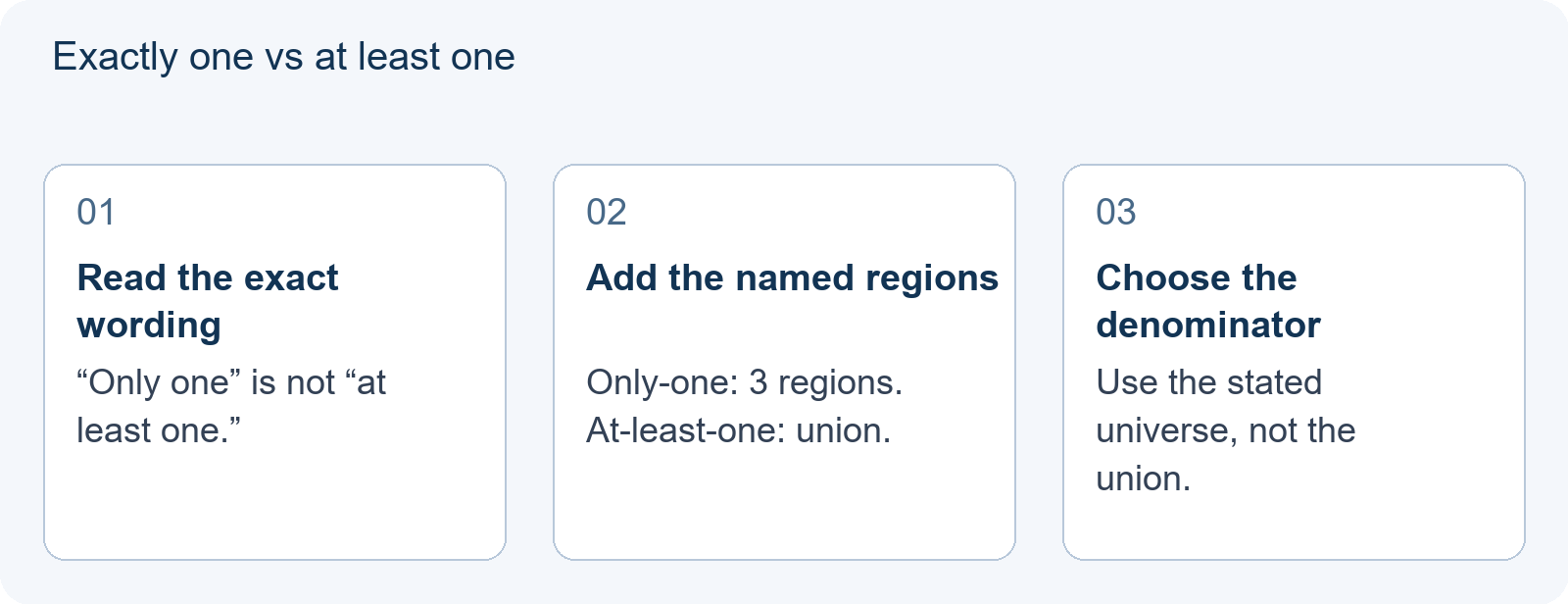
The choice between region sums and the union is settled by one question: does the prompt exclude anyone who belongs to two sets? If it does, add regions. If it does not — if it says “at least one,” “some,” “joined a club,” or asks for a probability over the whole surveyed group — compute the union.
Three signals point to a region sum: the prompt contains “exactly,” “only,” or “but not”; it restricts attention to part of the diagram rather than describing everyone; or the union is a tempting near-miss answer choice. In the illustration, 25 and 38 are both plausible-looking results on a multiple-choice paper, which is exactly how the trap is built.
Two signals point to the union. The prompt says “at least one” with no further restriction, or the complement is easier: when “none” is the smallest number in the diagram, at least one is |U| minus that number. Here, 40 − 2 = 38 in one subtraction.
The failure mode to watch is answering the question you solved rather than the one asked. A student who computes the union first and then notices “exactly one” will often reach for a single subtraction — 38 − 3 = 35 — and stop, because the number looks reasonable. That is what the audit below exists to catch.
Which Denominator Does the Probability Version Need?
Three-set prompts frequently end with “what is the probability that a randomly chosen student…” The counting work above is unchanged; only the denominator is at stake. The denominator is the population the prompt says the student is chosen from — normally the stated universe, not the union.
In the illustration, P(exactly one) = 25/40 = 5/8 and P(at least one) = 38/40 = 19/20. Dividing the first by the union would give 25/38, which answers a different question: the probability of exactly one given that the student joined at least one club. Conditional wording — “given that,” “among those who,” “if a student is chosen from those who” — changes the sample space, and the denominator has to move with it. It is the same error described in our note on AMC 10 Conditional Probability: Changing the Sample Space After New Information, transplanted into a Venn diagram.
A second trap is the denominator inside a subgroup. If the chosen student is drawn from the exactly-one group, the denominator is 25 and the answers are proportions within that group, such as 9/25 for A-only. Read the sampling sentence as carefully as the counting sentence, and write the denominator down before simplifying any fraction.
The Overcount Audit in Three Checks
Before committing to an answer, run three checks that catch many errors in this family.
Check one: the groups sum to the universe. 25 (exactly one) + 10 (exactly two) + 3 (all three) + 2 (none) = 40. If the four group totals do not add to |U|, at least one region is wrong.
Check two: the set sizes reconstruct. Each element in exactly one set is counted once, in exactly two sets twice, and in all three three times. So |A| + |B| + |C| should equal 25 + 2(10) + 3(3) = 25 + 20 + 9 = 54, and indeed 20 + 18 + 16 = 54. This check catches arithmetic slips in the region sums; a pair figure copied incorrectly and then used consistently will still satisfy it, so compare the labels against the original prompt separately.
Check three: inclusion–exclusion matches the region sum. 54 − 19 + 3 = 38. The triple is added back exactly once; subtracting all three pairwise intersections removes it three times, so one addition restores the correct count.
A fourth check is cheap and worth the ten seconds: each pair-only region must be smaller than its parent pair. If p = 5 then |A∩B| = 8 with t = 3, and 5 + 3 = 8 closes. A pair-only region larger than its pair is arithmetically impossible and signals a subtraction slip.
Turning Three Missed Questions Into a Drill
One mock paper is enough raw material if it is converted properly. Take three missed three-set questions and rewrite each as a labelled diagram, without re-solving it. Mark where the original attempt went wrong: a region-label error (an element placed in the wrong piece), a formula error (inclusion–exclusion applied where regions were needed, or the triple forgotten), or a denominator error (dividing by the union).
The diagnosis matters more than the volume of practice. Three region-label errors call for diagramming repetition. Three denominator errors call for reading the sampling sentence aloud before computing. Three formula errors call for the audit checks, run every time until they are automatic. Separating an execution slip from a genuine gap is the same distinction we apply in our note on AMC Mock Test Review: Separate a Knowledge Gap From a Pacing Failure.
On timing, Hanlin’s revision guidance of 24 October 2026 (“One Day Left! 2026 AMC10/12 A-Paper Registration Closes! How to Sprint-Prepare?”) groups AMC 10/12 content into algebra, geometry, number theory and combinatorics, and lists classification counting, probability and recursion inside combinatorics; combinatorics sits fourth in that guidance’s stated revision priority. The practical reading for a student who keeps losing exactly-one marks is to fix the diagramming routine now, across a small number of questions, rather than opening a broad combinatorics review in the final fortnight. The 2026 paper is 25 multiple-choice questions in 75 minutes, scored 6 for correct, 0 for wrong and 1.5 for blank, as restated in Hanlin’s 1 November 2026 note on admission tickets — another reason to keep the audit short enough to run inside the exam.
Preparing a Help Request That Saves Time
A counting question and a request for help are different documents. If you decide to ask for assistance — through this site’s contact page or anywhere else — bring three things.
- The three missed questions, photographed with your original working visible, including the answer choice you rejected.
- Your reconstruction of the diagram, even if it is wrong, with the region you now believe is correct marked.
- One sentence naming the error type you suspect: region label, formula choice, or denominator.
Where the errors cluster decides the response. A cluster of region-label errors is usually a routine problem and can be fixed with a short, targeted sequence. A cluster of formula-choice errors is a reading problem and needs different drills. Mixed errors usually mean the diagram was never finished before the formula was attempted, which is a sequencing issue rather than a knowledge one. A conversation that starts from three labelled diagrams is far more productive than one that starts from a score, and it makes it easier to judge whether what you need is a practice set, a book or a teacher — the question set out in our note on More Practice, a Better Book, or a Teacher? Matching AMC Help to the Gap You Actually Have.
For students inside a wider correction cycle, the same diagnostic applies: in this question family, “careless” usually means the diagram was skipped, not that the arithmetic failed.
None of this replaces official rules. The method is a coaching routine, the format and scoring facts above are attributed to Hanlin’s published notes, and this site is an independent English-language guide to the AMC sequence rather than the MAA or an issuer of AMC rules.
General event background is available at Event background.
This is an independent preparation guide, not affiliated with, endorsed by, or sponsored by the Mathematical Association of America.
Frequently Asked Questions
Should I label the seven regions or use inclusion–exclusion for a three-set AMC question?
Label the regions when the prompt says “exactly,” “only” or “but not,” because those words select particular regions. Use the union formula or the complement when the prompt asks for “at least one” over the whole surveyed group. In the teaching illustration in this article, exactly one is 25 and at least one is 38 out of 40, so the two approaches answer different questions rather than competing.
Why do I add the triple intersection back after subtracting the pairwise intersections?
Because each pairwise figure such as |A∩B| already includes the elements in all three sets. Subtracting |A∩B|, |A∩C| and |B∩C| removes the triple three times, so exactly one addition restores it. In the illustration, 20 + 18 + 16 − 8 − 6 − 5 + 3 = 38, which matches the sum of the seven regions.
What denominator should a three-set probability question use?
The population the prompt says the student is chosen from. With a stated survey of 40, P(at least one) = 38/40 = 19/20 and P(exactly one) = 25/40 = 5/8. Dividing by the union instead produces a conditional probability, 25/38, which is correct only when the prompt says “given that” or restricts the choice to students who joined at least one group.