For 2026-season practice, a downloaded AMC 10 past papers PDF is usable only when the year, the A or B label, all 25 questions, every figure and choice, and a 25-entry answer key agree with a second independent copy. If any of those pieces disagree, do not add the timed score to your practice log. A wrong file does not merely waste an hour; it corrupts the score record you will use to choose topics, pace and next steps.
This article is an independent editorial guide, not an official MAA publication. It is not affiliated with the Mathematical Association of America (MAA), the AMC organiser. The checks below use reader-visible signals in the file and a simple comparison method. They do not require you to know the original contest questions in advance.
Why file integrity comes before a difficulty ladder
A timed paper is a measurement instrument. If the file is missing a diagram, has a cropped answer choice or carries the wrong A/B label, the measurement no longer describes the paper you think you sat. The score-ladder approach described in AMC 10 Past Papers: A Self-Calibrating Difficulty Ladder from Timed Scores assumes a clean paper and a reliable score. That assumption has to be earned first.
The 24 October 2026 Hanlin WeChat notice, translated here as One Day Left! 2026 AMC10/12 A-Paper Registration Closes! How to Sprint-Prepare?, gives sprint guidance that recommends timed full papers and prioritising the most recent five years of A and B real questions, with older questions used less. That advice only works if the recent A and B files are correctly identified. A folder named 2024 AMC 10 is not enough. You need to know which paper, which sitting and which version you are about to time.
The same notice reports that the 2026 AMC10/12 format is 25 multiple-choice questions in 75 minutes, scored 6 for correct, 1.5 for blank and 0 for wrong. That scoring statement is useful for a mock log, but it is not a substitute for checking whether the answer key actually belongs to the question paper in front of you.
Check the year and paper label first
Open the first page and the file properties, then write down four identifiers: year, competition level, A or B, and source. A file called AMC10_2024.pdf tells you almost nothing. A file called AMC10_2024_A_verified.pdf is more useful, but only if the content supports the label.
The 24 October 2026 Hanlin notice lists separate A and B sittings and refers to recent A and B real questions as distinct practice material. For file management, treat A and B as separate papers. Do not combine them into one undifferentiated year folder and do not assume a generic year label identifies the paper you need. If you are choosing between AMC 10 and AMC 12 material, the content split discussed in AMC 10 Past Papers vs AMC 12 Past Papers: The Content Split That Makes Some Years Misleading for Your Level matters before you even begin timing.
A practical label test is simple. Does the first page, header or footer show the same paper identity as the filename? If the filename says A but the header says B, stop. If neither shows a label, mark the file unlabelled and do not use it for a timed mock until you can compare it with a verified copy.
Count questions, choices and figures
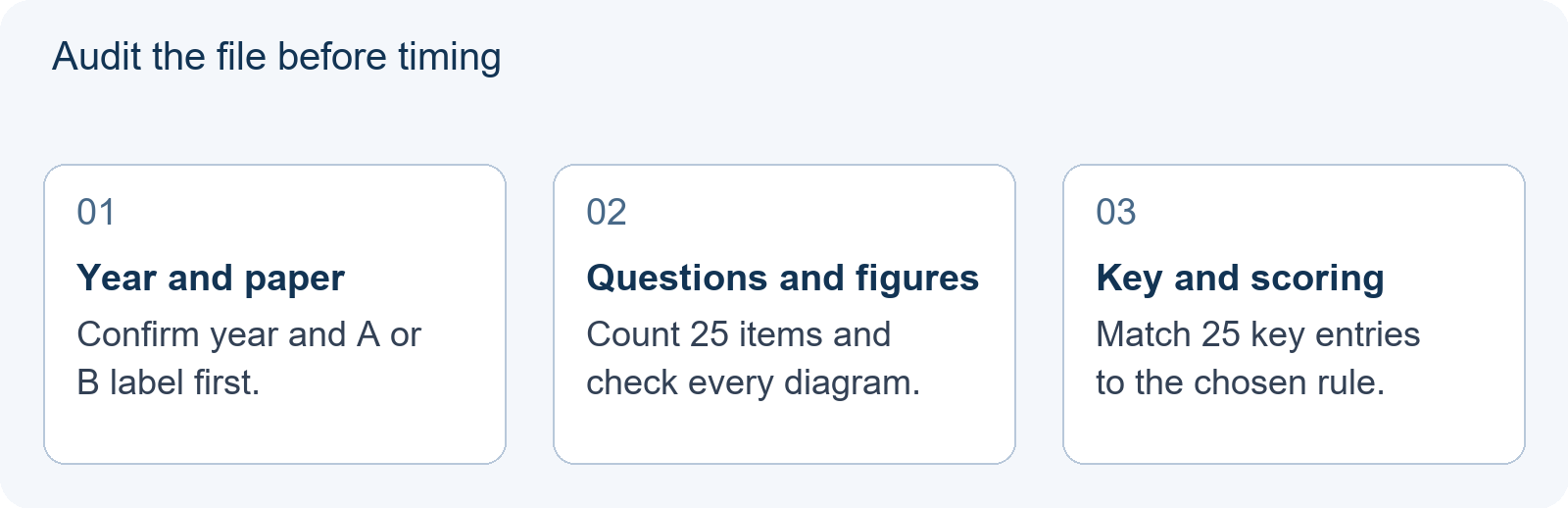
Count the question numbers from 1 to 25. Then check that each question has its full set of answer choices. A missing choice can make an easy item impossible or change the correct answer. Next, scan for visual items. A figure may be a diagram, a graph, a table or a labelled shape. If the text says see the figure and the figure is absent, the file is incomplete even if the question count is 25.
Cropping is a common problem in copied PDFs. A diagram may be present but cut off at the edge, or a coordinate grid may lose its axis labels. For a timed mock, an incomplete figure changes the problem. For a content review, it may still be usable, but label it as a partial file and do not mix its score with clean-paper scores.
Use a simple four-column sheet: question number, choices present, figure present, and note. A file with 25 questions but two missing figures is not a 25-question clean paper. It is a 25-question file with two invalid items for timed purposes.
Audit the answer key and the scoring rule
An answer key is usable only if it has 25 entries and each entry maps to the same question number as the paper. Count the key entries, not just the lines. Check for blank entries, duplicated letters, stray page numbers and key sections that begin at question 26 or question 1 of a different paper. A 25-letter key can still be the wrong key.
Separate the key from the scoring sheet. The 24 October 2026 Hanlin notice reports 6 for correct, 1.5 for blank and 0 for wrong in the 2026 AMC10/12 format. If you are simulating that rule, record blanks as 1.5, not as wrong. If you are using an older file for content review, label the scoring rule you apply rather than silently borrowing a current rule. The key tells you which option was correct; the scoring sheet tells you how to convert a response pattern into a practice score. They are different documents.
| Signal | Usable for timed practice | Action |
|---|---|---|
| Year and A/B label agree across filename, header and source note | Yes | Keep and log source |
| 25 questions, all choices, all figures intact | Yes | Run the timed paper |
| 25 key entries match question numbers | Yes | Score with the chosen rule |
| Filename label missing or contradicted by header | No | Relabel only after comparison |
| Question order, figure or key differs from a second copy | No | Discard for timed use |
Compare two copies without spoiling a mock
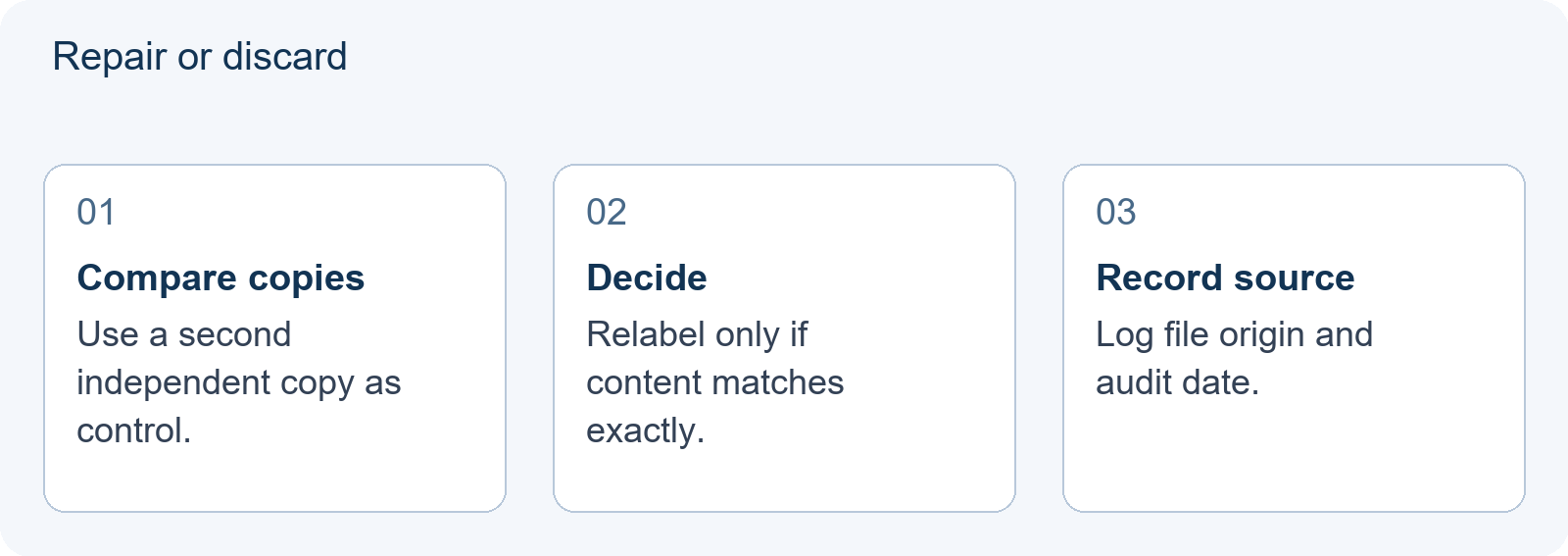
A second independent copy is your control, but it should not become an answer leak before the timed attempt. Compare page-one identity, question stems, choice order, figures and the answer key with a parent, tutor or study partner if you do not want to see the key yourself. Record the comparison date and the source of each copy. Do not treat two files from the same download folder as independent; they may share the same defect. Use a copy from a different source path or message when possible.
The comparison should be narrow. You are not checking whether you can solve the paper. You are checking whether question 1 in copy A is question 1 in copy B, whether the same figure appears in the same place, and whether the key entries line up by number. If the stems match but the key differs, the file is not clean for scoring. If the key matches but a figure is missing, the file is not clean for timed practice. These are separate defects and should be recorded separately.
Check solution provenance without confusing it with the key
A worked solution is explanatory material. It is not the same as the answer key and it is not official scoring guidance. The 24 October 2026 Hanlin notice says its resource list includes 2024 and 2025 real questions with answers and video explanations. Those are operator resources, not official MAA downloads. That distinction matters when you cite a solution in your error log.
Write the provenance next to the file: where it came from, whether the key and explanations came together, and whether the explanation author is identified. If the explanation is anonymous community work, treat it as a teaching aid to be checked, not as a ruling on what the contest meant. If the key and explanation disagree, the file is not clean enough for a timed score until the disagreement is resolved.
This is also why a single PDF that mixes questions, key and commentary can be harder to audit than three separate files. Separate files make it easier to see whether the key belongs to the question paper and whether the solutions are explanatory notes rather than a corrected key.
A worked hypothetical audit, clearly labelled as a teaching illustration
The following is a teaching illustration, not a real contest file, not an official scoring example and not a claim about any named past paper. Suppose a student downloads a file named AMC10_2024.pdf. It contains 25 numbered questions and a 25-letter key. The filename has no A or B label. The first page has no paper label either. The student compares the first three question stems with a second independent copy labelled AMC10_2024_A and finds that question 2 is different, while questions 1 and 3 match.
At this point the file fails the label test and the content test. A 25-question count and a 25-letter key do not rescue it. The student should not time the file, should not record a score and should not add its errors to a topic map. The correct decision is to discard it for timed practice or set it aside as unlabelled review material until a complete independent comparison is possible.
Now suppose a different file is named AMC10_2024.pdf but its first page reads AMC 10 A, its 25 questions match a second independent A copy, every figure is present and the 25 key entries match. Here the filename is incomplete but the content is consistent. The student may relabel the file as AMC10_2024_A, record the source and comparison date, and then use it. The difference between the two cases is not the filename alone; it is whether the content survives comparison.
Discard, repair or relabel: a decision rule for the practice log
Use three outcomes. Discard means the file is not safe for timed use because question order, figures or key entries disagree with a second copy. Repair means the file can be corrected without guessing, for example by adding a missing A/B label after a full content match. Review-only means the file has a known gap, such as one missing figure, and may be used for topic study but not for a timed score.
Record the outcome in the same log that holds your scores. A clean entry should include the year, A or B label, date practised, time limit, raw correct count, blank count and the scoring rule applied. If you later build a practice set by question position, as described in Stop Doing Whole Past Papers: How to Build an AMC Practice Set by Question Position, the file audit protects the item bank from contaminated questions.
Do not average scores from clean and unverified files. Do not compare a 75-minute mock from a complete paper with a shortened session from a partial file. The audit is there to keep the units consistent: one clean paper, one time limit, one key and one scoring rule.
What to prepare before asking for a file check or consultation
If you cannot find enough clean recent A and B papers, prepare a short file-audit request rather than asking for a vague resource pack. Bring two downloaded PDFs, their source pages or messages, the exact filenames, the page count and any label visible on page one. Add a recent score log with the date, paper label, time limit and scoring rule. State whether you need the file for timed practice or only for topic review.
A useful review can then check file integrity, paper labels and whether the practice ladder is clean enough to guide preparation. It cannot turn an unverified file into an official paper, and it should not promise a score outcome. If the Hanlin resource list is relevant, ask which years and formats are actually included; the 24 October 2026 notice describes 2024 and 2025 real questions with answers and video explanations as operator resources, not as official MAA downloads.
The reader takeaway is deliberately narrow: trust a PDF only after the paper identity, question set, figures, key and scoring rule agree. A clean file is the first step in a useful practice record; an unlabelled or mismatched file is not a harder mock, it is a different measurement problem.
General event background is available at Event background.
Frequently Asked Questions
How can I tell whether a downloaded PDF is AMC 10 A or B?
Check the filename, the first-page header or footer, and any source note. If those disagree or show no label, compare the file with a second independent copy. An unlabelled file should not be used for a timed mock until the content matches a verified A or B copy.
Can I use a community answer key for scoring?
You can use it only after checking that it has 25 entries matched to the same question numbers as the paper. Keep the key separate from explanatory solutions. If the key and explanations disagree, do not treat the file as clean for timed practice; resolve the disagreement or discard it for scoring.
What should I do if only the filename is wrong?
If the first page, question order, figures and key all match a verified copy, you may relabel the file and record the source and comparison date. If question order, figures or key entries differ, discard the file for timed practice even if it has 25 questions and a 25-letter key.