Preparing for the American Invitational Mathematics Examination (AIME) requires more than just solving random problems; it demands a strategic approach to AIME past papers. For students aiming to qualify via the AMC 10 or AMC 12, understanding how to select the right practice sets and verify solution accuracy is crucial. This article outlines how to align your study materials with your current performance level, leveraging historical data and structured preparation methods.
The Role of AMC Scores in AIME Preparation
The path to the AIME begins with the AMC 10 or AMC 12. According to the 2026 competition guidelines, the AMC 10 consists of 25 multiple-choice questions over 75 minutes, with a maximum score of 150. Students earn 6 points for correct answers, 1.5 for unanswered questions, and 0 for incorrect ones. The same structure applies to the AMC 12. Qualification for the AIME is determined by reaching a specific score threshold, which varies annually.
Historical data provides a benchmark for setting realistic practice goals. For instance, recent years have seen AMC 10 qualifying scores range between 94.5 and 112.5, while AMC 12 scores typically fall between 76.5 and 100.5. When selecting AIME past papers, students should first assess their current mock test scores against these benchmarks. If you are consistently scoring below 90 on AMC 10 mocks, focusing exclusively on high-difficulty AIME problems may be inefficient. Instead, prioritize strengthening foundational AMC concepts before transitioning to AIME-specific training.
Selecting the Right Practice Set
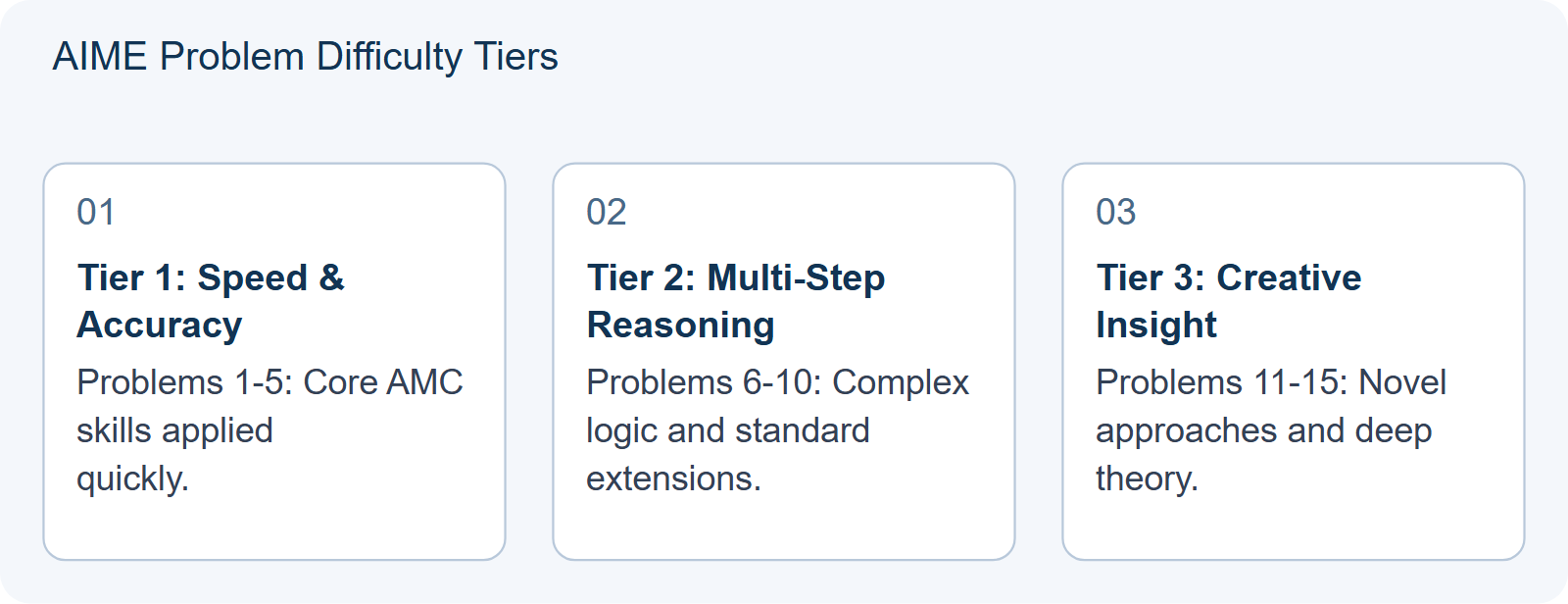
Not all AIME past papers are created equal for every student. The difficulty curve within the AIME itself is steep, with the first few problems often accessible to strong AMC qualifiers, while the final questions require advanced problem-solving techniques. A strategic approach involves categorizing practice sets by difficulty tier:
- Tier 1 (Problems 1-5): Focus on speed and accuracy. These problems test core algebra, geometry, and combinatorics skills similar to AMC 10/12 mid-range questions.
- Tier 2 (Problems 6-10): Introduce multi-step reasoning and less standard applications. This is where many students plateau.
- Tier 3 (Problems 11-15): Require deep insight and creative construction. These are best tackled after mastering Tier 1 and 2.
For students preparing for the 2026 season, note that the AMC 10/12 exams are scheduled for November 5 and 13 (US time), with Chinese regional references in early and mid-November. The AIME follows shortly after. Therefore, your practice schedule should ramp up intensity as you approach these dates. Use earlier years’ AIME papers for diagnostic testing and recent years for timed simulation.
Verifying Solution Coverage and Accuracy
A common pitfall in self-study is relying on incomplete or erroneous solutions. When working through AIME past papers, ensure that your resource provides detailed, step-by-step explanations rather than just final answers. The AIME requires integer answers from 000 to 999, so partial credit does not exist; understanding the logical flow is essential.
Checklist for evaluating solution quality:
- Clarity of Logic: Does the solution explain why a particular theorem or method was chosen?
- Alternative Methods: Are there different ways to solve the problem? Exposure to multiple approaches enhances flexibility.
- Error Analysis: Does the resource highlight common mistakes students make on this specific problem type?
At Hanlin, our coaching philosophy emphasizes independent verification. We recommend cross-referencing your solutions with official MAA archives when available, but always prioritize resources that offer pedagogical value—explaining the thought process behind the answer. Our internal team has curated materials that align with the rigorous standards expected for top-tier competition results, such as those achieved by our students who secured global top 1% rankings in previous seasons.
Integrating Past Papers into Your Study Plan
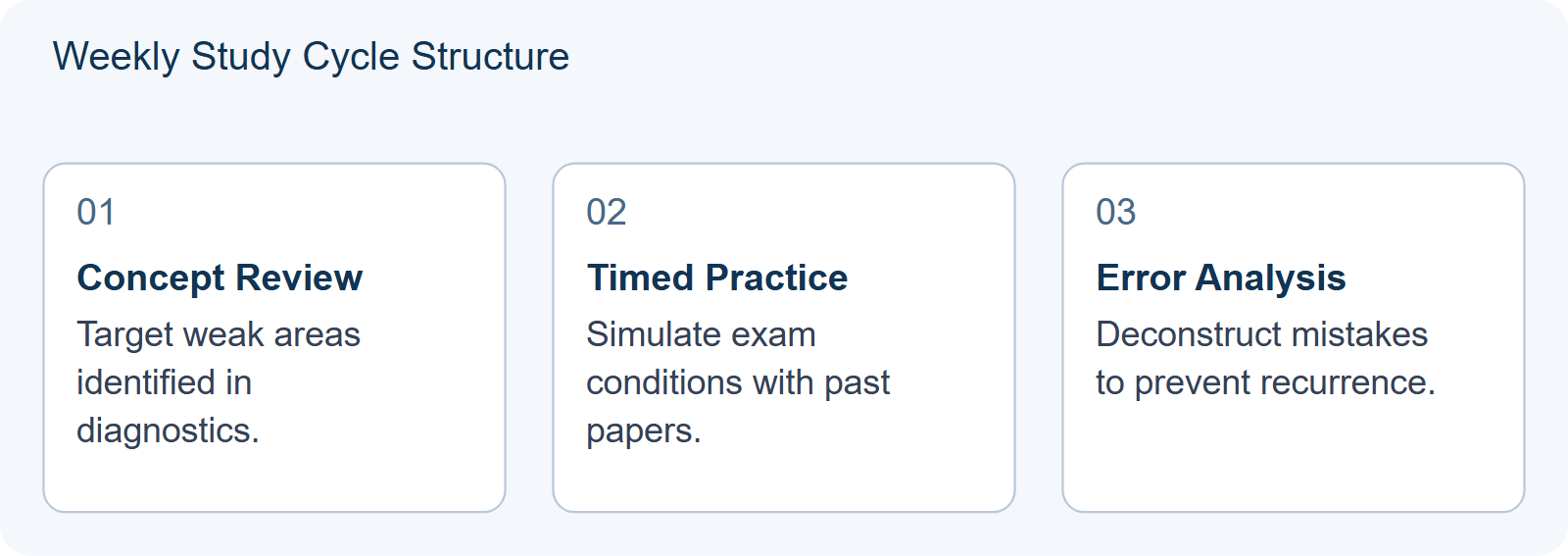
To maximize efficiency, integrate AIME past papers into a broader study framework. Start with a diagnostic AMC mock test to identify weak areas. If number theory is a gap, select AIME problems heavily featuring modular arithmetic or divisibility rules. If geometry is challenging, focus on problems involving circles, triangles, and coordinate systems.
Consider the following weekly routine during the pre-exam phase:
| Day | Activity | Focus Area |
|---|---|---|
| Monday | Review Concepts | Targeted topic study (e.g., Combinatorics) |
| Tuesday | Timed Practice | AMC 10/12 Sectional Test |
| Wednesday | Deep Dive | Solve 3-5 AIME Problems (Tier 1-2) |
| Thursday | Error Analysis | Review Tuesday/Wednesday mistakes |
| Friday | Full Simulation | Complete AIME Paper (timed) |
| Saturday | Rest/Light Review | Mental recovery |
This structured approach ensures consistent progress without burnout. Remember, the goal is not just to solve problems but to build a robust mental toolkit for tackling unfamiliar challenges under pressure.
Leveraging Coaching Support
While self-study with AIME past papers is valuable, expert guidance can accelerate improvement. Hanlin offers specialized courses designed to bridge the gap between AMC success and AIME qualification. Our instructors, including PhD-level mathematicians with extensive competition experience, provide personalized feedback on problem-solving strategies. For example, our AIME Full Course covers advanced techniques in number theory and geometry that are frequently tested in later AIME problems.
Students who achieve top 5% or top 1% in AMC competitions may also access exclusive benefits, such as complimentary AIME prep classes or one-on-one coaching sessions. These resources are tailored to help high-performing students refine their approach to complex problems, ensuring they are fully prepared for the unique demands of the AIME format.
Conclusion
Selecting the right AIME past papers and verifying their solution coverage is a critical step in effective preparation. By aligning practice materials with your current skill level, focusing on detailed explanations, and integrating these resources into a structured study plan, you can significantly enhance your chances of qualifying and succeeding in the AIME. Whether you are targeting a safe pass or aiming for a top rank, disciplined practice with high-quality resources remains the cornerstone of competitive mathematics success.
When selecting AIME past papers, verify solution coverage against current standards. Consider Stop Doing Whole Past Papers: How to Build an AMC Practice Set by Question Position for targeted practice. Ensure your materials align with the Your AMC Cutoff Table Expired in August: How to Date Any AMC or AIME Source Before You Plan Around It. Finally, review Training for the AIME, Not the AMC: What Changes When the Answer Choices Disappear to adapt your preparation strategy effectively.
Frequently Asked Questions
How do I know if my AIME past paper solutions are accurate?
Look for resources that provide step-by-step logical derivations, not just final answers. Cross-reference with official MAA archives if possible, and check for alternative solution methods which indicate thoroughness.
Should I start with recent or older AIME past papers?
Start with older papers for diagnostic purposes to gauge baseline ability. Use recent papers for timed simulations as they better reflect current trends in problem style and difficulty distribution.
What score do I need on AMC to justify AIME practice?
Generally, aim for at least 90-100 on AMC 10 or 85-95 on AMC 12 in mock tests. Historical cutoffs vary, but consistent performance near these levels suggests readiness for AIME-style problems.