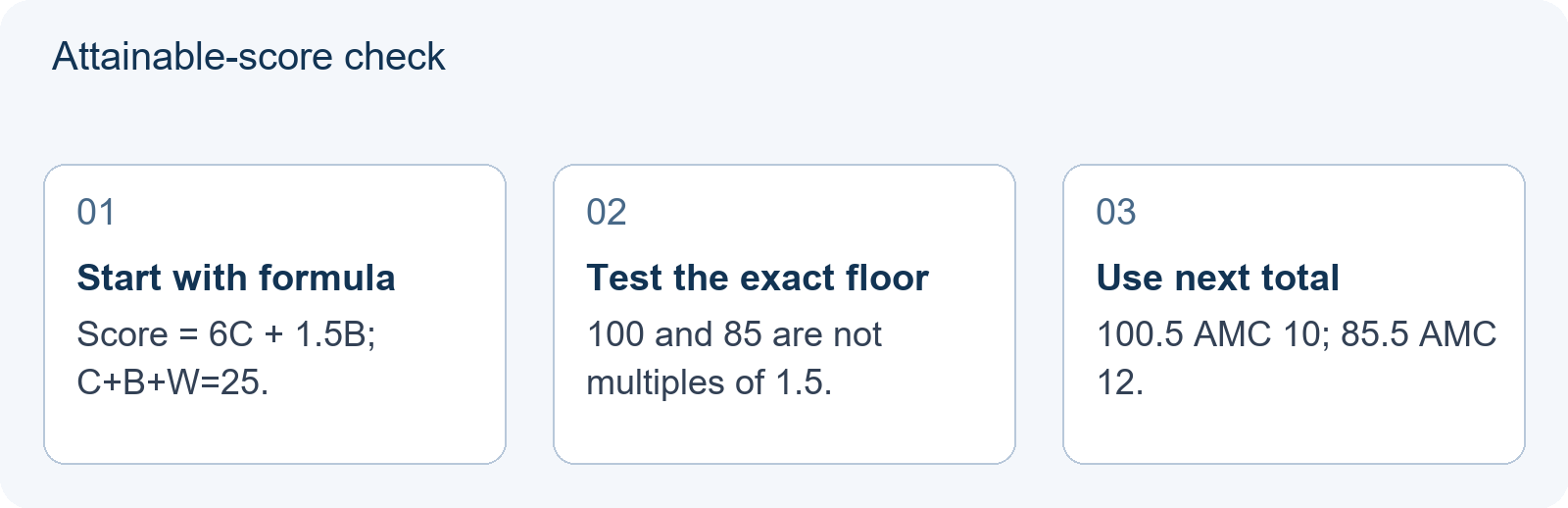
Short answer. The AIME 2027 fixed thresholds are paper-specific floors: AMC 10 at least 100 and AMC 12 at least 85, with other eligibility requirements still applying (Hanlin, ‘2027 AIME Qualification Moves to Fixed Score Lines: Preparation Planning and AIME Trial Class,’ 4 November 2026). The two numbers are not percentile equivalents. Under 6/1.5/0 scoring, exact 100 and exact 85 are not attainable totals; the lowest attainable totals at or above the floors are 100.5 on AMC 10 and 85.5 on AMC 12. That is arithmetic for target setting, not a revision of the rule.
What fixed changes, and what it does not
A fixed threshold changes the planning question. Instead of waiting for a percentage cutoff after a particular paper, a family can ask whether a timed attempt is producing the answer pattern needed to reach a named floor. That is a cleaner practice target because it can be audited. A score of 99 is not ‘almost 100’ in the abstract; it is a particular mix of correct, blank and wrong answers that either clears the floor or does not.
What it does not change: the AMC 10 and AMC 12 remain different papers, the floor does not merge them, and the floor does not replace eligibility. A score condition is one part of the AIME route. Age, paper and route requirements remain separate constraints. A qualifying AMC score does not override them. Nor should the fixed AIME line be read as a new honor-roll band: honor-roll recognition and AIME qualification are separate questions.
The fixed line is a planning anchor, not a promise. It tells a student what score to chase on a named paper. It does not tell a family what percentile that score represents, how a particular test centre will administer the paper, or whether the student will ultimately be invited. The practical consequence is that a target should be written as a paper, a raw score and an answer pattern.
‘Aim for 100’ is not a complete AMC 10 target because exact 100 is not attainable. ‘Aim for 85’ is not a complete AMC 12 target for the same reason. The usable forms are ‘AMC 10 at least 100.5’ and ‘AMC 12 at least 85.5,’ with the caveat that those totals still depend on the other eligibility conditions.
The arithmetic behind 100 and 85
Hanlin’s 5 November 2026 pre-exam note, ‘A Exam Tomorrow, B Exam Still Open: 2026 AMC 10/12 Pre-Exam Checklist and Score Strategy,’ gives the scoring rule: 25 questions in 75 minutes; 6 points for a correct answer, 1.5 for a blank, 0 for a wrong answer; maximum 150. Let C be correct, B blank and W wrong. Then C+B+W=25 and S=6C+1.5B. Multiplying by 2 gives 2S=12C+3B=3(4C+B), so every score is a multiple of 1.5.
| Paper | Fixed floor | Exact floor attainable? | Lowest qualifying total | One qualifying pattern |
|---|---|---|---|---|
| AMC 10 | at least 100 | No | 100.5 | 14 correct, 11 blank, 0 wrong |
| AMC 12 | at least 85 | No | 85.5 | 11 correct, 13 blank, 1 wrong |
The same arithmetic shows the near-miss totals. A score of 99 is attainable on either paper with 14 correct, 10 blank and 1 wrong. A score of 84 is attainable with 11 correct, 12 blank and 2 wrong. So the practical jump at the AMC 10 line is from 99 to 100.5; at the AMC 12 line it is from 84 to 85.5. Those are the nearest attainable scores on each side, not official cutoffs.
That is why a practice score should be converted before it is compared with a fixed line. A total such as 97.5 is attainable, but it is not a near miss to 100 in the same sense as 99. The useful comparison is always the next attainable total at or above the floor. For AMC 10, that is 100.5. For AMC 12, that is 85.5. Anything below those totals is a different target problem.
Why 100 versus 85 is not a 15-point difficulty discount
The raw gap is 15 points, but it is not a 15-point difficulty discount. A student who scores 99 on AMC 10 misses the AMC 10 floor; a student who scores 85.5 on AMC 12 meets the AMC 12 floor. The second raw score is lower, yet the qualification outcome is different because the floors are attached to different papers. Without score-distribution data for each paper, you cannot convert the 15-point gap into a percentile difference or say that 85 on AMC 12 is equivalent to 100 on AMC 10.
The papers also share some problems in a given year, but a shared item does not make the papers interchangeable for target setting. Paper identity, content coverage and pacing demands are not identical, so a lower AMC 12 floor is not a shortcut for a student who has not covered the relevant material. A student choosing AMC 12 only because 85 is lower may be choosing a paper with more content to check. A student choosing AMC 10 because it matches course coverage should still check whether the higher floor leaves enough buffer.
There is also a source-date trap here. A fixed line is not the same as an old cutoff table. The fixed line is a named raw-score threshold; an old table of percentiles describes a previous population on a previous paper. Those are different objects. A family should date every source before using it.
A four-check paper-choice audit
| Check | Question to answer |
|---|---|
| Paper actually timed | Was the attempt a full AMC 10 or AMC 12, with the correct paper label? |
| Answer pattern | How many were correct, blank and wrong? |
| Content losses | Did lost points cluster in topics the student has not studied? |
| Eligibility and route | Does the student meet the paper and AIME route requirements? |
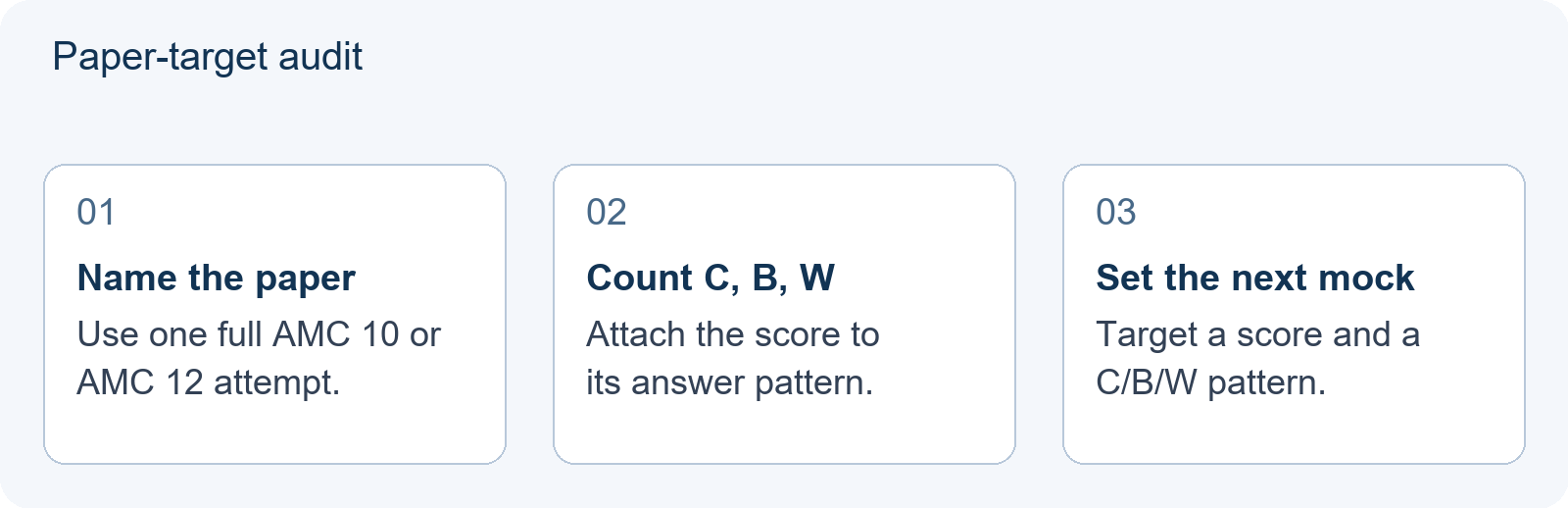
If the answer to the first check is ‘a mix of both papers,’ the evidence is not yet usable. A practice target must belong to one paper. If the answer to the second is only a total, convert it to the C/B/W pattern before comparing it with 100.5 or 85.5. If the answer to the third is ‘mostly material I have not studied,’ the next practice block should be content repair, not more full papers. If the answer to the fourth is uncertain, resolve eligibility before turning a practice score into a plan.
Teaching illustration: different totals, different floors
Teaching illustration, not an actual contest result. Student A takes a timed AMC 10 and records 14 correct, 10 blank and 1 wrong: 99 points. Student B takes a timed AMC 12 and records 11 correct, 13 blank and 1 wrong: 85.5 points. Student A has the higher raw score but misses the AMC 10 floor. Student B has the lower raw score but meets the AMC 12 floor.
This does not show that B is stronger. It shows that a raw score without its paper and floor is not a qualification comparison. If A had left the one wrong answer blank, A would have 14 correct, 11 blank and 0 wrong: 100.5, meeting the AMC 10 floor. That is a 1.5-point change from one answer-sheet decision, not evidence of new topic mastery. Near a fixed floor, blank management can change whether the floor is met.
The same illustration also shows why a family should not compare the two students by raw score alone. A’s 99 and B’s 85.5 are not two points on one scale. They are outcomes attached to different papers and different floors. The only safe comparison is paper-specific: first compare A with the AMC 10 floor, then compare B with the AMC 12 floor, and only then ask what each student’s answer pattern says about the next practice block.
Set a paper-specific target and audit it
Write the target as a score and an answer pattern. For AMC 10, one buffer target is 15 correct, 8 blank and 2 wrong: 102 points. For AMC 12, one buffer target is 12 correct, 12 blank and 1 wrong: 90 points. These are practice constructions, not official targets; the point is that each pattern is attainable and auditable.
Three questions before the next mock:
- Which paper did you actually sit, and was it timed at 75 minutes?
- What was the correct/blank/wrong pattern, not just the total?
- Which missed questions were content gaps and which were pacing or reading errors?
Then repeat the mock on the same paper and compare patterns. A student who moves from 99 to 100.5 by converting one wrong answer to a blank has improved answer-sheet control, but has not necessarily improved the mathematics. A student who moves from 99 to 103.5 by turning one blank into a correct answer has added a solved problem. Both changes matter, but they call for different practice.
A three-pass audit for the next mock
The first pass is paper identity. Confirm that the attempt was a full AMC 10 or AMC 12, not a mixed set, and that the 75-minute limit was enforced. The second pass is arithmetic. Mark every question as correct, blank or wrong, then compute the score from the formula rather than from memory. The third pass is diagnosis. Sort each lost question into content gap, pacing failure, reading or notation error, or answer-sheet decision. That sort is what turns a score into a next action.
Only after those three passes should the student compare the result with a fixed line. If the AMC 10 practice score is 99 with 14 correct, 10 blank and 1 wrong, the arithmetic says the next attainable qualifying total is 100.5. If the AMC 12 practice score is 84 with 11 correct, 12 blank and 2 wrong, the next attainable qualifying total is 85.5. In both cases, the useful question is not ‘how many points away?’ but ‘which answer-sheet or content change is realistic?’
The next stage after the line
The fixed line also changes the transition. If a student is near the floor, waiting for a qualification letter before starting AIME preparation can compress the next stage. But the AIME is not a longer AMC. Under the announced 2027 format, the AIME runs as two 90-minute segments, 8 questions then 7, answered electronically, with no returning to the first segment. The format changes pacing and review; see Eight Questions, Then Seven: How the AIME’s Two-Part Session Changes the Way You Prepare.
The sitting route also matters. The Pearson test-centre process announced for the 2027 AIME should not be applied to China-based candidates, who follow their International Group Leader; see AIME 2027 Moves to Pearson Test Centres: Every Change MAA Has Announced, and What Is Still Unknown for Candidates in China. For next-stage practice, Hanlin’s 4 November 2026 note offers a coaching mapping: AIME Q1-Q5 roughly AMC 12 Q15-Q18, and Q13-Q15 roughly AMC 12 Q24-Q25. Treat it as a teaching difficulty map, not an official scoring rule.
What to bring to a preparation conversation
A useful course-fit or resource request is specific. Bring one timed AMC 10 or AMC 12 attempt; the answer sheet with correct, blank and wrong marks; a list of the question numbers that were blank or wrong; and a note on which topics caused the loss. If you are asking for past-paper practice, ask which years are included and whether worked solutions are included for those years. Do not ask for a qualification promise; no practice score can supply one.
For families deciding whether to sit a second paper, the fixed line changes the decision from ‘wait for a cutoff table’ to ‘compare two paper-specific attempts.’ The adjacent analysis of Both AMC 10/12 Papers or Just One? How the Fixed AIME Line Changes the 2026 Second-Sitting Decision covers that second-sitting question; this article’s narrower point is how to audit the two fixed floors once they are known.
General event background is available at Event background.
This is an independent preparation guide, not affiliated with, endorsed by, or sponsored by the Mathematical Association of America.
Frequently Asked Questions
Is AMC 12 at 85 easier than AMC 10 at 100?
No. They are fixed floors on different papers. The AMC 12 number is lower, but the paper has different content and different paper-level demands. Without score-distribution data, the 15-point gap is not a difficulty discount or an equivalence.
Why can’t I score exactly 100 on AMC 10?
Under 6/1.5/0 scoring, every total is a multiple of 1.5. 100 is not. The lowest qualifying total at or above 100 is 100.5, for example 14 correct, 11 blank, 0 wrong.
My AMC 10 practice score is 99. What should I do?
First check the answer pattern. 99 can be 14 correct, 10 blank, 1 wrong. Changing that wrong answer to a blank raises the score to 100.5 and meets the floor. Then repeat under timed conditions; one score does not guarantee qualification, and other eligibility requirements still apply.