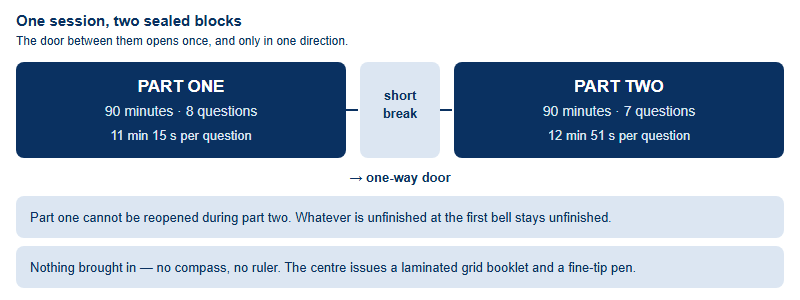
The 2027 AIME is not one long paper; it is two sealed blocks. MAA has confirmed a session of two 90-minute parts — eight questions, then seven — with part one closed once part two begins. That single design decision quietly retires the most common AIME habit there is: parking a hard problem and promising yourself you will come back to it at the end.
This article is about the session architecture rather than the news. If you want the full list of what MAA changed in August 2026 — the move to Pearson Professional Centers, the fixed qualifying thresholds, the retirement of AIME I and II — that belongs elsewhere. Here we take the two-part structure as given and work out what it does to pacing, to checking, and to the way a practice session should be built between now and February. Everything below that is a policy claim comes from MAA’s own AIME FAQs, and several sections of that policy are still marked as not yet posted. The November paper that produces the invitation is itself unchanged — its arrangements are set out in our guide to the 2026 in-person AMC rules and authorised test centres.
The session, in order
| Stage | What MAA has stated | What it removes |
|---|---|---|
| Part one | 90 minutes, eight questions | The option of skimming all fifteen questions before choosing where to start |
| Break | A short break between the parts | Nothing — but it is now a stage you should rehearse rather than ignore |
| Part two | 90 minutes, seven questions | Any return to part one: it cannot be reopened once part two has begun |
| Answering | Questions delivered electronically; answers entered electronically at the centre | Answer-sheet transcription at the end as a separate ritual |
| Materials | Nothing may be brought in; no compass and no ruler. The centre provides a laminated grid booklet and a fine-tip pen | Your own geometry kit, and your own paper habits |
| Leaving the room | Leaving during a part ends your work on that part | The mid-paper walk to clear your head |
| Sittings | A single competition window on 5–6 February 2027; one sitting per qualified student; no alternate date and no make-up | The two-bites comfort of AIME I and AIME II |
The arithmetic of the split
Divide the stated block lengths by the stated question counts and you get the number that should govern your training: 90 minutes over eight questions is 11 minutes 15 seconds each, and 90 minutes over seven is 12 minutes 51 seconds each. Those are averages rather than instructions — MAA does not publish a recommended pace — but they are worth internalising, because they are almost four times the roughly three minutes a question that the AMC 10 and AMC 12 allow across twenty-five questions in seventy-five minutes.
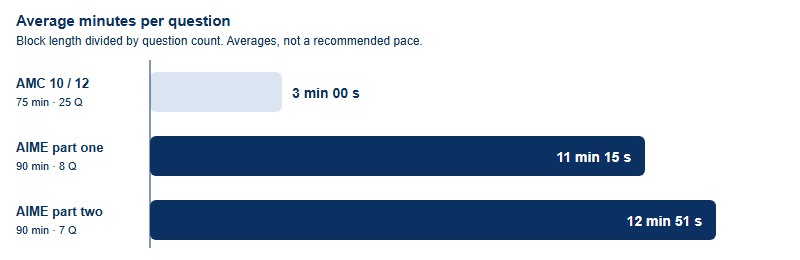
Eleven minutes changes what a sensible first move looks like. On an AMC paper, a problem that has not opened up within ninety seconds is usually a problem to leave. On the AIME, ninety seconds is barely the reading and set-up, and abandoning at that point wastes the very thing the format is giving you. The corresponding risk runs the other way: with eight questions and ninety minutes, two problems that each swallow twenty-five minutes will take the block down with them, and there is no later part of the paper to recover in.
The practical consequence is that you now need two pacing plans rather than one, and a checkpoint inside each. A workable habit is to note the clock at the halfway mark of each block — roughly 45 minutes — and count how many answers you have actually committed. If part one is half gone and you have committed one answer of eight, that is the moment to change what you are working on, not with fifteen minutes left.
Four habits the sealed blocks quietly retire
- “I will come back to it at the end.” There is no end to come back to, only the end of part one. Any question you defer inside part one has to be re-entered inside part one, which means the deferral has to be measured in minutes rather than in hours.
- Triage across the whole paper. You now triage twice, over eight and then over seven, and the second triage happens with no knowledge of what you might have salvaged in the first. Practising triage on a fifteen-question sheet trains a decision you will never get to make.
- Saving all checking until the finish. Verification has to be folded into each block. With an integer answer that you produce yourself and enter electronically, a checked answer and an unchecked answer look identical on the screen — the only difference is whether you spent the minute.
- Treating the break as dead time. The break is the only structural reset in the session, and the only moment where a bad part one can be prevented from contaminating part two. Rehearse it: stand up, stop thinking about the unfinished problem, and decide what your first thirty seconds of part two will look like.
The last of those matters more than it sounds. Every returning competitor knows the feeling of finishing a block one question short and carrying that failure into the next hour. Under the old single-paper design you could at least keep working. Now the door shuts, and the emotional handover between blocks is a skill in itself.
How to rehearse a two-block paper
Practice design is where this change has the largest practical bite, and it costs nothing to implement. From now on, run an old AIME paper as two sittings rather than one:
- Split it 8 / 7. Questions one to eight, ninety minutes, stop. Break. Questions nine to fifteen, ninety minutes.
- Seal the first block physically. Turn the first sheet face down and put it out of reach before the second begins. If you leave it on the desk, you will glance at it, and you will be training a move that does not exist.
- Take the break you will actually take. Time it, stand up, and do not use it to keep solving. A break you have never rehearsed is a break you will waste.
- Work without a compass or ruler. Nothing may be brought in, so a geometry habit that depends on an accurate construction has to be replaced by coordinates, trigonometry or a deliberately rough sketch. Find that out in October, not in February.
- Write on grid paper and commit answers separately. The centre issues a laminated grid booklet and a fine-tip pen, and answers are entered electronically. Approximate that by writing your final answers on a separate sheet you are not allowed to amend once the block ends.
- Log the two blocks separately. A single fifteen-question score hides the thing you most need to know: whether your part-two performance depends on how part one went.
Two or three papers run this way tell you more than a dozen run the old way, because the failure mode you are training against — the unfinished question you cannot return to — only appears when the block genuinely closes.
What China-based candidates must not assume
MAA’s AIME FAQs describe an invitation by email, a Pearson booking site, self-scheduling at one of the 200-plus Pearson Professional Centers in the United States and Canada, a fee of US$85 plus tax where applicable, and financial assistance for those who qualify. That is the route MAA has described. It has not said that candidates sitting outside that network follow it. MAA’s wording for the international programme is that participants should follow the policies of the International Group Leader for their country or region.
So if you sit in China, the correct question is not “where is my nearest Pearson centre” but “what has my region’s Group Leader announced.” Ask the centre that handles your AMC sitting — the same one that manages your November paper under the in-person AMC rules for 2026 — and take your answer from them rather than from a forum. The AMC-side facts are settled: MAA has stated that the AMC 10 and AMC 12 run in 2026 as they did in 2025, with A papers on 5 November and B papers on 13 November on MAA’s own calendar, and your centre’s sitting date published separately. It is the February end of the ladder where the international detail is still open.
What is still unpublished
Three things are worth holding loosely, because MAA marks them as still to come: the full AIME policy, the USAMO and USAJMO qualification detail, and the contest-day rules for the new centres. MAA has said that 2027 Olympiad qualification will be “primarily based on AIME scores” and that “AMC scores will no longer be a factor,” but the mechanics beyond that sentence are not out yet. Anything more specific circulating now is inference, and inference about rules is the fastest way to prepare for an exam that does not exist. Build your training on the four items MAA has actually stated — two blocks, eight then seven, no return, nothing brought in — and check maa.org again before you book anything.
None of this makes the AIME harder or easier. It makes it a different shape: two shorter races instead of one long one, with a wall in the middle. The candidates who handle it best in February will be the ones who have already sat in that shape a few times by then.
Frequently asked questions
How long is each part of the 2027 AIME?
MAA states two parts of 90 minutes each — eight questions in part one, seven in part two, with a short break between them.
Can I go back to part one during part two?
No. MAA states that part one cannot be reopened once part two has begun, so nothing can be deferred across the break.
May I bring a compass or ruler to the AIME?
No. MAA states that nothing may be brought in. The centre provides a laminated grid booklet and a fine-tip pen.
Do candidates in China book a Pearson centre?
MAA has not said so. It directs international participants to the policies of their region’s Group Leader — ask your own centre.
This is an independent English-language guide to the American Mathematics Competitions, operated by Hanlin Education for China-based international-school students. We are not affiliated with, endorsed by, or sponsored by the Mathematical Association of America. Several parts of the 2027 AIME policy are marked by MAA as not yet published — confirm current details on maa.org and with your own authorised test centre or regional Group Leader before acting on anything here. Errors reported to our editorial desk are corrected within 7 working days.