After completing a timed attempt with AMC 10 past papers, many students categorize errors simply as “didn’t know” or “careless.” This binary sorting hides the real issue. “Careless” is not a diagnosis; it is a placeholder for an unidentified cause. When you pick a wrong letter, you didn’t just miss the right answer—you selected a specific incorrect value engineered by test writers to trap common reasoning errors. Recording which wrong option you chose provides the strongest clue about your actual thought process under pressure.
This article sets out one narrow review method: an AMC 10 past papers distractor audit. It is meant for students who already have a timed attempt in hand and want their next practice hour to be sharper than their last. It is not a full mock-review framework; for the general routine of separating a gap from a pacing problem, see the AMC Mock Test Review: Separate a Knowledge Gap From a Pacing Failure. The audit here is the next, smaller layer under that routine.
Why “Careless” Is Not a Diagnosis After a Timed AMC 10 Attempt
The American Mathematics Competitions (AMC) are organised by the Mathematical Association of America (MAA), and every AMC 10 item offers five answer choices. Four are wrong. On the middle and later items in a paper, those four wrong choices are rarely random. They are engineered around plausible mistaken paths. A sign flip produces one, a premature division produces another, a forgotten axis of symmetry produces a third, and a unit mismatch produces the fourth. If you only check the right answer, you get a corrected letter but no information about your reasoning. If you also check the wrong letter you chose, you get a fingerprint of your process.
Take a student who consistently picks answer B on geometry items asking for area. The wording “I was careless” tells them to be more careful, which is advice they cannot act on. But if the audit shows that on four such items their B choice is exactly twice the correct value, then the mistake has a shape. They may be applying an area formula without halving, or reading a radius as a diameter, or summing a surface area with two faces counted twice. Each of those has a different drill. The point of the audit is to convert a fuzzy feeling of carelessness into a named, drillable procedural step.
A second reason to stop with “careless”: the word hides pattern. Students almost never make the same arithmetic slip twice in a row. Students very often make the same structural slip across a whole season. Counting “off by a factor of two” errors five times in ten past papers is a signal, not noise. Sorting them under “careless” washes the signal out. The audit exists to preserve that signal at the moment of the mistake, before memory fades.
The Distractor Audit Sheet: Recording What You Actually Chose
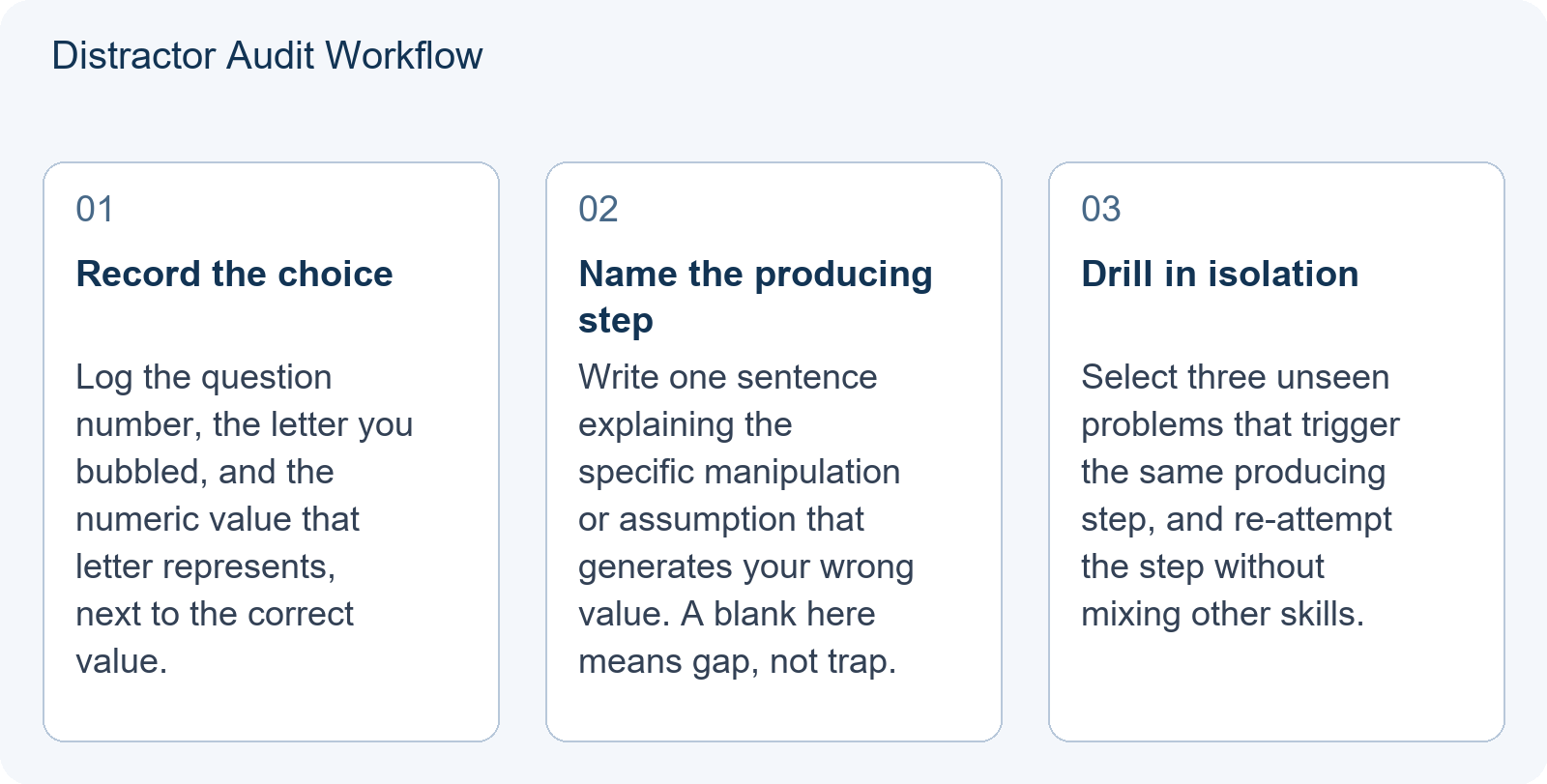
Build a single sheet with the following four fields for each missed or guessed item. Do not skip the last two. They are the ones that carry the diagnostic weight.
- Question number and source paper. Which paper, which position, and what topic the item looked like at a glance (algebra, geometry, counting, number theory). The topic tag matters because distractor families overlap across topics and you need to see whether your traps cluster.
- Your chosen letter and value. The letter you bubbled plus the numeric or symbolic value that letter corresponds to, written on its own line. This is the raw data point you will cluster on later.
- The correct value. Written on its own line, adjacent to your choice, so you can see the relationship between the two.
- The producing step. One sentence beginning with “I got my value because I…” and ending with the specific manipulation, assumption, or shortcut that generates that wrong value from the problem’s data. If you cannot write this sentence, you have found a knowledge gap, not a distractor trap; see the later section.
Here is what a completed row should look like in writing. Suppose the problem asks for the sum of the roots of x² + 5x + 6 = 0. Correct sum: −5. Your answer: 5. Producing step: “I factored as (x + 2)(x + 3) = 0 but read the roots as +2 and +3, then summed them to 5.” That sentence carries the entire correction; it tells you the diagnosis (sign propagation when reading roots from factors) and the drill (re-reading roots from factored form with sign tracking). It also tells you something you would never see from the answer key alone: the answer-key correction is “−5,” not “stop being careless.”
You do not need to audit every item. Audit the middle band, roughly questions 8 through 20, where most students’ scores live and where distractors are most deliberately engineered. Questions 1 through 5 usually have obvious distractors; questions 21 through 25 often fail for structural reasons that are easier to diagnose from a solution read than from an audit. For those hard problems, the audit becomes useful only after you can at least sketch a plausible path.
Trap Family 1: Sign and Order Errors That Create Adjacent Choices
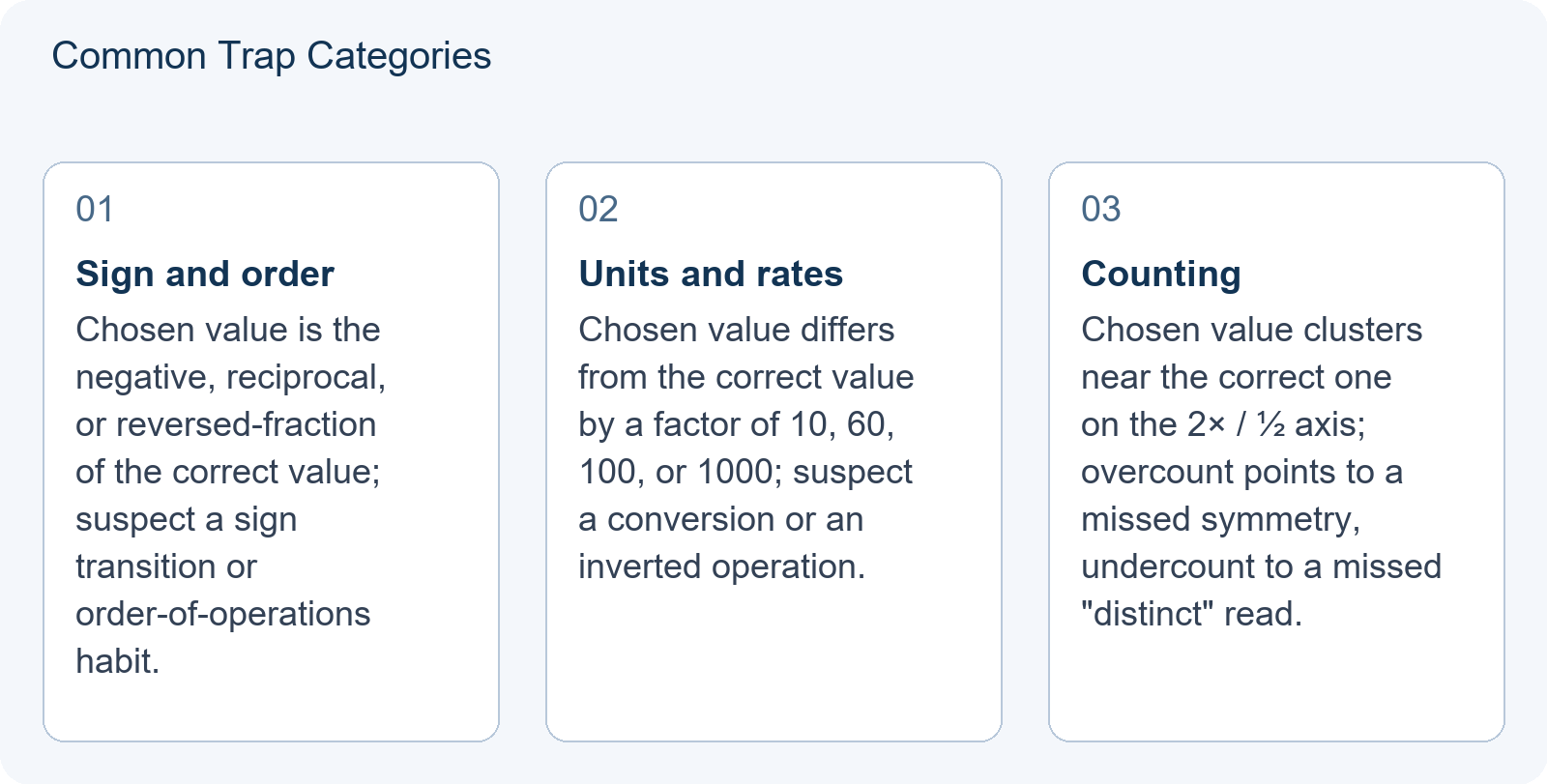
Sign and order errors reliably produce adjacent answer choices on AMC 10 papers. Adjacent here means not just adjacent letter (A next to B) but adjacent in value: 5 sits next to −5, 12 sits next to −12 or 21. Because the test writers know these are the most common slips, they plan for them. Two consequences follow for your audit.
First, if your chosen value is the negative of the correct value, your error is almost certainly at a sign transition, not in the arithmetic itself. The step to name is usually one of: distributing a negative through a bracket, moving a term across an equality, reading “a − b” as “b − a“, or forgetting a second root when taking a square root. Any of these yields the correct magnitude with the wrong sign. Fixing the sign habit is faster than “being more careful,” because you can add a single review checkpoint (say, re-expanding one distribution step) without slowing the whole paper.
Second, if your chosen value is the reciprocal or the reversed fraction of the correct value, your error is order-of-operations. For instance, dividing 6 by 12 instead of 12 by 6 gives ½ where 2 was needed. Distractors of this kind typically appear as a fraction and its reciprocal in the same problem. If the audit shows you catching the reciprocal slip more than twice in a season, do not just do more problems; do a short session where you write the division as a fraction first, then cancel only after checking which quantity is on top. This is a manufacturing habit, not a knowledge repair.
Trap Family 2: Unit and Rate Errors That Create Factor-Based Distractors
The following paragraph is a teaching illustration, not an actual contest problem, and every number is checkable.
Suppose a problem states that a vehicle travels at 60 miles per hour, and asks how many minutes it takes to travel 10 miles. The correct answer is 10 minutes, because time = distance ÷ rate = 10 ÷ 60 hours = 1/6 hour = 10 minutes. A student who correctly computes 10 ÷ 60 but then forgets to convert hours into minutes writes 1/6 as the answer. A student who inverts the operation and multiplies 10 × 60 instead of dividing writes 600 as the answer. A student who converts 60 mph into 1 mile per minute but then divides the wrong way writes 1/10 or 0.1 as the answer. The four values — 10, 1/6, 600, and 0.1 — are all on the same axis: each is derived from 60 or 1/60 applied to 10. This is exactly the shape of distractor engineering on unit problems.
When your audit turns up a run of answers that differ from the correct value by a factor of 60, 100, 1000, or one of their reciprocals, the diagnosis is nearly always a unit-handling slip, not a rate-comprehension gap. The remedy is procedural: on any problem involving time, distance, or rates, write the units next to each quantity at the top of your scratch work. Do not cancel units mentally. If you find that you are choosing the 1/60 version instead of the 60× version, the slip is on the conversion; if you are choosing 60× instead of 1/60, the slip is on the operation. These two produce different follow-up drills. A single “be careful with units” instruction would not distinguish them.
The same family covers seconds-vs-minutes, centimetres-vs-metres, and percent-vs-decimal conversions. In each case, the wrong answers are not random; they are the correct computation mis-scaled by the standard conversion factor for that pair. If your audit page shows one column of factor-10 slips and another of factor-60 slips, that is telling you which conversions to add to a five-minute warm-up before the next timed paper.
Trap Family 3: Counting Errors from Overcounting or Undercounting
Combinatorics on the AMC 10 is the trap family with the tightest numerical clustering. This is also the family with a dedicated audit method already published on the site; see the AMC 10/12 Counting and Probability: The Six Question Families and the Overcounting Audit. That article lays out the overcounting framework in detail. Within this distractor audit, the goal is narrower: to use your chosen wrong number to confirm which side of the symmetry you landed on.
Teaching illustration. Three distinct books are arranged on a straight shelf. The number of orders is 3! = 6. Now imagine the same three books are placed around a round table, and arrangements that differ only by rotation are considered the same. The number of distinct arrangements is (3 − 1)! = 2. A student who forgets to divide by rotation writes 6. A student who divides by the wrong symmetry — say by 2 instead of 3 — writes 3. A student who also treats the books as identical writes 1. The wrong numbers 6, 3, and 1 cluster around the correct 2.
In a typical AMC 10 combinatorics problem, the correct answer might be 12. Your audit then records whether your wrong value was 24 (an overcount by a factor of 2, usually a symmetry you did not divide out), 6 (an undercount, usually a repeated-element case treated as distinct, or a constraint you over-applied), or 48 (a double overcount, meaning two missed symmetries compounded). These three distinct diagnoses all produce plausibly printed distractors, and each calls for a different drill. Overcounters should rehearse the classic symmetry divisions — circular arrangements, reflection flips, indistinguishable duplicates. Undercounters should rehearse the “treat as distinct, then divide” discipline and check whether a constraint said “distinct” or “any.” Because both mistakes produce numbers that sit next to each other on the page, the only way to tell them apart is to log which one you actually wrote.
Turning the Audit Into a Targeted Three-Problem Set
When you finish auditing a paper, do not immediately launch another full mock. Instead, sort the audit rows by producing step and find the top three producing steps that appear more than once. Then build a three-problem set, one problem per step. The problems should come from past AMC 10 or AMC 12 papers you have not yet attempted, pulled by topic tag rather than by year. The purpose of the three-problem set is isolation: each problem should exercise the specific producing step without mixing in three other unfamiliar skills. If your producing step is “forgot to halve base-times-height,” you want three triangle-area problems on a single page, not a mixed review.
Roughly 45 minutes is enough for a three-problem set with two or three minutes of review per problem. If you can complete the set without reproducing the producing step, you have earned the right to move on. If you reproduce the step even once, repeat the drill with three fresh problems. This is a tighter feedback loop than a full past paper, because a 25-problem paper takes 75 minutes and reports one bit of information (score) at the end. A three-problem drill takes 15 minutes of work plus review and reports three bits — one per problem — during the session.
The audit also tells you when to stop drilling. If the same producing step appears in three consecutive audits, stop treating it as a procedure problem and treat it as a knowledge gap. Sign propagation, for instance, is easiest to fix by re-teaching the algebra, not by repetition. That transition — from trap to gap — is the subject of the next section.
Distinguishing a Knowledge Gap From a Distractor Trap
A distractor trap and a knowledge gap look the same on the answer sheet, because both produce a wrong letter. They look different on the audit sheet. A trap yields a clean producing step: you can write down how your wrong value arose from the problem’s given data. A gap yields a blank. If, at the producing-step field, your honest sentence would be “I do not know how I got this” or “I picked 12 because it looked plausible,” then the item is not a distractor trap; the item is a topic you have not yet learned.
The corrective action is different. Traps are repaired with targeted drills, because the machinery exists and only the habit is missing. Gaps are repaired with instruction, because drilling a topic you have never seen can rehearse the wrong method and make it harder to unlearn later. This distinction is the same logic that drives the review discipline in the AMC 10/12 Confidence Calibration: Why a Correct Guess Still Needs Review: the correct response depends on the type of failure, not on the size of the failure.
Two rules of thumb for classification. First, if your chosen option is at least two answer choices away in value from the correct answer, suspect a gap before a trap. Distractor engineering tends to keep traps close to the correct value, precisely so that a student who almost got it leans toward them. Second, if you cannot explain in one sentence why the correct value is correct — not just the method, but the specific numbers — suspect a gap. If you can explain the correct value but not how you got your own wrong value, suspect a trap.
Preparing the Next Full Timed Attempt
Only after you have cleared your top three producing steps in isolation should you sit another full timed past paper. Before starting, write your three producing steps on a sticky note and place it next to your scratch paper. That note is not a cheat sheet; it is a checklist of the specific errors you are most likely to repeat. During the paper, do not consult it; the point of putting it in view is that the habit of checking for the specific step becomes automatic after a few sessions, and the sight of the note reminds you without interrupting flow.
After the attempt, audit again. Look first for the three producing steps you were tracking. If they did not recur, you have evidence the drill worked — better evidence than a raw score improvement, because scores move for reasons other than your intended fix. If one of the three did recur, that producing step now has priority for the next cycle. Two recurrences in a row on the same step is the point at which you should consider switching from drill to instruction, because repetition alone is not doing the job.
The overall loop is short: attempt, audit, isolate, re-attempt. Each cycle takes roughly two weeks if you run it on a single past paper at a time. Over a full preparation season, that is between eight and twelve cycles, which is enough to convert a scattershot list of “careless” errors into a small set of named habits you can actually watch for. Precision is a habit before it is a talent. The distractor audit is simply the habit of noticing, at the moment you miss, exactly which wrong value you chose — and why that value existed in the first place.
Frequently Asked Questions
What is a distractor on an AMC 10 paper?
A distractor is a wrong answer choice that has been designed around a common reasoning error — a sign slip, a missed unit conversion, a forgotten symmetry, or an inverted operation. On middle and late AMC 10 items, distractors are usually only one step away from the correct value.
How does a distractor audit improve my score?
It converts a vague label like “careless” into a named producing step, so you can drill that specific step in three isolated problems instead of rereading the same kind of paper until it happens to come out right.
Should I redo the whole paper after an audit?
No. First run a three-problem drill targeting your top producing step; only after the drill is stable should you sit another full timed past paper, and then audit that paper with the same three producing steps on a sticky note beside your scratch work.