Should Students Prepare for AMC 10 Right After AMC 8?

The American Mathematics Competitions (AMC) system consists of multiple levels, including AMC 8, AMC 10, AMC 12, and AIME. Therefore, completing the AMC 8 does not mark the end of a student’s mathematics competition journey. In recent years, an increasing number of parents and students have begun paying close attention to AMC 10 preparation planning.

In this article, we provide a comprehensive overview of the AMC 10 mathematics competition, including its exam schedule, difficulty level, academic value, preparation strategies, and training pathways, to help students and families make informed decisions.

Part 01: Transitioning from AMC 8 to AMC 10

The AMC competition system is structured in progressive tiers, moving from foundational to advanced levels: AMC 8 → AMC 10 / AMC 12 → AIME → USA(J)MO → IMO. The difficulty increases at each stage, with the general hierarchy as follows:

AIME > AMC 12 > AMC 10 > AMC 8

Eligibility Requirements for Each Level

  • AMC 8: Open to students in Grade 8 and below, who are under 14.5 years old on the test day. Typically recommended for students in Grades 6–8.

  • AMC 10: Open to students in Grade 10 and below, who are under 17.5 years old on the test day. Commonly recommended for students in Grades 8–10.

  • AMC 12: Open to students in Grade 12 and below, who are under 19.5 years old on the test day. Generally suitable for students in Grade 10 and above.

The Trend Toward Younger AMC 8 Participants

In recent years, the AMC 8 has shown a clear trend toward younger participation, with many students in Grades 3 and 4 beginning to engage with the competition. This phenomenon can be attributed to two main factors:

  1. In contexts where domestic competitions are increasingly restricted, AMC 8 results have become a valuable academic credential during the middle school admissions process.

  2. Elementary school years are a critical period for developing mathematical thinking. Exposure to high-level competitions can significantly enhance logical reasoning and mathematical intuition.

While students are not required to start their AMC journey with AMC 8, building a solid foundation through AMC 8 preparation can boost confidence and strengthen core mathematical skills. As a result, AMC 8 remains an ideal starting point for many students.
推荐

Part 02: Key Differences Between AMC 8 and AMC 10

AMC 8 and AMC 10 are two distinct levels within the AMC competition system. They differ significantly in terms of target participants, exam duration, scoring rules, difficulty, and content coverage.

1. Target Participants

  • AMC 8: Students in Grade 8 and below, under 14.5 years old on the test date

  • AMC 10: Students in Grade 10 and below, under 17.5 years old on the test date

2. Exam Duration

  • AMC 8: 40 minutes

  • AMC 10: 75 minutes

3. Scoring System

  • AMC 8: Maximum score of 25 points; 1 point per correct answer; no penalty for incorrect answers

  • AMC 10: Maximum score of 150 points; 6 points for each correct answer; 1.5 points for each unanswered question; 0 points for incorrect answers

4. Difficulty Level

  • AMC 8: Focuses on computational accuracy and foundational reasoning. With systematic practice and attention to detail, students of varying backgrounds have opportunities to achieve strong results.

  • AMC 10: Represents a qualitative leap in difficulty. Beyond computation, it emphasizes deeper mathematical thinking and abstract reasoning. As algebraic concepts become more advanced, students must demonstrate stronger conceptual understanding to earn top scores.

5. Content Coverage

  • AMC 8: Covers all elementary mathematics, selected middle school topics, and introductory competition concepts. It is often regarded as the highest-level competition for upper elementary and early middle school students.

  • AMC 10: Covers a broader range of topics aligned with Grades 9–10 mathematics curricula, including elementary algebra, plane geometry, introductory number theory, and probability. Topics such as trigonometry, advanced algebra, and advanced geometry are not included.

Comparison of AMC 8 and AMC 10 Topics

AMC 8 Topics

  • Basic Algebra: Integers, rational and irrational numbers, real numbers, number lines, coordinate planes; linear equations with multiple variables; simple quadratic equations and inequalities; basic sequences; fundamental algebraic techniques

  • Basic Geometry: Elementary constructions; Euclidean plane geometry involving points, lines, triangles, quadrilaterals, and circles; perimeter and area of regular figures; introductory solid geometry

  • Basic Number Theory: Parity analysis, divisibility properties, least common multiple and greatest common divisor, basic modular arithmetic

  • Basic Combinatorics: Venn diagrams; introductory permutations, combinations, and probability; factorials, binomial coefficients, and Pascal’s Triangle

AMC 10 Topics

  • Advanced Algebra: Polynomials, Remainder Theorem, Vieta’s formulas, relationships between roots and coefficients, special higher-degree equations; advanced inequalities and mean inequalities; introductory functions, domains and ranges, quadratic, exponential, and logarithmic functions; sequences and advanced algebraic techniques

  • Advanced Geometry: Advanced constructions; triangle geometry including the Law of Sines and Cosines, incircles and circumcircles, Stewart’s Theorem, concurrency and collinearity; circles and quadrilaterals, cyclic quadrilaterals; regular polygons; analytic geometry; solid geometry with three-dimensional coordinate systems; Platonic solids and Euler’s formula

  • Advanced Number Theory: Integers, fractions, decimals, base conversions; modular arithmetic and complex congruence problems; basic Diophantine equations and advanced number theory strategies

  • Advanced Combinatorics: Inclusion–exclusion principle; binomial theorem and related results; advanced permutations, combinations, and probability; recursion, binary methods, and higher-level counting techniques

Part 03: How to Transition from AMC 8 to AMC 10

For students whose AMC 8 results did not meet expectations but who possess solid mathematical foundations, it is advisable to begin learning AMC 10 topics early—such as quadratic functions, advanced geometry, and number theory—during extracurricular study time.

If time permits and short-term results are not a priority, students may first consolidate the AMC 8 knowledge system before transitioning gradually to AMC 10 content.

AMC 10 places greater emphasis on deep mathematical reasoning and complex problem-solving, requiring stronger logical inference and creative thinking skills. Regular practice with logic-based problems and proof-oriented questions can help students develop habits of structured and in-depth thinking.

Past exam papers are an essential resource during preparation. The AMC 10 consists of two versions (A and B) each year, and students are strongly encouraged to practice both in order to fully understand the range of question types and difficulty levels.
Reduce 80% of Ineffective Practice: Master the AMC 10 Exam Content and Prepare Efficiently for Top University Applications

Students who have just completed the AMC 8 may already be turning their attention to the AMC 10. To achieve strong results in the AMC 10, the first and most important step is gaining a clear understanding of the exam content. In this article, we take a comprehensive look at the AMC 10 Mathematics Competition, helping students plan their preparation more efficiently and effectively.

1. Overview of the AMC 10 Competition

The AMC 10 is designed for students in Grade 10 and below. The exam consists of 25 multiple-choice questions, with a scoring system of +6 points for a correct answer, −6 points for an incorrect answer, and 0 points for unanswered questions. The maximum score is 150 points, and the total exam duration is 75 minutes.

The questions are generally divided into three difficulty levels:

  • Questions 1–10: Focus on fundamental concepts and core knowledge, emphasizing conceptual understanding.

  • Questions 11–20: Test integrated problem-solving and logical reasoning, requiring flexible use of multiple methods.

  • Questions 21–25: High-difficulty problems that differentiate top performers and often require creative or non-standard solutions.

Although the AMC 10 is intended for students up to Grade 10, many students in Grades 8–9 achieve outstanding results. This demonstrates that strategic preparation is often more important than grade level.

推荐

2. AMC 10 Exam Content

Approximately 90% of the AMC 10 syllabus overlaps with the content of China’s middle school mathematics curriculum. However, for students in Grade 10 and below, the AMC 10 extends slightly beyond standard coursework and includes a limited amount of Grade 10–11 material. Therefore, students aiming for strong performance are advised to consolidate school mathematics first and then engage in moderate advanced preparation.

Knowledge Areas and Topics

Basic Number Theory:
Prime numbers, prime factorization, divisor-counting formulas, greatest common divisor (GCD), least common multiple (LCM), Euclidean algorithm

Congruences and Divisibility:
Congruences, divisibility rules, Diophantine equations

Advanced Theorems and Number Bases:
Euler’s theorem, Fermat’s Little Theorem, Wilson’s theorem, Chinese Remainder Theorem, digit sums, number bases, repeating decimals

Basic Geometry:
Triangles, area, perimeter

Advanced Geometry:
Similar triangles, point-line relationships within triangles

Circles:
Fundamental circle properties and advanced theorems

Solid Geometry:
Lines, planes, angles, coordinate-based solid geometry, polyhedra

Coordinate Geometry:
Lines and circles

Geometric Transformations:
Translations, reflections, rotations

Addition and Multiplication Principles:
Fundamental counting principles

Permutations and Combinations:
Permutations, circular permutations, combinations, grouping, Vandermonde’s identity, inclusion–exclusion principle

Probability:
Classical probability, geometric probability, Markov chains, recursion

Sequences:
Arithmetic sequences, geometric sequences, and other sequence types

Polynomials:
Fundamental Theorem of Algebra, generalized Vieta’s formulas, rational root test, synthetic division, long division, Descartes’ Rule of Signs, remainder theorem, factor theorem

Functions and Graphs:
Common functions and their graphs, Gaussian function, ceiling function

Inequalities:
Linear inequalities, higher-degree polynomial inequalities, quadratic inequalities, Cauchy–Schwarz inequality, mean inequalities

3. Detailed Topic Analysis by Module

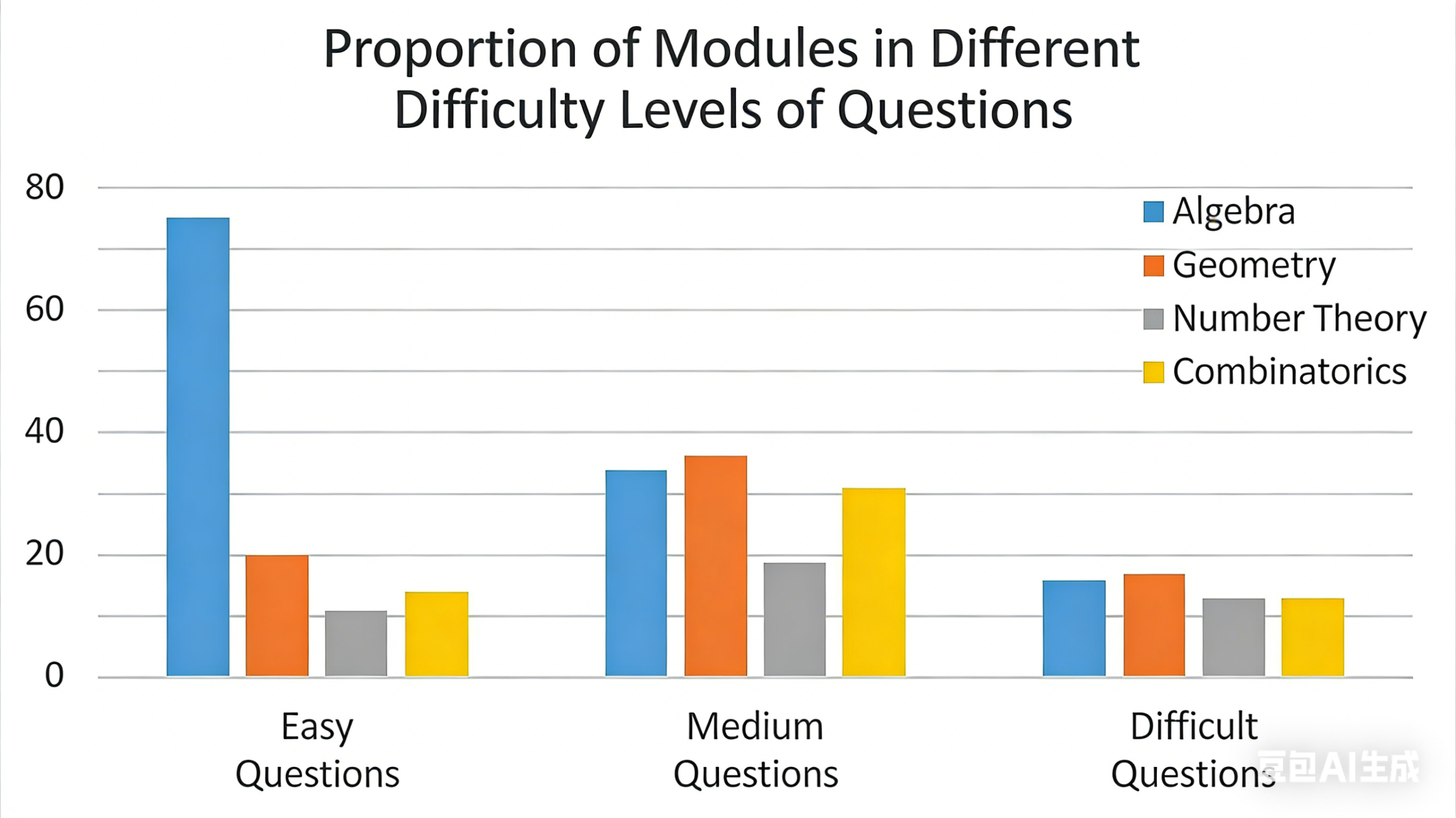
(1) Algebra (Approximately 35–40%)

Algebra is the core component of the AMC 10. It tests not only computational skills but also the ability to understand and construct algebraic relationships.

Key Topics:

  • Polynomial operations and factorization (especially higher-degree polynomials)

  • Systems of equations, including nonlinear systems

  • Function properties and graph analysis (quadratic, exponential, logarithmic functions)

  • Sequences and series (arithmetic and geometric)

  • Solving and proving inequalities (AM-GM, Cauchy–Schwarz, etc.)

Preparation Advice:
Avoid rote memorization of formulas. Focus on understanding underlying principles and applying them flexibly in real problems. Learn to translate word problems into algebraic models.

(2) Geometry (Approximately 30–35%)

Key Topics:

  • Triangle properties (similarity, congruence, special points, triangle inequality)

  • Circle theorems (inscribed angles, tangents, power of a point)

  • Polygons and area computation (dissection and rearrangement methods)

  • Introductory solid geometry (volume, surface area, spatial relationships)

  • Applications of trigonometric ratios and functions

Preparation Advice:
Combine visual reasoning with analytical thinking. Draw accurate diagrams and use visualization to support abstract reasoning.

(3) Number Theory and Combinatorics (25–30%)

These topics often determine score separation and are among the most challenging parts of the exam.

Key Topics:

  • Divisibility, primes and composites, modular arithmetic

  • Counting techniques (permutations, combinations, inclusion–exclusion, recursion)

  • Probability models and calculations

  • Logical reasoning and strategy-based problems

Preparation Advice:
There is no single fixed approach for these topics. Begin with a solid understanding of fundamental concepts and build intuition through extensive practice. Many problems admit elegant solutions—avoid unnecessary complexity.

4. Which Grades Are Suitable for the AMC 10?

In China, AMC 10 participants typically range from Grades 7 to 10. Many international schools treat AMC 10 results as an informal benchmark for admissions and may even include AMC-style questions in entrance exams. As a result, many students aim to complete the AMC 10 by Grades 7–9.

Students who begin preparation in Grade 7 can bridge into AMC 10 content through pre-AMC 10 coursework, with the goal of achieving a high score and qualifying for the AIME within one year. By Grade 8, these students often possess knowledge equivalent to middle school graduation and parts of high school mathematics, allowing for a smoother and more confident academic progression.

From AMC 8 to AMC 10: A Complete 2026 AMC 10 Preparation Plan

A Step-by-Step Roadmap from Fundamentals to the Top 1%

The 2026 AMC 8 Mathematics Competition has concluded. For many students, the next natural goal is the AMC 10. After AMC 8, parents and students often ask the same questions:

  • Which grade levels are eligible for AMC 10?

  • What topics are tested in AMC 10?

  • How difficult is AMC 10 compared to AMC 8?

  • How should students at different grade levels plan their preparation?

Today, AMC 10 has become a must-participate mathematics competition for students in international schools worldwide.

Introduction to the AMC Mathematics Competitions

The American Mathematics Competition (AMC) is organized by the Mathematical Association of America (MAA). Established in 1950, the AMC series now attracts over 300,000 students from more than 6,000 schools globally each year.

The AMC program consists of a progression of contests: AMC 8, AMC 10, AMC 12, and AIME, designed to identify top-performing students who may advance to the USA Mathematical Olympiad (USAMO). From there, elite students are selected to attend the Mathematical Olympiad Summer Program (MOSP), where six team members are ultimately chosen to represent the United States at the International Mathematical Olympiad (IMO).

This system is comparable to China’s National High School Mathematics League in terms of structure and academic prestige.

  • High scorers in AMC 12 + AIME are invited to USAMO

  • High scorers in AMC 10 + AIME are invited to USAJMO

The AIME is significantly more challenging than AMC 10 or AMC 12, and only students with outstanding AMC scores can qualify.

推荐

AMC 10 Competition Overview

Target Participants

  • Students in Grade 10 or below

  • Must be no older than 17.5 years old on the exam date

Exam Schedule

  • Held annually in November

  • Two versions: AMC 10A and AMC 10B

Format

  • Online examination

  • Bilingual (English & Chinese)

Duration

  • 75 minutes

Question Type

  • 25 multiple-choice questions (5 options)

Scoring Rules

  • Correct answer: 6 points

  • Unanswered: 1.5 points

  • Incorrect answer: 0 points

  • Calculators are not permitted

AMC 10 Awards & Score Benchmarks

  • Honor Roll of Distinction: Top 1% worldwide

  • Certificate of Distinction: Top 5% worldwide

  • Certificate of Achievement: Students in Grade 8 or below scoring 90+

  • AIME Qualification Certificate: Awarded to students who meet the AIME cutoff score

Why Is AMC 10 So Valuable?

As standardized test scores become increasingly similar among applicants, high-level academic competitions play a critical role in differentiating students.

AMC results are widely recognized by top universities in the United States, United Kingdom, Canada, and beyond. Institutions such as Harvard, MIT, and Carnegie Mellon University explicitly allow applicants to submit AMC and AIME scores on their application portals, highlighting the competition’s academic credibility.

Chinese students, who traditionally excel in mathematics, are especially well-positioned to leverage AMC competitions as a direct pathway to elite universities.

Additionally, AMC competitions help schools identify students with genuine mathematical reasoning ability—not just those skilled in memorization or formula application. The carefully structured difficulty range allows students of different levels to be distributed naturally across score bands, providing admissions committees with meaningful data.

AMC content also overlaps significantly with IB, A-Level, and other international curricula, making it academically efficient for students.

AMC 10 Registration Channels

Students from international schools, international divisions of public schools, or U.S. middle and high schools usually register through their schools or authorized testing partners.

Common Registration Platforms

  • ASDAN (China)

  • AMC China Official Platform (math-table.com)

While exam content and timing are identical across platforms, result release dates and cutoff announcements may vary slightly.

AMC 10 Content Coverage

AMC 10 generally covers material from Grade 9 to early Grade 10, including:

  • Elementary Algebra

  • Plane Geometry

  • Number Theory

  • Probability

Topics not included: trigonometry, advanced algebra, advanced geometry, or calculus.

Topic Weight Distribution

  • Algebra & Geometry: Over 60% of the exam

  • Algebra: 8–10 questions (core focus)

  • Geometry: 6–8 questions

  • Number Theory: 4–6 questions

  • Probability & Combinatorics: 3–5 questions

For students following international curricula, number theory and geometry often feel less familiar and require targeted preparation.

How to Prepare Effectively for AMC 10

Given the strong mathematical foundation of most Chinese students, it is possible to solve some AMC problems without preparation. However, AMC success is not about passing—it is about scoring high.

To achieve top results, students must develop:

  • Deep conceptual understanding

  • Advanced problem-solving techniques

  • Efficient time management strategies

1. Practice with Past Papers Strategically

Completing at least 5 years of official AMC 10 past papers is highly recommended. Based on historical performance data:

  • Questions 1–15: ≥90% accuracy

  • Questions 16–20: ≥60% accuracy

  • Questions 21–25: ≥40% accuracy

2. Build a Structured Study Plan

Set weekly goals for problem-solving volume and topic focus. Always practice without calculators or external tools to simulate real exam conditions and build speed and accuracy.

3. Identify Weaknesses and Final-Stage Optimization

In the final month before the exam, time is limited. Focus on reviewing mistake logs, reinforcing weak topics, and consolidating proven strategies. Targeted revision during this phase often leads to rapid score improvement and more reliable award outcomes.

How Different Are AMC 8 and AMC 10?

The AMC 8 and AMC 10 are globally recognized mathematics competitions organized by the Mathematical Association of America (MAA). Their scores are widely accepted by international schools and universities, making them an important academic credential for students applying to overseas institutions. Beyond admissions value, AMC competitions are also an effective way to develop mathematical thinking, problem-solving ability, and logical reasoning.

So, how different are AMC 8 and AMC 10 in terms of difficulty, content, and target participants? And how should students in different grade levels choose the most suitable AMC competition?

Overview of the U.S. Mathematics Competition System

  • IMO (International Mathematical Olympiad)
    The highest-level international mathematics competition. Students represent their national teams and compete with top math talents worldwide.

  • USAMO (USA Mathematical Olympiad)
    Comparable to China’s CMO. Participation is limited to U.S. citizens and permanent residents. It serves as the selection process for the U.S. IMO team.

  • AIME (American Invitational Mathematics Examination)
    Comparable to a provincial-level team competition. Held in February, with a maximum score of 15 points.

    • Scores of 7–10 are considered strong for applications to U.S. Top 30 universities

    • Scores of 10 or above qualify students for USAMO

  • AMC 10 / AMC 12
    Held every November, comparable to middle and high school math league competitions.

    • Top 2.5% of AMC 10 and top 5% of AMC 12 advance to AIME and receive the Honor Roll (HR) distinction.

  • AMC 8
    Held every January. It is a non-selective, introductory competition focused on building interest and confidence in mathematics, similar to elementary-level math contests in China.

推荐

1. AMC 8 Mathematics Competition

AMC 8 is a beginner-level mathematics competition designed to introduce students to competitive math and cultivate interest and confidence.

Eligibility

  • Designed for students in Grade 8 and below

  • Typically taken by students in Grades 4–6 in China

  • Maximum age: 14.5 years

  • No restrictions on nationality or school enrollment

Competition Format

  • Duration: 40 minutes

  • Questions: 25 multiple-choice problems

  • Scoring:

    • Correct answer: 1 point

    • Incorrect or unanswered: 0 points

    • No penalty for wrong answers

    • Maximum score: 25

  • Language: Bilingual (English & Chinese)

Content Coverage

AMC 8 focuses on core elementary and middle school math concepts. While closely aligned with school curricula, it emphasizes flexible thinking and problem-solving strategies.

  • Basic Algebra: integers, fractions, decimals, percentages, ratios, simple equations

  • Geometry: area and perimeter of plane figures, surface area and volume of solids, transformations

  • Number Theory: factors and multiples, primes and composites, parity, divisibility rules

  • Counting & Probability: basic counting principles, permutations, simple probability

Awards

  • Distinguished Honor Roll (DHR): Top 1% worldwide

  • Honor Roll (HR): Top 5% worldwide

2. AMC 10 Mathematics Competition

AMC 10 is an intermediate to advanced competition and serves as a key stepping stone to higher-level contests such as AIME and USAMO.

Eligibility

  • Open to students in Grade 10 and below

  • Maximum age: 17.5 years

  • No nationality or school restrictions

Competition Format

  • Duration: 75 minutes

  • Questions: 25 multiple-choice problems

  • Scoring:

    • Correct answer: 6 points

    • Incorrect answer: 0 points

    • Unanswered question: 1.5 points

    • Maximum score: 150

  • Language: Bilingual (English & Chinese)

Content Coverage

AMC 10 covers mathematics from middle school through early high school. The difficulty is significantly higher than AMC 8 and focuses on advanced reasoning and integrated problem-solving skills.

  • Algebra: linear and quadratic functions, inequalities, polynomials, sequences

  • Geometry: similar triangles, circle properties, trigonometry, coordinate geometry

  • Number Theory: modular arithmetic, Fermat’s Little Theorem, Euler’s theorem, base conversion

  • Combinatorics: advanced counting, recursion, inclusion–exclusion principle, probability extensions

Note: Calculus and university-level mathematics are not included.

Awards

  • Distinguished Honor Roll (DHR): Top 1% worldwide

  • Honor Roll (HR): Top 5% worldwide

  • AIME Qualification: Top 2.5% globally (typically scores around 120+)

3. How Should Students Choose Between AMC 8, AMC 10, and AMC 12?

Grades 4–6

  • Focus exclusively on AMC 8

  • Build a strong foundation in competition math and aim for Honor Roll or Distinguished Honor Roll

Grades 7–8

  • Option 1: Prepare for both AMC 8 and AMC 10

    • Target AMC 10 Honor Roll as the primary goal

    • Aim for Top 1% in AMC 8 if possible

  • Option 2: Focus on AMC 8

    • Recommended for students with weaker foundations

    • Take advantage of lower-age award opportunities and transition gradually to AMC 10

  • Option 3: Directly prepare for AMC 10

    • Suitable for students with strong math skills or previous high AMC 8 scores

Grades 9–10

  • AMC 10 is the primary choice

    • Students at this level are no longer eligible for AMC 8

  • Consider AMC 12

    • Recommended for students with solid math foundations seeking greater challenges and higher-level recognition

What Is the AMC 10 Competition? Why Does It Matter? How Early Should You Prepare?

What Is the AMC 10?

The AMC 10 (American Mathematics Competition 10) is a mathematics competition organized by the Mathematical Association of America (MAA) for students in Grade 10 and below. The exam is held annually in November.

As one of the most influential and widely recognized middle and high school mathematics competitions in the world, the AMC 10 attracts over 300,000 students globally each year.

Students who score within the top 2.5%–5% on the AMC 10 qualify for the AIME (American Invitational Mathematics Examination), a more advanced competition. Achieving a strong AMC 10 score is not only a clear demonstration of mathematical ability but also a highly valued academic credential when applying to top universities in the United States, United Kingdom, Canada, and other regions, including Harvard, MIT, Princeton, and many more.

Why Is the AMC 10 Important?

Enhancing Academic Credentials
As an internationally recognized mathematics competition, AMC 10 results are an important indicator of a student’s quantitative reasoning skills for top universities. A strong score can effectively supplement standardized test results and serve as a standout academic highlight in applications to Ivy League schools, G5 universities, and other elite institutions.

Comprehensive Skill Development
AMC 10 problems emphasize logical reasoning and real-world application. Preparing for the competition strengthens core mathematical skills such as algebraic manipulation, geometric reasoning, and number theory, while also positively reinforcing school mathematics performance.

Gateway to Advanced Competitions
Qualifying for AIME opens the door to higher-level competitions such as USAMO and even the IMO. These competitions provide invaluable experience for students pursuing advanced mathematics, STEM majors, or future research opportunities.

Stronger Competitiveness in Admissions
Whether for holistic evaluations in domestic education systems or international university applications, AMC 10 awards demonstrate independent learning ability, academic initiative, and long-term intellectual potential—key factors that help students stand out in a competitive admissions landscape.

推荐

Which Grade Levels Are Suitable for the AMC 10?

The AMC 10 is generally recommended for students in Grades 7–10.

Students below Grade 7 may not yet have sufficient mathematical foundations. For these students, it is advisable to first strengthen school mathematics and consider participating in the AMC 8 before advancing to the AMC 10.

Grades 7–8 (Middle School)
Students with strong mathematical foundations can absolutely challenge the AMC 10. Each year, many seventh- and eighth-grade students achieve outstanding results. Early participation helps students develop high school–level mathematical thinking and build a solid foundation for future studies.

Grades 9–10 (High School)
This is considered the optimal stage for AMC 10 participation. Students at this level typically possess stronger reasoning abilities and broader mathematical knowledge. For those planning to apply to overseas universities, achieving strong AMC 10 results during these years can be especially valuable.

How Long Should You Prepare for the AMC 10?

The recommended preparation time for the AMC 10 typically ranges from 3 to 12 months, depending on a student’s mathematical background. There is no one-size-fits-all timeline—factors such as completion of middle school mathematics and prior exposure to math competitions play a crucial role.

Students with No Competition Background
For beginners or students with little exposure to math competitions, a preparation period of 8–10 months is recommended. These students need sufficient time to build foundational knowledge, particularly in number theory and probability, before integrating concepts and developing problem-solving fluency.

Students with Prior Competition Experience
Students with strong mathematical foundations or prior competition experience can follow a shorter preparation cycle. Starting in the summer is often ideal—using the summer months to address knowledge gaps, followed by focused weekend practice during the fall semester to refine skills and aim for high scores.

Students Planning Structured Training
For students seeking systematic instruction and deeper mathematical thinking development, a total preparation time of 100–150 hours is recommended:

  • 40–50 hours for core concept review and supplementation

  • 20–30 hours for targeted skill reinforcement and topic-based practice

  • 20+ hours for intensive problem-solving and score optimization through past papers

推荐

AMC 12 Competition Guide: Exam Content, Difficulty Analysis, and Preparation Strategies

The AMC 12 is a highly recognized international mathematics competition designed for high school students. Success in the AMC 12 allows students to advance to the AIME (American Invitational Mathematics Examination) and further compete for qualification in elite mathematics contests such as the USA(J)MO. At the same time, strong AMC 12 performance serves as a significant academic credential for applications to top overseas universities.

Which grade levels is the AMC 12 suitable for? What topics are tested, and how challenging is the competition? This article provides a comprehensive overview of the AMC 12, covering exam content, difficulty analysis, and long-term preparation strategies.

推荐

1. AMC 12 Exam Content Overview

The AMC 12 is open to students in Grade 12 and below. It covers the full spectrum of high school mathematics, excluding calculus. The competition emphasizes both breadth of knowledge and depth of mathematical reasoning.

Building upon the AMC 10 syllabus, the AMC 12 introduces additional topics such as complex numbers, trigonometric identities, and advanced inequalities. The exam content is organized into four main modules with clearly defined weightings, focusing heavily on integrated and applied problem-solving skills.

Content Distribution by Topic

Algebra (35%–40%)
The largest component of the exam, algebra goes beyond basic topics such as polynomials, functions, and sequences, and places greater emphasis on advanced extensions and transformations.

Geometry (25%–30%)
Based on plane and solid geometry, AMC 12 geometry problems increase in complexity and often require multi-step reasoning and geometric insight.

Number Theory and Combinatorics (each 15%–20%)
These two modules are key differentiators among high-scoring students. Problems are often subtle and logic-intensive.

  • Number theory includes advanced applications of Euler’s theorem, the Chinese Remainder Theorem, higher-level Diophantine equations, and properties of arithmetic functions.

  • Combinatorics focuses on advanced applications of generating functions, the principle of inclusion–exclusion, conditional probability, and expected value, often embedded in real-world or innovative problem settings.

Detailed Topic Breakdown

Algebra (38%, 8–10 problems):
Algebraic manipulation, roots of polynomials, functions, sequences (arithmetic, geometric, and special sequences), inequalities, logarithms (Levels 1 and 2), complex numbers (Levels 1 and 2), trigonometric functions (Levels 1 and 2), greatest integer functions, binomial theorem, and algebraic identities.

Geometry (29%, 6–8 problems):
Triangles (lengths, areas, special triangles, similarity), quadrilaterals, polygons, circles, coordinate geometry (Levels 1 and 2), solid geometry, complex area and length calculations, and angle-related concepts.

Number Theory (19%, 4–6 problems):
Prime numbers and factors, divisibility, greatest common divisors and least common multiples, modular arithmetic, number bases (Levels 1 and 2), remainder theorem, Diophantine equations, algebraic number theory integrations, and miscellaneous number theory topics.

Combinatorics (14%, 3–5 problems):
Permutations and combinations, stars and bars, combinatorial identities, recursion, inclusion–exclusion principle, case analysis, complementary counting, geometric counting, probability (conditional, advanced, geometric), expected value, and logical reasoning.

2. AMC 12 Difficulty Analysis

Overall, the AMC 12 is significantly more challenging than the AMC 10. Problems are arranged in a progressive difficulty gradient.

Problems 1–10 (★☆☆, Foundational):
Relatively straightforward, though some questions are more challenging than AMC 10 problems. These test conceptual understanding and basic computation and form the foundation for scoring.

Problems 11–20 (★★☆, Intermediate):
These questions integrate multiple concepts and often include traps. Performance in this range largely determines whether a student qualifies for the AIME, requiring not only solid knowledge but also careful reading and efficient problem-solving strategies.

Problems 21–25 (★★★★★, Advanced):
Highly integrative, cross-topic problems that demand creative thinking and advanced reasoning. These questions are comparable to mid-to-upper AIME difficulty and are critical for achieving top 1% honors. In recent years, AMC 12 problems have increasingly emphasized conceptual transformations rather than direct formula application.

AMC 12 and AMC 10 Score Cutoffs (Past Four Years)

Year Exam Honor Roll of Distinction (Top 1%) Distinction Achievement Roll AIME Qualification
2025 AMC 12A 150 127.5 90 96
2025 AMC 12B 145.5 127.5 90 100.5
2024 AMC 12A 135 111 90 85.5
2024 AMC 12B 139.5 114 90 88.5
2023 AMC 12A 136.5 112.5 90 85.5
2023 AMC 12B 139.5 115.5 90 88.5
2022 AMC 12A 126 106.5 90
2022 AMC 12B 129 105 90 81

3. Long-Term AMC 12 Preparation Strategy for 2026

Preparing for the AMC 12 is not solely about winning awards; it is also about developing strong mathematical thinking and problem-solving skills. A structured approach—progressing through foundational, intensive, and advanced stages—can help students maximize both learning outcomes and competition performance.

Stage 1: Foundation Building
Focus on mastering AMC 12–specific topics such as complex numbers, trigonometric identities, and spatial vectors. Students with weaker foundations are advised to begin with AMC 10 preparation before transitioning to AMC 12.

Stage 2: Targeted Strengthening
Practice topic-based problem sets by module, prioritizing algebra and geometry as core scoring areas, while systematically addressing challenges in number theory and combinatorics. Time management training is essential to avoid overinvesting in difficult problems.

Stage 3: Advanced Refinement
Develop a personalized error log, clarify the classification of problem types, and complete full-length mock exams using past AMC 12 papers. Students aiming for top 1% honors are encouraged to incorporate AIME problems to enhance comprehensive reasoning skills.

Grades 9 through 11 represent the optimal window for AMC 12 preparation. Success during this period not only improves competition results but also strengthens mathematical foundations and adds value to competitive university applications.

推荐

AMC 10 Math Competition: Difficulty Patterns, Exam Syllabus, and Key Knowledge Points

The AMC 10 is one of the most widely recognized mathematics competitions for middle and high school students. Understanding the difficulty distribution of its 25 questions, the exam syllabus, and key knowledge areas is essential for efficient preparation and high performance.

AMC 10 Question Difficulty Distribution

The 25 AMC 10 questions are divided into three main difficulty tiers, which helps students allocate time effectively during the exam:

1. Basic Questions (1–10)

These questions are relatively easy and mainly test foundational algebra, geometry, and number theory concepts. Topics include integer operations, fractions, decimals, percentages, ratios, simple equations, and basic properties of plane geometry.

Students who have systematically studied AMC 10 foundational topics can usually solve these questions with confidence. However, due to limited exam time, students must apply efficient problem-solving techniques to answer accurately and quickly.

2. Medium Difficulty Questions (11–20)

The difficulty gradually increases, requiring stronger reasoning and analytical skills. These questions may eliminate a portion of candidates.

In addition to testing basic skills, medium questions introduce advanced concepts such as quadratic functions, triangle similarity, probability, and statistics. Solving these problems often requires integrating multiple knowledge areas and multi-step logical reasoning.

3. High Difficulty Questions (21–25)

These are the most challenging problems on the exam and are critical for distinguishing top performers. They may involve complex sequences, advanced combinatorics, applications of higher-level geometry theorems, or multi-step calculations.

Success on these questions requires deep mathematical knowledge, strong problem-solving intuition, and extensive experience with competition-style questions. Top students must flexibly apply various mathematical methods and strategies to solve these problems.

推荐

AMC 10 Exam Syllabus

The AMC 10 syllabus covers algebra, geometry, number theory, combinatorics, and probability/statistics. Calculus is not included.

No. Phase Chapters Topics Notes / Description Lecture
1 Phase I Algebra Polynomials and their Zeros Multiple forms and zeros, auxiliary methods L1
2 Phase I Algebra Exponentials and Radicals Exponents and roots L2
3 Phase I Algebra Equations and Inequalities Equations and inequalities L3
4 Phase I Algebra Vieta’s Theorem Introduction to Vieta’s Theorem L4
5 Phase I Algebra Defined Operations and Functions Function definitions, operation definitions L5
6 Phase I Geometry Triangles dealt with Traditions Classical methods for triangles L6
7 Phase I Geometry Triangles dealt with Laws of Cosines and Sines Law of cosines and sines for triangles L7
8 Phase I Geometry Quadrilaterals and Polygons Quadrilaterals and polygons L8
9 Phase I Geometry Circle Geometry Circle properties L8
10 Phase I Geometry Solid Geometry Solid geometry L8
11 Phase I Trigonometry Basics Basic trigonometry L9
12 Phase I Counting Combinations and Permutations Counting and permutations L10
13 Phase I Counting Tables, Forms and Matrix Tables and matrices L11
14 Phase I Counting Probability 1 - Traditional Classical probability L12
15 Phase I Counting Probability 2 - Geometric Geometric probability L13
16 Phase I Number Theory GCD and LCM, Prime Factors and Factorization Greatest common divisor, least common multiple, factorization L14
17 Phase I Number Theory Place Value and Digits Number digits L14
18 Phase I Number Theory Modular Arithmetic and Divisibility Modular arithmetic applications L15
19 Phase I Number Theory Diophantine Equations Indeterminate equations L16
20 Phase II Algebra Absolute Value, Functions, Gaussian Functions, Fractional Functions Absolute value functions, advanced functions L17
21 Phase II Algebra Functional Equations Functional equations L18
23 Phase II Algebra Vieta’s Theorem Further Advanced Vieta’s theorem L19
24 Phase II Geometry 7 Area Methods 7 methods for area calculation L20
25 Phase II Geometry 8 Methods to Draw Auxiliary Line 8 auxiliary line construction methods L21
26 Phase II Geometry Theorems Ceva, Stewart, Menelaus theorems, others L22
27 Phase II Geometry Geometry Parallelograms Parallelograms L23
28 Phase II Geometry Trapezoids Trapezoid geometry L24
29 Phase II Geometry Rotation, Symmetry and Extension Rotations, symmetry, transformations L25
30 Phase II Methods Quantity → Spatial Forms Quantity to spatial forms L26
31 Phase II Methods Optimal Method Optimal methods L27
32 Phase II Methods Transformation Transformations L28
33 Phase II Methods Mock Test 1: Pace Mock test – pacing L29
34 Phase II Methods Mock Test 2: Calculation Mock test – calculations L30

Key Knowledge Areas:

Algebra:

  • Advanced polynomials, remainder theorem, Vieta’s formulas, root-coefficient relationships, special higher-degree equations

  • Advanced inequalities and mean inequalities

  • Functions: domain and range, quadratic, exponential, logarithmic, and basic trigonometric functions

  • Sequences and series, algebraic problem-solving techniques

Geometry:

  • Advanced plane geometry: triangle and polygon constructions, similarity and congruence, area and perimeter calculation

  • Circles: incircle, circumcircle, cyclic quadrilaterals, Stewart’s theorem, co-linear and concurrent points

  • Solid geometry: 3D shapes, Euler’s formula, polyhedra, volume and surface area calculations

  • Analytic geometry: basic coordinate geometry

Number Theory:

  • Prime factorization, divisibility, congruences

  • Modular arithmetic, complex congruence problems

  • Integers, fractions, decimals, base conversions

  • Diophantine equations and advanced number theory techniques

Combinatorics and Probability:

  • Counting principles, permutations, combinations, inclusion-exclusion

  • Recurrence relations and advanced combinatorial methods

  • Classical probability and geometric probability problems

AMC 10 Key Knowledge Points by Category

Algebra

  • Sequences, quadratic functions, equations, inequalities, multiplication formulas

  • Focus: ability to simplify problems, factorization, divisibility of roots

Functions

  • Coordinate systems, transformations, linear functions, equations of circles

  • Focus: understanding problem statements and flexible application of formulas

  • Challenge: computing areas of polygons using Pick’s theorem or shoelace formula

Geometry – Triangles, Quadrilaterals, Polygons

  • Trigonometric concepts, similarity and congruence, area computation

  • Challenge: irregular shapes, area decomposition/replacement methods

Geometry – Circles and Solid Geometry

  • Circle properties, 3D shape volume and surface area, Euler’s formula

  • Challenge: circle theorems, spatial visualization, auxiliary constructions

Combinatorics

  • Addition and multiplication principles, tournament scheduling, complex permutations and combinations

  • Focus: analyzing scenarios, avoiding double counting

Probability and Statistics

  • Measures of central tendency, classical probability, geometric probability

  • Challenge: conditional probability analysis

Number Theory

  • Factors, multiples, digit analysis, primes and composites

  • Challenge: parity analysis, modular arithmetic, defining new operations

  • Typically tested in the later questions (high difficulty tier)

AMC 10 Must-Know and Recommended Knowledge Points

Essential (High Priority):

  • Algebra: factorization, substitution, expansions, quadratic functions, absolute value functions, sequences, summation, lines and circles

  • Geometry: transformations, circle properties

  • Number Theory: modular arithmetic, congruences, integer equations, position principles, base conversions

Recommended (Master for Better Performance):

  • Algebra: polynomials, inequalities, optimization problems

  • Geometry: angle calculations, triangle centers

  • Combinatorics: advanced counting methods (recursion, PIE, bijections), extreme values, geometric probability

Common Pitfalls by Module:

  • Algebra: word problems, absolute value equations, exponent and logarithm calculations

  • Geometry: congruence/similarity, auxiliary constructions, spatial visualization

  • Counting: distinguishing permutations vs. combinations, avoiding double counting

  • Number Theory: prime factorization, last-digit problems, modular arithmetic

  • Probability: discrete vs. geometric probability

AMC Math Competitions Explained: Levels, Eligibility, Rules, and Why You Should Study AMC

The American Mathematics Competitions (AMC) are a series of internationally recognized math contests organized by the Mathematical Association of America (MAA). Designed to inspire students’ interest in mathematics and develop problem-solving ability, AMC competitions are widely regarded as one of the most influential math contests for middle and high school students worldwide.

Based on age and academic level, AMC competitions are divided into AMC 8, AMC 10, and AMC 12, with advancement opportunities to AIME and ultimately USAMO / USAJMO. This article provides a comprehensive overview of each level, recommended grades, exam rules, preparation planning, and real exam strategies.

推荐

I. AMC Competition Levels and Recommended Grades

AMC 8

Target Students:
Students in Grade 8 or below, aged 15.5 or younger (under the updated age rule).

Recommended Starting Grade:
As early as Grade 5.

Exam Format:
25 multiple-choice questions completed in 40 minutes.
Scoring: 1 point for a correct answer, 0 points for blank or incorrect answers.
Maximum score: 25.

Test Content:
Middle school–level algebra, geometry, probability, and logical reasoning.

Value:
Ideal for introducing younger students to math competitions, strengthening logical reasoning, creative thinking, and problem decomposition. It also supports academic transitions such as middle school placement.

AMC 10

Target Students:
Students in Grade 10 or below, aged 17.5 or younger.

Recommended Grade:
Grade 8 and above.

Exam Format:
25 multiple-choice questions completed in 75 minutes.
Scoring: 6 points for a correct answer, 1.5 points for a blank answer, 0 points for an incorrect answer.
Maximum score: 150.

Test Content:
Covers mathematics from middle school through early high school, excluding calculus and trigonometry.

Value:
A significant academic credential for competitive university applications, especially for applicants to top institutions such as MIT and Stanford.

AMC 12

Target Students:
Students in Grade 12 or below, aged 19.5 or younger.

Recommended Grade:
Grades 10–11 are optimal.

Exam Format:
Same as AMC 10: 25 multiple-choice questions in 75 minutes, with a maximum score of 150.

Test Content:
Covers the full high school math curriculum, including trigonometry and advanced geometry, with a higher level of difficulty.

Value:
One of the primary qualification pathways to AIME and a strong academic indicator for STEM-focused university applications.

AIME (American Invitational Mathematics Examination)

Eligibility:
Top 2.5% of AMC 10 scorers and top 5% of AMC 12 scorers.

Exam Format:
15 questions completed in 3 hours.
Scoring: 1 point for a correct answer, 0 points otherwise.

Value:
AIME performance is essential for advancing to USAMO / USAJMO and serves as a highly respected academic credential for elite universities.

II. Why Is AMC Highly Recommended?

Strong Impact on College Applications

Top universities such as MIT, Stanford, and Cambridge explicitly encourage applicants to submit AMC and AIME scores. Qualification for AIME significantly strengthens an applicant’s academic profile.

For students applying to majors such as computer science, engineering, mathematics, or economics, AMC scores provide concrete evidence of advanced mathematical reasoning.

Development of Core Mathematical Skills

AMC emphasizes logical reasoning, creative problem-solving, and conceptual understanding rather than rote memorization.

The preparation process also improves students’ stress management, analytical thinking, and time management skills.

Globally Recognized Credentials

AMC certificates and scores are recognized worldwide, making them valuable not only within international education systems but also for domestic academic pathways.

A Clear, Progressive Learning Path

From AMC 8 → AMC 10 → AMC 12 → AIME → USAMO, AMC provides a structured, long-term progression that allows students to continuously develop their mathematical ability.

III. AMC Preparation Roadmap

Foundation Stage

Goal:
Master core concepts and avoid mistakes on basic problems (especially Questions 1–10).

Key Tasks:

  • Study systematically across four modules: algebra, geometry, number theory, and combinatorics

  • Identify and reinforce high-frequency concepts

  • Use Art of Problem Solving (AoPS) materials to build a strong foundation

Skill Enhancement Stage

Goal:
Achieve at least 85% accuracy on mid-level questions (Questions 11–20).

Key Tasks:

  • Practice AMC problems from the past 5–10 years by topic

  • Focus on high-frequency question types (e.g., geometry applications in AMC 10, complex number integration in AMC 12)

  • Build an error log and review it weekly

Intensive Mock Exam Stage

Goal:
Adapt fully to exam pace and target 105+ on AMC 10 (AIME cutoff) or 85+ on AMC 12.

Key Tasks:

  • Complete 2–3 full-length mock exams per week under timed conditions

  • Master test-taking techniques such as answer elimination and special-value substitution

  • Allocate time wisely to ensure accuracy on the first 20 questions while attempting harder problems strategically

IV. Exam-Day Strategies

Tackle Easy Questions First

  • Prioritize Questions 1–15 to secure accuracy

  • Carefully work through Questions 16–20

  • For Questions 21–25, attempt only those with a clear approach

Use Smart Techniques

  • Substitute answer choices to verify equations and inequalities

  • Apply special values to eliminate incorrect options

  • Always draw diagrams for geometry problems, even rough sketches

Control Your Pace

Avoid getting stuck on a single problem. Leave time at the end to check calculations and answer sheet markings to prevent avoidable mistakes.

What Is Covered in the AMC 10 Math Competition?How Difficult Are AMC 10 Problems?

The AMC 10 is a multiple-choice mathematics competition designed for students in grades 10 and below. The contest consists of 25 multiple-choice questions. For each question, 6 points are awarded for a correct answer, 1.5 points for leaving it blank, and 0 points for an incorrect answer, for a maximum score of 150.

The AMC 10 primarily tests students’ understanding and application of mathematics in the following areas: algebra, geometry, number theory, probability and statistics, and combinatorics. The exam does not include calculus or trigonometry.

Topic Distribution and Key Focus Areas

Module Percentage High-Frequency Topics
Algebra ~30%–35% Quadratic functions, equations and inequalities, series and summations, polynomials, absolute value and floor functions, advanced algebraic manipulation
Geometry ~25%–30% Similar triangles, circle properties (inscribed angles, tangents), Pythagorean theorem, area calculations, auxiliary lines, coordinate geometry, solid geometry
Number Theory ~20% Prime factorization, divisibility, modular arithmetic, parity analysis, number bases
Combinatorics ~15%–20% Permutations and combinations, inclusion–exclusion principle, probability calculations, recursive counting
推荐

Difficulty Structure of the AMC 10

The AMC 10 is carefully designed with a clear difficulty progression, allowing it to distinguish students at different competitive levels.

Basic Level (Questions 1–10)

These problems focus on fundamental mathematical concepts and computational skills. The difficulty is relatively low, and students are expected to solve them quickly and accurately to save time for later questions.

Intermediate Level (Questions 11–20)

These questions involve more complex concepts and problem-solving strategies. Strong logical reasoning and analytical ability are required. This section is critical in distinguishing average participants from award-level competitors.

Advanced Level (Questions 21–25)

The most challenging part of the contest, designed to identify top-performing students. These problems require deep conceptual understanding, flexible integration of multiple topics, and sometimes creative or non-routine thinking. Only a small number of elite students can solve all of them.

Example: AMC 10 (2024) Topic and Difficulty Distribution

Question Main Topic Module Difficulty
1 Permutations (position counting) Arithmetic / Algebra
2 Factorials and factorization Algebra ★★
3 Absolute values and inequalities (with π approximation) Algebra / Number Theory ★★
4 Sequences and periodic arrangements Combinatorics ★★
5 Optimization of odd sums (properties of squares) Algebra / Number Theory ★★
6 Factorization and minimum perimeter Geometry / Number Theory ★★★
7 Modular arithmetic and exponent properties Number Theory ★★
8 Factorization and number theory (units digit of products) Number Theory ★★
9 Algebraic identities and averages Algebra ★★
10 Geometric similarity and area ratios Geometry ★★★
11 Pythagorean theorem and equation solving Geometry / Algebra ★★★★
12 Set theory and optimization Combinatorics ★★★
13 Square root expansion and quadratic optimization Algebra / Number Theory ★★★
14 Geometric area and probability Geometry / Probability ★★★★
15 Statistics (extremes, median, and mean) Algebra / Statistics ★★★★
16 Parity analysis and operational strategy Combinatorics ★★★★
17 Permutations with repeated grouping Combinatorics ★★★★
18 Modular arithmetic and Euler’s theorem Number Theory ★★★★
19 Line properties and rational/irrational analysis Algebra / Number Theory ★★★★
20 Constrained permutations Combinatorics ★★★★★
21 Geometric constructions with excircles and the Pythagorean theorem Geometry ★★★★★
22 Permutations and factorization (factorial analysis) Combinatorics ★★★★★
23 Fibonacci sequence and recurrence relations Number Theory / Sequences ★★★★★

Feeling Lost Preparing for AMC 10/12?A Complete Study Plan and Full Prep Materials to Help You Reach the Top 1%

The AMC (American Mathematics Competitions) is one of the most influential mathematics contests for middle and high school students worldwide. It is not only a well-recognized academic credential for top universities such as MIT and Yale, but also an excellent pathway for developing logical reasoning and advanced problem-solving skills.

Scoring 110+ in AMC 10 or AMC 12 cannot be achieved through blind problem drilling alone. What truly matters is a well-structured study plan and long-term, strategic preparation. In this article, we have compiled a complete set of AMC 10/12 preparation materials along with a highly practical and executable study roadmap to help you prepare efficiently.

推荐

Why Is the AMC Competition So Important?

Strong Academic and Admissions Value

Recognition by Top Universities
World-class institutions such as MIT, Stanford, Harvard, Cambridge, and Oxford highly value AMC performance. MIT explicitly recommends applicants submit AMC and AIME scores, while Stanford has been known to invite high-scoring AMC students to exclusive summer programs.

Advantages in Domestic Admissions
In China and other regions, AMC-style problems account for 30%–50% of entrance exams at top international schools. AMC awards are also valuable credentials for admission pathways such as the Strong Foundation Program and Comprehensive Evaluation admissions.

Authoritative Proof of Academic Ability

Comprehensive Skill Assessment
AMC problems emphasize logical reasoning, creativity, and problem-solving ability rather than rote memorization. Strong results demonstrate a student’s potential to handle rigorous academic challenges, particularly in mathematics, physics, computer science, and economics.

Global Benchmarking
With participants from over 30 countries and regions, AMC allows students to objectively evaluate their mathematical standing among peers worldwide and showcase international competitiveness.

High Educational Value for Skill Development

Advanced Thinking Training
AMC problems are known for their flexible design and cross-topic integration. Preparation helps students master advanced strategies such as reverse thinking and answer substitution, strengthening mathematical resilience and adaptability.

Strong Curriculum Alignment
Approximately 75% of AMC content overlaps with AP, IB, and A-Level curricula. Preparing for AMC significantly reinforces in-school learning and deepens conceptual understanding.

AMC mathematics competitions are not just “admission boosters,” but globally recognized platforms for cultivating advanced mathematical thinking and academic excellence.

AMC 10 Preparation Materials

1. Textbooks

These textbooks explain AMC concepts through diagrams, worked examples, and progressive exercises. After each example, students are given practice problems that gradually increase in difficulty, making them highly effective for systematic preparation.

2. Formula Sheet

AMC 10 frequently tests core formulas across four major areas: algebra, number theory, counting, and geometry. Mastery of approximately 19 high-frequency formulas is essential.

3. Past Papers

Past AMC problems are the most critical preparation resource. They help students understand competition-style thinking and significantly improve problem-solving ability.

To support preparation for the 2026 AMC 10, we have compiled AMC 10 past papers from 2000 to 2025, including official answers. Printable PDF versions are available upon request.

AMC 12 Preparation Materials

1. Textbooks

AMC 12 covers a wider range of mathematical fields and requires familiarity with advanced formulas and theorems.

Recommended resources include AoPS textbooks such as First Steps for Math Olympians and Dr. John Chung’s AMC 10/12 Prep. These books systematically introduce algebra, geometry, probability, statistics, and number theory, with difficulty increasing gradually and a strong focus on mathematical reasoning.

2. Formula Sheet

Similar to AMC 10, AMC 12 emphasizes key formulas from algebra, number theory, counting, and geometry. Thorough mastery of these formulas is essential for high scores.

3. Past Papers

For students preparing for the 2026 AMC 12, we have organized AMC 12 past papers from 2010 to 2023, including bilingual versions and full solutions. These materials are available for download.

Efficient AMC 10/12 Preparation Plan for 2026

Foundation Stage (January–March)

  • Learn core concepts in algebra, geometry, number theory, and combinatorics by module

  • Build a solid knowledge framework

  • Complete textbook examples and introductory practice (AMC 10/12 Problems 1–8)

Systematic Development (April–June)

  • Focus on high-frequency theorems such as Vieta’s formulas and triangle similarity

  • Apply concepts through classic problems

  • Start a mistake log and review errors weekly

Consolidation Phase (July–August)

  • Systematically review all four major modules

  • Master high-frequency theorems such as the Cauchy-Schwarz Inequality and Power of a Point

  • Complete classified training for the first 15 problems from the past five years

  • Refine the mistake log to identify thinking gaps

Targeted Strengthening (September–October)

  • Reinforce weak areas (e.g., congruences in number theory, recursive counting in combinatorics)

  • Complete one full mock exam per week using recent past papers

  • Analyze recurring mistakes and address conceptual weaknesses

Final Sprint (November)

  • Full-length timed mock exams, reducing time to 70 minutes per paper

  • Focus on Problems 21–25, including advanced topics such as complex numbers and trigonometric combinations (AMC 12)

  • Strengthen advanced techniques such as proof by contradiction and mathematical induction

推荐
Online Consultation
Online Consultation