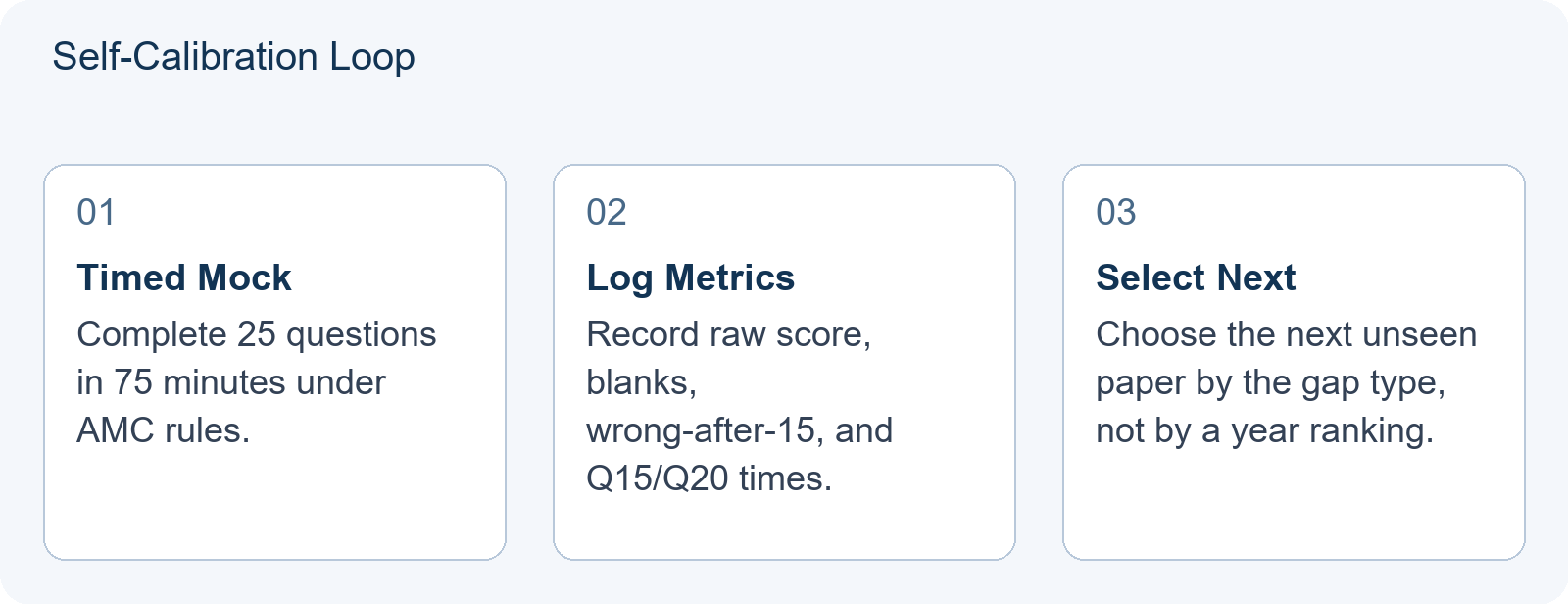
Students searching for AMC 10 past papers often want a simple order: start with the hardest years or save them for last. The useful answer is different. For AMC 10 preparation, there is no official year-by-year difficulty ladder that fits every student. The reliable ladder is your own timed performance. Use each full paper as a diagnostic: record score, blanks, errors after question 15, and checkpoint times. Then choose the next paper by the gap you need to fix. This is a teaching framework, not an official MAA placement rule.
For the 2026-27 season, each AMC 10/12 paper is 25 multiple-choice questions in 75 minutes, and AMC 10 excludes trigonometry, advanced algebra and advanced geometry. Those fixed rules matter because they define the paper you are calibrating against. What changes from student to student is not the official syllabus but the interaction between that syllabus and your current speed, accuracy, and topic confidence.
Why External Difficulty Rankings Fail
A common mistake is treating all students as having the same baseline. A paper considered easy by a strong geometry student might be brutal for someone still building algebra fluency. A paper that feels hard in October can feel routine in November after targeted review. Because perceived difficulty is personal, a third-party hardest-years list can waste your best diagnostic attempts. If you start with a random hard year, you may hit a wall not because you lack ability but because that specific mix of topics does not match your current study focus. If you start with a paper you half-remember, you may score well without proving you can solve it under exam pressure.
The better use of AMC 10 past papers is not to rank the papers. It is to rank your own attempts. Each timed paper becomes a calibration point. The next paper should change one variable: question position, topic mix, time pressure, or solution review depth.
What to Record from One Timed Paper
To calibrate your ladder, you need data beyond the final score. After one full timed mock, record these metrics:
| Metric | What to Record | Why It Matters |
|---|---|---|
| Raw score | Correct answers count as 6 points, blanks as 1.5 points, wrong answers as 0. Full score is 150. | Shows your current scoring baseline under AMC arithmetic. |
| Blank count | Number of questions left unanswered. | High blanks with high accuracy often signal pacing, not knowledge gaps. |
| Wrong-after-15 count | Errors on questions 16-25. | Shows whether the back half is breaking down from stamina, topic gaps, or time pressure. |
| Q15 and Q20 checkpoint times | Minutes elapsed when you reach question 15 and question 20. | Reveals whether early questions are consuming too much of the 75-minute budget. |
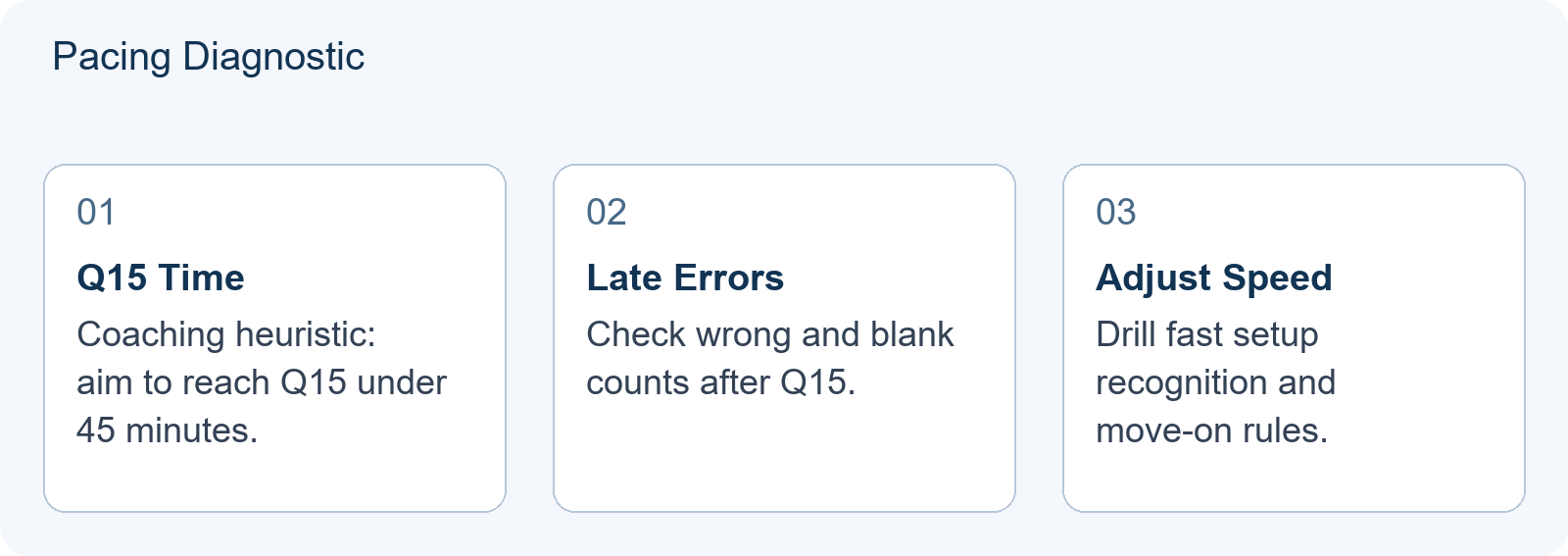
The Q15 and Q20 checkpoint targets below are coaching heuristics, not official MAA rules. A reasonable training target is to reach Q15 by around 40-45 minutes. That leaves adequate time for the final ten questions, where reading load and multi-step reasoning usually increase.
If you have many blanks but strong accuracy on attempted questions, your problem is likely pacing. If you attempt most questions but make repeated errors after Q15, your problem is likely stamina, topic gaps, or decision-making under time pressure. Those are different problems, and they require different next papers.
The Score-Band to Next-Paper Rule
Use your recorded metrics to decide the next step. The table below is a teaching framework, not an official rule, cutoff, or placement guide. Score bands are based on raw AMC scoring out of 150.
| Your Profile | Next Action | Paper Selection Strategy |
|---|---|---|
| Score below 80, high blanks | Repeat topic drill | Do not take another full paper immediately. Isolate the weak module, such as counting or geometry, and drill untimed until accuracy improves. |
| Score 80-100, slow pacing | Fresh unseen paper with pacing constraint | Choose a paper you have not seen. Set a strict Q15 checkpoint and force movement before you are fully comfortable. |
| Score 100-120, mixed errors | Standard rotation | Alternate between two different years or paper versions. Change one variable: try a paper with a topic mix that challenges your weaker module. |
| Score above 120, low blanks | Stress test | Use a fresh unseen paper and reduce first-pass time to 65 minutes, then use the remaining time to review flagged questions. |
The goal is not to find the single hardest AMC 10 paper. The goal is to choose the paper that tests the specific weakness your last timed attempt revealed.
Building a 4-6 Paper Ladder Without Memorising Answers
Memorisation ruins the diagnostic value of AMC 10 past papers. To avoid it, rotate through a set of 4-6 papers over several weeks. When possible, spread selections across different years and paper versions, such as A and B releases, so you are not relying on memory of the same release. Do not immediately review solutions after finishing. Wait at least 24-48 hours before reviewing errors. This delay helps distinguish between genuine misunderstanding and simple calculation slips.
Each paper in the ladder should have one calibration purpose:
- Paper 1: Baseline. Take it under full timing and record all four metrics.
- Paper 2: Pacing. Choose a fresh paper and focus on reaching Q15 by your checkpoint.
- Paper 3: Topic mix. Choose a paper with more questions from your weaker module.
- Paper 4: Accuracy. Review every wrong answer and classify it as knowledge, setup, execution, or reading.
- Paper 5: Stress test. Use a shorter first-pass limit or a no-return rule on flagged questions.
- Paper 6: Consolidation. Retake a previously reviewed paper only under new conditions, such as solving only Q16-25 first.
If you must repeat a paper due to a limited number of resources, change the conditions. Attempt it without looking back, or solve only selected question ranges. The repetition is useful only if it tests a new skill rather than memory of the answer key.
Worked Hypothetical: Diagnosing a 14-Correct Attempt
Consider a hypothetical student who completes a timed AMC 10 paper with 14 correct, 4 wrong, and 7 blank. This is a teaching illustration, not an official placement rule. Their raw score is:
14 x 6 = 84 points from correct answers.
7 x 1.5 = 10.5 points from blanks.
Total = 94.5 out of 150.
Their time log shows they reached Q15 at 50 minutes. That means they had only 25 minutes for the final ten questions. For many students, that is not enough time to read, set up, and solve the harder questions.
Diagnosis: They are spending too much time on early questions. The score is not the main issue. The pacing profile is the main issue.
Action: Do not jump to a harder paper. Instead, select a fresh unseen paper and set a strict timer. Force yourself to move on from any question taking more than 3 minutes before Q15. The goal is not to maximise this attempt. The goal is to reach Q15 in under 45 minutes consistently. Once that pacing becomes normal, you can increase difficulty or add a stress constraint.
For a deeper review method, see our article on AMC Mock Test Review: Separate a Knowledge Gap From a Pacing Failure. That distinction is exactly what this hypothetical is designed to show.
Checking Solution Coverage Without Official Reliance
Many online sources provide solutions for AMC 10 past papers, but quality varies. Never assume AoPS or another forum is the official issuer of MAA rules. When checking solutions, verify the logic against the current syllabus. For AMC 10, ensure that methods do not rely on trigonometry, advanced algebra, or advanced geometry. If a solution uses a theorem outside the AMC 10 scope, discard it and find an alternative approach. This keeps your preparation aligned with what the AMC 10 actually tests.
Also separate official rules from coaching judgment. The MAA publishes competition rules and scope. It does not provide a personalised difficulty ranking for your next practice paper. A solution explanation can be useful without being an official scoring interpretation.
When to Abandon a Past Paper Mid-Set
If you encounter a paper where more than half of the questions feel unfamiliar or require tools you have not learned, stop. Do not waste time trying to brute-force through it. Switch to a targeted module drill. For example, if number theory is the blocker, spend the week doing only number theory problems from several years. Return to full papers once you have built competence in that area.
This prevents frustration and keeps practice efficient. A full paper is most useful when you can engage with most of the questions, even if you do not solve them all.
If you find that full mocks are inefficient, the question-position method is explained in Stop Doing Whole Past Papers: How to Build an AMC Practice Set by Question Position. It can complement this ladder when you need to isolate the back half without spending another full 75 minutes.
Turning Errors into the Next Calibration Point
After reviewing a paper, classify every error. A wrong answer can come from a missing theorem, a misread condition, a setup mistake, an arithmetic slip, or a time-pressure decision. These categories point to different next steps. A missing theorem calls for topic review. A misread condition calls for slow reading practice on wordy questions. A setup mistake calls for drawing or translating problems before calculating. A time-pressure decision calls for pacing drills.
For a structured error review, see our article on AMC 10 Past Papers: Analyzing Wrong Answers to Stop Calling Mistakes ‘Careless’. The goal is not to label yourself. The goal is to choose the next AMC 10 past paper that tests the corrected behaviour.
Course-Fit and Resource Preparation
Before consulting a tutor or buying a course, prepare your data. Bring your timed score logs, error types, and pacing notes. A good instructor will help you interpret this data to refine your ladder. Avoid providers who promise guaranteed awards or specific score jumps without analysing your individual weaknesses. Look for resources that offer detailed breakdowns of question positions, topic mixes, and review methods.
The self-calibrating ladder works because it keeps the decision local to your own evidence. You do not need a perfect ranking of AMC 10 past papers. You need the next paper that tests the weakness your last timed attempt exposed.
This is an independent preparation guide, not affiliated with, endorsed by, or sponsored by the Mathematical Association of America.
Frequently Asked Questions
Is there an official list of hardest AMC 10 years?
No official MAA year-by-year difficulty ranking is needed for this method. Perceived difficulty depends on your strengths in algebra, geometry, counting, and number theory, so a third-party hardest-years list should be treated as a coaching opinion rather than an official placement guide.
Should I use old or new past papers?
Use recent papers for the most current wording and style, and use older papers for targeted topic drilling. The key is to take each selected paper under timed conditions and record the same calibration metrics.
What if I run out of unique past papers?
Re-attempt papers under stricter conditions, such as a shorter first-pass time or a no-return rule on flagged questions. You can also isolate specific question ranges such as Q16-25 to focus on high-difficulty segments without relying on memory of the full set.