Most students prepare by working through one whole past paper after another. That is a testing habit, not a training habit. A full paper produces a single number and twenty-five unrelated lessons you cannot act on. The higher-yield method is to break papers apart and rebuild them into sets banded by question position — then return to whole papers only in the final phase, when stamina and sequencing are what you still need to train.
This matters more in August than it does in October. With the 2026 A paper on 5 November and the B paper on 13 November, you have roughly thirteen weeks — enough to build skill, and also enough to burn through your entire stock of practice material before you have anything left to measure yourself with.
What a whole paper is good for, and what it is not
A complete AMC 10/12 sitting is 25 multiple-choice questions in 75 minutes, scored 6 for correct, 0 for incorrect and 1.5 for blank, with no calculator permitted. That design is excellent for measurement: it forces the pacing decisions, the skip-or-guess judgements and the stamina that a real sitting demands.
It is a poor teaching instrument, for three reasons:
- The feedback is diluted. Twenty-five items span every topic and every difficulty level. You finish with one score and no pattern. Was the problem geometry, or was it that you spent eleven minutes on question 19 and rushed questions 12 to 15? A whole paper cannot tell you.
- The cost is high and the reps are low. A full sitting is 75 minutes plus a genuine review session — call it two and a half hours. In that same time you could attempt thirty problems drawn from one band and actually see the recurring structure.
- It consumes a finite resource. There are only so many past papers. Every paper you use as casual practice is a paper you can never again use to get an honest, uncontaminated read on where you stand. A paper you have already seen cannot measure you.
The conclusion is not “never sit a full paper.” It is that full papers are a diagnostic instrument, and diagnostic instruments should be rationed.
Position is a more useful label than year
Ask a student what they practised this week and they will name a year: “the 2019 AMC 10A.” That label carries almost no training information. The useful label is the position number.
The AMC papers are built so that demand rises across the paper. That means question 7 from one year and question 7 from another year are asking for something far more similar to each other than question 7 and question 22 from the same paper. Difficulty tracks position, not vintage. Once you accept that, the natural unit of practice stops being “a paper” and becomes “a band.”
Two honest caveats. First, the band boundaries below are an editorial approximation for study purposes — the MAA does not publish a per-question difficulty index, and the exact point where a paper turns hard moves from year to year. Second, do not compare raw scores across years as if they were interchangeable; qualification thresholds are set by the MAA each cycle and are not fixed, so never plan against a number you half-remember from a forum. Confirm anything official on maa.org.
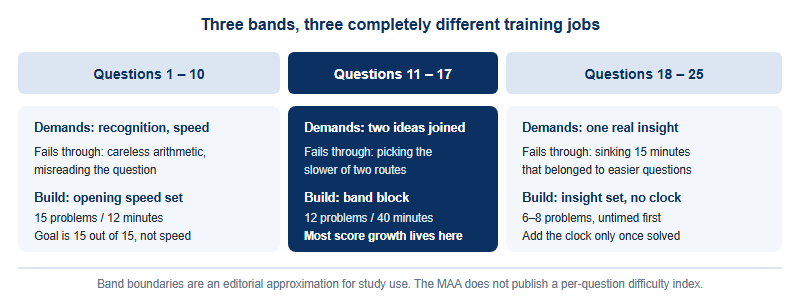
The four set types
A “set” is eight to fifteen problems pulled from across many papers, sharing a position band and sometimes a topic, with a single time rule and a single thing you are trying to learn. Four types cover almost everything you need.
| Set type | Composition | Time rule | What it actually trains |
|---|---|---|---|
| Opening speed set | 15 problems from positions 1–8, many different years | 12 minutes, hard stop | Protecting your floor. Any loss here is a loss you cannot afford, because these are the points everyone else banks |
| Band block | 12 problems, all from positions 11–15 | 40 minutes | Depth in the band with the most available marks. Repetition makes the recurring structures visible |
| Topic × position set | 8 problems, one topic, one band — e.g. geometry from positions 16–20 | Untimed first pass, then timed retest | Targeted repair after a diagnostic has told you exactly where the weakness sits |
| Ladder set | 10 problems climbing positions 6 → 20, in ascending order | 25 minutes | Pacing under rising demand — the skill a whole paper trains, at a fraction of the cost |
The ladder set is the quiet star of this list. Pacing is the reason most students under-perform their true ability, and pacing is usually assumed to require a full sitting to practise. It does not. Ten problems ascending from position 6 to position 20 reproduces the essential pressure — the moment when the problems stop yielding and you have to decide whether to keep pushing or move on — in twenty-five minutes rather than seventy-five.
Ration your papers: mine most, seal some
Whatever archive of past papers you are working from, treat it as a non-renewable resource and split it deliberately at the start of the season rather than drifting through it.
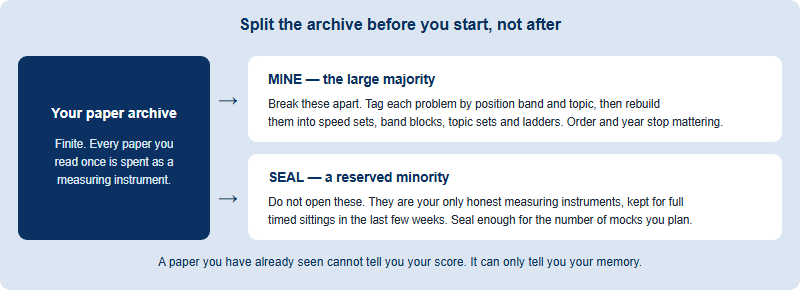
How many to seal? Work backwards from the number of full sittings you intend to do in the final phase, and seal that many plus one for slippage. Everything else goes into the mine. If you also plan to sit both the A and B papers this year — the 2026 dates are 5 and 13 November, both in person at authorised centres — you may want one extra sealed paper to use between them; the 2026 in-person arrangements are worth reading before you plan that week.
When to switch back to whole papers
Set-based training has a ceiling, and you will hit it. Three things it cannot teach:
- Stamina. Concentration at minute 65 is a different resource from concentration at minute 15, and only a full sitting loads it.
- Sequencing across the whole paper. Deciding, live, that question 14 is not worth another minute because questions 15 and 16 look friendlier is a whole-paper skill.
- The blank decision under real pressure. With 6 points for correct, 0 for wrong and 1.5 for blank, the final five minutes involve genuine judgement about which unanswered questions to attempt. In a 12-minute set that pressure does not exist.
The switch point is behavioural, not calendar-based: move to whole papers once your band accuracy has stabilised — when an opening speed set reliably returns near-perfect scores and a band block is no longer producing new categories of error. From that point, sealed papers under exam conditions become the main event, and sets shrink to short warm-ups and targeted repairs between sittings.
One last point on conditions. Because the 2026 sittings are in person on paper with no calculator or electronic device, your final-phase practice should match that: printed problems, physical scratch paper, one continuous 75-minute block, phone in another room. Training on a screen and sitting on paper is a small mismatch that costs real marks in the first ten minutes, and it is entirely avoidable — the 2026 in-person rules set out exactly which conditions your mocks should reproduce.
Frequently asked questions
How many past papers should I keep sealed for mocks?
Seal one per planned full sitting, plus one spare. Decide the number in August; students who improvise run out of clean papers by late October.
Is it a problem that I already know some answers from papers I have seen?
For set training, no — you still practise the method. For measuring your score, yes. That is exactly why some papers must stay sealed.
Should the sets mix AMC 10 and AMC 12 problems?
Only within shared topics. The AMC 12 covers extra content the AMC 10 never tests, so check the current syllabus statement on maa.org first.
How long before the exam should I stop doing sets?
Do not stop entirely. Short opening speed sets stay useful right through the taper; it is the long untimed insight work that should wind down.
This is an independent English-language guide operated by Hanlin Education for China-based international-school students. We are not affiliated with, endorsed by, or sponsored by the Mathematical Association of America (MAA). Competition dates, eligibility rules, permitted materials and scoring are set by the MAA and can change; always confirm current details on maa.org and with your authorised test centre. If you find an error in this article, tell us and we will correct it within 7 working days.