For many students preparing for the American Mathematics Competitions (AMC) 10, conditional probability presents a specific cognitive hurdle. The difficulty is not usually in calculating fractions, but in correctly identifying which outcomes remain possible after new information is revealed. A common error is treating the entire original set of possibilities as the denominator when the condition has already restricted the universe of events.
This article focuses on that precise reasoning failure. Unlike broad overviews of counting principles, we will work through two concrete teaching illustrations to demonstrate how the sample space changes. We will also provide a diagnostic table to help you identify where your logic might be breaking down during timed practice.
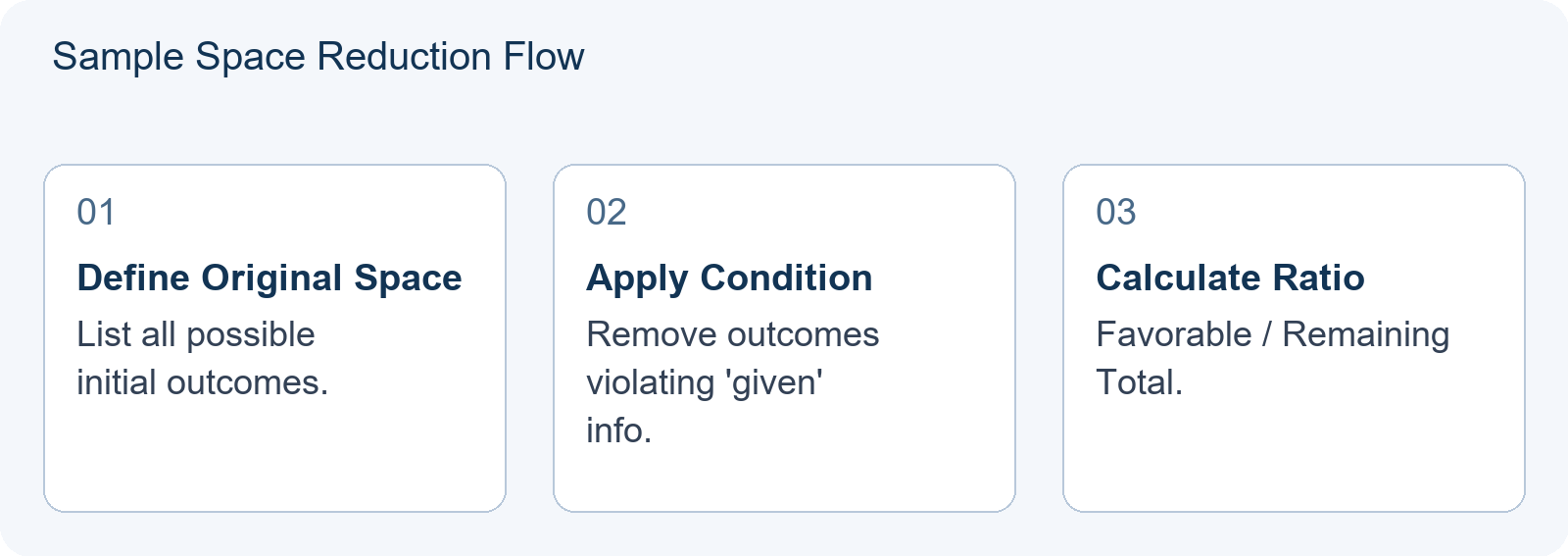
The Core Concept: Restricting the Universe
In standard probability, . In conditional probability, asks: “Given that event B has occurred, what is the probability of event A?” The critical shift is that the “total outcomes” are no longer the original sample space. They are only those outcomes where B is true.
If you fail to update the denominator, you are effectively asking a different question than the one posed. For AMC 10 problems, this often manifests in scenarios involving selection without replacement, or filtering data sets based on a specific attribute.
Teaching Illustration 1: The Standard Filter
This is an original teaching illustration, not an official past-paper question.
Imagine a bag contains 3 red marbles and 2 blue marbles. You draw two marbles without replacement. What is the probability that the second marble is red, given that the first marble was red?
Incorrect Approach: Some students calculate the total ways to pick two marbles from five () and count favorable pairs. While this can work if done carefully, it risks confusion about order.
Correct Approach (Shrinking the Space):
- Condition: The first marble is red. We remove one red marble from the bag.
- New State: The bag now contains 2 red marbles and 2 blue marbles.
- Total Outcomes: There are 4 marbles remaining.
- Favorable Outcomes: There are 2 red marbles remaining.
- Calculation: .
By physically removing the known outcome, the problem becomes a simple single-step probability calculation. This method reduces cognitive load and minimizes arithmetic errors.
Teaching Illustration 2: The Ambiguous Attribute
This is an original teaching illustration, not an official past-paper question.
Consider a group of 10 students: 6 girls and 4 boys. Three students are selected at random. What is the probability that all three are girls, given that at least one girl was selected?
This is a classic trap. The condition “at least one girl” does not specify which student is the girl. It restricts the sample space to all combinations except those with zero girls.
Step-by-Step Deduction:
- Total Combinations: Selecting 3 from 10 is .
- Excluded Cases: The condition excludes cases with 0 girls (i.e., 3 boys). Since there are only 4 boys, selecting 3 boys is .
- New Denominator: The valid sample space under the condition is .
- Numerator: We want cases where all 3 are girls. Selecting 3 from 6 girls is .
- Result: .
Note that the answer is not simply . The condition “at least one girl” removes the 4 boy-only cases from the denominator, slightly increasing the probability compared to the unconditional case. As a verification: , while . The conditional probability is indeed larger, as expected.
Diagnostic Table: Identifying Your Error
| Symptom | Likely Cause | Correction Strategy |
|---|---|---|
| Answer matches unconditional probability | Ignored the condition entirely | Re-read the “given that” clause; define Event B explicitly. |
| Denominator is too large | Used original total instead of restricted total | List all outcomes satisfying Condition B; count them. |
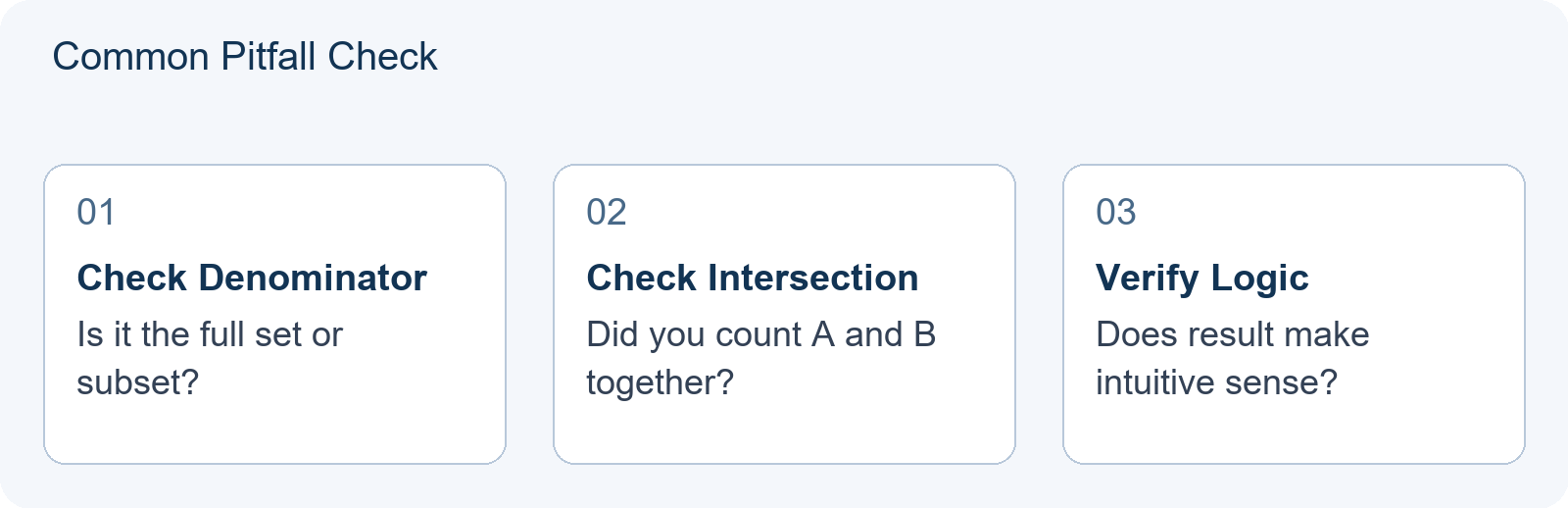
| Numerator is too small | Double-counted restrictions or missed overlaps | Use Venn diagrams or tree branches to visualize intersections. |
| Confusion between “and” vs “given” | Misinterpreting logical operators | Translate “A given B” to “A and B divided by B”. |
Targeted Practice Sequence
To solidify this skill, avoid jumping straight to complex combinatorics. Follow this progression:
- Physical Simulation: Use coins or cards to manually perform trials. Physically remove the “known” item to see the reduced pool.
- Tree Diagrams: Draw full trees for multi-stage events. Cross out branches that violate the condition. Count only surviving leaves.
- Formula Application: Once visual methods are clear, apply . Ensure you calculate the intersection correctly.
For broader context on counting families, refer to our guide on AMC 10/12 Counting and Probability: The Six Question Families and the Overcounting Audit. If you are deciding between AMC 10 and AMC 12, review AMC 10 Past Papers vs AMC 12 Past Papers: The Content Split That Makes Some Years Misleading for Your Level. For proof-based progression after AIME, see USAMO Past Papers: Is Proof-Based Practice the Right Next Step After AIME?.
Next Steps for Learners
The specific skill you should be able to demonstrate next is the ability to verbally explain why the denominator changed in a given problem before writing any numbers. If you cannot articulate the restriction, you likely have not identified the correct sample space. Practice this verbal check on every conditional probability problem in past papers.
Frequently Asked Questions
Why do we subtract the excluded cases from the denominator?
Because the condition states those cases did not happen. The probability is calculated within the universe where the condition is true.
Can I always use the formula P(A∩B)/P(B)?
Yes, but for AMC 10, counting outcomes directly (combinatorics) is often faster and less prone to fraction errors than calculating probabilities first.
What if the condition is ‘exactly one’ vs ‘at least one’?
‘Exactly one’ is a stricter filter. It removes more cases from the denominator than ‘at least one’, which only removes the zero-case scenario.