For many students preparing for the AMC 12, complex numbers represent a distinct jump in difficulty compared to the AMC 10. While the AMC 10 rarely tests complex arithmetic beyond basic definitions, the AMC 12 frequently integrates complex roots into polynomial equations, geometry, and trigonometry. The key to mastering these problems is not just algebraic manipulation, but geometric visualization. By treating complex numbers as points or vectors on the Argand plane, you can often bypass tedious calculations and find elegant solutions.
The Geometric Advantage
In competition mathematics, time is your scarcest resource. When faced with an equation involving complex roots, ask yourself: What does this look like? A complex number corresponds to a point in the Cartesian plane. Its modulus is the distance from the origin, and its argument is the angle it makes with the positive real axis. This translation allows you to use tools from Euclidean geometry—such as circles, triangles, and symmetry—to solve algebraic problems.
Consider a typical AMC 12-style scenario where you must find the sum of the moduli of the roots of a polynomial. Instead of solving for each root explicitly using the cubic formula or factoring, you might recognize that the roots lie on a circle centered at the origin. If the polynomial is reciprocal or has symmetric coefficients, the roots often come in conjugate pairs or have equal magnitudes. Recognizing this pattern saves minutes.
Teaching Illustration: Visualizing Conjugate Pairs
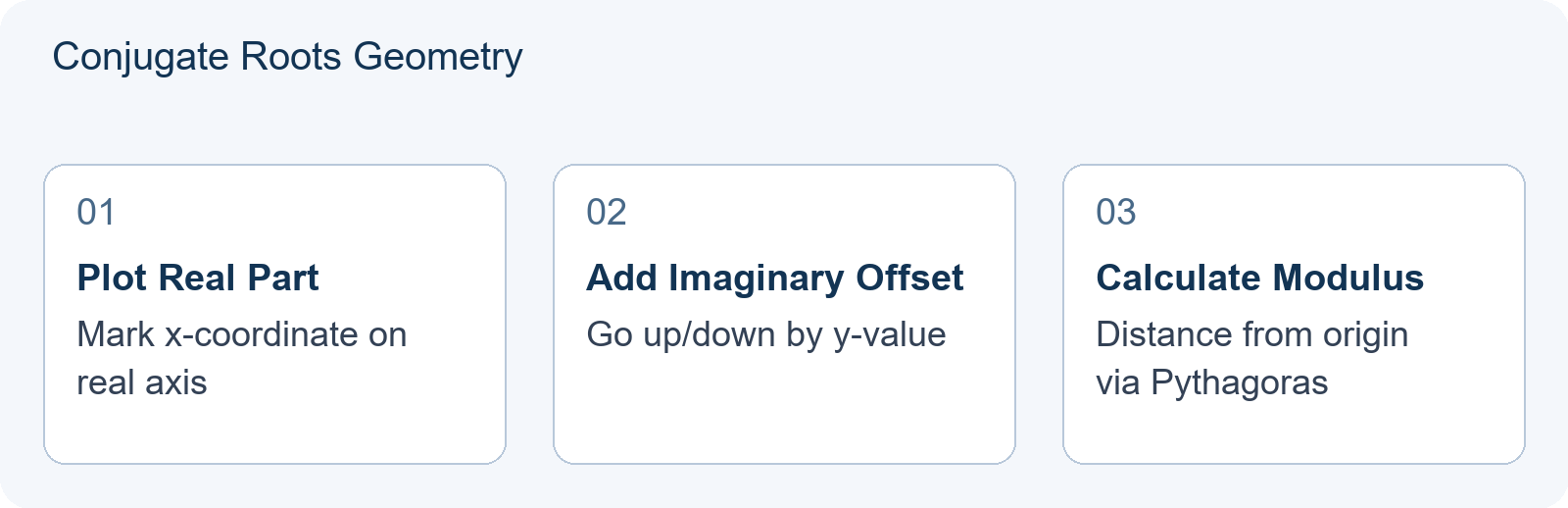
Let’s examine a simplified example to illustrate the method. Suppose we have a quadratic equation with real coefficients: . The discriminant is , indicating two complex conjugate roots: .
- Algebraic View: You calculate the roots directly. Sum = 4, Product = 13.
- Geometric View: Plot the points and . They are symmetric across the real axis. The midpoint is . The distance from the origin to either point is .
This geometric insight immediately tells you that the product of the roots (which equals the constant term in monic quadratics) is the square of the modulus. This relationship holds generally: for any complex number , . In multiple-choice questions asking for the product of roots, recognizing this identity can prevent calculation errors.
Roots of Unity and Symmetry
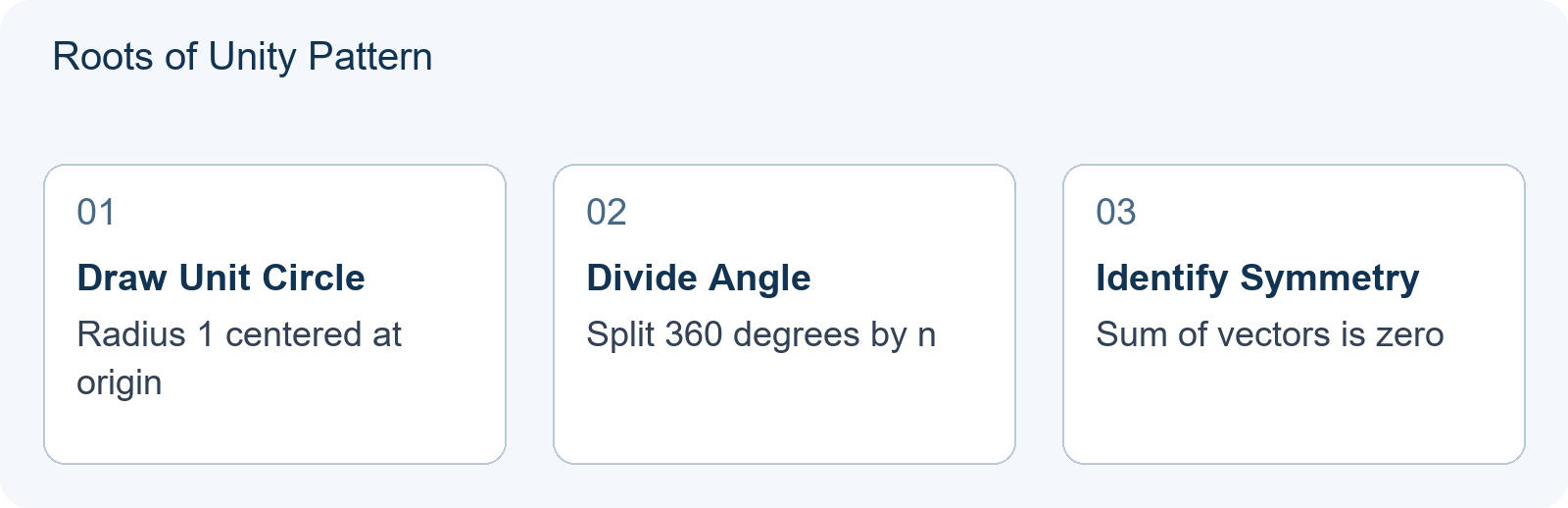
A recurring theme in AMC 12 is the use of roots of unity. These are solutions to . Geometrically, they form a regular -gon inscribed in the unit circle. Problems often ask for sums of powers of these roots or products of differences. Knowing that the sum of all -th roots of unity is zero (for ) is a powerful shortcut. For instance, if a question asks for the sum of the real parts of the 5th roots of unity, you know the total sum is 0, and by symmetry, the real parts balance out in specific ways relative to the imaginary parts.
When preparing for the November 2026 exams, focus on identifying when a problem’s structure implies symmetry. Look for coefficients that suggest palindromic polynomials or equations invariant under rotation. These cues signal that a geometric approach will be faster than brute-force algebra.
Strategic Preparation
To build proficiency, practice translating word problems into diagrams. Start with simple loci: “The set of points such that ” is a circle centered at with radius 2. Then move to intersections: finding common solutions to and becomes a triangle geometry problem. This skill is particularly useful for the harder questions (numbers 21-25), where time pressure is highest.
Remember that the The AMC 12 Content the AMC 10 Never Tests: A Study Map for Trigonometry, Logarithms and Complex Numbers includes advanced topics like complex numbers. Ensure your study plan allocates time specifically for these areas. Additionally, reviewing AMC 10 Past Papers vs AMC 12 Past Papers: The Content Split That Makes Some Years Misleading for Your Level helps you understand the depth required for complex number questions in the higher tier.
Finally, keep in mind the structural changes for the upcoming season. With Both AMC 10/12 Papers or Just One? How the Fixed AIME Line Changes the 2026 Second-Sitting Decision highlighting the importance of consistent scoring against fixed thresholds, efficient problem-solving techniques like geometric visualization become even more valuable. These methods help secure the necessary score to qualify for the AIME, where the format shifts to integer answers and no multiple-choice safety nets.
Frequently Asked Questions
Do I need a calculator for complex root problems?
No. AMC 12 prohibits calculators. Focus on mental arithmetic for moduli and arguments, and use geometric properties to simplify expressions before calculating.
How do I quickly identify if a polynomial has complex roots?
Check the discriminant for quadratics. For higher degrees, look for sign changes in coefficients or test if the graph stays above/below the x-axis. In competitions, complex roots often appear in symmetric configurations.
Is Vieta’s formulas still useful for complex roots?
Yes. Vieta’s formulas apply to complex roots exactly as they do to real ones. For a monic quadratic , the sum of roots is (real part of axis of symmetry) and the product is . If roots are conjugates , then and . This distinction between linear sum and modulus-squared product is key.