Counting and probability is where competent AMC students lose the most avoidable points — not because the ideas are hard, but because a correct method still produces a wrong number. Almost every failure traces to one error: an outcome counted twice, or a legitimate outcome counted zero times. This article maps the six question families that recur on the AMC 10 and AMC 12, and gives you an audit that catches both.
A note on honesty before we start. The MAA does not publish a fixed per-topic weighting for the AMC 10/12, so any article telling you “counting is 20% of the paper” is estimating, not quoting. What is verifiable is the shape of the exam itself: 25 multiple-choice questions in 75 minutes, scored 6 points for a correct answer, 0 for a wrong one and 1.5 for a blank, with no calculator permitted. Confirm the current rules and permitted materials on maa.org and with your authorised centre — our summary of the 2026 in-person AMC arrangements covers what changed this cycle.
Why counting punishes strong students specifically
Algebra and geometry give you feedback while you work. An equation that fails to balance tells you something broke. A diagram that will not close tells you a length is wrong. Counting gives you nothing. A count that is 20% too high looks exactly like a count that is right — a plausible integer, sitting on your scratch paper, wearing no warning label.
Three features of the AMC make this worse than it would be on a school test:
- The answer choices absorb your error. On a well-written multiple-choice item, the wrong options are not random. The value you get from forgetting to divide by 2, or from double-counting one overlapping case, is often one of the five options. Finding your answer in the list is therefore not confirmation.
- You have no computational safety net. Calculators, phones and similar devices are not permitted; the materials you may bring are limited to items such as blank scratch paper, rulers, erasers and compasses — check the current list on maa.org. That is fine, because counting arithmetic is small. What it means is that your only instrument is organised bookkeeping.
- The scoring makes an unverified count a bad bet. A blank is worth 1.5 and a wrong answer is worth 0. So a counting answer you cannot justify is not “free” — you are staking 1.5 guaranteed points on a number you did not check.
The six question families
Almost every counting or probability item on an AMC 10/12 paper is a member of one of six families. Learning the families is more useful than learning a list of formulas, because the family tells you which failure mode to expect.
| Family | What it looks like | Standard handle | Where the points leak |
|---|---|---|---|
| 1. Restricted arrangements | Seatings, orderings, letters in a row, “these two must / must not be adjacent” | Place the constrained objects first; glue adjacent pairs into one block; use the complement for “at least one” | Forgetting the internal order of a glued block, and taking the complement of the wrong event |
| 2. Structured selections | Committees, subsets, teams with a quota or a forbidden pair | Casework on the binding condition, or total minus violations | Cases that quietly intersect, so a selection satisfying two conditions gets counted twice |
| 3. Distributions | Objects into boxes; splitting a number into ordered parts; identical sweets among children | Stars and bars when items are identical and boxes are distinct | Using stars and bars when the objects are actually distinguishable, or the boxes are not |
| 4. Lattice paths and routes | Grid walks, staircase routes, paths avoiding a blocked cell | Multinomial coefficient for the free grid; subtract paths through each forbidden point | Subtracting two blocked cells separately when some paths pass through both |
| 5. Geometric counting | Triangles from marked points, diagonals, intersection points, regions of a divided figure | Choose-based counting on the underlying point or line set | Degenerate configurations — collinear triples that form no triangle, concurrent lines that share an intersection |
| 6. Dependent probability | Draws without replacement, conditional events, multi-stage games, expected value | Multiply stage by stage, or count favourable and total in the same units | A denominator that silently changes between stages, or a numerator counted with order against an unordered total |
Notice that the “standard handle” column is short and the “leak” column is specific. That is the real lesson: you almost certainly already know the formulas. What separates a 6 from a 0 on these items is whether you can name the way this particular family tends to break.
The overcounting audit: four questions before you commit
An audit is not a proof. It is a fast, mechanical pass that catches the four errors responsible for most lost counting marks. It costs perhaps forty seconds. Against a 1.5-point blank and 6 points on the line, that is an easy trade.
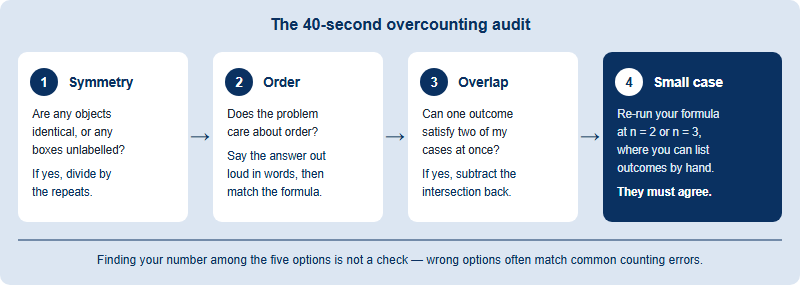
Step 4 deserves emphasis because students skip it. Suppose you have derived a general expression for the number of ways to seat n people under some restriction. Substitute n = 3, then physically list the arrangements on your scratch paper. If your formula says 12 and the list says 8, you have found the error in ninety seconds — and, crucially, you have found it before writing the answer, not three weeks later during review. The small-case test converts an abstract count into something you can verify by brute force, which is exactly what the exam denies you elsewhere.
Probability is counting with a denominator
Every probability item on the AMC 10/12 is a counting item wearing a fraction. Once you accept that, the failure modes narrow to three, and all three live in the denominator.
- The sample space is not equally likely. Dividing favourable by total only works when every outcome in the total is equally probable. Two dice summing to 7 is not one of eleven equally likely sums; it is six of thirty-six equally likely ordered pairs. When a problem describes outcomes at a coarse level (“the sum”, “the colour drawn”), rebuild the space at the fine level before you divide.
- The denominator moves and you did not notice. In without-replacement problems the total shrinks at every stage. Write the stages as a product with the shrinking denominators visible — 5/9 × 4/8 × 3/7 — rather than computing a single ratio at the end.
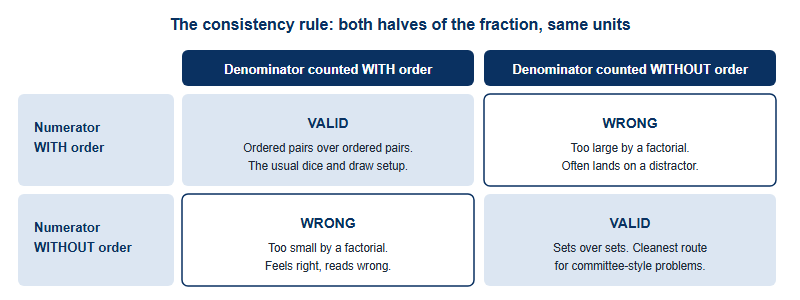
- Numerator and denominator are counted in different units. This is the subtle one. If you count favourable outcomes as ordered sequences, the total must also be ordered. If you count favourable as unordered sets, the total must be unordered too. Mixing them gives an answer that is wrong by a factorial — and, reliably, one that appears in the answer list.
One more idea belongs here because it is disproportionately useful on the AMC 12: linearity of expectation. When a problem asks for an expected count — the expected number of fixed points, matches, adjacent pairs, or successes — you may add the individual probabilities directly, without any concern for whether the events are independent. Problems that look like a wall of casework often collapse to a one-line sum. It is one of the few genuine shortcuts in the topic, and it is worth deliberate practice.
How to train the topic in three weeks
Counting rewards a concentrated block far more than it rewards being sprinkled through general practice, because the families only become visible when you meet them back to back. A workable structure, sized for a student already comfortable with the opening third of the paper:
- Week 1 — families 1 to 3. Arrangements, selections, distributions. Untimed at first. After every problem, write one line naming the family and the leak you nearly fell into. Do not move on because you got the right number; move on because you can say why the wrong number was tempting.
- Week 2 — families 4 to 6. Paths, geometric counting, dependent probability. Add the consistency grid above to your working: literally write “ordered” or “unordered” at the top of the page before computing anything.
- Week 3 — mixed and timed. Sets of eight to ten mixed counting problems at roughly three minutes each, running the four-step audit on every one. The audit has to become automatic before exam conditions, or it will be the first thing you drop.
On pacing: 75 minutes across 25 questions is an average of three minutes per question, but nobody spends three minutes on question 2. A counting problem in the middle of the paper should be closed in around three and a half minutes or consciously banked — and if you bank it, remember that leaving it blank is worth 1.5 points, which is more than a wrong answer is worth. If you are sitting in 2026, both the A paper on 5 November and the B paper on 13 November are in-person sittings at authorised centres, so practise the audit on paper rather than on a screen; the in-person format notes explain why that matters more this cycle than it used to.
Frequently asked questions
Is counting and probability tested more heavily on the AMC 12 than the AMC 10?
Both papers test it. The MAA publishes no fixed weighting, so treat any percentage you read as an estimate rather than fact.
Do I need to memorise the inclusion-exclusion formula?
For two and three sets, yes — it appears constantly. Beyond three sets, structured casework is usually faster and safer under time.
How do I know whether to count directly or use the complement?
Count the complement whenever the condition contains “at least one”. Direct counting there almost always fragments into overlapping cases.
Can I bring anything to help with bookkeeping on test day?
No calculator or electronic device is allowed. Permitted items are limited — check the current list on maa.org before the day.
This is an independent English-language guide operated by Hanlin Education for China-based international-school students. We are not affiliated with, endorsed by, or sponsored by the Mathematical Association of America (MAA). Competition dates, eligibility rules, permitted materials and scoring are set by the MAA and can change; always confirm current details on maa.org and with your authorised test centre. If you find an error in this article, tell us and we will correct it within 7 working days.