When students search for amc 10 past papers, they often receive the same undifferentiated lists as those searching for AMC 12 materials. Search results may bundle both exams together, presenting them as interchangeable practice resources. Both exams share a 25-question multiple-choice format, 75-minute duration, and overlapping foundations in algebra, geometry, and basic number theory. Yet the content gap between them is specific, well-defined, and consequential for preparation efficiency. AMC 12 adds trigonometry, logarithms, complex numbers, and advanced number theory including Euler’s theorem and the Chinese Remainder Theorem—none of which appear on AMC 10. Without understanding this boundary, students waste hours on untestable material or miss the challenges that would actually advance their skills.
This article provides a decision framework for selecting past-paper problems that match your target exam, based on the content boundaries described in Hanlin’s AMC 10/12 preparation materials. The goal is not to discourage cross-exam practice but to ensure that as much preparation time as possible maps to content that will appear on your actual exam.
The Search Trap: Why Results for AMC 10 and AMC 12 Past Papers Look Identical
Some search results and repository pages may not clearly distinguish between AMC 10 and AMC 12 when displaying past papers. A student typing amc 10 past papers may receive combined PDFs, mixed problem sets, or AMC 12 papers labeled simply as “AMC past papers.” This aggregation creates a false equivalence. The exams share problem formats and some overlapping content, but they are not the same test with different difficulty levels. They are distinct exams with different content families that matter for preparation strategy.
The consequence is practical and damaging. A student preparing for AMC 10 who works through an unfiltered AMC 12 paper may encounter trigonometric identity problems—problems that cannot appear on their exam. They may spend thirty minutes attempting a logarithmic equation before realizing, or worse, they may never realize and conclude that their preparation is inadequate. Conversely, a student ready for AMC 12 who practices only with AMC 10 papers avoids the very content families that distinguish the higher exam, arriving underprepared for the structural complexity of logarithmic, trigonometric, and advanced counting setups.
Content Families Exclusive to AMC 12
According to Hanlin’s 2026 AMC10/12 preparation guide, AMC 12 builds upon AMC 10’s foundation with specific, identifiable additions. The following table summarizes the content boundary:
| Content Area | AMC 10 Coverage | AMC 12 Addition |
|---|---|---|
| Algebra | Simple functions, equations, inequalities, basic coordinate geometry | Trigonometric functions, logarithms, complex numbers, advanced polynomials |
| Geometry | Parallel lines, similarity, basic circles, simple polygons | Trigonometric methods, simple conic sections, complex number methods in geometry |
| Number Theory | Divisors, divisibility, basic congruence, simple counting | Euler’s theorem, Chinese Remainder Theorem, advanced combinatorial structures |
These additions are not marginal extensions of existing topics. They represent entirely new mathematical tools. Trigonometry introduces periodic functions and angular measurement. Logarithms introduce inverse exponential relationships. Complex numbers introduce two-dimensional arithmetic and geometric interpretation. Each of these tools enables problem types that do not exist in AMC 10 scope.
Why Mixed Practice Creates Concrete Problems
For AMC 10 Students Using AMC 12 Papers
When an AMC 10 student works through unfiltered AMC 12 past papers, the time lost on untestable material is direct and measurable. An AMC 12 paper may contain problems requiring trigonometric identities, logarithmic manipulation, or complex-number arithmetic. Each such problem may consume five to fifteen minutes of a student’s practice session. Over a full paper, this can amount to thirty to sixty minutes spent on content that will never appear on their exam.
Beyond time loss, there is confidence erosion. When AMC 12 problems involving excluded content appear in the middle or later difficulty range, they may fall in the zone where AMC 10 students are working to build consistency. When a student repeatedly fails to solve these problems, they develop a false sense of their own inadequacy. The issue is not their ability but the mismatch between their preparation target and their practice material. This psychological cost is rarely discussed but significantly impacts preparation trajectory.
For Strong AMC 10 Students Under-Preparing
The reverse problem affects students who have mastered AMC 10 content but continue with only AMC 10 past papers. These students develop speed and accuracy on problems within a constrained toolset, but they never encounter the structural complexity that AMC 12 introduces. Logarithmic setups require recognizing when exponential relationships can be linearized. Trigonometric problems require selecting among multiple identity pathways. Complex-number geometry requires translating between algebraic and geometric representations. These are not merely harder versions of familiar problems; they are different problem types requiring distinct strategic approaches.
A student who scores consistently above 100 on AMC 10 practice but avoids AMC 12 materials may find that their first exposure to these content families occurs during the actual exam—a high-stakes environment where adaptation is costly.
A Practical Filtering Framework for Past-Paper Selection
Since past-paper sets are often not labeled by content family at the problem level, students and families can apply systematic filters. The following markers identify AMC 12-exclusive content:
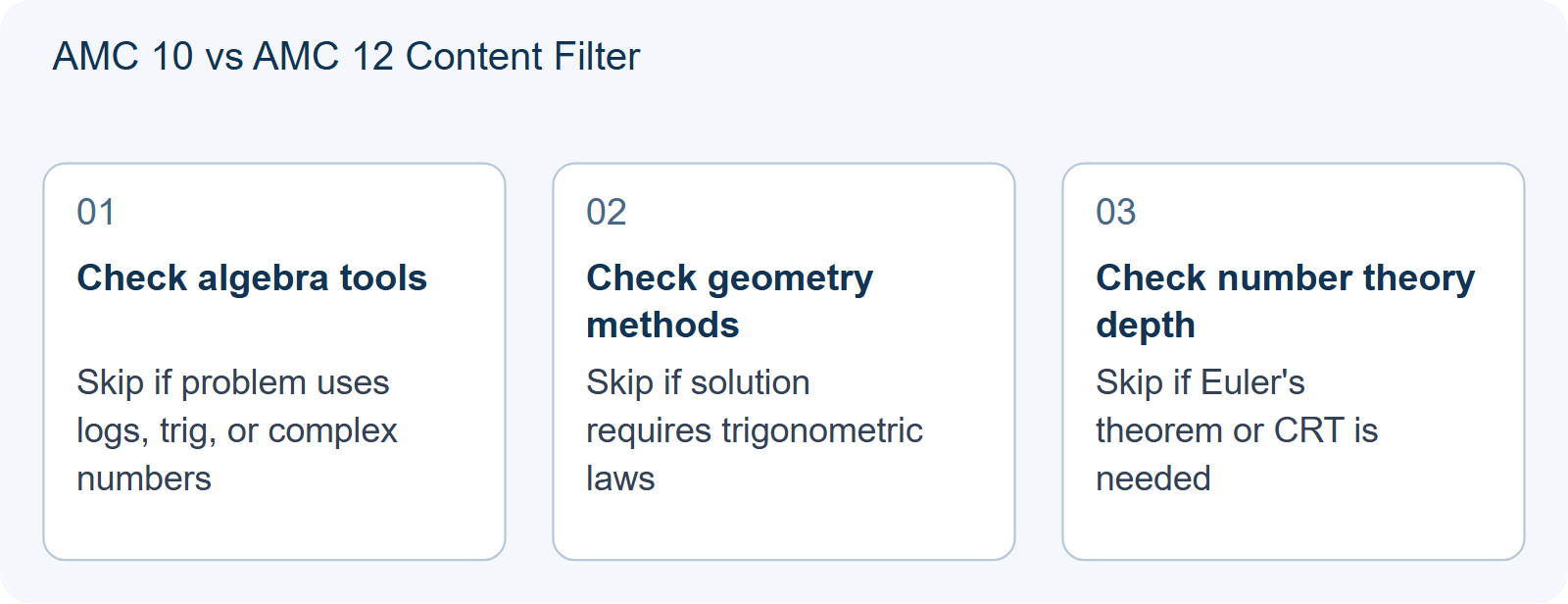
- Algebra problems with non-polynomial functions: If a problem involves trigonometric functions, logarithms, or complex arithmetic, it is AMC 12-only material. Look for notation like sin, cos, log, ln, or i.
- Geometry with trigonometric tools: Problems requiring law of sines, law of cosines, or trigonometric area formulas exceed AMC 10 scope. Check for angle measures in non-special triangles or area expressions involving sine.
- Number theory beyond basic congruence: Problems mentioning Euler’s theorem, Chinese Remainder Theorem, or requiring modular arithmetic with composite moduli that factor non-trivially are likely AMC 12 content.
For AMC 10 preparation, we suggest skipping these problem types when encountered in AMC 12 papers. This does not mean avoiding AMC 12 papers entirely—many early problems in AMC 12 papers are suitable for AMC 10 practice. The skill is in rapid identification and selective engagement.
For students transitioning to AMC 12, these same markers identify the highest-value problems to prioritize. Rather than working sequentially through papers, a student can filter for problems containing these content families and concentrate their effort where the exam differs most from AMC 10.
Year-by-Year Filtering: Maximizing Cross-Exam Practice Value
Not all AMC 12 papers are equally useful for AMC 10 practice, and not all papers are equally challenging for AMC 12 preparation. Papers from years with more conservative content placement—where advanced topics appear concentrated in later problems—offer better crossover value for AMC 10 students. Papers where trigonometry, logarithms, or complex numbers appear earlier in the sequence provide less useful material for AMC 10 practice.
Without inventing specific year-by-year data not present in sources, the general principle holds: examine the first fifteen problems of any AMC 12 paper. If multiple problems in this range require excluded content families, that paper offers lower efficiency for AMC 10 preparation. Conversely, AMC 12 papers where the first fifteen problems rely primarily on algebra, basic geometry, and elementary number theory provide substantial AMC 10-relevant practice.
For AMC 12 students, the opposite logic applies. Papers with early appearance of advanced content families offer more concentrated training in the distinguishing skills. Seek out these papers when building targeted practice sets.
When to Consider Both Exams
Hanlin’s preparation guidance notes that 9th–10th grade students should prioritize AMC 10. If mock exam scores stabilize above 100 points, simultaneous registration for both exams becomes a viable strategy—using AMC 10 as a safer award path and AMC 12 to pursue higher targets. Students in 11th–12th grade are restricted to AMC 12 by eligibility rules.
Eligibility differs by age: AMC 10 requires students to be under 17.5 years old on exam day; AMC 12 requires under 19.5 years old. Grade level also applies: AMC 10 is for 10th grade and below, AMC 12 for 12th grade and below. These constraints are the eligibility rules described in Hanlin’s guide.
The decision to sit both exams should be based on demonstrated readiness, not aspirational targeting. A student scoring 85 on AMC 10 practice gains little from dividing attention to AMC 12 content. A student scoring 105 with time to spare, however, may find that AMC 12 exposure sharpens their approach to AMC 10’s hardest problems while opening additional qualification pathways.
Building a Level-Matched Practice Set
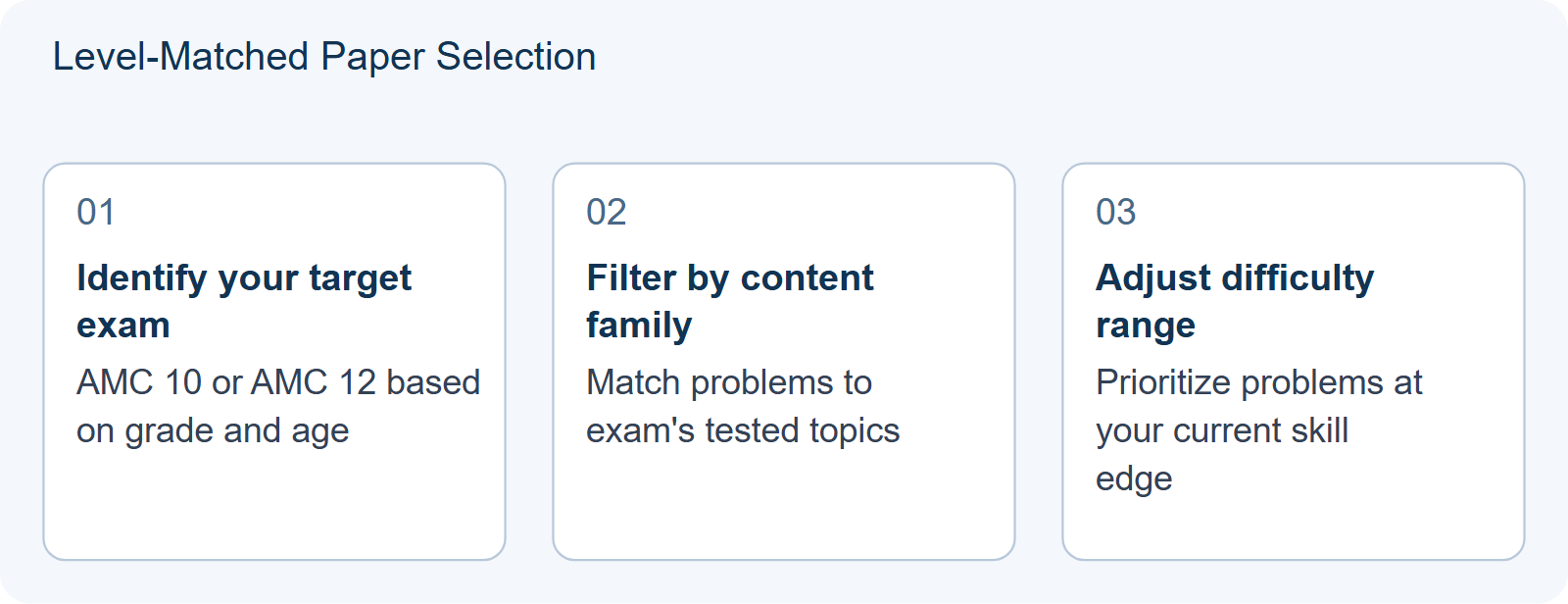
A productive past-paper strategy combines content awareness with positional difficulty. The following approach structures practice for each exam level:
- AMC 10 preparation: Focus on problems 1–20 from AMC 10 papers, which emphasize core algebra, geometry, and basic number theory. When borrowing from AMC 12, select early problems that do not involve the excluded content families. Reserve problems 21–25 for targeted challenge work, as these often require creative combinations of allowed techniques.
- AMC 12 preparation: Ensure exposure to problems 15–25, where advanced content often appears, while maintaining speed on foundational problems. Do not neglect problems 1–10 entirely, as time efficiency here determines availability for later challenges, but recognize that these problems do not represent the exam’s distinguishing content.
Related reading on practice structure: The AMC 12 Content the AMC 10 Never Tests and Stop Doing Whole Past Papers.
Signals That an AMC 10 Scorer Is Ready for AMC 12 Past Papers
Transition timing matters for preparation efficiency. Students should consider moving to AMC 12 materials when they observe several of the following signals: consistent scores above 100 on full AMC 10 papers under timed conditions; ability to complete problems 1–20 with confidence and time remaining; recognition that AMC 10’s hardest problems feel repetitive rather than challenging; and explicit interest in the mathematical tools excluded from AMC 10 scope. These signals, taken together, suggest that the student may have exhausted much of the value of AMC 10 materials and could benefit from the expanded content set.
For additional context on competition value and long-term preparation, see The 16-Week AMC 10/12 Countdown.
Frequently Asked Questions
Can I use AMC 12 papers to prepare for AMC 10 if I skip certain problems?
Yes, with content filtering. AMC 12 papers contain many problems suitable for AMC 10 practice, particularly in algebra and basic geometry. The key is identifying and skipping problems involving trigonometry, logarithms, complex numbers, and advanced number theory. Without this filtering, you risk spending time on untestable material.
How do I know if I am ready to switch from AMC 10 to AMC 12 past papers?
Consider your mock exam performance and eligibility. Hanlin's guidance suggests that 9th–10th grade students who consistently score above 100 on AMC 10 practice exams may benefit from adding AMC 12 preparation. Age and grade restrictions also apply: AMC 10 requires being under 17.5 years old, while AMC 12 extends to under 19.5 years old.
What specific content should I avoid if I am only preparing for AMC 10?
Based on the content boundary described in Hanlin's preparation materials, avoid problems involving trigonometric functions, logarithms, complex numbers, and advanced number theory including Euler's theorem and the Chinese Remainder Theorem. These content families are explicitly outside AMC 10 scope.