In the 2026 AMC 10/12, a correct answer is worth 6 points, a wrong answer 0, and a question left blank 1.5. That single 1.5 changes the guessing maths completely. A blind guess among five options is worth only 1.2 points in expectation — less than the blank you gave up to make it. You need a better-than-25% chance of being right before answering beats leaving the question empty.
Almost every Chinese-language AMC guide tells students “don’t guess randomly.” Very few of them show the arithmetic, and the arithmetic is what actually tells you when to break the rule. This article works it out honestly, then attaches it to the 2026 season calendar, the award tiers, and the AMC 10 vs AMC 12 topic gap.
The 2026 season: what is fixed and what is not
The American Mathematics Competitions are run by the Mathematical Association of America (MAA) and sit at the base of a ladder that runs AMC 10/12 → AIME → USA(J)MO. The scale is worth stating plainly: this is a large international field sat at registered schools and test centres worldwide, and the MAA publishes the participation figures for each cycle rather than us quoting one second-hand. That whole population — not your school — is what your percentile is measured against, and it is why an award tier means something different from a school prize.
The MAA’s published 2026–27 competition schedule gives the following contest dates. The sitting window shown alongside them is the China-region window announced by the local organiser — treat it as the China-region window only, and confirm your own start time with your authorised test centre:
| Paper | Date (MAA schedule) | China-region window | Format |
|---|---|---|---|
| A paper (AMC 10 A / 12 A) | 5 November 2026 | 17:00–18:15 | 75 min · 25 multiple-choice · in person |
| B paper (AMC 10 B / 12 B) | 13 November 2026 | 17:00–18:15 | 75 min · 25 multiple-choice · in person |
Papers in the China region are printed bilingually in Chinese and English. Eligibility has two conditions, not one — year group and age: AMC 10 is for students in grade 10 or below who are also under 17.5 years old on the day of the contest; AMC 12 is for students in grade 12 or below who are also under 19.5 years old on the day of the contest. Both conditions have to hold, so check the age rule as well as the grade rule on maa.org. Sitting windows are set locally, so students outside the China region should confirm their own start time and venue arrangements on maa.org or with their test centre rather than assuming the window above applies. Registration mechanics, permitted materials and conduct rules are set out on our AMC policies and eligibility page, and the official version always lives with the MAA.
75 minutes across 25 questions is an average of 3 minutes per question. Nobody actually spends 3 minutes on question 2. The real shape of a good paper is roughly 60–90 seconds each on the opening block, banking time to spend on the middle, and then a deliberate decision about the last handful — which is exactly where the blank rule starts to matter.
How 150 points is actually assembled
Twenty-five questions at 6 points each gives a maximum of 150. But the three-way scoring means the paper behaves less like a test and more like a series of small bets:
- Correct: +6
- Wrong: 0
- Blank: +1.5
Two consequences follow immediately, and both are unintuitive:
1. A completely blank paper scores 37.5. Twenty-five blanks at 1.5 each is 37.5 out of 150 — a quarter of the paper, for writing nothing. This is not a trick; it is the floor the scoring system deliberately gives you, and it is the baseline every strategic decision is measured against.
2. Converting a blank into a correct answer is worth 4.5, not 6. You already held 1.5 by leaving it empty, so the true gain is 6 − 1.5 = 4.5. And converting a blank into a wrong answer costs you 1.5. The upside is exactly three times the downside — and that 3:1 ratio is the whole game.
The increment: the break-even is 25%, not 50%
Here is the calculation almost nobody writes down. Suppose you have some probability p of getting a question right if you answer it. Answering is worth 6p. Leaving it blank is worth 1.5, guaranteed. Answering beats blanking when:
6p > 1.5 ⟹ p > 0.25
The break-even confidence is 25%. Now compare that to what a guess actually gives you on a five-option multiple-choice paper:
| Your situation | Options left | Chance right | Expected points | vs. blank (1.5) |
|---|---|---|---|---|
| No idea at all — pure guess | 5 | 20% | 6 × 1/5 = 1.2 | −0.3 · worse |
| Ruled out one answer | 4 | 25% | 6 × 1/4 = 1.5 | 0 · exactly break-even |
| Ruled out two answers | 3 | 33.3% | 6 × 1/3 = 2.0 | +0.5 · answer it |
| Ruled out three answers | 2 | 50% | 6 × 1/2 = 3.0 | +1.5 · answer it |
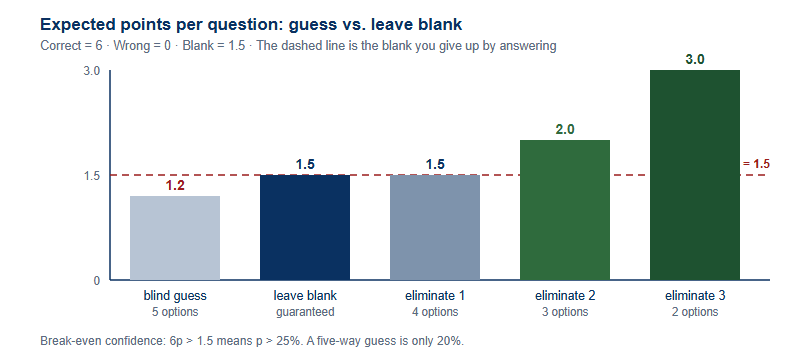
Read the table again and notice where the line falls. Eliminating exactly one option is not progress — it is a tie. Students routinely knock out one obviously silly answer, feel like they have improved their odds, and fill in a bubble. In expectation they have gained precisely nothing, and they have swapped a certain 1.5 for a coin-flip with worse variance.
What this costs over a whole paper
Small per-question edges compound. Suppose a student reaches the last ten minutes with eight questions untouched and bubbles all eight at random. Expected score from those eight: 8 × 1.2 = 9.6 points. Had they left all eight blank: 8 × 1.5 = 12.0 points. The panic-bubbling cost them 2.4 points in expectation — and on a paper where award cutoffs move in 1.5-point steps, that is not noise.
Now the other direction. A student who works patiently through five hard questions and genuinely narrows each to three plausible answers gains 5 × (2.0 − 1.5) = +2.5 points in expectation. Same ten minutes, roughly a 5-point swing between the two behaviours, purely from decision discipline rather than extra mathematics.
The honest caveats
Two things this arithmetic does not say, and it is worth being precise about both:
Expected value is not certainty. A blank is deterministic; a guess is a lottery ticket. If you are on the wrong side of an award cutoff and genuinely have nothing to lose, deliberately accepting worse expected value for higher variance can be rational — that is a real decision, not a mistake. It is just a different decision from the one most students think they are making.
Elimination on AMC problems is often illusory. AMC distractors are constructed from the specific errors students make — sign slips, off-by-one counting, using diameter for radius. The answer that “looks wrong” is frequently the trap that looks right. Genuine elimination means you have a mathematical reason a choice is impossible (wrong parity, wrong order of magnitude, violates a constraint in the stem), not a feeling. If your reason is a feeling, you are at 20%, not 33%.
Where the award tiers sit
Scores map onto recognition tiers that are defined by percentile, not by fixed marks:
- Perfect score: 150.
- Distinguished Honor Roll: global top 1%.
- Honor Roll: global top 5%.
- AIME qualification: this one is now fixed rather than floating. For 2027 MAA has set the thresholds at 100 or above on the AMC 10 and 85 or above on the AMC 12, replacing the percentile band described in older guidance including our own.
- Early-achievement recognition for younger students who clear a set score: the qualifying grade band and score threshold are defined by the MAA and are worth reading in the official wording rather than from a figure quoted second-hand — confirm the current definition on maa.org.
Because the tiers are percentile-based, the useful question is never “is 100 a good score” but “where did 100 rank against the whole international field that year.” Our AMC scores and cut-offs page tracks how these lines have behaved across past years, which is the closest thing to a forecast anyone can honestly offer.
Notice how the blank rule interacts with a target. With c correct answers and every remaining question left blank, your score is 6c + 1.5(25 − c) = 37.5 + 4.5c. So if you are aiming at around 100, 14 correct answers with the other 11 left blank gives 100.5 — 84 points earned and 16.5 collected from the blanks. Treating the paper as “I must attempt all 25” makes that target harder, not easier.
AMC 10 vs AMC 12: the topic delta
The two papers share a substantial core. The AMC 12 does not simply make the same material harder — it opens additional toolkits.
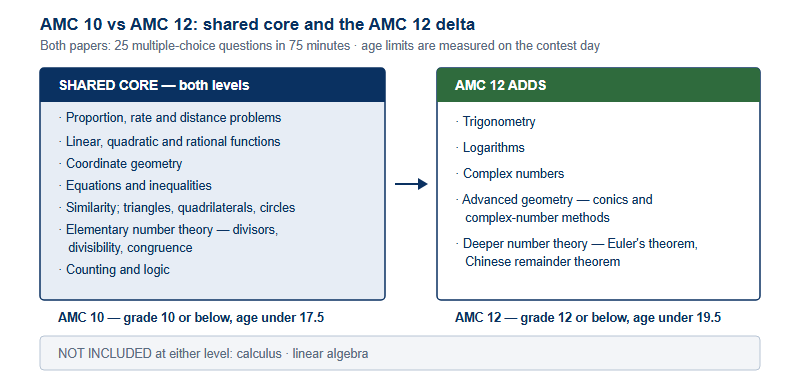
This matters for the blank decision in a specific way. On the AMC 12, a question that hinges on a tool you have not yet learned — a logarithm identity, a rotation done with complex numbers — is a question where you have no basis for elimination. Your honest probability is 20%, and 20% is below the 25% bar. Recognising “this is outside my toolkit” quickly is worth more than 6 minutes of hopeful algebra, because it converts a wasted 6 minutes into a clean 1.5 points plus time returned to a question you can actually finish.
It also shapes the AMC 10 vs 12 choice for a grade-10 student who is eligible for both. The AMC 10 core is entirely within reach of a strong international-school curriculum; the AMC 12 delta usually requires deliberate extra study. Neither is “better” — they lead to different percentile pools and different early-achievement thresholds.
How to practise the blank decision
The decision cannot be learned on exam day. It has to be rehearsed, and the rehearsal has a specific shape:
- Sit a full past paper under real conditions — 75 minutes, no calculator, no interruptions, in one sitting.
- Before you mark it, annotate every answer with why you chose it: solved it, eliminated two then chose, eliminated one then chose, pure guess, or left blank.
- Now mark it, and score your decisions separately from your mathematics. Count how many “pure guess” bubbles you filled. Every one of those cost you 0.3 points in expectation. Count how many “eliminated two” guesses came in — that is where your judgement is earning.
- Track your real elimination hit rate over several papers. Most students discover their “I eliminated two options” confidence is closer to a coin-flip on easy questions and closer to nothing on questions 21–25. That number, measured on yourself, is worth more than any general rule.
Step 4 is the one people skip, and it is the one that converts this article into points. You are not trying to memorise “guess only if you can eliminate two” — you are trying to find out whether your elimination is real.
For the papers themselves, we keep our own organised practice sets — past papers arranged by year and level with answer keys, worked solutions for many (not all) of the years, topic-sorted question banks, and formula and vocabulary sheets for students working across Chinese and English. You can browse what we have gathered on the AMC 10 practice pack page, and ask us for the material that fits your level — solution coverage is still being extended year by year, so tell us which years you want and we will send what we have.
FAQ
Is it ever right to guess on the AMC 10/12?
Yes, but only once you can genuinely eliminate at least two of the five options. Because a blank is worth 1.5 and a correct answer 6, answering beats blanking only when your chance of being right exceeds 25%. A blind guess is 20%, which is worse than the blank. Eliminating one option gets you to exactly 25% — a tie, not an improvement. Eliminating two puts you at 33.3%, worth 2.0 points in expectation against the blank’s 1.5.
What are the 2026 AMC 10/12 dates?
The MAA’s published 2026–27 schedule gives the A paper (AMC 10 A / 12 A) on 5 November 2026 and the B paper (AMC 10 B / 12 B) on 13 November 2026. In the China region the local organiser has announced a 17:00–18:15 sitting window on those dates, printed bilingually in Chinese and English; that window is the China-region window, so confirm your own start time and venue with your authorised test centre. Both papers are 75 minutes and 25 multiple-choice questions, sat in person.
What score do I need to qualify for the AIME?
For 2027 there is a fixed number, which reverses what we said earlier. MAA has set AIME qualification at 100 or above on the AMC 10 and 85 or above on the AMC 12, replacing the floating percentile line. The recognition structure is unchanged: a perfect score is 150, Distinguished Honor Roll is the global top 1%, and Honor Roll is the global top 5%, and those remain percentile bands published after the papers are sat. Confirm the current policy on the official channels.
What is the difference between AMC 10 and AMC 12?
Eligibility runs on grade and age together: AMC 10 is open to students in grade 10 or below who are under 17.5 years old on the day of the contest, and AMC 12 to students in grade 12 or below who are under 19.5 years old on the day of the contest — confirm both conditions on maa.org. Both papers are 25 multiple-choice questions in 75 minutes. They share a core of proportion and rate problems, functions and coordinate geometry, equations and inequalities, similarity and plane geometry, elementary number theory, and counting and logic. The AMC 12 additionally covers trigonometry, logarithms, complex numbers, advanced geometry including conics, and deeper number theory such as Euler’s theorem and the Chinese remainder theorem. Neither paper includes calculus or linear algebra.
AMC Club is an independent English-language guide to the American Mathematics Competitions. We are not affiliated with, endorsed by or sponsored by the Mathematical Association of America (MAA), and official rules, sitting dates, cut-off scores and registration are published on maa.org — always confirm procedural details there or with your registered test centre. Any student results referenced on this site are de-identified Hanlin Education data, are reported per Hanlin, and vary from student to student; they are not a prediction of any individual outcome. Confirmed errors are corrected within 7 working days.