AMC geometry rewards two things: a small library of configurations you recognise instantly, and disciplined drawing. The MAA’s permitted-materials rule shapes both — you may bring “rulers, compasses, and erasers” and “blank scratch paper (NOT graph paper),” and no calculator of any kind. That means every figure is redrawn by hand, every coordinate system is one you choose, and every answer stays in exact form.
What does the permitted-materials rule tell you about AMC geometry?
Most students read the materials rule as bureaucracy. Read properly, it is a strategy briefing. The MAA states that “the only materials students can have during the competition are writing utensils, blank scratch paper (NOT graph paper) provided by a teacher, rulers, compasses, and erasers,” and separately that “NO CALCULATORS OR PHONES AND SIMILAR ELECTRONIC DEVICES OF ANY KIND ARE ALLOWED. No questions require the use of a calculator.” Four consequences follow:
- A ruler and compass are legal, so accurate redrawing is available to you. Papers in the archive carry the standing note that figures are not necessarily drawn to scale, which means the printed picture proves nothing — but a figure you construct from the stated data, to scale, is a legitimate sanity check on your answer.
- No graph paper means coordinate work is freehand. If you have practised coordinate geometry on squared paper, you have been rehearsing with a crutch you will not have. Practise drawing your own axes on blank paper, spaced generously.
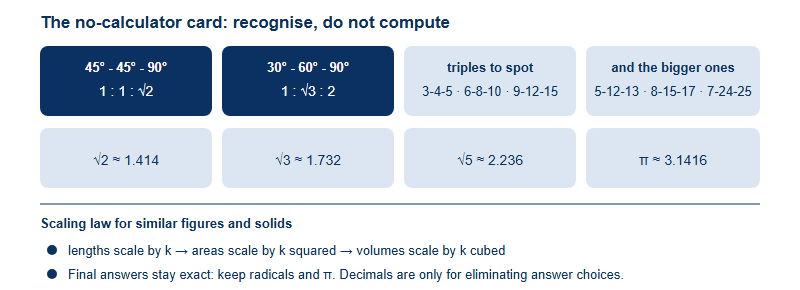
- No calculator means answers stay exact. Radicals, fractions and π survive to the final line. You need instant recognition of the common exact values rather than decimal approximation.
- Scratch paper is blank and provided. Space is not scarce; use a whole sheet per hard geometry problem instead of squeezing a diagram into the margin.
All of this assumes the 2026 sitting format: papers taken in person at authorized centers, AMC 10A and 12A on 5 November and AMC 10B and 12B on 13 November. The logistics are covered separately in our guide to the 2026 in-person AMC rules, and you should confirm what your particular centre supplies before the day.
Which configurations actually recur?
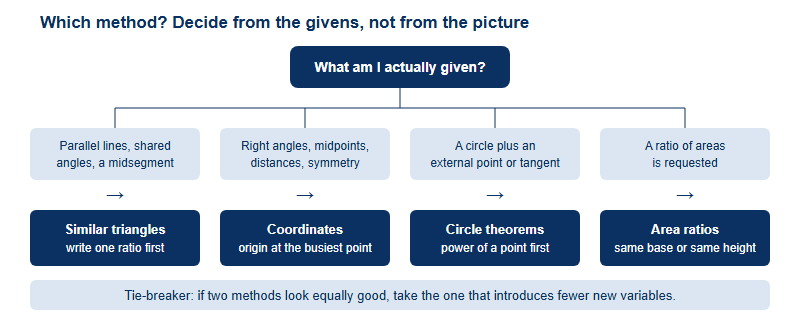
Competition geometry is not an infinite space. A modest library of configurations covers a large share of what appears, and the skill worth training is recognition speed — seeing the configuration inside a cluttered figure, then knowing the first move without deliberation.
| Configuration | Trigger in the stem or figure | First move | Typical pitfall |
|---|---|---|---|
| Similar triangles from parallel lines | Parallel marks, a transversal, or a midsegment | Write one ratio of corresponding sides before anything else | Pairing the wrong corresponding vertices |
| Special right triangles | 45°, 30°, 60°, or a square’s diagonal | Apply 1 : 1 : √2 or 1 : √3 : 2 immediately | Assigning the hypotenuse ratio to a leg |
| Pythagorean families | Two integer sides, or an integer answer expected | Test 3-4-5, 5-12-13, 8-15-17, 7-24-25 and their multiples | Grinding the algebra when the triple was visible |
| Area ratio by shared height | A cevian splitting a triangle; “ratio of areas” | Areas share a height → ratio equals ratio of the bases | Computing both areas fully instead of the ratio |
| Inscribed angle and Thales | An angle with vertex on the circle; a diameter | Inscribed angle is half the central angle; an angle in a semicircle is a right angle | Confusing central with inscribed |
| Power of a point | An external point with two secants, or a tangent and a secant | Set the two products equal before trying coordinates | Reaching for trigonometry first |
| Tangent perpendicular to radius | The word “tangent” | Draw the radius to the point of tangency and look for a right triangle | Not drawing the radius at all |
| Cyclic quadrilateral | Four points stated or implied to lie on a circle | Opposite angles are supplementary | Assuming concyclicity that was never given |
| Coordinate placement | Right angles, midpoints, distances, or heavy symmetry | Put the origin at the busiest point and an axis along the longest given segment | Choosing coordinates that create fractions everywhere |
| Similar solids and cross-sections | Cones, pyramids, or a plane cutting a solid | Scale factor k → areas scale by k2, volumes by k3 | Scaling volume linearly |
| Unfolding a solid | “Shortest path” across a surface | Flatten the net and draw a straight line | Trying to optimise in three dimensions |
One scope caveat: the AMC 12 is pitched at a higher level than the AMC 10, so techniques such as trigonometric identities or the law of cosines may be more relevant to one paper than the other. Check the current syllabus statement on maa.org rather than relying on second-hand summaries of what is or is not in scope.
The drawing protocol — and the honest limits of the ruler
The single cheapest improvement in AMC geometry scores is redrawing. Students who work on the printed figure inherit its distortions and its clutter; students who redraw inherit neither. The protocol we drill:
- Redraw at two to three times the printed size, on blank scratch paper, one problem per area of the page. Small diagrams cause small handwriting, which causes mislabelled points.
- Construct from the data, not from the picture. If the stem says a triangle is isosceles, build it that way with the compass. If the stem does not say a triangle is isosceles, deliberately draw it clearly scalene.
- Mark everything once. Equal segments with tick marks, equal angles with arcs, right angles with squares. Then never re-derive a fact you have already marked.
- Draw the second, awkward case. When a configuration could be arranged two ways — a point inside or outside, an obtuse rather than acute triangle — sketch the awkward one too. Many wrong answers come from silently assuming the pretty case.
- Add the standard auxiliary lines early. The radius to a point of tangency, the altitude from the apex, the diagonal of a quadrilateral, the line joining two centres.
Now the ruler. Because rulers and compasses are permitted, you can construct a to-scale figure and measure it. This is genuinely useful — and it has a hard limit. Measuring eliminates answer choices; it never proves one. Use it when you have a value and want to check it is not absurd, or when you are out of time and want a defensible last resort on one problem. Do not use it as a first-line method: figures are not necessarily drawn to scale, so the only trustworthy drawing is one you constructed yourself from the given lengths and angles, and hand construction error easily exceeds the gap between two adjacent answer choices.
The no-calculator numeracy card
Because no question requires a calculator and none is permitted, exact form is the finishing standard: leave √3, π and fractions as they are. But you still need approximate values in your head to eliminate choices and to sanity-check an area or a length. These are the values worth being able to produce without thinking.
A four-week geometry block before a November sitting
Geometry responds well to a concentrated block because the library is finite. Four weeks, roughly three hours each, is a realistic shape alongside school:
- Week 1 — recognition. Mine 30 geometry problems from the past-paper pack we have gathered — the AMC 10 set and AMC 12 set are split by level, and you can message us for the current version. Do not solve them. For each, write only the configuration name and the first move. Check against the worked solutions, which cover many of the years rather than all of them. You are training the first 30 seconds.
- Week 2 — drawing. Solve 15 problems with a full redraw for every single one, ruler and compass on blank paper. Slow and deliberate. Count how often the redraw itself revealed the answer.
- Week 3 — method choice. For 12 problems, write down two viable methods before starting, choose one, and afterwards test the road not taken. This builds the tie-breaker instinct: fewer new variables wins.
- Week 4 — timed integration. Geometry-heavy sets under the clock, blank paper only, no graph paper, no device. Log every error as recognition, drawing, algebra or arithmetic; the distribution tells you what to fix next.
Two habits to carry into the sitting itself. First, on any figure marked as not to scale, spend five seconds deciding whether to redraw before you begin — usually the answer is yes. Second, remember the MAA rule that students “may only take one competition per competition date” while being permitted to take an A version and a B version: with 5 November and 13 November eight days apart in 2026, whatever your geometry log tells you after the first paper is still actionable before the second. Confirm your centre’s arrangements and the current rules through the 2026 in-person AMC guide and on maa.org.
Frequently asked questions
Q: Can I bring a ruler and compass to the AMC?
The MAA’s permitted materials include rulers, compasses, erasers, writing utensils and blank non-graph scratch paper. Confirm current rules on maa.org.
Q: Can I measure the printed figure to find the answer?
No. Papers state that figures are not necessarily drawn to scale. Measuring a figure you construct yourself can only help eliminate choices.
Q: Should I always use coordinates?
No. Coordinates suit right angles, midpoints and symmetry. With parallel lines or circles, similar triangles and circle theorems are usually far shorter.
Q: Is trigonometry needed for AMC geometry?
The AMC 12 is pitched higher than the AMC 10. Check the current syllabus statement on maa.org rather than assuming a topic is out of scope.
This is an independent English-language guide operated by Hanlin Education for China-based international-school students. It is not affiliated with, endorsed by, or sponsored by the Mathematical Association of America (MAA). Competition dates, syllabus scope, permitted materials and all administrative rules are set by the MAA and can change — always confirm current details on maa.org and with your authorized competition manager. Note that the US AMC (MAA) is a different competition from the Australian AMC (AMT) and from AMO (SIMCC, Singapore). If you spot an error, tell us and we will correct it within 7 working days.