2012 American Mathematics Competitions 12B paper

2012 AMC 12B

Get Free AMC Competition Past Exam Preparation Resources

Practicing past AMC exams thoroughly is the most effective way to prepare. By becoming familiar with question types and mastering key concepts, students can perform confidently on test day. Below are the past exam questions, answer keys, and detailed solutions for AMC 8/10/12, AIME, and USA(J)MO. Students preparing for math competitions can download these resources for free.

Competition Level Exclusive Free Resources
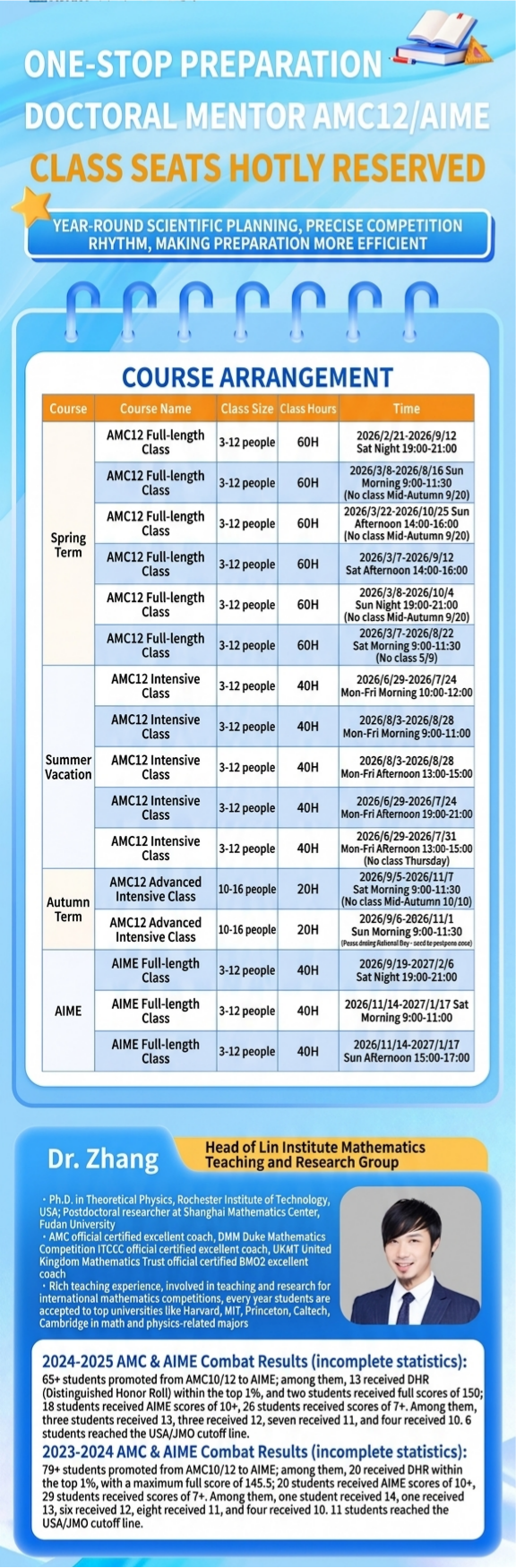
AMC 8 2000–2026 AMC 8 past exam questions and answer keys (includes recorded lecture explanations for the past 20 years)
AMC 10 2010–2025 AMC 10 past exam questions and answer keys (includes video solutions)
AMC 12 2010–2025 AMC 12 past exam questions and answer keys (includes video solutions)
AIME 2011–2026AIME past exam questions and answer keys
USA(J)MO USA(J)MO past exam questions and answer keys
推荐

2012 American Mathematics Competitions 12A paper

2012 AMC 12A

Get Free AMC Competition Past Exam Preparation Resources

Practicing past AMC exams thoroughly is the most effective way to prepare. By becoming familiar with question types and mastering key concepts, students can perform confidently on test day. Below are the past exam questions, answer keys, and detailed solutions for AMC 8/10/12, AIME, and USA(J)MO. Students preparing for math competitions can download these resources for free.

Competition Level Exclusive Free Resources
AMC 8 2000–2026 AMC 8 past exam questions and answer keys (includes recorded lecture explanations for the past 20 years)
AMC 10 2010–2025 AMC 10 past exam questions and answer keys (includes video solutions)
AMC 12 2010–2025 AMC 12 past exam questions and answer keys (includes video solutions)
AIME 2011–2026AIME past exam questions and answer keys
USA(J)MO USA(J)MO past exam questions and answer keys
推荐

2011 American Mathematics Competitions 12B paper

2011 AMC 12B

Get Free AMC Competition Past Exam Preparation Resources

Practicing past AMC exams thoroughly is the most effective way to prepare. By becoming familiar with question types and mastering key concepts, students can perform confidently on test day. Below are the past exam questions, answer keys, and detailed solutions for AMC 8/10/12, AIME, and USA(J)MO. Students preparing for math competitions can download these resources for free.

Competition Level Exclusive Free Resources
AMC 8 2000–2026 AMC 8 past exam questions and answer keys (includes recorded lecture explanations for the past 20 years)
AMC 10 2010–2025 AMC 10 past exam questions and answer keys (includes video solutions)
AMC 12 2010–2025 AMC 12 past exam questions and answer keys (includes video solutions)
AIME 2011–2026AIME past exam questions and answer keys
USA(J)MO USA(J)MO past exam questions and answer keys
推荐

2011 American Mathematics Competitions 12A paper

2011 AMC 12A

Get Free AMC Competition Past Exam Preparation Resources

Practicing past AMC exams thoroughly is the most effective way to prepare. By becoming familiar with question types and mastering key concepts, students can perform confidently on test day. Below are the past exam questions, answer keys, and detailed solutions for AMC 8/10/12, AIME, and USA(J)MO. Students preparing for math competitions can download these resources for free.

Competition Level Exclusive Free Resources
AMC 8 2000–2026 AMC 8 past exam questions and answer keys (includes recorded lecture explanations for the past 20 years)
AMC 10 2010–2025 AMC 10 past exam questions and answer keys (includes video solutions)
AMC 12 2010–2025 AMC 12 past exam questions and answer keys (includes video solutions)
AIME 2011–2026AIME past exam questions and answer keys
USA(J)MO USA(J)MO past exam questions and answer keys
推荐

2010 American Mathematics Competitions 12B paper

2010 AMC 12B

Get Free AMC Competition Past Exam Preparation Resources

Practicing past AMC exams thoroughly is the most effective way to prepare. By becoming familiar with question types and mastering key concepts, students can perform confidently on test day. Below are the past exam questions, answer keys, and detailed solutions for AMC 8/10/12, AIME, and USA(J)MO. Students preparing for math competitions can download these resources for free.

Competition Level Exclusive Free Resources
AMC 8 2000–2026 AMC 8 past exam questions and answer keys (includes recorded lecture explanations for the past 20 years)
AMC 10 2010–2025 AMC 10 past exam questions and answer keys (includes video solutions)
AMC 12 2010–2025 AMC 12 past exam questions and answer keys (includes video solutions)
AIME 2011–2026AIME past exam questions and answer keys
USA(J)MO USA(J)MO past exam questions and answer keys
推荐

2010 American Mathematics Competitions 12A paper

2010 AMC 12A

Get Free AMC Competition Past Exam Preparation Resources

Practicing past AMC exams thoroughly is the most effective way to prepare. By becoming familiar with question types and mastering key concepts, students can perform confidently on test day. Below are the past exam questions, answer keys, and detailed solutions for AMC 8/10/12, AIME, and USA(J)MO. Students preparing for math competitions can download these resources for free.

Competition Level Exclusive Free Resources
AMC 8 2000–2026 AMC 8 past exam questions and answer keys (includes recorded lecture explanations for the past 20 years)
AMC 10 2010–2025 AMC 10 past exam questions and answer keys (includes video solutions)
AMC 12 2010–2025 AMC 12 past exam questions and answer keys (includes video solutions)
AIME 2011–2026AIME past exam questions and answer keys
USA(J)MO USA(J)MO past exam questions and answer keys
推荐

AMC10 Preparation Guide: Target Scores by Foundation

How to Prepare for AMC10 with Different Foundations?

推荐

Students who have completed Algebra 1 at school

You are ready to start preparing for the AMC10 competition. If you want to try taking the exam this November, it is recommended to first supplement your knowledge of number theory and combinatorics/probability, and try to finish learning the basic content of the four major AMC10 modules (algebra, geometry, probability, combinatorics). Your target score should be 70-80 points.
  • Strengthen the foundation: Systematically learn the basic knowledge points of algebra, geometry, number theory, and combinatorics. You can sort out the knowledge framework through textbooks or basic courses.
  • Consolidate through practice: Start with basic AMC10 questions to familiarize yourself with the question types and exam style.
  • Time management: Control the first 15 questions to be completed within 30 minutes during mock exams.

Students who have completed algebra and geometry at school

You can start systematic AMC10 preparation now and officially strive for the exam. First, master the first 15 questions of the AMC10 competition. After reaching 90 points in mock exams, then tackle the last 10 questions. Your target is to qualify for AIME.
  • Specialized training: Conduct targeted practice for weak modules and master problem-solving skills.
  • Stabilize basic questions: Ensure all the first 15 questions are correct, and focus on breaking through medium-difficulty questions.
  • Improve through mock exams: Take at least one mock exam per week to train your answering speed and accuracy.

Students who have already prepared for AMC10

If you have already prepared for AMC10 and scored above 90 points, but there is still a gap between you and AIME qualification or the top 5%, it is likely that you need to improve your problem-solving strategies. You can start with wrong questions to identify weak links.
  • Tackle difficult questions: Focus on studying questions 21-25 and learn the application of advanced number theory, combinatorics, and geometry theorems.
  • Flexible problem-solving: Cultivate skills such as quick question reading, elimination method, and substitution method.
  • Full simulation: Conduct multiple full mock exams to optimize time allocation and answering strategies.
For parents who are unsure about their child's current level and weak modules, you can obtain AMC10 pre-test questions. After completing them within the time limit, you will receive a complete analysis report.

AMC10 vs AMC12: Key Differences, Difficulty, and Preparation Guide

Many parents have reflected that their children are about to enter 10th grade (after 9th grade) and are unsure whether to choose the AMC10 or AMC12 math competition. What are the differences between AMC10 and AMC12? How difficult are AMC10 and AMC12? Do AMC10 and AMC12 have the same gold value?
According to AMC official recommendations: Students in 9th grade and below should prioritize the AMC10 math competition, while those with a solid math foundation can challenge the AMC12 math competition. Today, we will clarify all the key preparation questions you are most concerned about in one go.
推荐

What Are the Differences Between AMC10 and AMC12?

AMC10/12 are comparable to domestic high school and junior high school math competitions. AMC8 focuses on fostering interest and is equivalent to domestic primary school Olympiad math, forming the overall American math competition system.
IMO (International Mathematical Olympiad) represents the U.S. national team to compete with top math talents around the world. USAMO, comparable to CMO, is only open to U.S. citizens and essentially serves as a selection competition for the U.S. national team; winners represent the U.S. team in the IMO. AIME (American Invitational Mathematics Examination), comparable to provincial teams, is held in February of the following year with a full score of 15. A score of 7-10 can help apply for top 30 U.S. universities, and a score of ≥10 can qualify for USAMO and apply for Ivy League schools.
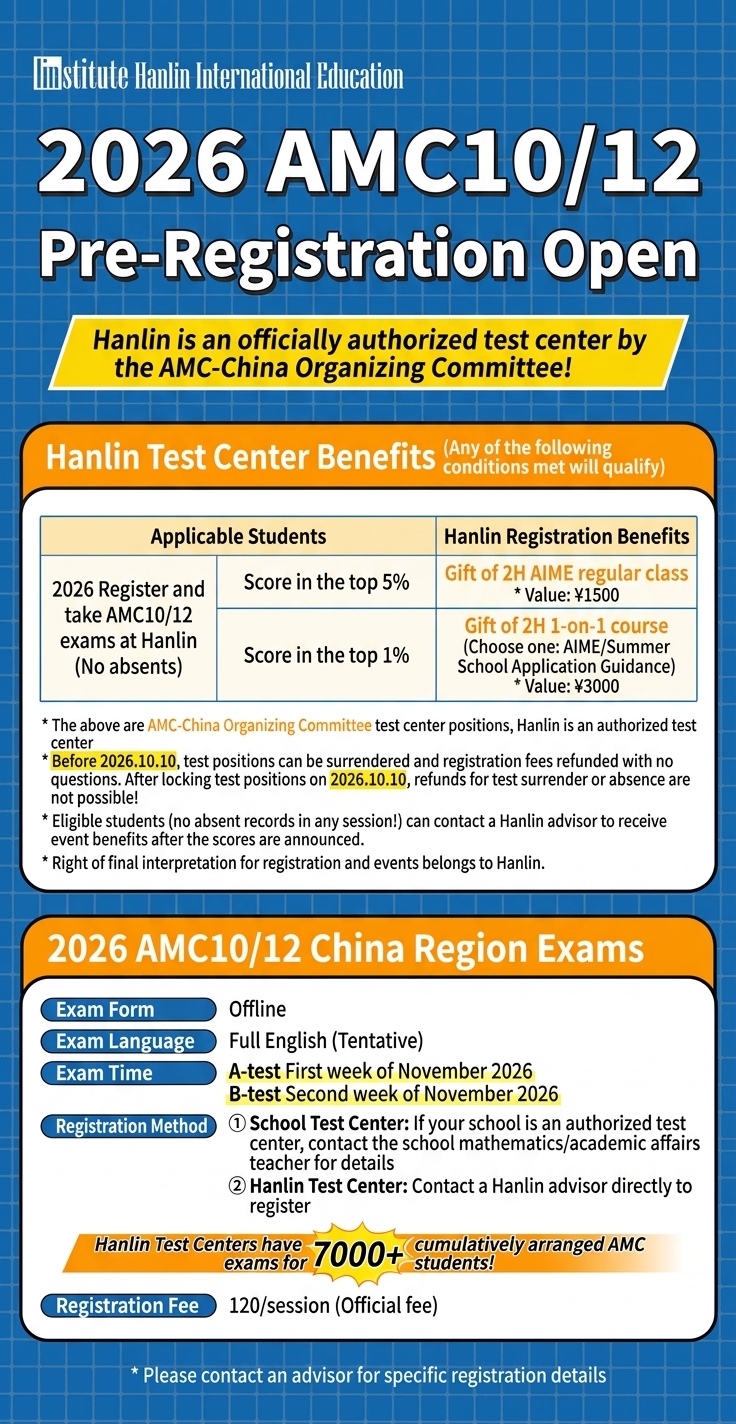
Every November, the top 2.5% of AMC10 participants and the top 5% of AMC12 participants advance to AIME and receive HR certificates. AMC8 is held every January, is non-selective, and serves as an introductory event for American math competitions.

Competition Format Comparison Between AMC10 and AMC12

AMC10 Math Competition Format

Suitable for: Students in 10th grade and below, and under 17.5 years old
Exam Duration: 75 minutes
Number of Questions: 25
Scoring: 6 points for each correct answer, 1.5 points for each unanswered question, 0 points for each incorrect answer; full score is 150
Exam Difficulty and Content: Junior high school 3rd grade and high school 1st grade curriculum content, including elementary algebra, basic geometry, elementary number theory, and probability problems
Exam Time: Every November
Difficulty Level: Intermediate, suitable for high school level
Awards: Perfect Score Award, Global Distinction Award, Global Achievement Award, AIME Qualification Certificate, Global Honor Roll, etc.
AMC10 mainly examines geometry, number theory, probability and statistics, permutations and combinations, etc., but does not involve calculus or trigonometric function knowledge. Some questions are relatively in-depth, such as logical reasoning questions, which require time to understand and master.
Number and Proportion of Questions in Each Module:
Algebra & Sequences: 8 questions, accounting for 32%
Combinatorics & Probability: 6 questions, accounting for 24%
Geometry: 8 questions, accounting for 32%
Number Theory: 3 questions, accounting for 12%
Core Test Points of Each Module:
Algebra: Equations and inequalities, functions and graphs, sequences and series, etc.
Geometry: Plane geometry (triangles, quadrilaterals, circles, etc.), solid geometry (polyhedrons, rotating solids, etc.), Pythagorean theorem, etc.
Number Theory: Prime and composite numbers, divisors and multiples, divisibility problems, remainder problems, etc.
Combinatorics and Probability: Permutations and combinations, counting principles, introductory graph theory, probability calculation, etc.
Functions: Coordinate system, position transformation, linear functions, circle equations, etc.
Solid Geometry: Point-line-plane relationships, 3D coordinate system, solid geometry drawing, regular polyhedrons, Euler's formula, special solid geometric figures, solid geometry skills, etc.
Analytic Geometry: Equations of lines and circles, parabolas, ellipses, hyperbolas, etc.
Inequalities: Linear inequalities, polynomial inequalities, quadratic inequalities, etc.

AMC12 Math Competition Format

Suitable for: Students in 12th grade and below, and under 19.5 years old
Exam Duration: 75 minutes
Number of Questions: 25
Scoring: 6 points for each correct answer, 1.5 points for each unanswered question, 0 points for each incorrect answer; full score is 150
Exam Difficulty and Content: All high school knowledge, including AMC10 content, plus logarithms, complex numbers, trigonometric functions, etc.
Exam Time: Every November
Difficulty Level: Advanced, suitable for high school students with high academic levels
Test Points: All knowledge points of AMC10, plus logarithms, calculation and graphs of trigonometric functions, complex numbers and other high school knowledge points
Awards: Perfect Score Award, Global Distinction Award, Global Achievement Award, AIME Qualification Certificate, Global Honor Roll, etc.
The questions and scope of the AMC12 exam overlap a lot with the AMC10 exam, mainly focusing on the four modules of algebra, geometry, number theory, and combinatorics. However, at the core knowledge level, it adds three knowledge modules: logarithms, calculation and graphs of trigonometric functions, and complex numbers, and these three modules are almost 100% tested in the AMC12.
Number and Proportion of Questions in Each Module:
Number Theory: 7 questions, accounting for 28%
Algebra: 6 questions, accounting for 24%
Geometry: 7 questions, accounting for 28%
Probability/Combinatorics/Logic: 5 questions, accounting for 20%
Core Test Points of Each Module:
Algebra: Various factorization methods and their wide applications, basic rules of exponential operations and solving equations.
Plane Geometry: Calculation of isosceles, equilateral and right triangles, basic trigonometric function calculation of special angles.
Number Theory: Divisibility theory, congruence theory, Fermat's little theorem and fundamental theorem of arithmetic, number theory proofs.
Permutations and Combinations: Counting principles, mastering permutation and combination principles and calculations, calculation of mean, mode, median and weighted mean.
Trigonometric Functions: Basic trigonometric knowledge and formulas, calculation and simplification of trigonometric functions, comprehensive application of trigonometric functions.
Sequences and Series: Solution methods of arithmetic and geometric sequences, learning skills to solve special sequences and series, solution methods of competition questions combining trigonometry, algebra and combinatorics.

Different Thresholds for Advancing to Higher-Level Competitions

Both exams allow advancement to AIME (American Invitational Mathematics Examination), but the advancement ratios are different:
AMC10: The proportion of advancing to AIME is about the top 2.5%, with a higher score line
AMC12: The proportion of advancing to AIME is about the top 5%, with a relatively lower score line
If a child has sufficient mathematical ability, taking the AMC12 math competition is easier to advance.

How to Choose Between AMC10 and AMC12?

If the child has not finished learning high school math: Prioritize AMC10, which is more suitable and easier to win awards
If the child has finished learning high school math and aims to apply for top universities: Choose AMC12, which has higher gold value
If time and energy permit: You can take both exams, one as a backup and the other as a sprint
Suggestions for Taking Both AMC10 and 12:
AMC10A + AMC12B
AMC10B + AMC12A
Competition Name
AMC8
AMC10
AMC12
Suitable for
Students in 8th grade and below, and under 14.5 years old on the competition day
Students in 10th grade and below and under 17.5 years old
Students in 12th grade and below and under 19.5 years old
Registration Time
Around January every year
Held every November, divided into two sessions: A and B, one week apart
Exam Time
40 minutes
75 minutes
75 minutes
Domestic Equivalent
Hope Cup
Junior High School League
High School League
Scoring Standard
Complete 25 multiple-choice questions (25 points) within 40 minutes: 1 point for each correct answer, no points deducted for incorrect answers
Complete 25 multiple-choice questions within 75 minutes: 6 points for each correct answer, 0 points for incorrect answers, 1.5 points for unanswered questions; full score is 150
Exam Content
Mainly divided into three directions: primary school math, junior high school math, primary school Olympiad math
Junior high school and part of high school math in-class knowledge + extracurricular knowledge
High school math in-class knowledge + extracurricular knowledge
Awards
Perfect Score Award: 25 pointsGlobal Distinction Award: Top 1% globallyGlobal Achievement Award: Top 5% globallyGlobal Honor Roll: G6 and below with 15+ points
Perfect Score Award: 150 pointsGlobal Distinction Award: Top 1% globallyGlobal Achievement Award: Top 5% globallyGlobal Honor Roll: G8 and below with 90+ pointsAIME Qualification: Top 2.5% globally
Perfect Score Award: 150 pointsGlobal Distinction Award: Top 1% globallyGlobal Achievement Award: Top 5% globallyGlobal Honor Roll: G8 and below with 90+ pointsAIME Qualification: Top 5% globally

How Difficult Are AMC10 and AMC12?

How difficult are the AMC10 and 12 math competitions? How to judge if a child is suitable for learning? How much energy does it take to prepare?
Compared with in-school math:
AMC10 ≈ Domestic junior high school competition enhancement + a small amount of high school 1st grade math
AMC12 ≈ Domestic high school math league preliminary difficulty
In what ways is AMC12 more difficult than AMC10?
1. One more large block of knowledge
AMC12 adds: Trigonometric functions, logarithms, complex numbers, higher-order algebra. It is impossible to solve without learning high school math.
2. The questions are more tricky and the calculations are more complex
For questions in the same position, AMC12 is obviously more difficult to figure out.
3. The high score segment is more competitive
Many top students take the AMC12, making it more difficult to get high scores.

Gold Value of AMC10 and 12

The gold value of AMC12 is higher than that of AMC10. Because AMC12 is more difficult, covers more extensive and in-depth mathematical knowledge, and has more flexible questions, its difficulty is naturally higher than that of AMC10. Therefore, when applying for top universities, AMC12 scores are often more valued.
推荐

From 15 to 20+: A Complete Guide to AMC 8 Math Competition Topics Across the Four Core Modules

In the AMC 8 mathematics competition, a score of around 15 points generally indicates that a student has a solid foundation. However, reaching 20 points or higher requires a deeper understanding of the exam’s key knowledge areas and more systematic preparation.

To make this improvement, students should carefully review the core AMC 8 topics and strengthen their problem-solving strategies across the competition’s four major modules: Algebra, Geometry, Number Theory, and Combinatorics & Probability.

Below is a comprehensive summary of the major concepts tested in AMC 8 and the strategies students need to move from basic proficiency to top-tier performance.

推荐

AMC 8 Math Competition Topic Overview

Part 1: Algebra

Common Bottleneck at the 15-Point Level

Students at this level are typically able to solve standard linear equations and ratio-based word problems. However, they often rely heavily on routine step-by-step methods. When encountering complex real-world modeling problems with multiple conditions, their problem-solving process may become slow or unclear.

Three Key Breakthroughs to Reach 20+

  1. Develop skills in numerical estimation and efficient calculation, frequently using substitution, verification, and elimination techniques.

  2. Study common problem models in profit, rate, work, and distance problems to improve speed in interpreting questions and forming equations.

  3. Begin building functional thinking, recognizing relationships between variables and applying them to pattern or sequence problems.

Preparation Strategy

Algebra forms the foundation of the AMC 8 exam, and students should aim for close to 100% accuracy in this section. Extensive timed practice is essential to reduce solving time and leave more room for challenging questions in later sections.

Part 2: Geometry

Common Bottleneck at the 15-Point Level

Students can usually apply formulas to calculate perimeter, area, and volume of standard shapes. However, when encountering non-standard diagrams that require auxiliary lines or geometric transformations, they often struggle to find an effective starting point.

Three Key Breakthroughs to Reach 20+

  1. Master techniques such as area transformation and decomposition to handle irregular shapes.

  2. Gain a deeper understanding of the Pythagorean theorem and similarity models, allowing students to identify or construct key right triangles and similar figures.

  3. Develop a geometric perspective using symmetry and rotation to simplify complex diagrams and calculations.

Preparation Strategy

Geometry is often a critical module for score improvement. Through targeted practice, students should memorize classic geometric models and learn common strategies for adding auxiliary lines to unlock difficult problems.

Part 3: Number Theory

Common Bottleneck at the 15-Point Level

Students usually understand basic concepts such as prime numbers, composite numbers, and divisibility. However, their knowledge may remain fragmented. When problems involve remainder cycles, place value properties, or integer solutions to equations, students often struggle to apply concepts flexibly.

Three Key Breakthroughs to Reach 20+

  1. Memorize prime numbers below 100 and become comfortable with prime factorization of composite numbers.

  2. Learn common divisibility rules to quickly filter and simplify calculations.

  3. Understand and apply the properties of remainders and modular relationships.

Preparation Strategy

With systematic learning and targeted practice, number theory can transform from a challenging area into a consistent scoring opportunity on the AMC 8.

Part 4: Combinatorics and Probability

Common Bottleneck at the 15-Point Level

Many students perceive combinatorics as extremely difficult and may either skip these problems entirely or resort to guessing. They often struggle with classification, systematic counting, or multi-step probability reasoning.

Three Key Breakthroughs to Reach 20+

  1. Build a solid understanding of fundamental counting principles.

  2. Learn structured counting strategies such as organized enumeration and the inclusion–exclusion principle.

  3. Use practical tools such as tree diagrams or tables to transform abstract counting problems into visual and manageable steps.

Preparation Strategy

By mastering several core combinatorics models and techniques, students should aim to reliably solve two to three medium-difficulty problems in this section. Even when facing harder questions, structured reasoning can significantly increase the chance of reaching the correct answer.

Final Thoughts

Improving from 15 points to 20+ on the AMC 8 requires more than simply solving additional practice problems. Students must build a complete knowledge system across all four modules, strengthen their mathematical reasoning, and develop efficient problem-solving strategies.

With consistent training, targeted topic review, and timed practice, students can significantly improve their performance and compete for top AMC 8 awards in future competitions.

推荐

AMC 8 2026 North America Cutoffs Reach Record High: Will China Set Separate Score Lines? How to Prepare for AMC 8 2027

The cutoff scores for the 2026 AMC 8 competition in North America have reached a new high, reflecting the increasingly intense level of competition. This year, the organizers also released the Top 10% score benchmark for reference, giving students and parents a clearer picture of performance distribution.

推荐

2026 AMC 8 North America Score Distribution

According to the official statistics, the 2026 AMC 8 results in North America are as follows:

  • Top 1% Score: 24.00

  • Distinguished Honor Roll (DHR): 23.00

  • Top 2.5% Score: 21.00

  • Top 5% Score: 16.00

  • Top 25% Score: 12.00

  • Top 50% Score: 9.00

  • Top 75% Score: Not specified

  • High Score: 25.00

  • Average Score: 12.42

  • Standard Deviation: 4.72

  • Total Students: 80,998

  • Total Schools: 2,131

2026 AMC 8 Award Cutoffs (North America)

  • Perfect Score Award: 25

  • Distinguished Honor Roll (Top 1%): 24

  • Honor Roll (Top 5%): 21

  • Top 10%: 19

  • Top 25%: 16

  • Global Honor Award: 15

These results highlight just how competitive the AMC 8 has become in recent years.

Will the AMC 8 China Division Set Separate Cutoffs?

In 2026, students in the China division encountered an unusual situation: three different versions of the exam were administered.

Many educators and participants believe that the China competition paper was noticeably more difficult than those used in other regions. If the North American cutoff scores were applied directly, it could potentially disadvantage students in China.

At present, the China organizing committee is still carefully evaluating the results. The final cutoff scores have not yet been announced.

According to official statements, the committee will conduct a comprehensive assessment based on the full score distribution of Chinese participants before determining the final award thresholds. Students and parents are advised to wait for the official announcement.

Planning and Preparing for AMC 8 2027

Regardless of how the final cutoffs are determined, one clear trend has emerged: AMC 8 competition is entering a stage of refined competition, where early planning and systematic preparation are key to success.

AMC 8 Competition Overview

Eligible Grades: Grade 8 and below
Exam Date: January 2027
Exam Duration: 40 minutes
Number of Questions: 25 multiple-choice questions
Languages: English and Chinese bilingual exam

Scoring Rules:

  • Correct answer: 1 point

  • Incorrect or blank answer: 0 points

  • Maximum score: 25 points

Key Topics Tested in AMC 8

The AMC 8 focuses on four major areas of mathematics:

  • Number Theory

  • Algebra

  • Geometry

  • Combinatorics and Logical Reasoning

Algebra (Approximately 40%, around 10 questions)

Topics include algebraic operations, rational number calculations, exponent rules, radicals, defined operations, arithmetic and geometric sequences, equations and word problems, proportional relationships, and coordinate geometry concepts such as linear functions and graph intersections.

Combinatorics and Probability (8–16%, about 2–4 questions)

This section covers probability formulas, independent and mutually exclusive events, tree diagrams and tables for probability calculation, statistics (mean, median, mode, range), permutations and combinations, factorials, counting principles, and inclusion–exclusion.

Geometry (12–20%, about 3–5 questions)

Common topics include angle relationships, triangle properties, polygon angle sums, the Pythagorean theorem, special triangles, parallel lines, similarity, area and perimeter problems, circle properties, sector calculations, and surface area and volume of three-dimensional figures.

Number Theory (16–24%, about 4–6 questions)

This section includes divisibility rules, parity (odd and even numbers), factors and multiples, greatest common divisors and least common multiples, prime factorization, number of divisors, remainder problems, and modular arithmetic patterns.

AMC 8 Preparation Strategy by Grade Level

Grade 3: Build Interest and Mathematical Intuition

Students at this stage should focus on developing curiosity and enjoyment in mathematics rather than rushing into competition preparation. Activities such as logic puzzles, Sudoku, Rubik’s Cube challenges, and reading resources like Singapore Math can help cultivate number sense. Participation in AMC 8 can be viewed as a learning experience.

Grades 4–5: Establish Foundations and Attempt the First Competition

This is an ideal stage to begin systematic learning of the four core AMC 8 topics. Students may attempt the competition for the first time, with a realistic goal of achieving around 15 points, which may qualify for the Achievement Roll (AR) for younger participants.

Grades 6–7: Intensive Training and Award Targets

At this stage, students should focus on structured practice and targeted training using past AMC 8 problems and full mock exams. Expanding knowledge in more advanced topics such as number theory and combinatorics is essential. The goal can be to reach Honor Roll (Top 5%) or Distinguished Honor Roll (Top 1%).

Grade 8: Final Opportunity to Achieve a Top Score

For many students, Grade 8 represents the final chance to participate in AMC 8. The goal is to achieve a strong score and build a solid mathematical foundation that prepares students for AMC 10 and AMC 12 competitions.

推荐

Online Consultation
Online Consultation