If a page gives the AIME qualifying score as a percentile, refers to AIME I and AIME II, or builds a USAMO index out of your AMC score, it predates MAA’s August 2026 revision and describes a system that no longer runs. Qualification, format, venue and schedule all changed together. This is how to date a source before you plan a season around it.
The reason this matters in September rather than in February is that the planning happens now. A student who sets an autumn target from a 2025 cutoff table, or who schedules a February around two AIME dates, has committed the season before anyone checks the source. Below is a dating routine you can run in about a minute on any page, plus the one over-correction that is now almost as common as the original error.
What actually changed, in one paragraph
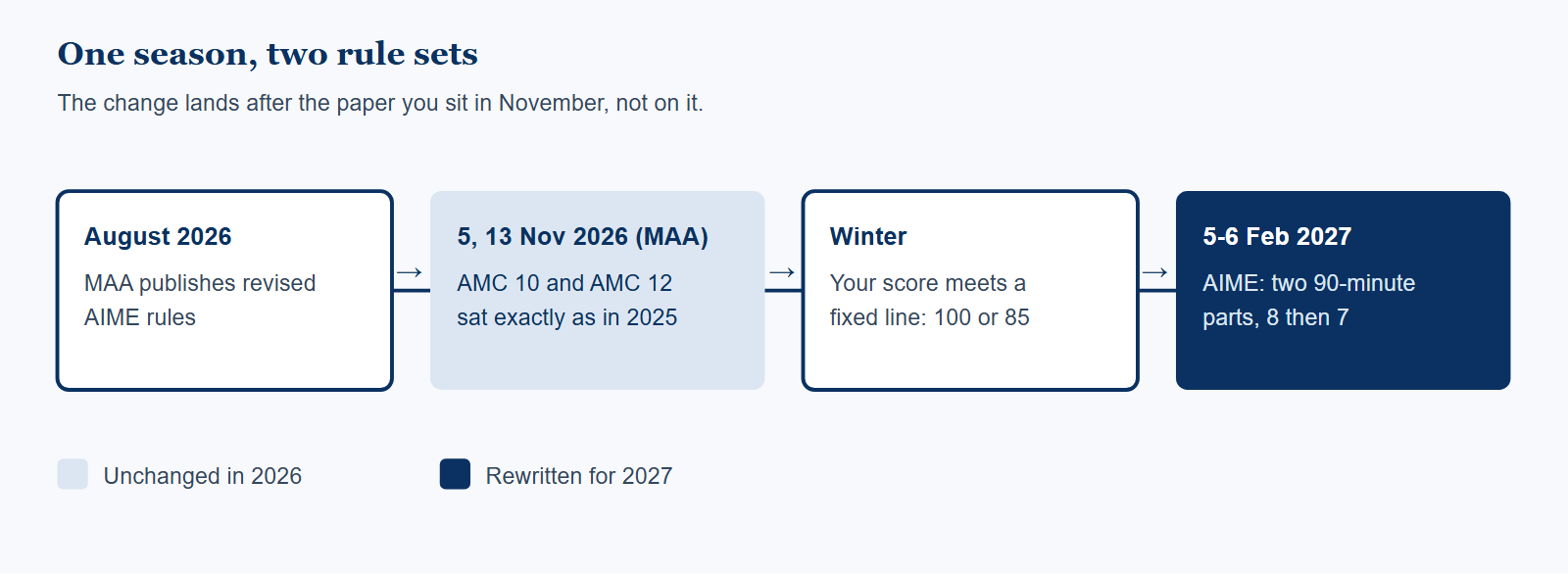
MAA rewrote the round between the AMC and the olympiad. Qualification stopped being a rank and became a number: 100 or above on the AMC 10, 85 or above on the AMC 12, in MAA’s own words because “the thresholds for qualifying for AIME will be set numbers rather than based on percentages.” Selection for the USAMO and USAJMO is now “primarily based on AIME scores; AMC scores will no longer be a factor.” The exam moves to Pearson Professional Centers with student self-scheduling, runs electronically as two 90-minute parts of eight questions and then seven, permits nothing to be carried in, and runs in a single window on 5–6 February 2027 after AIME I and AIME II were retired. Candidates must be 13 or over, and the fee is US$85 plus tax. Everything in that paragraph is taken from MAA’s revised AIME material, read on 26 August 2026.
Five separate mechanisms changed at the same time. That is why partial updates are so common: a page can correct the qualifying score and still describe a three-hour paper, or fix the format and still run an index calculation that no longer exists.
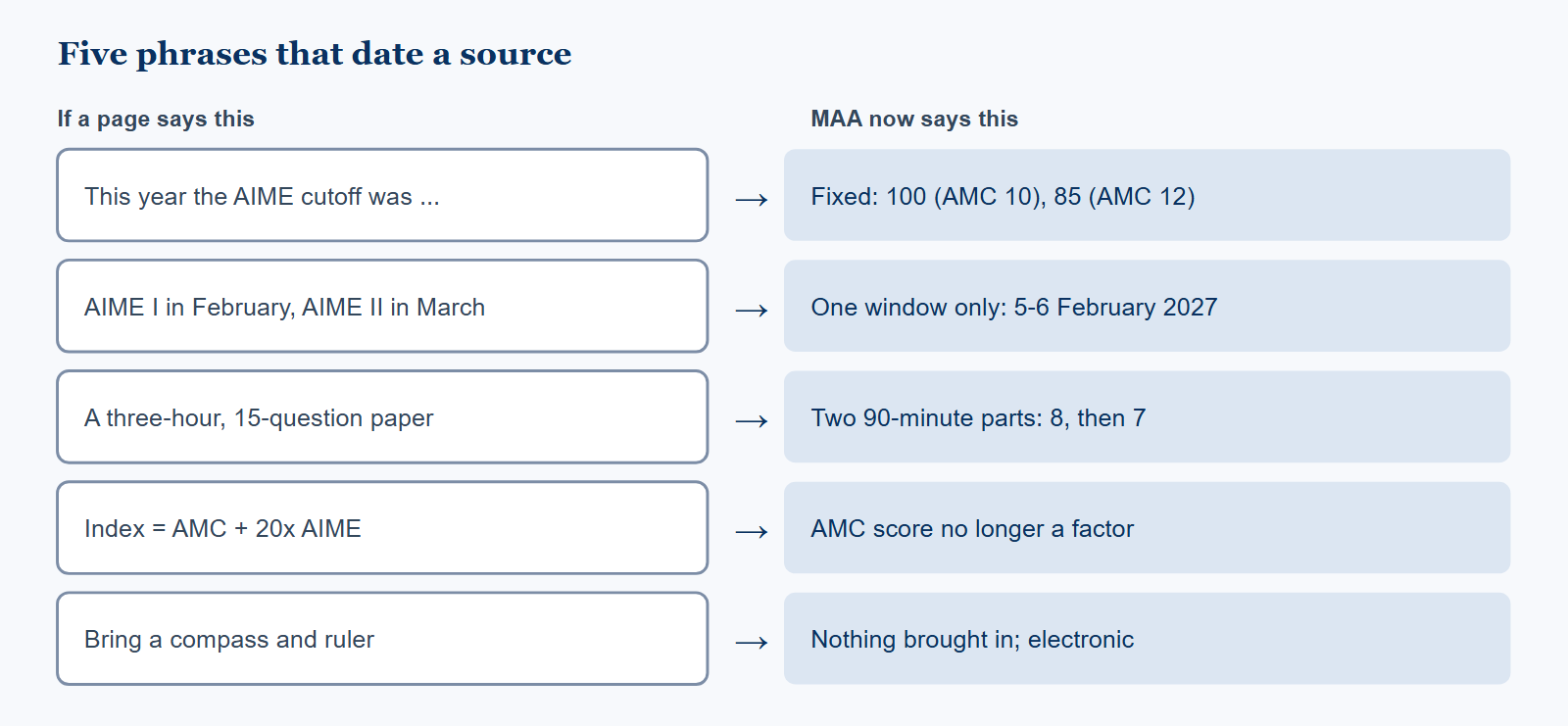
Five phrases that date a source
You do not need to audit a page line by line. Each of the following is load-bearing enough that its presence tells you the whole page belongs to the retired model, and that anything else on it about the AIME is unverified until you check.
| If the page says | The model it belongs to | What MAA says now |
|---|---|---|
| “The AIME cutoff this year was …” or “the qualifying score for 10A” | Qualification set by percentile and published after the paper | Fixed thresholds, known in advance: 100 on the AMC 10, 85 on the AMC 12 |
| “The top 2.5% qualify” | The same percentile mechanism, stated as a rank | A percentile is no longer the mechanism at all |
| “AIME I in February, AIME II in March” | Two administrations with a choice of date | One window: 5–6 February 2027. AIME I and AIME II are retired |
| “A three-hour paper of fifteen questions” | A single continuous sitting on paper | Two 90-minute parts, eight questions then seven; part one closes when part two begins |
| “Your index is your AMC score plus twenty times your AIME score” | Combined AMC-and-AIME selection for the olympiad | “Primarily based on AIME scores; AMC scores will no longer be a factor” |
| “Bring a compass and ruler” or “your school will run the AIME on …” | A paper AIME administered by the institution | Nothing may be brought in; taken electronically at a Pearson centre with self-scheduling |
The over-correction: assuming the AMC changed too
Once a student learns that something big changed, the instinct is to distrust everything. That produces a second error, and in September it is the more expensive one, because it makes people rewrite plans that were correct. MAA is explicit: “AMC 10 and AMC 12 will be administered in 2026 as they were in 2025.”
So the following all still stand, and a source that “corrects” them is now the stale one:
- The dates. MAA publishes 5 November 2026 for the AMC 10A and 12A and 13 November 2026 for the 10B and 12B. Your authorised centre publishes its own sitting arrangements, which is a separate thing to confirm.
- The scoring. 150 points maximum, and 1.5 points for a question left blank.
- The percentile recognitions. Honor Roll at the top 5%, Distinguished Honor Roll at the top 1%.
- The achievement award at 90. The fixed-score award for younger students is unchanged.
- The format of the day. The 2026 season is in person at authorised centres, and the 2026 in-person AMC rules and centre arrangements are the ones you should be reading for November.
There is one genuine casualty in this list, and it is a subtle one. Honor Roll and AIME qualification used to move together, because both were percentile creatures. They no longer are. One is a rank in the field; the other is a number on your own answer sheet. Depending on how hard a given paper turns out to be, you can now clear one and miss the other in either direction. Do not treat them as the same line, and be wary of any source that still does.
What to do with a plan built on the old numbers
Most students who did any planning over the summer built it on a cutoff table. The instinct now is to throw those tables away. That is half right.
An old qualifying figure is no longer a target, because a percentile no longer decides anything. But it was never only a target: it was also a rough record of how hard a particular paper turned out to be relative to the field that sat it. That second use survives the rule change intact. A year whose qualifying score sat unusually low was telling you something real about that paper, and it still does.
What does not survive is putting an old figure anywhere near your own planning arithmetic, which is why this guide does not reproduce past qualifying scores at all. Printing a retired number next to a live rule is precisely how a reader ends up aiming at a line that has stopped existing.
Your target is now something you can write on a piece of paper in September and not revise: 100 out of 150 on the AMC 10, which is two thirds of the paper, or 85 out of 150 on the AMC 12, a little under fifty-seven per cent. It will not move when the field moves. That is the single largest practical gain from the change, and it is worth restating because almost every stale page on the internet still implies the opposite.
A one-minute source-hygiene routine
Run this on any page, forum answer or class handout before you let it shape a decision.
- Find the date. Publication or last-updated. Anything before late August 2026 is presumed stale on the AIME and must be verified claim by claim. Undated pages are treated as stale.
- Scan for the five phrases. One hit and you stop trusting the page’s AIME content entirely, including the parts that happen to be right.
- Check it did not over-correct. If a page tells you the AMC 10 or AMC 12 itself has changed for 2026, it has gone the wrong way. MAA says they run as they did in 2025.
- Go to maa.org for anything procedural. Registration, eligibility, scoring, dates and permitted materials are worth reading from the source rather than from a summary of a summary.
- Do not let a source fill a gap MAA has left open. Several AIME policies are marked as still to be posted. A page that confidently states one of them is guessing.
- Treat entry route as region-specific. MAA says participants in the AMC international program should follow the policies of the International Group Leader for their country or region. It has not said that candidates based in China use the Pearson booking flow, so do not import it. Ask your Group Leader or your centre, and read it alongside the in-person centre rules for the 2026 season.
One first-party note, because it belongs in an article about stale sources. On 27 August 2026 we audited our own published archive against MAA’s revised material and corrected the pages that were wrong, and there were a number of them: articles that had been accurate when written and had quietly stopped being accurate. That is the normal condition of competition writing, not an unusual failure. It is also the reason to check a date before you check an argument. If a page has no visible date and no correction policy, you have no way to know which version of the rules its author was looking at.
Frequently asked questions
How do I know if a page about the AIME is out of date?
Look for a percentile cutoff, AIME I and II, a three-hour paper, or an AMC-plus-AIME index. Any one of them predates the August 2026 revision.
Did the AMC 10 and AMC 12 change too?
No. MAA states they are administered in 2026 as they were in 2025: same scoring, same 1.5 for a blank, same Honor Roll percentiles.
Are old AIME cutoff tables useless now?
Not useless, but they no longer set your target. Read them as evidence about how hard a paper was, never as a qualification line.
Does the Pearson booking process apply to students in China?
MAA has not said so. It directs international participants to the Group Leader for their country or region. Confirm your route there.
This is an independent English-language guide to the American Mathematics Competitions, operated by Hanlin Education for China-based international-school students. We are not affiliated with, endorsed by, or sponsored by the Mathematical Association of America. Rules and dates change between cycles — confirm current details on maa.org and with your own authorised test centre or regional Group Leader before acting on anything here. Errors reported to our editorial desk are corrected within 7 working days.