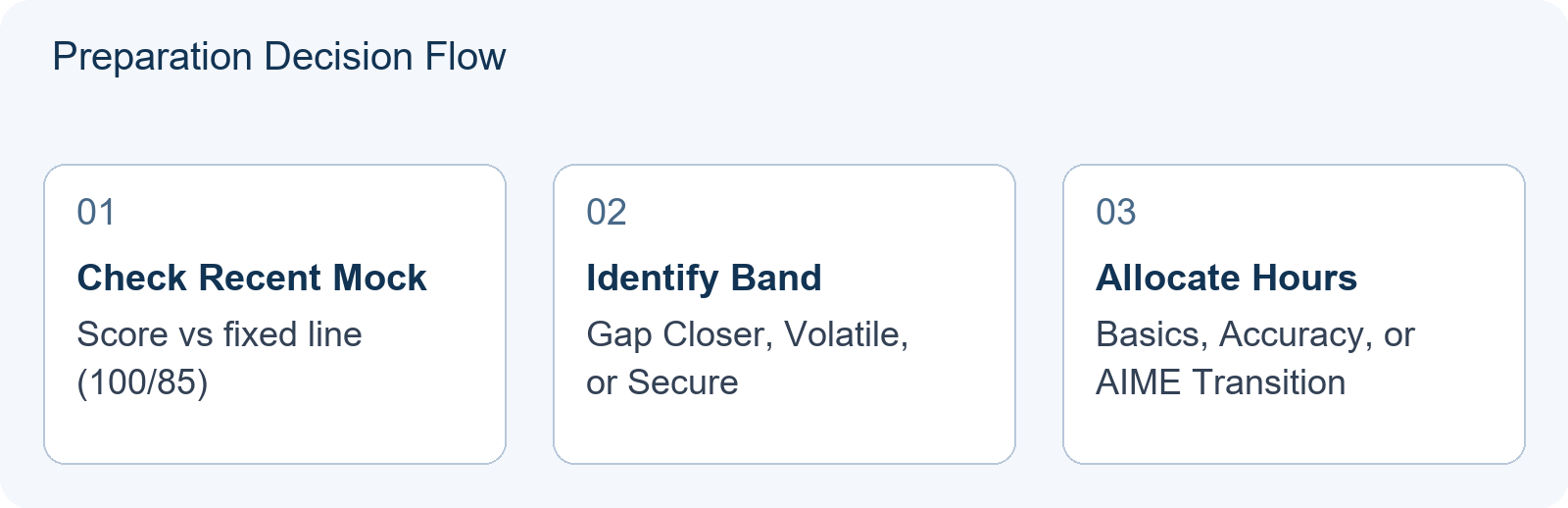
For families preparing for the American Mathematics Competitions (AMC) in late 2026, a critical strategic question arises: How should a student balance the final month of AMC 10/12 preparation with the need to start training for the AIME? The answer depends on the student’s current performance relative to the newly fixed qualification thresholds, and on which region they will sit the exam.
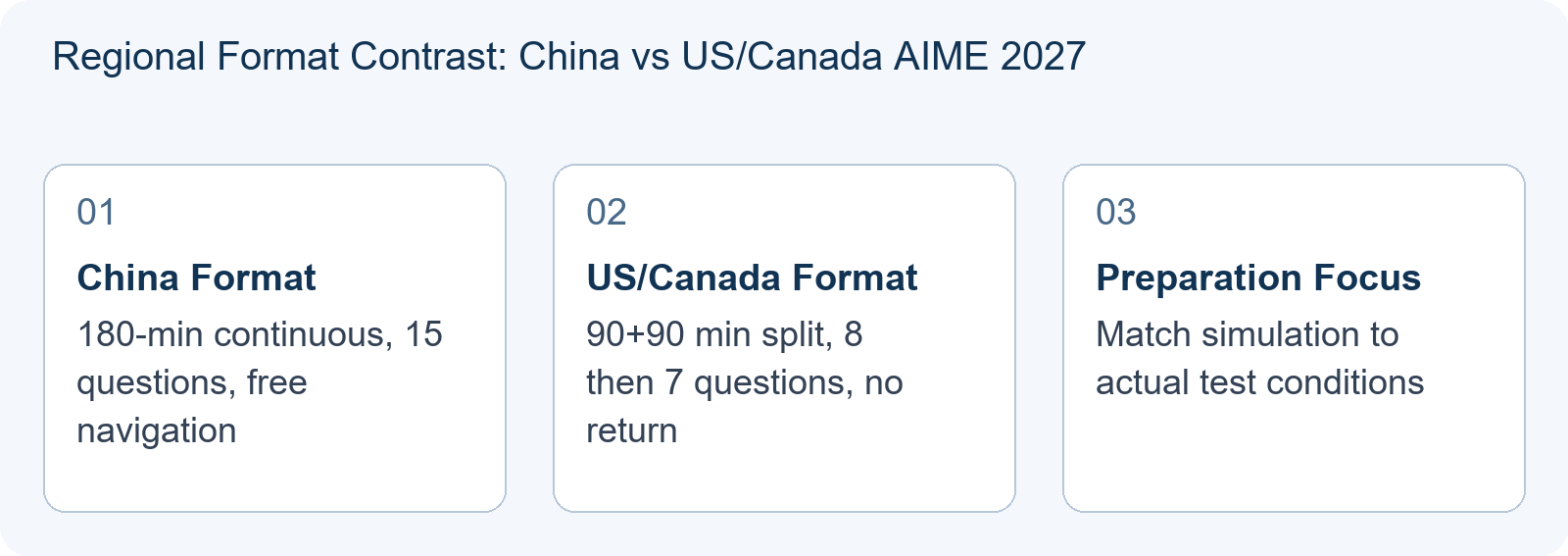
As of the 2027 season, the MAA has established static cutoffs: an AMC 10 score of 100 or an AMC 12 score of 85 qualifies a student for AIME, provided other eligibility criteria are met. However, the exam format differs sharply by region. In the US and Canada, AIME 2027 moves to Pearson Professional Centers with a split-session format: two 90-minute halves with 8 and 7 questions respectively, no return to the first half, and a minimum age of 13 under the US/Canada policy. In China, the AIME retains its 180-minute continuous format according to the October 10, 2026 operator report, with eligibility to be confirmed through the regional organizer. This article provides a framework for balancing AMC and AIME preparation that respects these regional differences.
The Structural Shift: Fixed Lines and Regional Formats
Previously, AIME qualification was determined by percentile rankings, which fluctuated based on the strength of the global candidate pool. The 2027 reform introduces fixed integer thresholds—100 for AMC 10 and 85 for AMC 12. According to MAA official rules checked in October 2026, this change aims to provide transparency and stability.
For the prospective family, this means the target is no longer “beat X% of students” but “hit Y points.” However, the path after qualification diverges by region. In the US and Canada, the AIME is now computer-based at Pearson centers, split into two 90-minute sessions with a short break between them. The first session covers questions 1–8; the second covers questions 9–15, with no ability to return to the first half. In China, students following the region-specific arrangement reported by the operator still face 15 questions in a single 180-minute continuous block, with full freedom to allocate time across all problems.
These format differences matter for preparation. A student training for the US/Canada must build stamina for two intense focused bursts and practice committing to answers without later revision. A student in China must sustain concentration for three hours and manage their own pacing without enforced breaks. Both paths require the same mathematical foundation, but the simulation conditions should match the actual test.
Teaching Illustration: Diagnostic Band Analysis
To illustrate how preparation should differ by current standing, consider three teaching illustrations. These are constructed scenarios for pedagogical purposes, not based on individual students.
Band 1: The Gap Closer (Below Threshold)
Consider “Alex,” a hypothetical student who currently scores between 70 and 90 on AMC 10 practice tests. Alex is below the fixed 100-point threshold. For Alex, the primary risk is premature AIME study.
Worked Teaching Illustration: Let us analyze a concrete problem type that Alex should master versus one that would distract from qualification.
AMC 10 Problem (Position 12): A rectangle has length L and width W. If L = W + 3 and the area is 40, find the perimeter. Solution: W(W+3) = 40 ⇒ W² + 3W − 40 = 0 ⇒ (W + 8)(W − 5) = 0. Since W > 0, W = 5 and L = 8. Perimeter = 2(5 + 8) = 26. This requires basic algebra and factoring.
By contrast, consider the following AIME-level problem: Find all positive integers n such that n² − 19n + 99 is a perfect square. Complete derivation: Let n² − 19n + 99 = m² for non-negative integer m. Complete the square in n: (2n − 19)² − 4m² = 361 − 396 = −35. Thus (2n − 19)² − (2m)² = −35, or (2m)² − (2n − 19)² = 35. Factor as (2m − (2n − 19))(2m + (2n − 19)) = 35. Let a = 2m − (2n − 19) and b = 2m + (2n − 19), so ab = 35 with b > a ≥ 0 and b − a = 2(2n − 19) even, so a and b have same parity. Since 35 is odd, both a and b are odd. Factor pairs of 35: (1, 35), (5, 7), (−35, −1), (−7, −5). Solving:
- a = 1, b = 35: 4m = 36 ⇒ m = 9; 2(2n − 19) = 34 ⇒ n = 18
- a = 5, b = 7: 4m = 12 ⇒ m = 3; 2(2n − 19) = 2 ⇒ n = 10
- a = −35, b = −1: 4m = −36, invalid (m ≥ 0)
- a = −7, b = −5: 4m = −12, invalid
Also check a = −5, b = −7 (giving m = −3, invalid) and a = −1, b = −35. The valid positive solutions are n = 1, 9, 10, 18 (verified by substitution: 1−19+99=81=9²; 81−171+99=9=3²; 100−190+99=9=3²; 324−342+99=81=9²). The sum is 1 + 9 + 10 + 18 = 38.
Extensive work on the second problem type may be less targeted than repairing the AMC errors identified in Alex’s attempts, though deeper reasoning can transfer between exams. Fifteen correct AMC 10 answers plus ten blanks give 15 × 6 + 10 × 1.5 = 105 points. This arithmetic does not guarantee Alex can achieve that pattern. Use the actual error record to balance accuracy, timing and a limited amount of stretch work.
Band 2: The Volatile Qualifier (Near Threshold)
Consider “Jordan,” who scores between 90 and 105 on AMC 10 mocks. Jordan is near the 100-point threshold but inconsistent. A single careless error in a mid-level problem can drop the score below the line.
Contrasting Case: Suppose Jordan attempts AMC 10 Problem 22 (a complex counting question) during a mock test. He spends 8 minutes deriving a solution but makes an arithmetic slip in the final combination calculation, selecting the wrong multiple-choice option. Meanwhile, he rushed Problem 14 (a straightforward geometry question) and misread the scale factor, losing 6 points. Total loss: 12 points. Result: Score 97.5. Failed qualification.
Note that 97.5 is a valid AMC score (achievable with 16 correct and 1 blank: 6 × 16 + 1.5 × 1 = 97.5). The point is that Jordan’s issue is not ceiling but floor—process discipline, not problem difficulty. Practicing AIME-style deep thinking is premature. Jordan needs full-length 75-minute simulations where the goal is reliable execution on every solvable problem.
Band 3: The Secure Qualifier (Above Threshold)
Consider “Sam,” who consistently scores 115+ on AMC 10. Sam has cleared the qualification bar. Here, the risk is complacency about the format transition.
Worked Teaching Illustration: Compare the approach to a counting problem.
AMC Approach: “How many ways can you arrange 3 red and 2 blue balls in a row?” Sam recognizes this as C(5,2) = 10. He selects answer C in 30 seconds.
AIME Approach: “Find the number of sequences of length 10 consisting of digits 0–9 such that no two adjacent digits are equal, and the sequence starts with 5.” Sam cannot apply a formula directly. He must define states, derive a recurrence, and calculate manually. There are no options to guess.
For Sam, 30–40% of study time should pivot to AIME-specific skills: writing out solutions, checking edge cases, and managing the 180-minute endurance (or the two 90-minute sessions for US/Canada). The transition is from selection to generation.
Regional Format Implications for Preparation
The China-US format divide affects how students should simulate conditions. For China-based students following the region-specific arrangement reported by the operator, practice should mirror the 180-minute continuous block with full navigation freedom. For US/Canada students at Pearson centers, practice should incorporate the split-session constraint: work 8 problems in 90 minutes, take a break, then work 7 problems in 90 minutes with no return to the first set.
Importantly, the two halves have comparable difficulty—do not assume the second half is uniformly harder. The restriction is on revisiting the first half during the second, not on revisiting within a half. Students should practice committing to answers and managing the psychological shift at the break.
Practical Next Steps for Families
Before consulting with tutors or purchasing resources, gather three data points:
- Recent Full-Length Mock Scores: Total and breakdown by question range (1–10, 11–20, 21–25).
- Error Log: Categorize mistakes as “conceptual,” “calculation,” or “time management.”
- Target Region and Format: Confirm whether the student will sit in China (180-min continuous) or US/Canada (90+90 split).
For China-based families, confirm the current AIME format and participation arrangements with the intended regional organizer or test center before booking. The continuous-format discussion here follows the operator report dated October 10, 2026; it is not a guarantee of a particular venue, service package or automatic continuation from an AMC registration.
Conclusion: Balance Through Evidence
Balancing AMC and AIME preparation means aligning effort with evidence. Use mock scores to diagnose your band. If below the line, focus on AMC fundamentals. If near it, prioritize accuracy and process. If securely above, begin the format transition—but simulate the correct regional conditions. The fixed thresholds offer clarity, but disciplined execution converts clarity into qualification.
Frequently Asked Questions
Can I start AIME prep if my AMC 10 score is 95?
If practice scores remain below the applicable qualification threshold, prioritize the errors limiting AMC performance while keeping some appropriately chosen stretch work. Fifteen correct answers and ten blanks total 105 under AMC 10/12 scoring, but a preparation plan should use the student’s actual accuracy and timing record rather than assume that pattern is reliable.
Does a high AMC score guarantee AIME success?
No. The exams test different skills. AMC rewards speed and pattern recognition in multiple-choice formats. AIME rewards rigorous derivation and endurance in integer-answer formats. A student can excel in one and struggle in the other without targeted transition training. The format also differs by region—China uses 180-minute continuous; US/Canada uses 90+90 split.
How do I practice for the AIME if I am in China?
China-based students should simulate the 180-minute continuous format used at authorized centers like Hanlin. Practice full 15-problem sets in a single sitting with complete time freedom. Do not train using the US/Canada split-session model unless you will sit in that region. Hanlin provides AMC-to-AIME transition courses and mock testing aligned with the China format.