On the AMC 10/12, a correct answer is a correct answer—until it isn’t. The multiple-choice format means a student can guess right for the wrong reasons, walk away with 6 more points, and never realize the foundation underneath is shaky. This is the core problem of AMC 10/12 confidence calibration: the scoreboard says you know it, but your actual readiness for harder problems—or for AIME—says otherwise. In this article, we explain why every correct answer deserves a second look, how to distinguish genuine mastery from lucky guesses, and what to do with the results.
Why the AMC 10/12 Rewards Uncalibrated Confidence
The AMC 10/12 scoring system is simple: 6 points for a correct answer, 1.5 points for a blank, 0 for a wrong answer. With five choices per question, a pure guess has expected value 1.2 points—below the blank. If you can legitimately eliminate one choice and guess uniformly among the remaining four, the expected value rises to 1.5, equal to the blank. Only when you eliminate two choices and guess uniformly among three does the expected value reach 2.0, clearly exceeding the blank.
This creates a dangerous feedback loop. A student who guesses correctly on two problems in the 15–20 range might see a score jump by 12 points—approaching or crossing the fixed AIME threshold of 100 for AMC 10 or 85 for AMC 12 (MAA official rules, checked October 12 2026). But that same student, sitting AIME with no answer choices and integer answers from 0 to 999, would have no scaffolding to fall back on. The guess that saved an AMC sitting becomes a liability in the next round.
With fixed AIME thresholds now in place, students should focus on whether they can reliably reach those scores, not whether a single sitting happened to break the line.
The Mechanics of a Lucky Guess: A Worked Teaching Case
Consider a teaching illustration typical of problems in the AMC 12 range 18–22:
Teaching illustration: A positive integer with satisfies that is divisible by 6 but not by 9. How many such values of exist?
A student might try small cases: gives 6 (works), gives 12 (works), gives 30 (works). Noticing gives 20 (not divisible by 3, so fails), they might spot that always fails. They guess the pattern continues with period 3, estimate about 66 values, then pick 44 because it “looks reasonable” among the choices—without any proof.
Let us verify properly. Since is always even, divisibility by 6 requires divisibility by 3. This occurs when , i.e., or . Among , there are 33 values for each residue class, so 66 values with .
For non-divisibility by 9: we need . This fails when or , i.e., or . Checking residues mod 3: and , so all such are among our 66 candidates. From 1 to 99, there are 11 values each: 7, 16, 25, …, 97 and 8, 17, 26, …, 98. Total exclusions: 22.
Therefore, the answer is .
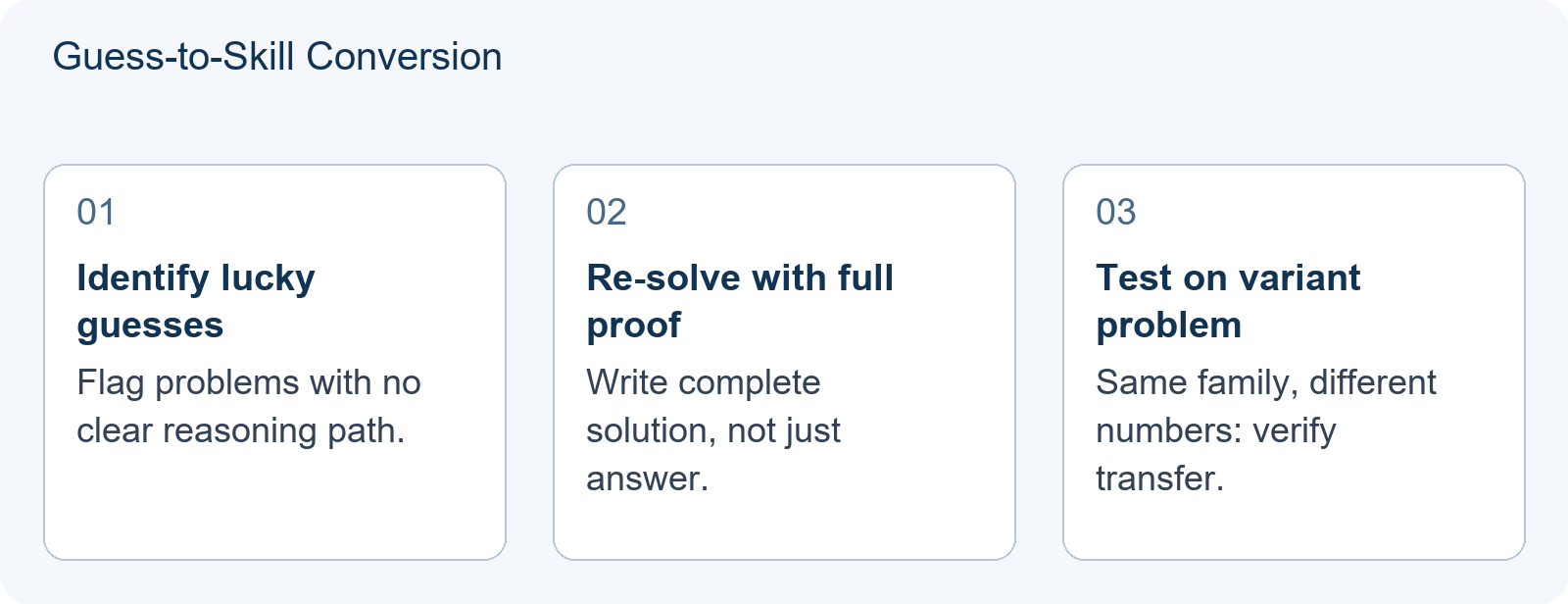
The student who guessed 44 was right by luck, not by reasoning. They had no proof that the pattern was periodic with the right exclusions, and if the problem had changed slightly—say, divisibility by 7 instead of 9—their pattern-matching would likely fail. The deeper lesson: a correct answer without verifiable reasoning is a liability dressed as an asset.
Where a Similar Approach Fails: The Contrasting Case
Consider a superficially similar problem where pattern-matching destroys you:
Teaching illustration: How many integers with make divisible by 3?
A student tries small cases: gives 3 (yes); gives 7 (no); gives 13 (no); gives 21 (yes). Pattern: yes at 1, 4, … period 3? Guess about 33 or 34.
Proper verification: . Since is always even, consider mod 3. If , value ; if , value ; if , value . So only works. From 1 to 100: 1, 4, 7, …, 100? Since , yes. So 34 values.
The pattern guess of “about 33” was close but not reliably derived. More critically, the student who got lucky on the first problem might assume pattern-matching works here too. If the answer choices had included 33 instead of 34, they would have been wrong. The contrast: problems with hidden modular constraints punish guessing; problems with explicit multiplicative structure can sometimes tolerate it, but only with verification.
Building a Confidence Audit System
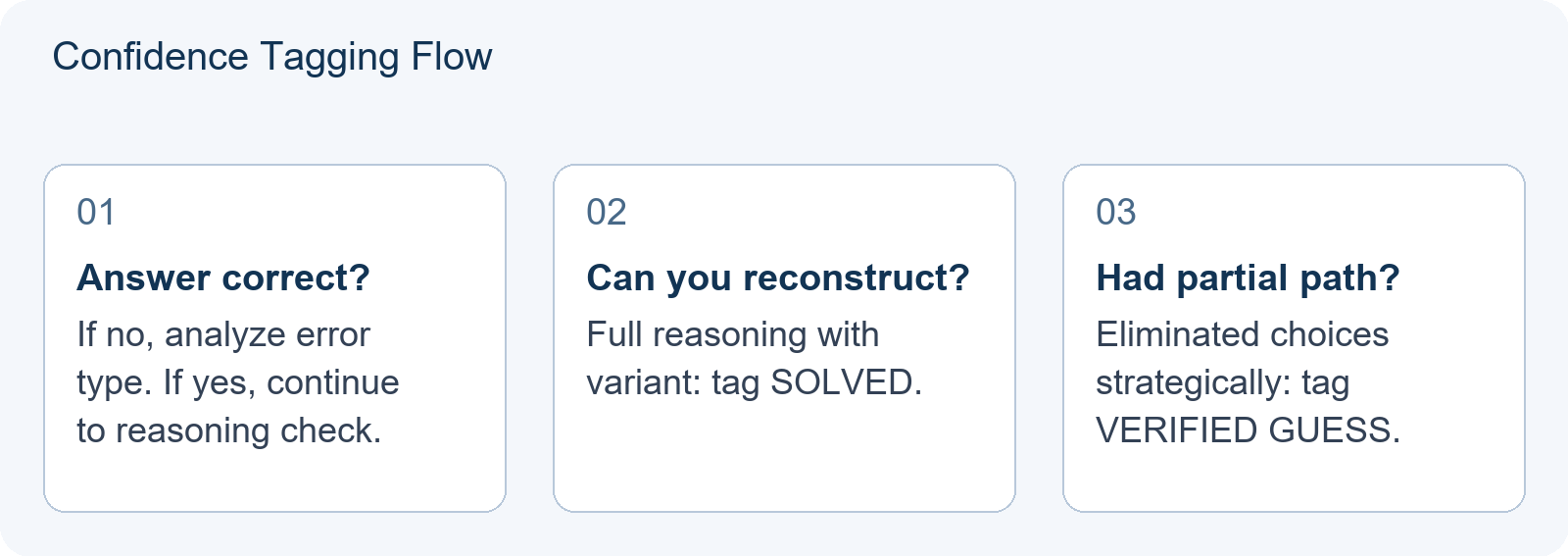
To calibrate confidence, we need to separate outcome from process. Here is a suggested exercise for after each practice test: label every correct answer with one of three tags:
- Solved: You can reconstruct the full reasoning and would bet on getting a variant correct.
- Verified guess: You eliminated choices strategically and had a plausible path, but could not fully verify.
- Lucky guess: You had no clear path, or your reasoning contained a flaw that happened to lead to the right choice.
Only “Solved” answers indicate reliable mastery. The goal of review is to convert “Verified guess” to “Solved” and to identify “Lucky guess” as the emergency it is. Stable performance matters more than occasional breakthroughs on hard problems—and stability comes from shrinking the lucky-guess category.
What the Diagnostic Means for Your Next Steps
Suppose a student scores 105 on AMC 12—well above the 85-point AIME threshold—but 12 of those points came from two lucky guesses on problems 19 and 21. Their score looks comfortable, but those 12 points represent unstable ground. For AIME preparation, this matters enormously: AIME problems require constructing answers from scratch, and the 15-question format (with its new 90+90 minute split structure in 2027 for US/Canada candidates at Pearson centers) punishes gaps in foundational reasoning.
The useful feedback addresses specific error patterns:
- If lucky guesses cluster in number theory, drill AMC 10/12 Number Theory, Family by Family: Divisors, Remainders, Digits and the AMC 12 Extensions.
- If they cluster in counting, work through AMC 10/12 Counting and Probability: The Six Question Families and the Overcounting Audit.
- If algebra feels solid but geometry collapses under time pressure, the issue is transfer, not knowledge—addressed in AMC 10/12 Geometry Without a Calculator: The Recurring Configurations Worth Drilling.
Preparing for Honest Self-Assessment: A Resource Request Guide
Before seeking external help, gather evidence of your actual confidence distribution. We suggest this preparation:
- Complete one timed AMC 10 or 12 past paper under exam conditions.
- Immediately after, without checking answers, mark each problem with your confidence level (1–5) and your perceived solution method.
- Only then grade the paper. Compare confidence to correctness. High confidence + wrong answer = systematic misconception. Low confidence + right answer = lucky guess requiring review.
- Bring this annotated paper to any consultation. It saves time and targets help precisely.
Hanlin’s AMC 10/12 mock system, referenced in October 2026 materials, provides automated diagnostic reports that identify such patterns across multiple tests. For students preparing for the 2026 November AMC 10/12 sittings, this kind of structured review is especially valuable given the fixed AIME thresholds—there is no “maybe the cutoff drops” safety net.
Conclusion: Correctness Is Necessary, Not Sufficient
The AMC 10/12 is a filtering mechanism, not just a scoring event. A correct guess gets you past the filter, but it does not build the skills AIME and beyond demand. Confidence calibration—honestly tagging how you got each point—is the bridge between a score that looks good and preparation that actually is. For families planning around the 2026–27 season, with its fixed AIME thresholds and restructured AIME format for US/Canada candidates, this honesty is not optional. It is the difference between a one-time crossing and sustainable competition math growth.
Calibrating Confidence Under the New AIME Format
The framework for tagging answers as Solved, Verified guess, or Lucky guess is essential, but it must be applied with awareness of structural changes in the 2027 AIME. For US and Canada candidates, the exam now moves to Pearson Professional Centers with a split format: two 90-minute sessions (8 questions then 7), with no return to the first half once the second begins. Within each half, students can revisit questions freely. This mechanical constraint transforms how confidence calibration impacts your actual score.
In the old continuous 180-minute format, a student might spend 15 minutes on a difficult problem in the first half, realize they are guessing, skip it, and potentially return later if time allowed. In the new split format, that flexibility across halves vanishes. If you mark a problem as “Solved” during practice but cannot reconstruct the reasoning under pressure, you are effectively gambling with your session time. Once you are taking AIME, the AMC invitation threshold is a separate matter. Time spent reconstructing an uncertain solution reduces time available for other problems in the same half.
To address this gap, we suggest adding a Time-Boxed Reconstruction Drill to your confidence audit. After labeling an answer as “Solved,” set a timer appropriate to the problem’s difficulty and your experience level—perhaps 3–5 minutes for medium AMC problems, longer for AIME-level material. Attempt to write out the full solution without looking at the original work. If you exceed the timer or get stuck, downgrade the tag to “Verified guess.” This simulates the cognitive load of the AIME’s timed halves. A true “Solved” status should allow reconstruction within a reasonable window, leaving buffer for calculation errors.
For China-based candidates, the 2027 AIME format remains 180 minutes continuous (per current regional notices). However, the principle holds: the shift to fixed thresholds removes cutoff anxiety but increases the stability requirement. You cannot rely on a lucky break to push you over a percentage line that fluctuates; you must reliably clear a static bar. Therefore, the distinction between a “Lucky guess” and a “Solved” problem is not just about learning—it is about predicting whether you will cross the line consistently across multiple sittings.
Use this drill to identify which topics require deeper foundational work before November. If number theory problems consistently fail the reconstruction test, prioritize AMC 10/12 Number Theory, Family by Family: Divisors, Remainders, Digits and the AMC 12 Extensions. If geometry configurations collapse under time pressure, review AMC 10/12 Geometry Without a Calculator: The Recurring Configurations Worth Drilling. The goal is to ensure that when you sit for the AIME, your “Solved” tags are robust enough to withstand the rigid pacing of the new format.
Frequently Asked Questions
Does a correct guess hurt my AMC score?
No—AMC scoring gives full points for correct answers regardless of method. The risk is to your preparation: undetected lucky guesses create false confidence and leave gaps that AIME’s free-response format will expose.
How can I tell if my correct answer was a lucky guess?
The key test is reconstruction: within 24 hours, try to re-solve the problem fully without hints. If you cannot, or if your remembered reasoning contains logical holes, it was likely a guess.
Should I ever guess on the AMC 10/12?
Yes, strategically—if you can eliminate at least two choices, the expected value exceeds the 1.5-point blank. If you eliminate only one, the expected value equals the blank, so indifference is reasonable. But every guessed answer, correct or not, should be reviewed afterward to distinguish luck from skill.