When students receive their first full-length AMC mock test results, the immediate reaction is often focused on the raw score. A student scoring 70 on an AMC 10 might conclude they need to study more algebra, while another scoring 95 might feel ready for the real exam. However, the score itself rarely tells the whole story. The critical distinction in preparation is separating a knowledge gap (not knowing how to solve the problem) from a pacing failure (knowing how to solve it but running out of time). This article provides a framework, developed through Hanlin’s experience with AMC 10/12 candidates, for reviewing mock tests to identify which type of error is limiting your performance and how to address it specifically.
The Anatomy of an AMC Error
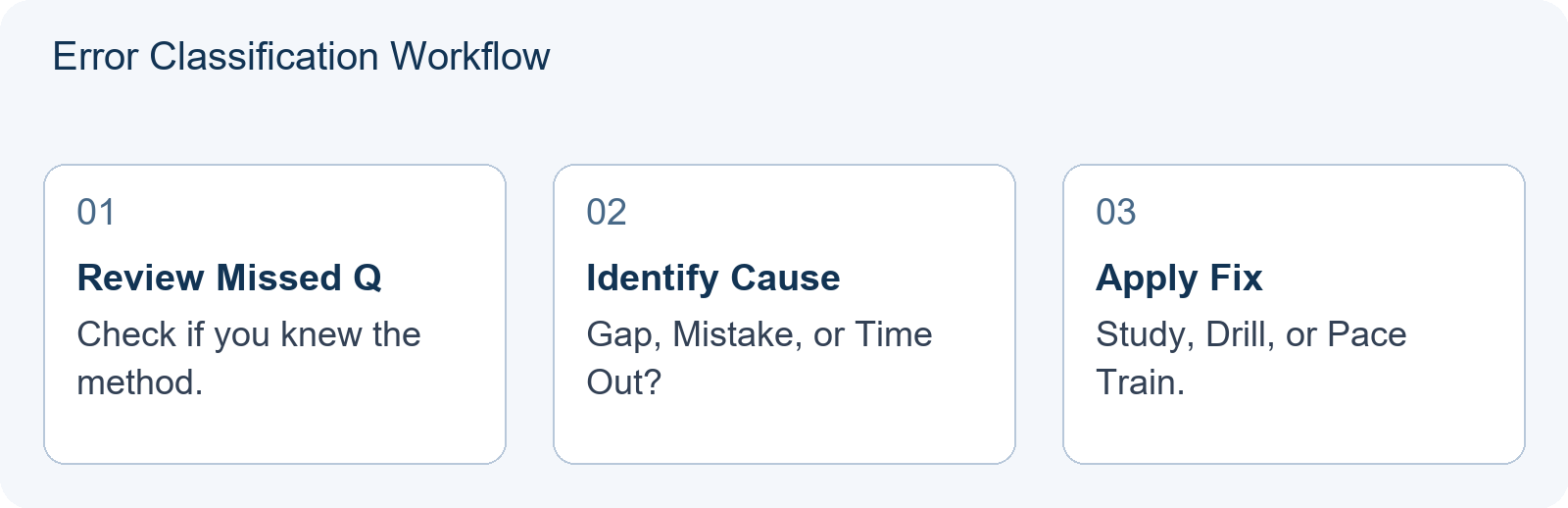
To effectively review a mock test, you must categorize every incorrect or unanswered question into one of three buckets. This classification moves beyond simple right/wrong analysis and focuses on the cognitive process during the exam.
- Bucket 1: Conceptual Gap. You did not know the theorem, formula, or technique required. For example, failing a geometry problem because you didn’t recognize the power of a point theorem.
- Bucket 2: Execution Error. You knew the method but made a calculation mistake, misread the question, or chose the wrong answer due to carelessness.
- Bucket 3: Time/Strategy Failure. You could have solved the problem given unlimited time, but you spent too long on earlier questions or got stuck on a difficult item, leaving no time for this one.
A common misconception is that Bucket 3 errors are less important than Bucket 1. In reality, fixing pacing issues often yields higher score gains than learning new advanced topics, especially for students aiming for the AIME cutoff line. A student may understand a concept yet fail to finish a problem under time pressure. Review the written attempt before deciding which explanation fits.
Worked Teaching Illustration: Diagnosing a Pacing Failure
Teaching illustration: This is a hypothetical scenario for instructional purposes, not an actual contest problem.
Consider a student taking an AMC 10 mock test. They finish with a score that leaves them below the fixed AIME qualification threshold. Upon review, they find they left Questions 18, 19, and 20 blank. Let’s analyze Question 18:
Teaching Illustration Q18: “How many integers from 1 through 100 inclusive are divisible by 3 or 5?”
The student admits they knew the inclusion-exclusion principle () but skipped it because they were “rushing.” They had spent 12 minutes on Question 16, a complex combinatorics problem they eventually guessed on.
Diagnosis: This is a classic pacing failure. The knowledge was present (Bucket 1 cleared), but the time allocation strategy failed (Bucket 3). If they had moved on from Q16 after 5 minutes, they would have had ample time to solve Q18 correctly.
Correct Calculation Check:
For integers 1 through 100 inclusive:
Divisible by 3:
Divisible by 5:
Divisible by both 3 and 5 (i.e., by 15):
Total: .
The student could have secured these points easily if they had managed their clock better.
Contrasting Case: When It Is Actually a Knowledge Gap
Now consider a different scenario where the same student leaves Question 22 blank. The question involves a recursive sequence definition they have never seen before. Even with unlimited time, they cannot derive the pattern.
Hypothesis Test: To determine whether this represents a knowledge gap rather than a pacing issue, the student should attempt the problem again without time pressure and with access to a hint about common recurrence patterns. If, after this untimed attempt with guidance, they still cannot solve it or recognize the required technique, this supports the hypothesis of a conceptual gap in recurrence relations.
Diagnosis: This is a conceptual gap (Bucket 1). No amount of time management training will help here. The solution requires targeted study of sequences and series, potentially looking at past problems involving similar structures.
Key Difference: In the pacing case, the fix is strategic (time limits per question, skip-and-return protocols). In the knowledge case, the fix is academic (learning new material). Mixing these up leads to inefficient preparation—studying advanced topics when you should be practicing speed, or drilling speed when you don’t understand the math.
Strategic Implications for the 2026-27 Season
With the recent changes to AIME qualification lines, understanding your error profile is more critical than ever. According to MAA official rules checked in October 2026, the fixed thresholds for AIME qualification are now clear: AMC 10 scores of 100 or above and AMC 12 scores of 85 or above, subject to other eligibility criteria.
For China-based students, the format remains 25 multiple-choice questions in 75 minutes. Unlike the US/Canada region which has moved to a split-session computer-based format for AIME, the AMC 10/12 itself retains its traditional structure. This means pacing is still the primary enemy for most students. A single minute wasted on a hard problem can cost you two easy problems later.
Source: MAA AIME official rules, checked October 12 2026.
How to Conduct an Effective Mock Test Review
Simply grading your paper is insufficient. You must perform a “post-mortem” analysis. Follow these steps for every mock test:
- Time Log: Record exactly how long you spent on each question. Identify any question where you spent more than 3-4 minutes without making progress.
- Error Tagging: Label every missed question as Conceptual, Execution, or Pacing.
- Re-solve Without Pressure: Take the questions you missed due to pacing or execution and solve them again with unlimited time. Did you get them right? If yes, your issue is definitely strategic, not intellectual.
- Pattern Recognition: Look for trends. Do you always run out of time on geometry? Do you consistently make sign errors in algebra?
A Practical Diagnostic: The 5-Question Audit
After your next mock test, apply this concrete check to five questions you missed or skipped:
- Re-attempt in isolation: Give yourself 10 minutes per question with no time pressure. Can you now solve it?
- Identify the blocker: If still stuck after 10 minutes, mark “Conceptual Gap.” If you solve it correctly, mark “Pacing Failure.”
- Check execution: If you solved it but made an arithmetic or sign error originally, mark “Execution Error.”
- Map to position: Note whether the question appeared in positions 1-10, 11-20, or 21-25. Pacing failures cluster in the middle; conceptual gaps often appear at the end.
- Calculate opportunity cost: Add up the points from all “Pacing Failure” and “Execution Error” questions. This is your immediate gain potential without learning new content.
Teaching illustration: A student misses 8 points total. After audit, 5 points are from pacing/execution, 3 from conceptual gaps. Their priority should be timed drills and carefulness checks, not new topic study.
Adjusting Your Study Plan Based on Diagnosis
If your review shows mostly Pacing Failures:
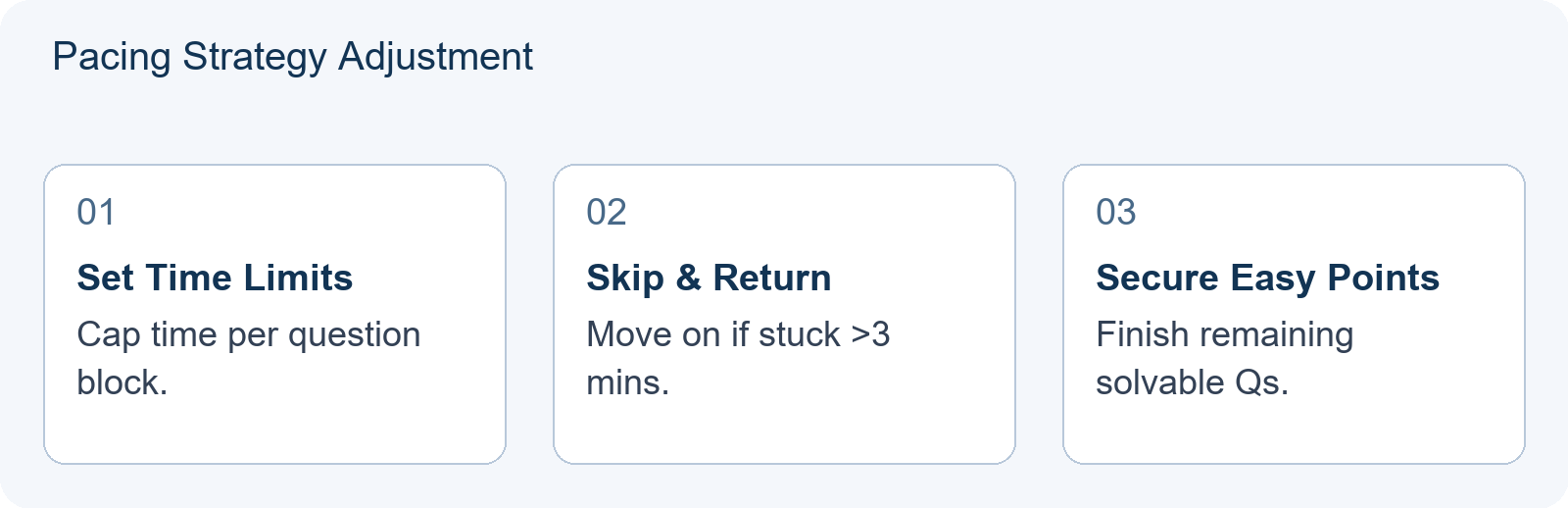
- Practice with strict timers. Set a limit of 2 minutes for questions 1-10, 3 minutes for 11-20, and allow yourself to skip anything taking longer.
- Focus on “easy win” drills. Solve large sets of straightforward problems quickly to build confidence and speed.
- Learn to guess strategically. Eliminate obviously wrong answers and move on.
If your review shows mostly Conceptual Gaps:
- Pause timed practice. Spend time reading solutions and understanding the underlying theory.
- Target specific topics. If you miss all number theory questions, do a dedicated module on modular arithmetic and divisibility rules.
- Use resources like our AMC 10/12 Number Theory, Family by Family: Divisors, Remainders, Digits and the AMC 12 Extensions to fill these holes systematically.
The Role of Mock Tests in Preparation
Mock tests are diagnostic tools, not just practice runs. Their value lies in the data they provide about your current state. Many students fall into the trap of taking test after test without deep review, hoping for improvement through repetition alone. This is ineffective. One well-reviewed mock test is worth ten poorly reviewed ones.
At Hanlin, we emphasize that preparation must be tailored to the individual’s error profile. Whether you are struggling with the basics of probability or the advanced applications of trigonometry, identifying the root cause of your lost points is the first step toward recovery. For more insights on specific topic areas, see our articles on AMC 10/12 Counting and Probability: The Six Question Families and the Overcounting Audit and AMC 10/12 Geometry Without a Calculator: The Recurring Configurations Worth Drilling.
Conclusion: Precision Over Volume
In the final weeks before the AMC, resist the urge to cram new, obscure topics if your mock reviews show you are losing points on standard questions due to time pressure. Conversely, if you are finishing early but missing hard questions, you need depth, not speed. Use your mock test reviews to make precise adjustments. By distinguishing between what you don’t know and what you couldn’t reach in time, you create a targeted path to a higher score.
Calibrating the “Skip” Decision: A Quantitative Approach
The existing framework correctly identifies that pacing failures often stem from poor time allocation. However, a common follow-up question is: When exactly should I skip? Many students hesitate because they fear losing potential points on a problem they might solve if given just one more minute. To address this, we introduce a quantitative decision rule based on expected value (EV) rather than intuition.
The Opportunity Cost Formula
For AMC 10/12, a correct answer earns 6 points, an unanswered question earns 1.5 points, and an incorrect answer earns 0. Turning a blank into a correct answer therefore adds 4.5 points. When deciding whether to spend another minute on a hard question, compare that opportunity with other unfinished questions; a blind guess among five choices has expected score 6/5 = 1.2, below the 1.5 available for leaving it blank.
Teaching Illustration: Suppose you are at Question 14 with 40 minutes remaining. You have spent 5 minutes on Q14 without progress. You estimate your probability of solving Q14 if you spend another 3 minutes is 20%. Meanwhile, Questions 18-20 are typically solvable in 2 minutes each with high confidence (90% success rate).
- Option A (Stay): Spend 3 more minutes on Q14. Expected gain = points. Time used = 3 minutes.
- Option B (Skip): Move to Q18. In 3 minutes, you can likely attempt Q18 and Q19. Expected gain = points (assuming you can do two quick ones or one solidly). Even conservatively, solving one easy problem yields 5.4 points.
The difference is stark: 1.2 vs 5.4+ points. This calculation demonstrates that unless the probability of solving the current hard problem exceeds ~90%, skipping is mathematically superior when easier problems remain unsolved.
Implementing the “Two-Minute Checkpoint”
To make this actionable during a mock test, adopt a strict checkpoint system:
- Minute 0-2: Read and set up. If no clear path emerges by minute 2, mark it as “High Risk.”
- Minute 2-4: Attempt partial work. If stuck, skip immediately.
- End of Section Review: After finishing all attempted questions, return to skipped items only if time remains. Never sacrifice a guaranteed easy point for a speculative hard point.
This method transforms vague anxiety about “running out of time” into a concrete strategic choice. It prevents the “sunk cost fallacy” where students persist on difficult problems simply because they’ve already invested time, ignoring the higher yield available elsewhere. For China-based students preparing for the November 2026 AMC 10/12, practicing this specific decision logic in timed drills will build the instinct needed to protect scores against pacing failures.
Frequently Asked Questions
What is the difference between a knowledge gap and a pacing failure?
A knowledge gap means you do not understand the concept needed to solve the problem. A pacing failure means you understood the concept but ran out of time because you spent too long on other questions or got stuck.
How does the fixed AIME cutoff affect my mock test review?
The fixed cutoffs (100 for AMC 10, 85 for AMC 12, with other eligibility criteria) mean you need consistent accuracy rather than just high peaks. Your review should focus on eliminating avoidable errors (execution/pacing) to ensure you reliably hit these thresholds.
Should I stop doing mock tests if I am making mistakes?
No. Mistakes are valuable data. Stop only if you are not reviewing them. Each mock test should be followed by a detailed analysis of why you missed questions to adjust your next study session.