Among the 2027 AIME rules MAA published in August is one that has had almost no attention: candidates must be 13 or over. The floor is attached to the AIME, not to the AMC 10 — whose own age and grade limits are MAA’s to set and are published on maa.org. So a strong Grade 7 or Grade 8 student can sit the AMC 10 in November, clear the fixed qualifying score of 100, and still not be able to sit the round that score qualifies them for. That is a planning problem, not a maths problem.
It is also a narrow one. It affects a specific and, in Chinese international schools, unusually visible group: the accelerated younger student whose family has been building a competition plan two or three years ahead of their year group. If that is not you, most of this article is not about you. If it is, the decision you are making this month — whether to enter, and what the entry is for — changes shape once the floor is on the table.
The rule, and the part MAA has not spelled out
MAA states that AIME candidates must be 13 or over. That is the whole of what we can report, and it is worth being precise about the shape of the gap, because it is exactly the kind of gap that gets filled in by guesswork on forums.
What we can tell you:
- The requirement exists, and it is new alongside the rest of the 2027 changes: fixed qualification at 100 on the AMC 10 or 85 on the AMC 12, a single window on 5–6 February 2027, two 90-minute parts of eight questions and then seven, a Pearson Professional Center venue with self-scheduling, nothing carried in, and a fee of US$85 plus tax.
- MAA has marked several AIME policies as still to be posted. The published age line is one sentence, not a policy document.
What we cannot tell you, and will not invent:
- How the age is measured. On the day you sit? On a registration cut-off? Neither is stated in the material we have read, and the difference matters enormously to a student whose birthday sits in January or February.
- How it is applied on an international route. MAA says only that participants in the AMC international program “should follow the policies of the International Group Leader” for their country or region. It has never said that candidates based in China use the Pearson booking flow, and it has not said how the age requirement is administered where that flow does not apply.
The practical rule that follows is simple. If a student’s thirteenth birthday falls anywhere near the February 2027 window, treat the AIME as unconfirmed and get it in writing before it becomes the reason for anything. Do not build an autumn on a round whose entry condition you have not verified for your own candidate, in your own region.
Who this actually affects
The floor bites in one place and only one place: the conversion of an AMC score into an AIME sitting. It does not touch the AMC paper itself, which is the point most families get backwards on first reading.
| Student | Can sit the AMC 10 or 12 in November? | Can convert a qualifying score in February 2027? | What the season should be for |
|---|---|---|---|
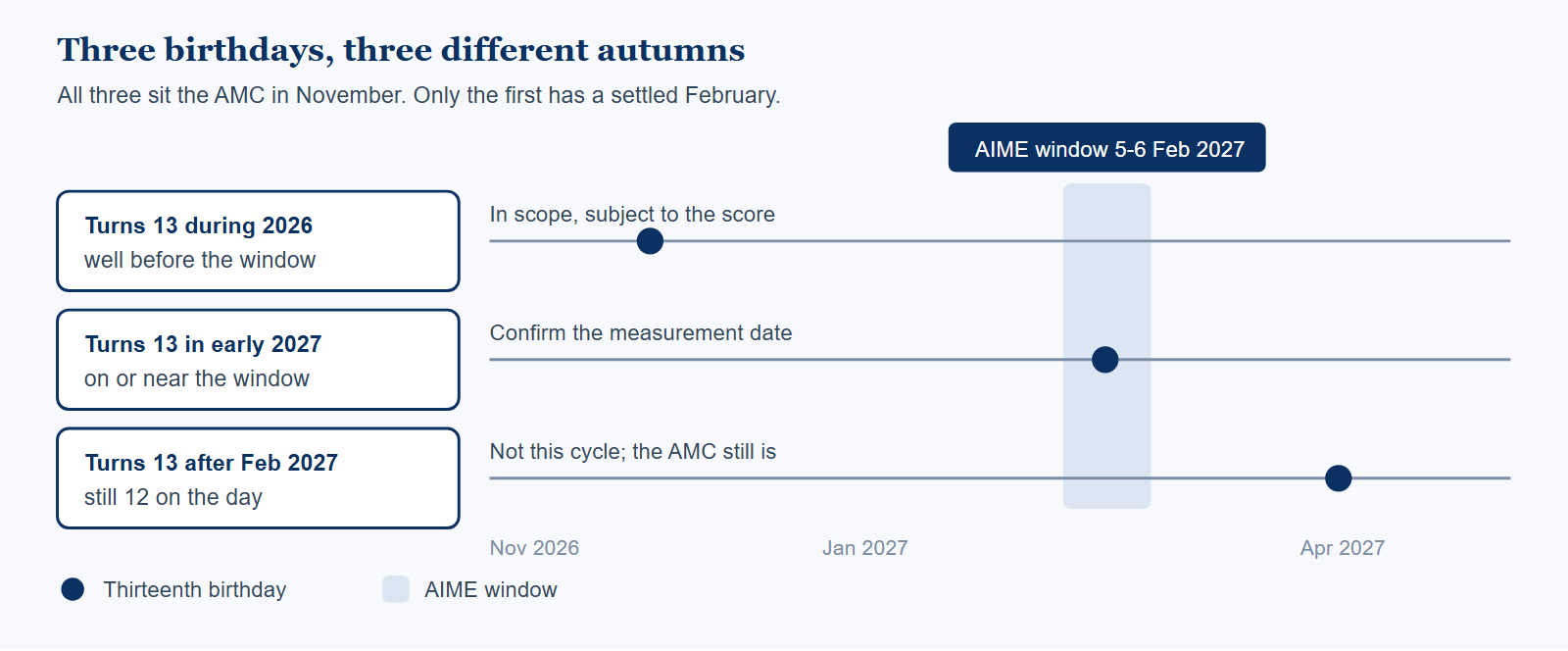
| Turns 13 during 2026, well before the window | Yes, subject to MAA’s own age and grade limits for the paper | Yes, subject to the score and the remaining rules | The normal ladder. Plan as any candidate would |
| Turns 13 in January or February 2027 | Yes, same conditions | Unresolved. Depends on how the age is measured, which is not published | Sit the AMC as a full-value target in its own right; treat any AIME entry as upside you confirm, not as the plan |
| Still 12 throughout the window | Yes, same conditions | No | Recognition on the AMC paper itself, plus a measurement that tells you what to do at fourteen |
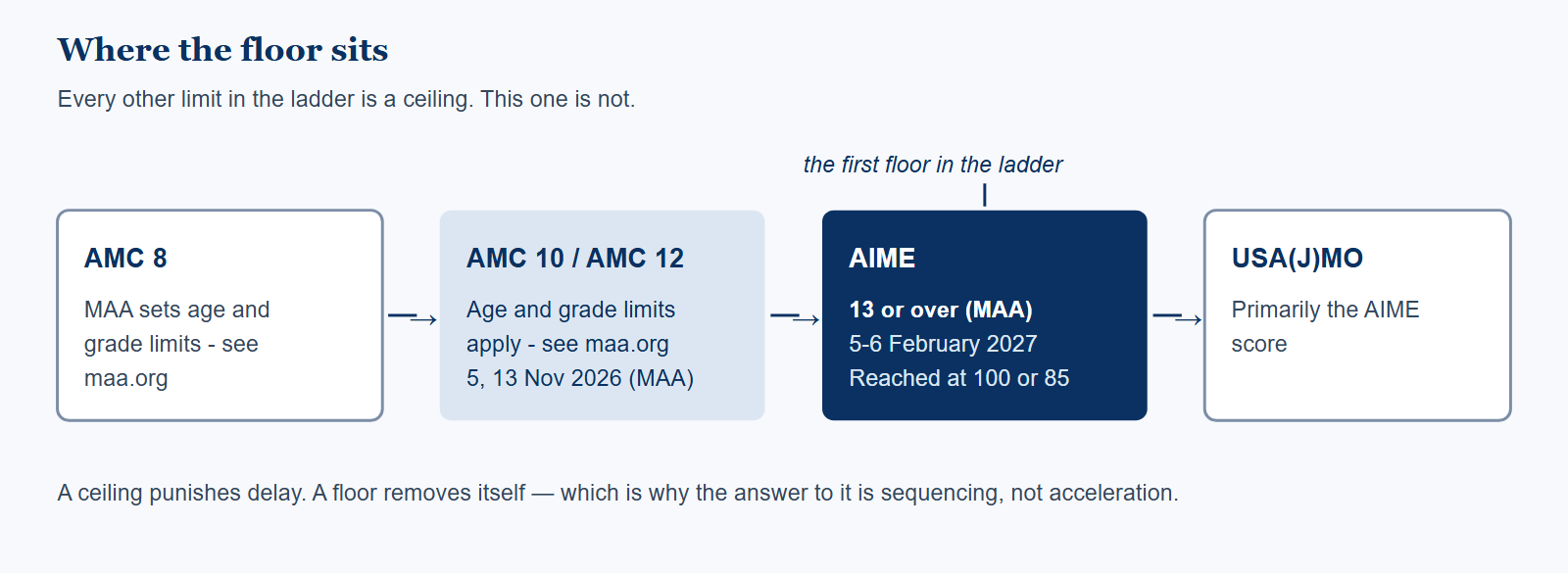
Note what kind of constraint this is. Every other limit in the ladder is a ceiling: the AMC papers carry upper age and grade limits, and the university application calendar closes in Grade 12 whether you are ready or not. Ceilings punish delay. A floor is the opposite — it is a constraint that removes itself. A student who cannot sit the February 2027 AIME because they are 12 will not have that problem in a later cycle, and the qualifying line they would be aiming at is a fixed number rather than a percentile that moves with the field.
What an early AMC sitting is still worth
If the February round is closed to a candidate, the honest question is what the November paper is for. There are three real answers, and none of them requires an AIME.
The first is recognition attached to the paper itself. The AMC 10 and AMC 12 carry their own recognitions, and they are unchanged for 2026: Honor Roll at the top 5%, Distinguished Honor Roll at the top 1%, and a fixed achievement award at 90 or above for younger students — check on maa.org which paper that award attaches to and what grade conditions apply. That last one exists precisely for this cohort. For a strong twelve-year-old it is the target in reach, and it has the useful property of being a fixed number rather than a rank — you can aim at it in September and it will not move.
The second is a measurement you will use later. A score sat at twelve is worth having mainly because of what it tells you at fourteen: which question families you own, where the front half of the paper is leaking, whether the AMC 12 content gap is real yet. That information does not expire, and it is far more useful early than a qualification you cannot use.
The third is the beginning of a record rather than a single result. On an application read three or four years later, an admissions reader is checking a competition record against the rest of the file — the transcript, the activity list, what the essays say a student actually does with their time. A sequence of AMC results that starts early and improves is doing something a single strong score cannot: it corroborates the rest of the file, which is what makes the file believable as a whole. That is an argument for starting early and staying in, not for chasing a round you cannot enter.
And there is one thing an early sitting is not worth: reorganising a school year around a February round the student cannot sit. If a family is choosing between the AMC 10 in November and something with a real deadline — a school assessment block, a project, a sport — the AIME should not be in the argument at all for this candidate.
The temptation to avoid: jumping to the AMC 12 to bank a qualification
Once a family understands that the qualifying line is 85 on the AMC 12 against 100 on the AMC 10, a plausible-sounding idea appears: move the young student up to the AMC 12, because the number is lower. For a candidate under the age floor, this does not work, for two independent reasons.
The first is that the floor is attached to the AIME, not to which AMC paper produced the qualification. Qualifying by a different route does not change who is permitted to sit the February round.
The second is mathematical rather than administrative. The AMC 12 assumes content the AMC 10 never tests, and a student two or three years ahead of their year group has usually not met it in any systematic way. Sitting a paper whose back half depends on material you have not studied does not produce a lower effective threshold; it produces a lower score with a smaller ceiling on it. The lower number is not a discount.
There is a third, quieter cost. Every early sitting is also a measurement, and a measurement taken on the wrong paper tells you very little. An accelerated student who sits the AMC 10 gets clean information about a syllabus they are actually working through. The same student on the AMC 12 gets a score that mostly measures which topics nobody has taught them yet.
What to confirm, and with whom
These are the questions to put to your school’s competition manager or to the Group Leader for your region — and to get answered in writing before a young student is entered on the strength of an AIME plan.
- How is the age requirement measured for the February 2027 AIME? On the sitting date, or at some earlier point? This is the single question that decides the middle case above.
- What is the entry route for candidates in our region? MAA directs participants in the AMC international program to the Group Leader for their country or region rather than to the booking flow used elsewhere, so this must be answered locally rather than inferred from a US-facing page.
- Is there a registration or payment step that falls before eligibility is even determinable? MAA states a fee of US$85 plus tax; how and whether that applies through an international route is a question for the Group Leader, not something to assume.
- What is our centre’s own arrangement for the November paper? MAA publishes 5 November 2026 for the A papers and 13 November 2026 for the B papers, and the season runs in person at authorised centres — the 2026 in-person rules and centre arrangements are worth reading before you enquire, so you know what you are asking about.
- Does the AMC entry itself carry any condition we have missed? Age and grade limits for each paper are MAA’s to set and are published on maa.org; read them for the specific paper you intend to enter.
A last word on tone, because this is a subject where anxiety does more damage than the rule does. An age floor is the least consequential constraint a young mathematician will meet. It costs a cycle. It does not close a route, it does not reduce what can be learned this autumn, and it does not touch the paper that is actually in front of the student in November — which, under the in-person arrangements for 2026, is the same paper on the same terms as for everyone else in the room. The correct response to a constraint that expires is to keep working and let it expire.
Frequently asked questions
Can a 12-year-old sit the AMC 10?
AMC eligibility is separate from the AIME age rule; MAA sets its own age and grade limits for each paper. Confirm the current wording on maa.org.
What happens to a qualifying score if I am too young to sit the AIME?
It stays a score, with whatever recognition attaches to it. MAA has not published whether a qualification can carry forward to a later cycle — confirm before assuming either way.
How is the age requirement measured?
MAA states candidates must be 13 or over and marks several AIME policies as still to be posted. Confirm the measurement date before planning.
Should a young student sit the AMC 12 instead to qualify more easily?
The age rule attaches to the AIME, not to which AMC you sat, and the AMC 12 assumes content most young students have not met.
This is an independent English-language guide to the American Mathematics Competitions, operated by Hanlin Education for China-based international-school students. We are not affiliated with, endorsed by, or sponsored by the Mathematical Association of America. Eligibility rules are MAA’s to set and several 2027 AIME policies remain unpublished — confirm current details on maa.org and with your own authorised test centre or regional Group Leader before entering any student. Errors reported to our editorial desk are corrected within 7 working days.