Sit both papers if your recent timed scores straddle the AIME line, and one if they sit well clear of it either way. That rule matters more this season. MAA has made AIME qualification a fixed score — 100 on the AMC 10, 85 on the AMC 12 — so a paper that runs hard no longer arrives with a lower line. At our China-region centres a refundable cancellation is only possible before 10 October, weeks before either paper.
This is about one change, the fixed line, and what it does to the second-sitting question. If you have not yet confirmed where you are sitting, start with the 2026 in-person AMC rules and centre arrangements; none of what follows matters without a seat.
What a fixed line does to a second sitting
Under the retired model, each paper came with its own AIME line, worked out from how that paper’s field performed. A paper that ran hard pulled scores down and, with them, the line, so part of the luck of the draw was absorbed before it reached you.
That buffer is gone. MAA’s wording is direct: “The thresholds for qualifying for AIME will be set numbers rather than based on percentages” — 100 or above on the AMC 10, 85 or above on the AMC 12, alongside MAA’s other eligibility requirements. A hard paper now costs you points against a line that stays put. MAA also confirms that “eligible students are permitted to take both an A exam on November 5 and a B exam on November 13,” so the second attempt is still available. It simply means something different.
| What it concerns | Retired model | 2026 season |
|---|---|---|
| Where the AIME line comes from | A percentile of each paper’s results | A fixed number: 100 on the AMC 10, 85 on the AMC 12 |
| When you know it | After marking | Now, in September |
| A paper that runs hard | Your score falls, and the line tends to fall with it | Your score falls; the line does not move |
| What a second sitting gives you | A second draw against a second, separately set line | A second attempt at the same known number |
| Honor Roll (top 5%) and Distinguished Honor Roll (top 1%) | Percentile recognitions | Still percentile recognitions, unchanged |
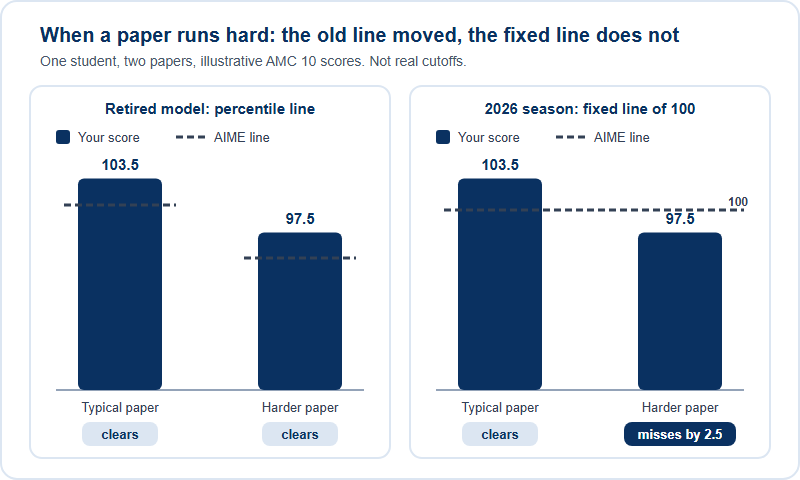
The consequence is counter-intuitive: the fixed line makes your target certain and your outcome less so. A student scoring 103.5 on a typical paper is one unfamiliar question from missing — a correct answer turned into a blank costs 4.5 points, into a wrong answer 6. That student is exactly the one for whom a second attempt has become more valuable, not less.
Measure your margin in questions, not in hope
A second sitting is insurance, priced against risk. Your risk has two parts: the distance between your realistic score and the line, and how much your score moves from paper to paper. Both can be measured before 10 October.
- Sit three or four sealed papers at the level you will enter, one a week, under real conditions: 75 minutes, no calculator, printed paper, a separate answer sheet.
- Score each with MAA’s scheme — 6 points for a correct answer, 1.5 for a blank, 0 for a wrong answer — and record the three counts, not only the total.
- Write down your lowest, middle and highest score. The spread matters as much as the middle.
- Convert the gap to the line into questions. A blank turned into a correct answer is worth 4.5 points; a wrong answer turned into a correct one is worth 6. A margin under 6 points is a one-question margin.
Suppose your last four AMC 10 mocks came out at 94.5, 99, 106.5 and 112.5 — an illustration, not a cohort figure. The line of 100 sits inside that range, and two of the four papers cleared it. On any given night you are roughly a coin flip, which is the clearest case there is for a second sitting.
| Your mock pattern | What a second sitting does for the AIME question | Our suggestion |
|---|---|---|
| Every mock clears the line by 12 points or more — two questions of margin | Very little: one sitting already clears on most nights | One sitting is usually enough; add a second only for a reason you can name |
| Your range straddles the line | The most it ever does: two attempts at something close to a coin flip | The strongest case for booking both dates |
| Your best mock is below the line, by less than 12 points | Something, but a better month of preparation does more | Book a second sitting only alongside a repair plan aimed at that gap |
| Your best mock is more than 12 points below the line | Unlikely to change this season’s AIME outcome | Sit for measurement and recognition, and decide the second date on other grounds |
Two cautions: use sealed papers only, because a paper you have seen cannot measure you; and never average a bad mock away, because your lowest score is exactly the unlucky night a second sitting insures against.
What a second ticket can buy, and what it cannot
A simple model makes the trade visible. If one sitting gives you a chance p of clearing the line, two independent sittings give you 1 − (1 − p)² of clearing it at least once. The extra chance the second sitting adds works out to p(1 − p), which peaks when p is one half and shrinks towards both ends.
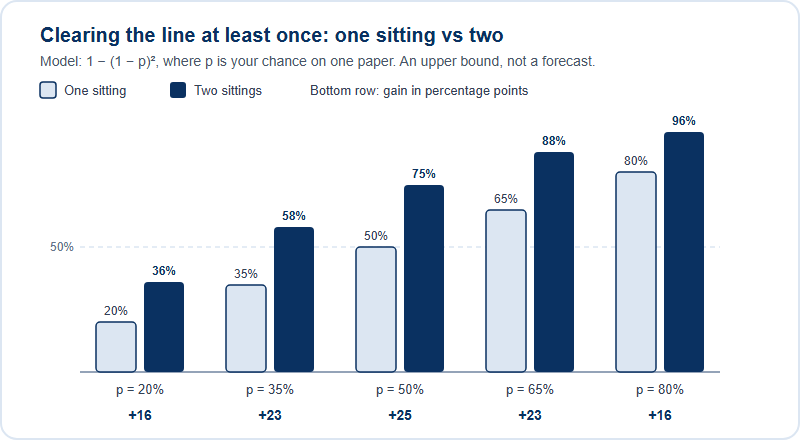
Read the chart as a ceiling: the same student sits both papers, so only the paper and the night vary, and the true gain sits below the navy bars. The shape survives the caveat — a second attempt is worth most to the student who is least certain. For your own p, two clears out of four mocks is roughly a half.
What a second sitting cannot buy:
- A combined score. MAA words qualification as 100 or above on the AMC 10, or 85 or above on the AMC 12. Nothing in that wording adds or averages two sittings.
- A second AIME. MAA says qualified students may take the AIME once, in the window of 5–6 February 2027.
- A way past the age floor. MAA states that only students aged 13 and older are eligible for the 2027 AIME, however they score.
- An answer to the China-region AIME question. MAA says participants in the AMC international program should follow the policies of the International Group Leader for their country or region. If the AIME is your reason for a second sitting, confirm that route first.
The split: two papers, two fixed lines
Students eligible for both competitions have a third option: an AMC 10 on one date and an AMC 12 on the other. MAA sets two conditions for each paper. The AMC 10 is for students in grades 10 and below who are under 17.5 years old on the day of the competition; the AMC 12 is for grades 12 and below and under 19.5. MAA also states that students may not take both the AMC 10 and the AMC 12 on the same day.
The fixed line changes how the split should be judged. When the AIME line was a percentile, the AMC 12 line depended on how the AMC 12 field performed, and stepping into an older field was a real consideration. For the AIME that argument has lapsed: 85 is 85 whoever else sits the paper. What is left is whether you can reach 85 on a paper that, in MAA’s description, covers the full high school curriculum, including trigonometry, advanced algebra and advanced geometry — all three excluded from the AMC 10.
| Paper | Fixed AIME line | Fewest correct, rest left blank | Fewest correct, all 25 answered |
|---|---|---|---|
| AMC 10 | 100 | 14 correct, 11 blank: 100.5 | 17 correct: 102 |
| AMC 12 | 85 | 11 correct, 14 blank: 87 | 15 correct: 90 |
If you do split, the order carries real trade-offs:
- AMC 10 first, AMC 12 second. Your stronger paper comes first, and the eight days between our centres’ sittings go to AMC 12 timing and selection. Eight days will not make new content secure.
- AMC 12 first, AMC 10 second. The stretch paper becomes a full-length rehearsal, and the week between goes to repairing whatever it exposed in your home paper.
- Either way, confirm in writing that your centre runs the level you want on each date.
Our own view is narrow: split only if your AMC 12 mocks already sit near 85. A split chosen because 85 looks smaller than 100 tends to trade a paper you can prepare for into one you cannot, in the time left.
The calendar you are actually deciding on
Two calendars apply, and neither corrects the other: MAA publishes the competition dates, and your centre publishes the sitting you actually attend. Here is how they line up at our China-region centres, per our organising channel’s September materials.
| Item | MAA | Our China-region centres |
|---|---|---|
| A paper (AMC 10A / 12A) | 5 November 2026 | Friday 6 November 2026, 17:00–18:15 |
| B paper (AMC 10B / 12B) | 13 November 2026 | Saturday 14 November 2026, 17:00–18:15 |
| Registration | Opened 2 September 2026 | Through the centre |
| Format | 25 questions, 75 minutes | Bilingual paper |
| Fee | — | RMB 120 per sitting |
| Changing your mind | — | Cancellation with a refund before 10 October; no refund once seats are locked |
Look at where the decision sits. At our China-region centres, refundable cancellation ends before 10 October and the first paper is on 6 November, so you buy the second attempt before seeing the first — which is why the margin work belongs in September. Nor should you plan on an official score arriving between the two papers; a score reconstructed from memory is a guess.
By 10 October you should have: three or four sealed mocks scored with their correct, blank and wrong counts; your margin written in questions; a decision — one sitting, two or a split — with the reason next to it; your centre’s levels, dates and start times confirmed in writing; and, if the AIME is the reason, your regional route to it confirmed. The day-of conditions are the same on either date, and the in-person arrangements for the 2026 season are worth reading before either sitting, not after.
Frequently asked questions
Can I take both the AMC 10A and the AMC 10B in 2026?
Yes. MAA says eligible students may take an A exam on 5 November and a B exam on 13 November; at our China-region centres those papers sit on Friday 6 and Saturday 14 November. You may not take the AMC 10 and AMC 12 on the same day.
If the B paper turns out harder, is its AIME line lower?
No. For the 2027 AIME, MAA sets fixed numbers of 100 on the AMC 10 and 85 on the AMC 12 rather than a percentile of each paper.
Are two AMC scores added together or averaged?
No. MAA words qualification as a score of 100 or above on the AMC 10 or 85 or above on the AMC 12, and qualified students take the AIME once.
When do I have to decide on a second sitting?
At our China-region centres, a cancellation is refunded only before 10 October 2026. Other centres set their own terms, so confirm yours.
This site is an independent guide operated by Hanlin Education for China-based international-school students. It is not affiliated with, endorsed by, or sponsored by the MAA (the Mathematical Association of America). Competition dates, eligibility, scoring and AIME policies are the MAA’s to set, and centre fees and withdrawal terms are set by each authorised centre — confirm current details on maa.org and with the centre that will seat you. Errors reported to our editorial desk are corrected within 7 working days.