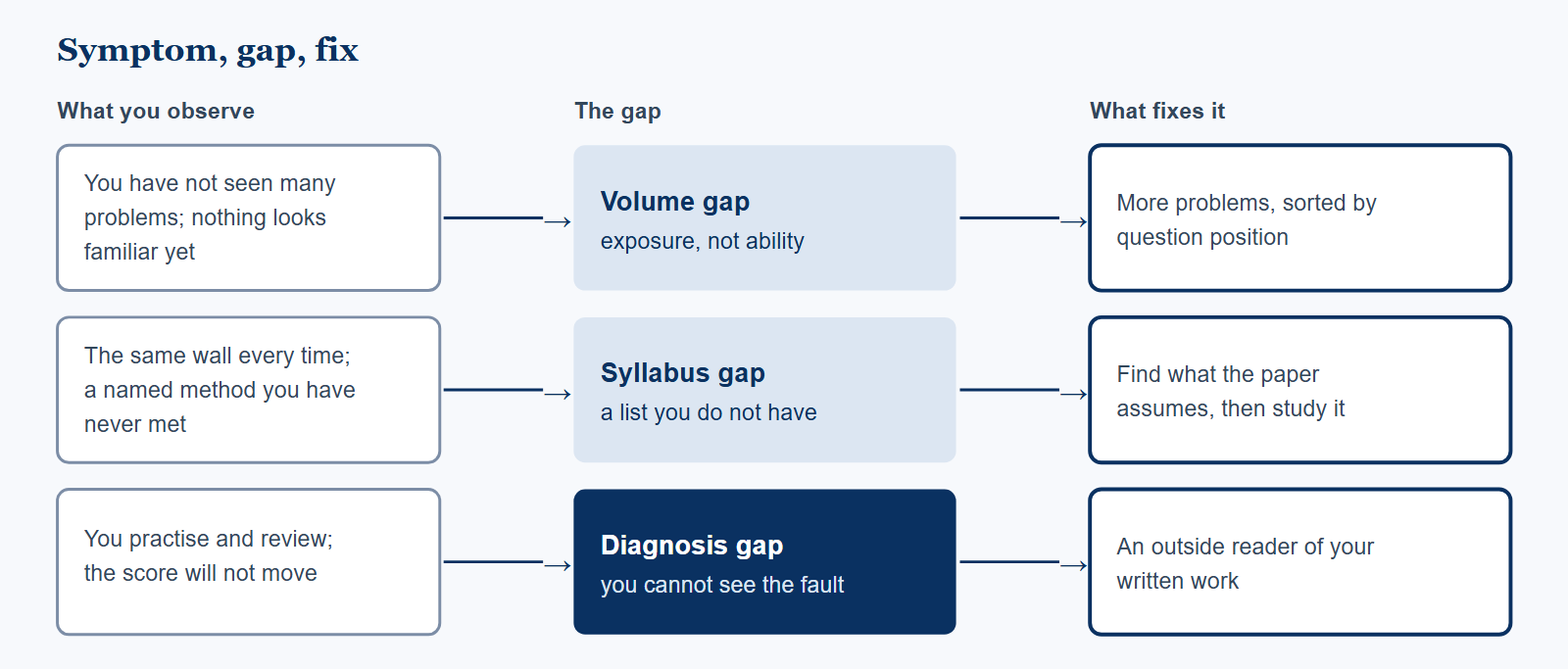
A stalled AMC score is usually one of three things, and they need three different fixes. A volume gap is solved by doing more problems. A syllabus gap is solved by finding out what the paper assumes and learning it. Only a diagnosis gap — you practise, you review, and the score still will not move — is reliably solved by another person. In our teaching team’s experience, students most often buy the third fix for the first problem.
This matters in September because the season is now short. MAA publishes 5 November 2026 for the AMC 10A and 12A and 13 November 2026 for the 10B and 12B, so whatever you decide this month is what you get roughly eight weeks of. Spending four of those weeks on the wrong kind of help is the most common way a promising autumn goes flat.
Three gaps, three fixes, and one of them is free
The three gaps feel identical from the inside. All three produce the same experience: you sit a paper, the score is lower than you expected, and you cannot immediately say why. They are distinguished by what happens next, not by how they feel.
| Volume gap | Syllabus gap | Diagnosis gap | |
|---|---|---|---|
| What it looks like | Nothing looks familiar. You solve problems from first principles that others recognise on sight | You hit the same wall repeatedly — a named technique you have simply never been taught | You review properly, you understand the solutions, and the score does not move |
| What is actually missing | Exposure. You have not seen enough problems for patterns to form | A list. Nobody has told you what the paper assumes you already know | An outside view of your reasoning, which you cannot generate yourself |
| What fixes it | Volume, organised by question position rather than by whole papers | A source that enumerates the assumed content, then deliberate study of it | Someone competent reading your written work, not your answers |
| What does not fix it | More explanation. You are not short of explanations | More practice papers. You will meet the same wall each time | More volume. You will get better at repeating the same fault |
| Cost | Time only | Time only | Usually money, or a very generous teacher |
That last row is the uncomfortable one, and it is the reason this article exists. Two of the three causes we see most often behind a flat AMC score cost nothing but time and honesty. It is worth being certain you are not in one of them before you spend anything.
The four-question audit
Each question has an evidence test attached, because the honest answer and the flattering answer differ. Do not answer from impression; answer from something you can point at.
- Recognition. Reading a question in the first half of a paper, can you name what kind of problem it is within about twenty seconds — before you start solving? Evidence test: take ten problems you have not seen and write only the family name for each. Do not solve them. Count how many you can name.
- Retrieval. Can you produce the standard facts cold, with nothing in front of you? Evidence test: write out, from memory, the facts you would need for a mid-paper geometry or number theory question. If you have to look one up, you do not have it under exam conditions.
- Self-diagnosis. When you get one wrong, can you say which of three things happened — you did not know the method, you knew it and did not see that it applied, or you saw it and executed badly? Evidence test: take your last ten errors and assign each to exactly one of those three. If most land in a vague fourth category, that is the finding.
- Feedback. Has your error rate on the front half of a paper moved at all in the last month? Evidence test: you need two comparable measurements. If you do not have them, you have been practising without instrumentation, and no adviser can help you until you do.
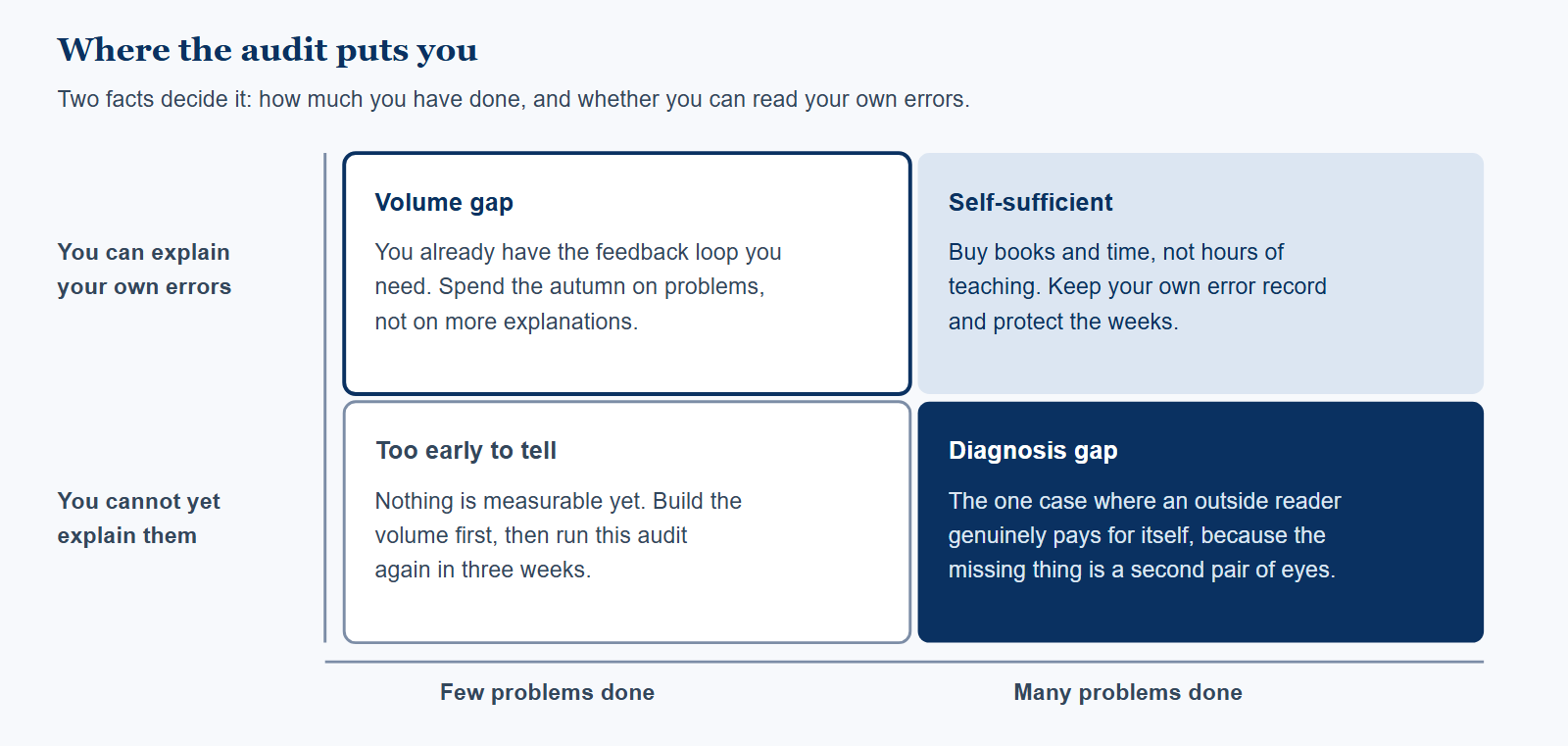
Read the results as follows. Weak recognition with weak retrieval is a volume gap almost every time. Strong recognition but a repeated named wall is a syllabus gap. Strong self-diagnosis and a flat feedback line means you are close to self-sufficient and simply need more time. Weak self-diagnosis with substantial volume already behind you is the diagnosis gap, and it is the only one of the four patterns where paying for help is straightforwardly the efficient move.
When self-study is genuinely enough — and its one real weakness
Most of the AMC ladder is learnable from written material by a motivated student. That is not a concession; it is the observable fact that the competition has produced strong self-taught candidates for decades. The techniques are documented, the problems are abundant, and nothing in the syllabus requires a laboratory or a supervisor.
Self-study has one structural weakness, and it is specific enough to name and to patch. On a multiple-choice paper, a right answer can conceal a method that will not scale. You guessed intelligently, you back-solved from the options, you noticed the answer had to be even — and you moved on with a tick in your log. None of those is cheating and all of them are legitimate exam craft, but if they are how you are getting the answer, your log is recording a competence you do not have. The failure surfaces later, on the harder half of the paper, where the options stop being informative and nothing is standing behind them.
The patch is cheap and does not require buying anything:
- Write full solutions to two or three problems a week, in prose, as though the answer choices did not exist. In our experience this is the highest-yield unpaid intervention available to a self-studying student.
- Compare your method to a published method, not your answer to a published answer. If they differ, the interesting question is what in the problem signalled the other route.
- Have anyone competent — a school teacher, an older student, a parent who did mathematics — read one written solution a fortnight. They do not need to know the AMC. They need to be able to tell you where your reasoning stops being followable.
When guided work earns its keep
Being specific about this is more useful than being enthusiastic about it. Structured help is the efficient choice when several of these are true at once:
- You have real volume behind you and the score has genuinely stopped moving — not stalled for three weeks, stalled across two measurements a month apart.
- Your errors are heterogeneous. When errors cluster, you can see the cluster yourself and fix it yourself. When they scatter, you usually cannot.
- The calendar is fixed and short. The dates are published and do not negotiate, and the operational side — sitting in person at an authorised centre, under the 2026 in-person rules — is settled well before you sit.
- You have a specific question you cannot answer about your own work, and you can state it in one sentence.
It is a poor purchase when the honest reason is any of these: you have not done the volume and hope that instruction substitutes for it; you want the accountability of a scheduled slot rather than the instruction in it (a study group is cheaper); or you are chasing a number and hoping that spending converts into scoring. It does not, and no provider can honestly tell you otherwise.
How to check any provider, including this one
These questions are answerable before you commit, and the answers are informative in themselves.
- Ask them to name, from your own work, the question families where you lose points. If the answer is general — “you need to strengthen geometry” — nobody has read your work.
- Ask whether they teach the paper as well as the mathematics. The scoring structure, the value of a blank, the position gradient across the paper and the centre arrangements are all part of the score, and a course that never mentions them is teaching half the subject.
- Ask what you keep. You should leave with your own error record and a written diagnosis, not only with notes someone else wrote.
- Test whether their information is current. Ask how AIME qualification works. If the answer involves a percentile, a published cutoff, or an index built from your AMC score, they have not read MAA since August 2026, and everything procedural they tell you is suspect.
- Treat these as red flags: any promise about a score, an award or an admissions outcome; a syllabus that is a stack of past papers with no diagnostic step; a schedule that ignores your school’s own assessment calendar in October and November.
Disclosure, because it is relevant to how you should read the paragraphs above. Hanlin Education operates this guide and also runs paid preparation. This article has deliberately been written so that it is useful to a reader who never buys anything from anyone, it does not rank providers, and the checklist in this section is one we would expect to be held to as much as anyone else. Across the cohorts we have worked with, the pattern that shows up most often in a first session is not a missing technique but a missing record — students who have worked hard and cannot say what happened. That is our own observation rather than a published statistic, and individual results vary.
The last point is the one worth carrying into November. Nothing you buy, read or attend changes what the paper is: a fixed date at an authorised centre, a fixed structure, and a score that is yours. The rules for the 2026 sitting are the same for every candidate in the room, whatever they spent getting there.
Frequently asked questions
How do I know whether I need a teacher or just more practice?
Ask whether you can explain why you got a question wrong. If you can, you have a volume gap. If you cannot, you have a diagnosis gap.
Is self-study enough for the AMC?
For most of the ladder, yes. Its weak point is calibration: on multiple choice, a right answer can hide a method that will not scale.
What is the biggest red flag in an AMC course?
Any promise about a score, an award or an admissions outcome. Nobody can promise those, and the claim tells you how the course is run.
How can I tell whether a provider’s information is current?
Ask them the AIME qualifying rule. A percentile answer or an AMC-plus-AIME index means they have not read MAA since August 2026.
This is an independent English-language guide to the American Mathematics Competitions, operated by Hanlin Education for China-based international-school students. We are not affiliated with, endorsed by, or sponsored by the Mathematical Association of America. Nothing here is a claim about what any preparation produces — results vary by student. Confirm current competition details on maa.org and with your own authorised test centre. Errors reported to our editorial desk are corrected within 7 working days.