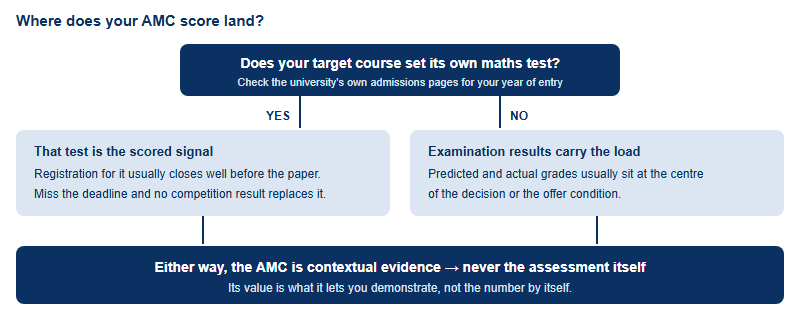
The AMC is not an admissions test anywhere — including in the United States. MAA runs it as a competition, not as an entrance examination, and no university owns it. Outside the US that distinction gets sharper, because many systems already have a maths assessment of their own. Where one exists, it is the scored signal, and your AMC result sits somewhere else in the file entirely.
That is not an argument against sitting the AMC. It is an argument for knowing which job it is doing in your application, so you can budget your autumn honestly. This guide is for China-based international-school students whose university list is not purely American, and it deliberately avoids telling you what any particular university requires — requirements change by course and by cycle, and the only reliable source is each university’s own admissions pages for your year of entry.
Two kinds of maths signal, and only one of them is scored
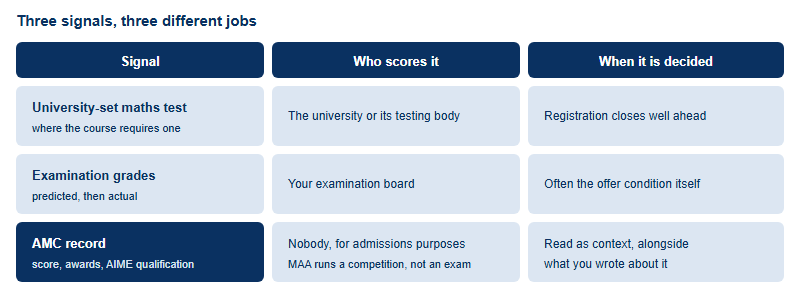
Every application system handles mathematical ability in one of two ways, and the difference decides everything about how much a competition record is worth to you.
| Assessed requirement | Contextual evidence | |
|---|---|---|
| What it is | A test the university or system sets, sits and marks, with a result that feeds the decision or the offer | Anything you did outside the required assessment: competitions, projects, reading, olympiad work |
| Who controls it | The university or an admissions-testing body acting for it | You |
| Where the AMC sits | Never here. The AMC is not an admissions test for any university | Always here |
| What it rewards | Meeting the standard on a specified date, in a specified format | Sustained, verifiable, independent mathematical work |
| Failure mode | Missing the registration deadline — often set well before the paper | Substituting activity for evidence: many entries, nothing that shows progression |
The UK: your competition record is not the test
Applications to UK mathematics and mathematics-adjacent courses frequently involve an admissions test that the university requires and that is administered on its own timetable. The tests students most often encounter in this space are the MAT, the TMUA and STEP. Which courses require or recommend which test — and whether any test is required at all — varies by university, by course and by cycle, and it does change. Check the entry requirements page for your exact course and year of entry, and note the registration deadline the moment you find it, because in this branch of the map a missed registration is the only truly unrecoverable mistake.
Once that is in hand, the honest read on the AMC is worth stating plainly. It does not substitute for a required admissions test. It is not marked by the university. It is a competition result you may mention in a personal statement, and there its value comes from what you can say about it rather than from the number. “I scored 96 on the AMC 12” is a fact. “Working through counting problems for the AMC is what sent me to read about generating functions, and here is the thing I could not resolve” is evidence of the mathematical curiosity a tutor is actually reading for.
There is also a genuine training question, and it cuts both ways. The AMC gives you twenty-five questions in seventy-five minutes with five options each, so it develops fast recognition, estimation and the willingness to abandon a route quickly. Where a university test instead asks for extended written solutions, those are not the same muscles: a long structured problem rewards choosing a single approach and carrying it carefully to the end, with the reasoning legible on the page. The AMC has no written-proof component at all. Train both if your list needs both, and do not assume that AMC practice is quietly preparing you for a paper that asks you to write.
Hong Kong, Singapore and Canada: examination-led files
These systems differ from one another in important ways, but they share a structure: the academic core of the file is your examination record — predicted grades, actual grades, and the specific subject requirements attached to the programme — and supplementary material is read around that core rather than in place of it. Some programmes additionally run interviews, portfolios or their own tests; some do not; several universities publish detailed course-by-course requirements that change annually. Confirm each one directly rather than reasoning from another applicant’s experience or from a different country’s system.
For planning purposes, the practical implication is simple. If the offer will be conditional on grades, then the hours that protect the offer are the hours spent on those subjects, and everything else — including the AMC — is competing for what is left. That is a legitimate trade to make in either direction, as long as you make it deliberately in September rather than discovering it in December.
What does travel, in every system
Three things about an AMC record are legible anywhere, and they are worth understanding precisely.
- The ladder is structurally clear. AMC 8, then AMC 10 or AMC 12, then the AIME by qualification, then the USA(J)MO. A reader who knows nothing about the competition can still see that progression means something, because the AIME and USA(J)MO rungs are gated by qualification at the level below.
- The AIME threshold is now a checkable number. MAA states that qualifying thresholds “will be set numbers rather than based on percentages,” giving 100 or above on the AMC 10 and 85 or above on the AMC 12. A stated fact of that kind is more legible to a non-specialist reader than a percentile claim. If you sit in China, confirm your own route with your region’s International Group Leader — in practice, start by asking the centre that runs your November paper under the 2026 in-person AMC arrangements — since MAA directs international participants to their Group Leader’s policies rather than describing one global process.
- The mathematics itself transfers. Number theory, counting arguments and the habit of finding structure before computing are useful in any first-year course, whatever the admissions route was.
And one thing does not travel: causation. No competition result causes an offer, in any system. Anyone telling you a particular score converts into an admission is describing something no university has published.
How much AMC is right for your list
Turn the map into an hours decision. Between now and the November sitting there is a fixed amount of study time, and the AMC is one of several claims on it.
- US-heavy list. The AMC is the most legible mathematics signal available to you, and the ladder above it is the reason. Sitting it is straightforwardly worth the hours.
- UK-heavy list with a required admissions test. The required test wins any direct conflict. If you can protect its preparation and still sit the AMC, do both; if something has to give, it is not the required test. Sitting one AMC paper rather than two is a reasonable compromise.
- Examination-led list — Hong Kong, Singapore, Canada. Protect the subjects the offer will be conditional on first. The AMC then earns its place as genuine evidence of independent interest, not as a tick.
- Mixed list. Assume the strictest branch applies. Plan around whichever destination has the earliest hard deadline, and let the others fit around it.
One scheduling note specific to this season. Because seats at our centres lock on 10 October 2026, with withdrawal and no-shows non-refundable after that date, the decision about how many papers you sit has to be made in the first half of October — earlier than most students have finished thinking about their university list. The 2026 in-person AMC rules and authorised centre arrangements are worth reading alongside your application calendar rather than separately from it. MAA’s published dates are 5 November 2026 for the A papers and 13 November 2026 for the B papers; your centre publishes its own sitting date, and you should confirm yours with the centre holding your seat.
Read this way, the AMC stops being a thing you either “need” or “do not need” and becomes what it actually is: an unusually well-structured piece of mathematics that most systems will read as evidence rather than score as a requirement. That is a smaller claim than the one usually made for it — and it is the one you can defend in an interview.
Frequently asked questions
Is the AMC an admissions test for UK universities?
No. The AMC is a competition run by MAA and is not set or marked by any university. Check your course’s own required admissions test.
Does an AMC score help a Hong Kong or Singapore application?
It is read as supplementary context alongside your examination record. No competition result causes an offer in any system.
Should I skip a required admissions test to prepare for the AMC?
No. A required test is scored by the university and cannot be replaced. Its registration deadline is the one you cannot miss.
What is the best thing to say about my AMC score?
What it led you to study next. The number is a fact; the mathematics it sent you to read is the evidence a tutor is looking for.
This is an independent English-language guide to the American Mathematics Competitions, operated by Hanlin Education for China-based international-school students. We are not affiliated with, endorsed by, or sponsored by the Mathematical Association of America, and we are not affiliated with any university or admissions-testing body named here. Admissions requirements change by course and by cycle — confirm them on each university’s own admissions pages, and confirm AMC details on maa.org and with your own authorised test centre. Errors reported to our editorial desk are corrected within 7 working days.