Problems 21–25 on the AMC 10 and AMC 12 are not simply harder versions of Problems 1–20. They test whether you can combine two or three ideas under time pressure, on what the MAA describes as a “25-question, 75-minute multiple-choice competition” where no calculator is permitted. Training for the tail therefore needs a different method: fewer problems, longer thinking time, and a disciplined way of reading solutions.
What actually changes at Problem 21?
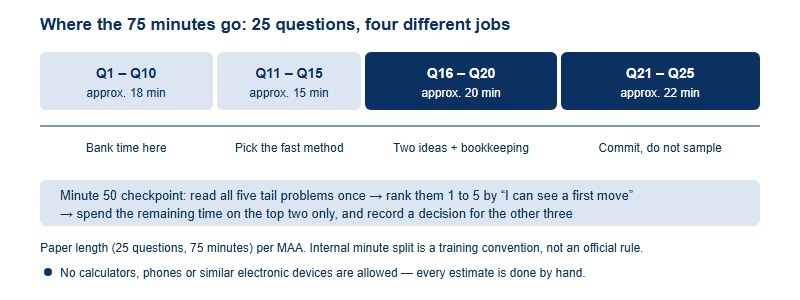
Across a 75-minute paper with 25 questions, the average budget is three minutes per problem. Nobody actually spends it that way. Strong candidates bank time in the opening block precisely so they can afford to be slow at the end — and the reason they need that time is that the last five problems change what is being tested, not just how hard it is.
Four things shift once you cross Problem 20:
- Synthesis replaces recognition. Problems 1–15 usually reward “I have seen this shape before.” Tail problems typically need two or three ideas chained together, and the chain order is not signposted.
- The setup is the problem. On many tail questions the actual computation is short; the difficulty sits in choosing coordinates, choosing a variable, or reframing a count. Students who rush to calculate lose the problem before they start.
- Answer choices stop helping. Plugging in the lettered options and eliminating by estimation works well early on. In the tail the options are often structurally similar or deliberately near-miss values, so back-solving burns minutes without narrowing anything.
- The clock becomes psychological. With eight minutes left, most errors are not mathematical. They are decisions: which problem to abandon, whether to re-check Problem 17, whether to leave a question blank.
| Block | What it mostly tests | Time a well-drilled candidate spends | Where points leak |
|---|---|---|---|
| Q1–10 | Clean execution of standard ideas | Roughly 15–20 minutes | Careless arithmetic; misreading the question stem |
| Q11–15 | One idea, slightly disguised | Roughly 15 minutes | Choosing the slow method (brute-force casework) |
| Q16–20 | Two ideas, or one idea with heavy bookkeeping | Roughly 20 minutes | Running out of patience and guessing early |
| Q21–25 | Synthesis, construction, non-obvious setup | Whatever is left — often 20–25 minutes | Spreading time thinly across all five instead of committing to one or two |
What are the last five actually worth to you?
This is where most preparation plans go wrong. The tail is glamorous, so students train it first. For many candidates it is the wrong bottleneck.
Start from the outcome you are chasing. MAA has changed how you reach the AIME. The percentile bands quoted in older guidance, ours included, are gone: for 2027 the thresholds are “set numbers rather than based on percentages,” namely 100 or above on the AMC 10 and 85 or above on the AMC 12. The AIME still asks for 15 answers that are integers from 0 to 999, but from 2027 it runs as two 90-minute parts at a Pearson Professional Center rather than one continuous paper. Full policies are still to be posted, so confirm the current position on maa.org.
Under the scoring structure used on recent papers, a correct answer is worth 6 points and an unanswered question 1.5 — verify the current scoring table on maa.org before you build a strategy on it, because the whole blank-versus-guess calculation depends on it.
Now sort yourself honestly into one of three profiles:
- Profile A — still leaking in the first twenty. If a timed mock shows two or more avoidable errors before Problem 20, the tail is not your bottleneck. Every hour spent on Problem 24 is an hour not spent removing a repeatable mistake that costs you the same points more reliably.
- Profile B — clean through Problem 20, stuck after it. This is the group the rest of this article is written for. Your ceiling is genuinely set by the tail.
- Profile C — already solving one or two tail problems. Your training should start drifting toward AIME-style depth: longer problems, exact integer answers, no answer choices to lean on.
A four-phase protocol for training the tail
The single biggest error we see in China-based international-school students is treating hard problems like ordinary homework: twenty problems in an evening, solutions checked immediately, move on. That builds familiarity, not capability. Hard-problem ability comes from long, uncomfortable, unassisted thinking followed by a structured post-mortem.
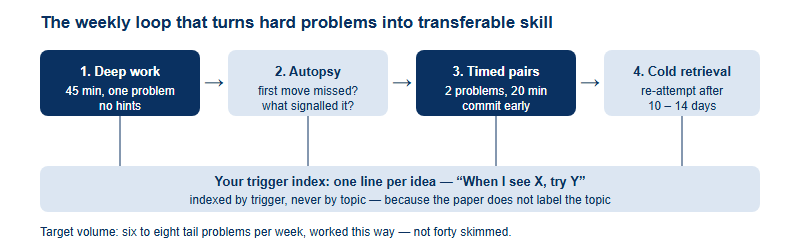
| Phase | Session shape | Frequency | Success signal | Failure mode |
|---|---|---|---|---|
| 1. Deep single-problem work | One tail problem, 45 minutes, no solution, no hints, everything written down | 2–3 sessions per week | You can list three distinct approaches you tried and why each stalled | Staring without writing; quitting at minute 8 |
| 2. Solution autopsy | 15 minutes on the worked solution after — never before — Phase 1 | Immediately after every Phase 1 | You can name the exact step you would not have found | Reading, nodding, filing it away |
| 3. Timed pairs | Two tail problems in 20 minutes, exam conditions, blank paper only | Once per week | You commit early and finish one cleanly | Splitting 10 minutes each and finishing neither |
| 4. Cold retrieval | Re-attempt problems from 10–14 days ago, from memory of the idea only | Once per week | You reconstruct the key move without the write-up | Recognising the answer instead of the method |
Six problems a week, worked this way, will move a Profile B student further in a term than sixty problems skimmed. The scarce resource is not problems — the AMC past-paper pack we have gathered already holds decades of them, with the AMC 10 set and AMC 12 set split by level — it is your attention. Worked solutions accompany many of those years rather than all of them; message us and we will send you the current set.
Five ways students waste a whole summer on hard problems. Every one of these feels productive at the time, which is exactly why they survive:
- Volume over depth. Forty problems skimmed, none owned. If you cannot re-derive a problem two weeks later, you did not learn it.
- Reading the solution at minute five. The struggle is the training stimulus. Reading early feels efficient and builds almost nothing.
- Training only the tail. Accuracy in Problems 1–20 decays without maintenance. Keep one timed full paper every two weeks even inside a tail-focused block — and run it under the conditions you will actually face in November, which are set out in our guide to the 2026 in-person AMC rules.
- Practising untimed forever. Untimed skill does not automatically survive contact with a 75-minute clock. Phase 3 exists for exactly this reason.
- Sorting practice by topic. If you know a problem is “a counting problem” before you read it, you have removed the hardest step. Mix your sets.
How do you read a solution so it actually transfers?
Understanding a solution and being able to produce it are completely different skills. Bridge them with a three-question autopsy, written down, every time:
- What was the first move I did not make? Not the whole solution — the single decision that unlocked it. Usually it is a reframing: introduce a variable, add an auxiliary line, count the complement, fix an ordering.
- What in the problem statement should have signalled that move? This is the transferable part. Force yourself to point at a phrase, a structure, or a number.
- Where else have I seen this trigger? If the answer is “nowhere,” the idea is new and belongs in your index. If you have seen it twice, it is a pattern and should now be automatic.
Then write one sentence in the form “When I see X, try Y.” Keep these in a single running document indexed by trigger, not by topic — because the paper does not tell you the topic. Examples of the form (not a list to memorise; yours must come from your own failures):
- When a count has a forbidden adjacency or a forbidden case, try counting the complement.
- When two secants or a tangent meet a circle from an external point, test power of a point before coordinates.
- When an expression is symmetric in several variables, look for a substitution or a relationship between sum and product rather than solving for each variable.
- When a problem asks for the number of integers satisfying a divisibility condition, test small cases first and look for periodicity.
What are the rules on the day, and what do they mean for the tail?
Two published rules shape how you should rehearse. First, the MAA is explicit that “NO CALCULATORS OR PHONES AND SIMILAR ELECTRONIC DEVICES OF ANY KIND ARE ALLOWED. No questions require the use of a calculator.” Second, the permitted materials are narrow: “writing utensils, blank scratch paper (NOT graph paper) provided by a teacher, rulers, compasses, and erasers.” If you have been practising on a tablet or with graph paper, you have been rehearsing a different exam.
For 2026, the AMC 10A and 12A fall on November 5 and the 10B and 12B on November 13, sat in person at authorized centers — the practical logistics are covered in our guide to the 2026 in-person AMC rules. The MAA also sets out a combination rule worth knowing early: “students may only take one competition per competition date,” but they “are permitted to take the A version of any competition and the B version of any competition” — so an AMC 10A plus an AMC 12B is allowed, while an AMC 10A plus an AMC 12A is not.
That matters for tail training, because two sittings mean two live rehearsals eight days apart. Whatever you learn on 5 November about your own decision-making under pressure is still actionable on 13 November.
Four triage rules for the last five, to rehearse in every timed session:
- Read all five before committing. Difficulty is not perfectly monotonic; the problem that suits you may be Problem 24, not Problem 21.
- Apply a two-minute entry test. If after two minutes you cannot write down a first concrete move, park it and move on. Coming back with a fresh angle costs less than grinding.
- One problem finished beats three started. Partial work earns nothing on a multiple-choice paper.
- Write the setup before the arithmetic. Under time pressure the temptation is to compute immediately. On tail problems the wrong setup computed perfectly is still zero.
Frequently asked questions
Q: How many hard problems should I do each week?
Six to eight, worked deeply, beats forty skimmed. Budget roughly three to four hours across two or three sessions plus one timed pair.
Q: Should I guess on Problems 21–25 if I am out of time?
It depends on the current scoring table for blanks versus wrong answers. Check the official scoring on maa.org, then decide before exam day — never in the last minute.
Q: Can I sit both the A and the B paper in 2026?
Yes, within the MAA rule: one competition per date, and you may take an A version and a B version — for example AMC 10A on 5 November and AMC 12B on 13 November.
Q: Do I need a calculator strategy for the tail?
No. The MAA states no calculators or similar electronic devices are allowed and that no question requires one. Practise all estimation by hand.
This is an independent English-language guide operated by Hanlin Education for China-based international-school students. It is not affiliated with, endorsed by, or sponsored by the Mathematical Association of America (MAA). Competition dates, eligibility, scoring, permitted materials and AIME qualification rules are set by the MAA and can change — always confirm current details on maa.org and with your authorized competition manager. Note that the US AMC (MAA) is a different competition from the Australian AMC (AMT) and from AMO (SIMCC, Singapore). If you spot an error, tell us and we will correct it within 7 working days.