For a student at an international school in China, one strategic question comes up early: should you invest in the AMC, or in the domestic mathematics-olympiad route — the national high-school league that leads toward the Chinese Mathematical Olympiad? They are different systems built for different destinations. For students on international curricula aiming at universities abroad, the AMC is usually the natural fit; but the honest comparison has real nuance. Confirm domestic-route rules with your school and official Chinese sources, and AMC rules on maa.org.
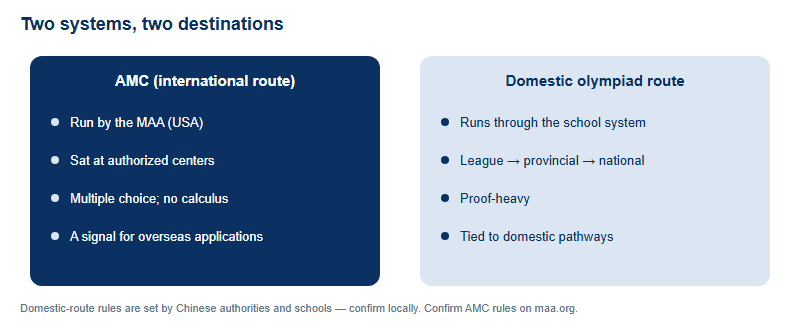
Two systems, two destinations
The most useful way to frame the choice is not “which is harder” but “which is built for where I am going.” The AMC is run by the Mathematical Association of America and is the entry point to the American competition ladder that leads to the AIME and the national olympiad. It is recognized internationally and is designed to be taken by students around the world. The domestic olympiad route runs through China's own school system: a national high-school league that feeds provincial rounds and, above them, the Chinese Mathematical Olympiad, historically connected to domestic university admission and enrichment pathways.
What the AMC route looks like
The AMC route is well-defined and, importantly, open. You sit the AMC 10 or AMC 12 — a 25-question, 75-minute multiple-choice paper with no calculator and, notably, no calculus required. Score high enough and you are invited to the AIME; perform well there and you can reach the national olympiad. In 2026 the AMC is offered in person at authorized test centers, and the registration and logistics are covered in our 2026 in-person AMC guide.
Two features make this route attractive for international-school students. First, access is straightforward: the exam is built to be taken through authorized centers rather than through a specific national school system, so a student on an IB, AP, or A-Level curriculum can sit it. Second, it is a recognized signal for overseas university applications, where admissions readers are familiar with the AMC, AIME, and the olympiads above them. That recognition is a genuine advantage — though, as with any competition, it is one part of a profile and never a guarantee of admission.
The ladder is also clear enough to plan around: AMC 10/12, then the AIME, then the USAMO or USAJMO. Each rung is a concrete, checkable goal, which makes the AMC route easy to build a multi-year plan around even before you know how far you will climb.
There is a planning advantage in how gradual the AMC route is. You are not forced to commit to a distant, all-or-nothing goal; you climb one visible rung at a time, and each rung is worth having on its own. A student who qualifies for the AIME but never reaches the olympiad still holds a result that overseas admissions readers recognise. That optionality — real value at every level, not only at the summit — is part of why the route suits students who are still deciding how far into competition math they want to go.
What the domestic olympiad route looks like
The domestic route is the path most Chinese-school students know: a national high-school mathematics league, provincial competitions, and above them the Chinese Mathematical Olympiad, with further national training beyond that. It is a proof-heavy tradition — closer in character to the USAMO end of the American ladder than to the multiple-choice AMC — and it has historically connected to domestic university admission and enrichment pathways.
Two honest caveats matter here. First, the domestic route is administered through China's own education system and its rules, eligibility, and admission links are set by Chinese authorities and schools; they also change over time. Nothing in this guide should be treated as the current rulebook — confirm the specifics with your school and official Chinese sources before making a decision. Second, and most practically, the route is generally organized around the domestic school (gaokao) track, which shapes who can realistically enter it.
It is also worth respecting how demanding the domestic route is on its own terms. The proof-based tradition it belongs to is intense and highly competitive, and the students who succeed in it are formidable problem-solvers. Choosing the AMC instead is not a judgement that one tradition is easier or better — it is a recognition that the domestic system is optimised for a destination, and organised around a school track, that may not be yours. Match the system to your situation, not to a reputation.
That second point is usually the deciding factor for families weighing the two systems, so it deserves its own section.
The access reality for international-school students
For a student enrolled in an international-curriculum school, the practical crux is access, not ambition. The domestic league is typically entered through domestic-track schools, so international-school students often cannot register for it easily — and where they can, the benefits that make it attractive to domestic students (its links to Chinese university pathways) may not apply to someone aiming abroad. The AMC has the opposite profile: it is designed to be sat at authorized centers by an international audience, which is exactly why it has become the default competition for this cohort.
The cleanest way to test fit is to ask two blunt questions before you invest a single study hour. Can I actually register for and sit this competition, given my school and curriculum? And do the rewards it offers point at the universities I am aiming for? For most international-school students in China, the domestic league stumbles on the first question and the AMC clears both — which is less a verdict on the mathematics than on the plumbing of who each system is built to serve.
| Dimension | AMC (international route) | Domestic olympiad route |
|---|---|---|
| Organizer | MAA (USA) | China's education system |
| Access for intl-school students | Open — sat at authorized centers | Often hard to access; confirm with school |
| Format | Multiple choice (10/12); no calculus | Proof-heavy; confirm details |
| Primary recognition | Overseas university applications | Domestic pathways |
| Next rungs | AIME → USAMO / USAJMO | Provincial → Chinese Mathematical Olympiad |
Read the table as a map of fit, not a ranking of quality. Both systems produce world-class mathematicians. The question is which one your enrollment, curriculum, and university destination actually let you use — and for most international-school students in China, that answer is the AMC.
Which fits you? An honest decision guide
Strip the decision down to where you are headed and what you can access, and it usually resolves quickly.
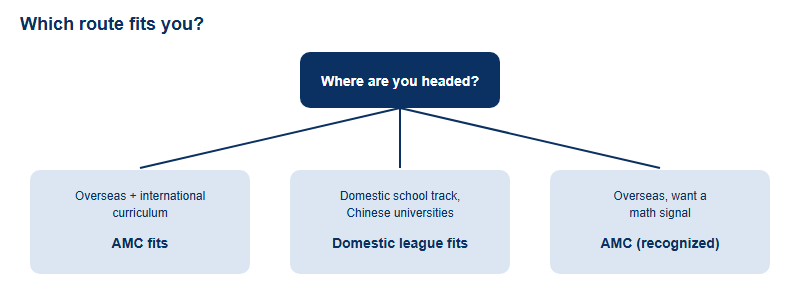
If you are on an international curriculum and aiming at universities abroad, the AMC is almost always the route you can both access and use — and you can start planning it around the 2026 in-person schedule described in our in-person AMC rules. If you are firmly on the domestic track toward Chinese universities, the domestic league is the system designed for you; confirm its current rules and benefits with your school. And you do not have to treat the two as mutually exclusive in principle — some students pursue the AMC for its overseas recognition regardless — but for most, time and access make the choice for them.
One more practical point for families running the numbers: competition math is a multi-year investment of a student's scarcest resource, time. Spreading effort across two systems that pull in different directions usually means doing neither well. If your destination is overseas and your curriculum is international, concentrating that time on the AMC ladder — where access is open and recognition is real — is almost always the higher-return choice, and it leaves room for the depth that actually moves the needle.
A first-party note for the China cohort: the most common mistake we see is choosing a route for its prestige rather than its fit. A route you cannot access, or one whose rewards point at a destination you are not headed to, is not an advantage no matter how respected it is. Pick the ladder you can actually climb toward the future you are actually building.
Frequently asked questions
Can international-school students in China take the AMC?
Yes. In 2026 the AMC is sat in person at authorized centers, which serve the international-school audience. Confirm registration and centers on maa.org.
Can international-school students join the domestic math-olympiad league?
Often not easily. It runs through the Chinese school system, and eligibility is set by Chinese authorities. Confirm with your school.
Which is better for overseas university applications?
For students on international curricula aiming abroad, the AMC is the natural, widely recognized fit. No competition guarantees admission, though.
Do I have to choose only one?
No. Some students focus on the AMC for overseas signaling regardless of route. Weigh your time, destination, and access before committing.
This is an independent English-language guide operated by Hanlin Education for China-based international-school students. It is not affiliated with, endorsed by, or sponsored by the Mathematical Association of America (MAA). Competition formats, dates, and rules — including those of the domestic olympiad system — change; always confirm current details on maa.org and with your school. We correct any error within 7 working days.