The single highest-leverage habit in AMC 10/12 preparation is not doing more problems — it is systematically recording, classifying, and retesting every problem you get wrong. An error log turns each mistake into a data point: was it a knowledge gap, a method gap, or an execution slip? Each type has a different fix, and students who track the difference typically stop repeating the same mistakes within weeks. This guide gives you the complete system: the log template, the mistake taxonomy, a full mock-exam protocol, and the review cycle that closes the loop before the November 5 and 13, 2026 exams.
Why untracked practice plateaus
Here is the pattern we see constantly among China-based international-school students: a student grinds through hundreds of past problems, watches solution videos, feels productive — and their timed scores barely move. The reason is almost never effort. It is that practice without mistake analysis only reinforces what you already do well. The problems you get right needed no work; the problems you got wrong get a quick glance at the solution (“oh, I see”) and are never revisited. Two weeks later, the same trap catches you again.
“Oh, I see” is the most expensive sentence in competition prep. Recognising a solution when it is shown to you is a completely different skill from producing it under time pressure. The error log exists to force the second skill: every wrong answer becomes an entry with a diagnosis and a scheduled re-attempt, done cold, from a blank page.
The math of the AMC makes this even more valuable. With 25 questions in 75 minutes and roughly six points per correct answer under MAA’s long-standing scoring format (confirm current rules on maa.org), eliminating just two recurring mistake patterns is worth on the order of twelve points — often the entire distance between a middling score and an award-region score. No new textbook chapter offers a return that fast.
The three mistake types — and why they need different fixes
Every wrong answer on a practice AMC falls into one of three categories. Classifying honestly is the heart of the method, because the fixes do not transfer across categories.
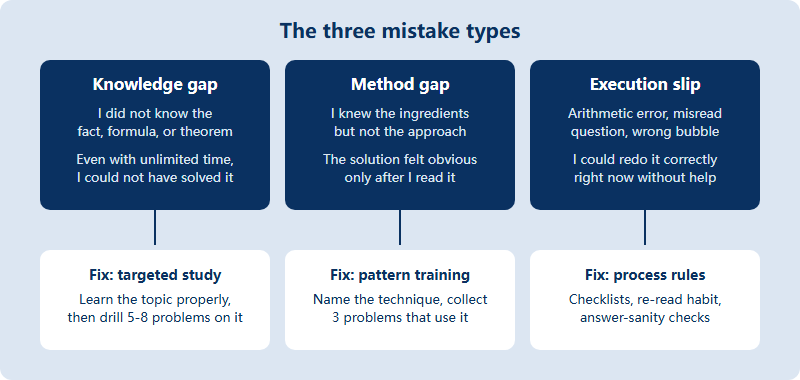
The most common self-diagnosis failure is calling everything “careless.” Students hate admitting method gaps because it feels like admitting weakness, so they file real gaps under execution slips — and then the fix (“be more careful”) does nothing, because carefulness was never the problem. Use this test: if you can redo the problem correctly right now with no hints, it was an execution slip. If you needed to see the solution, it was not.
Building the log: the six columns that matter
You do not need software; a spreadsheet or a dedicated notebook works. What matters is that every wrong or lucky-guess problem gets a row with these six fields:
| Column | What goes in it | Example entry |
|---|---|---|
| Problem ID | Source, year, paper, number — enough to find it again | AMC 10A practice set, Q17 |
| Topic | One of the four AMC pillars plus subtopic | Number theory — modular arithmetic |
| Mistake type | Knowledge gap / method gap / execution slip | Method gap |
| Root cause (one sentence) | The specific reason, written honestly | Did not think to count complements instead of direct cases |
| The fix | The concrete action you will take | Drill 3 complement-counting problems this week |
| Retest date + result | When you re-attempted it cold, and whether you solved it | Redo Jul 20 — solved in 4 min |
Two rules make the log work. First, log lucky guesses too. A problem you guessed correctly is a wrong answer wearing a disguise; on the real paper the disguise falls off. Second, write the root cause as a decision, not an event. “I made an algebra mistake” is an event. “I expanded instead of factoring, which created six terms to track instead of two” is a decision — and decisions can be changed next time.
The mock-exam protocol: generating clean data
The error log is only as good as the data feeding it, and the cleanest data comes from full simulations run under real conditions. From now until November, run timed mocks on a regular schedule — weekly in the final two months — using this protocol:
- Full paper, 75 minutes, one sitting. No pausing, no phone in the room, no music. Partial sets in casual conditions measure a different skill than the one being tested in November.
- Paper conditions. The 2026 AMC is in-person only, administered on-site at authorized centers — so practise the way you will test: printed problems if possible, handwritten scratch work, and answers recorded on a separate sheet to simulate bubbling. Our guide to the 2026 in-person format and test-day rules covers what the room will actually look like.
- No calculator, standard materials only. Match the official rules exactly; confirm the current list of permitted materials on maa.org before your first mock so you never build a habit you must unlearn.
- Score it honestly using the official scheme, counting blanks and wrong answers separately — the blank-versus-guess decision is itself a skill your mocks should be training, and your log should capture bad guessing decisions as execution-category entries.
- Record three numbers every time: score, number of problems attempted, and accuracy on attempted problems. Score alone hides the diagnosis: a 90 built on 15 attempts at 100% accuracy and a 90 built on 24 attempts at 60% accuracy call for opposite adjustments.
The review cycle: 48-hour redo and spaced retests
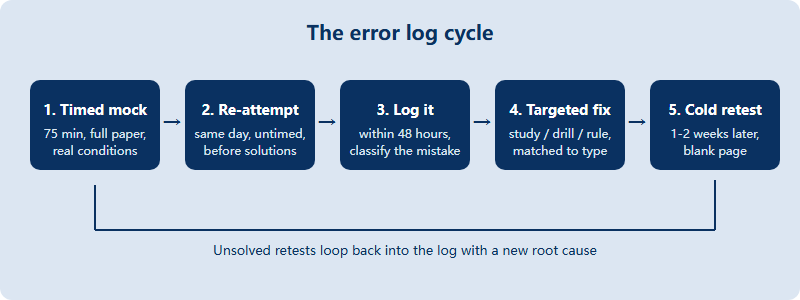
After each mock, the review is a three-stage cycle — and the stages are separated in time on purpose.
Stage 1 — same day: re-attempt before reading solutions. Go back to every problem you missed or skipped and try again with unlimited time. Anything you now solve was a time-pressure or execution issue, not a knowledge issue — log it accordingly. Only after this second attempt do you open solutions, and even then, read only far enough to find the idea you were missing, then close the solution and finish the problem yourself.
Stage 2 — within 48 hours: log and classify. Fill in the six columns for every missed problem while your memory of your own reasoning is still alive. This is the step that dies if you postpone it a week: you will remember that you missed Q17 but not why, and a log without root causes is just a list of bad memories.
Stage 3 — one to two weeks later: cold retest. Re-attempt the logged problems from a blank page, no notes. A problem leaves the log only after you solve it cold. Problems that fail the retest go back in with a new root-cause sentence — repeated failures on the same entry are your single most precious prep signal, because they mark the exact boundary of your current ability.
Reading your data: what the log tells you after four weeks
After a month, the log becomes a diagnostic instrument. Sort your entries by topic and by mistake type and look for the two dominant patterns:
If one topic dominates — say, a third of your entries are combinatorics — you have found your study priority, and it usually contradicts your intuition. Students consistently over-study the topics they like and under-log the ones they avoid. The log does not care what you like.
If one mistake type dominates, adjust the whole training plan, not just topics. A log full of knowledge gaps means you are mocking too early and should shift hours toward content; a log full of method gaps means content is fine and you need exposure to more problem archetypes; a log full of execution slips at the end of papers usually means a pacing problem — you are buying attempts on late questions with rushed, error-prone work on early ones. That last pattern matters double on the AMC, where an early careless miss costs the same six points as an unsolved hard problem.
Finally, watch the trend in your attempted-accuracy number across mocks. Rising accuracy at constant attempts, or constant accuracy at rising attempts, are both real progress even when the headline score wobbles — individual papers vary, which is exactly why the November exams offer two in-person dates in 2026, and why your log, not any single mock score, is the truest picture of where you stand.
FAQ
How many problems should my error log have?
There is no target size. A healthy log grows after every mock and shrinks as cold retests clear entries. If it only ever grows, you are logging but not retesting.
Should I log problems I guessed correctly?
Yes. A lucky guess is a wrong answer in disguise — the underlying gap is still there. Log it with the same six columns and retest it cold like any miss.
How often should I run full timed mocks before November 2026?
Roughly every two weeks through summer, moving to weekly in the last six to eight weeks. Each mock needs a full review cycle, so more frequent than weekly usually backfires.
What if I keep failing the retest on the same problem?
That marks the edge of your current ability — the most valuable signal in the log. Reclassify it (often a method gap mislabeled as careless), study the technique by name, then retest again.
This is an independent guide operated by Hanlin Education for China-based international-school students. It is not affiliated with, endorsed by, or sponsored by the Mathematical Association of America (MAA). Competition dates, rules, scoring, and permitted materials change — always confirm current details on maa.org. Factual errors reported to us are corrected within 7 working days.