The “A” and “B” in AMC 10A, 10B, 12A, and 12B are not difficulty levels — they are two separate administration dates of the same competition. In 2026, the A papers (AMC 10A and 12A) are given on November 5 and the B papers (AMC 10B and 12B) on November 13, in person at authorized test centers. Under MAA’s long-standing rules, a student may sit both the A and B versions of a competition, but never the AMC 10 and AMC 12 on the same date. This guide explains what actually differs between A and B, which combinations are permitted, and how to decide.
What “A” and “B” actually mean
The Mathematical Association of America (MAA) — the U.S. organiser of the AMC series since 1950 — writes two distinct papers for each of the AMC 10 and AMC 12 every cycle. The A paper and the B paper cover the same syllabus, follow the same format, and are targeted at the same difficulty band. They exist for one practical reason: not every school or test center can administer the competition on a single fixed day, so MAA offers two dates roughly a week apart, each with its own fresh set of problems.
Because the papers are different, the two dates are scored and ranked separately. The AMC 10A has its own score distribution and its own award thresholds, and the same is true for the 10B, 12A, and 12B. That is why published award cutoffs list four separate numbers per year. One line no longer varies this way: for 2027 MAA has set AIME qualification at a fixed 100 on the AMC 10 and 85 on the AMC 12, the same on either date — and why “which version is easier” is the wrong question, as we cover below.
One disambiguation before going further, because it trips up many China-based families: this article is about the American Mathematics Competitions run by the MAA. The Australian Mathematics Competition (run by AMT) and the AMO (run by SIMCC in Singapore) are entirely different events with different organisers, formats, and dates. The A/B structure discussed here applies only to the US AMC 10 and 12.
The 2026 dates — and why in-person logistics now shape your choice
For the 2026 cycle, the confirmed schedule for the upper-level competitions is:
| Administration | Competitions | 2026 date | Who typically sits it |
|---|---|---|---|
| A date | AMC 10A and AMC 12A | Thursday, November 5, 2026 | Students whose center offers the A date; students planning an A+B double |
| B date | AMC 10B and AMC 12B | Friday, November 13, 2026 | Students whose center only runs one date; second attempt for A-date sitters |
| AMC 8 | AMC 8 (separate, younger competition) | January window — confirm on maa.org | Grade 8 and below |
The 2026 cycle is also in-person only: there is no at-home online option, and every student must test at an authorized center under proctored conditions. For students in China, that makes center availability the first constraint on the A-vs-B decision — some centers run both dates, others only one. We break down how the in-person rules work and how to find an authorized center in our companion guide to the 2026 in-person AMC rules and test dates. If your preferred center offers only the B date, your decision is made for you; if it offers both, the strategy questions below apply.
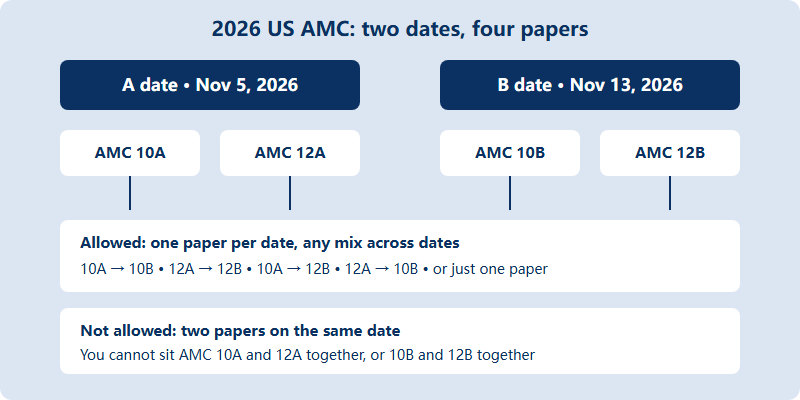
Can you take both? The combination rules
Under MAA’s long-standing administration rules, the combinations work like this (your test center is the final authority on what it can offer, so confirm when you register):
- You may take both the A and the B administration. A student can sit the AMC 10A on November 5 and the AMC 10B on November 13. Each is a completely separate competition with its own paper and its own AIME qualification line — qualifying on either one earns the AIME invitation.
- You may not take the AMC 10 and AMC 12 on the same date. The 10A and 12A are administered simultaneously, as are the 10B and 12B, so you choose one competition per date.
- Cross-level splits are allowed. An eligible student may take, for example, the AMC 10A on November 5 and the AMC 12B on November 13. Eligibility still applies to each paper separately: the AMC 10 is for students in grade 10 or below within MAA’s age limits, and the AMC 12 for grade 12 or below — confirm the exact eligibility wording for the current cycle on maa.org.
- Each sitting is registered and usually paid for separately. Fees and registration deadlines are set through the test center, and centers in China each run their own sign-up process and pricing — confirm directly with your center.
Why double up? The honest case for taking both dates is variance reduction, not doubled glory. Any single 75-minute paper carries luck: one unfamiliar problem type, one careless bubble, one bad night of sleep. A second administration a week later gives you an independent draw. For students right at the margin of AIME qualification, that second draw is genuinely valuable. For students far below or far above the margin, it matters much less.
Is A or B harder? What the moving cutoffs really tell you
Every year, students compare the A and B cutoffs and conclude that one version was “easier.” That reads the data backwards. MAA targets the same difficulty band for both papers, but because the problems are different, the realised difficulty always drifts a little — and the qualification thresholds are set after the fact from each paper’s own score distribution. A harder B paper simply produces a lower B cutoff. The percentile you need is what stays roughly stable, not the raw score.
Three practical consequences follow. First, you cannot game the choice in advance — nobody knows which 2026 paper will run harder, and the cutoff will partially compensate either way. Second, raw-score goals borrowed from a previous year are soft targets: treat historical thresholds as orientation, not promises, and never assume a specific number will qualify (exact cutoffs vary each year and are published by MAA after scoring). Third, the strongest argument for taking both papers is precisely this unpredictability — two different papers smooth out the luck of which topics happen to appear.
The format itself is identical across A and B and has been stable for years: 25 multiple-choice questions in 75 minutes, no calculator, with correct answers, blanks, and wrong answers scored differently so that blind guessing is penalised relative to leaving a question blank. Confirm the current year’s official rules and scoring details on maa.org before test day, and read our breakdown of what the 2026 in-person format changes on the ground.
A decision framework for China-based students
Working with international-school students across China, we see the A-vs-B decision reduce to four questions, in order:
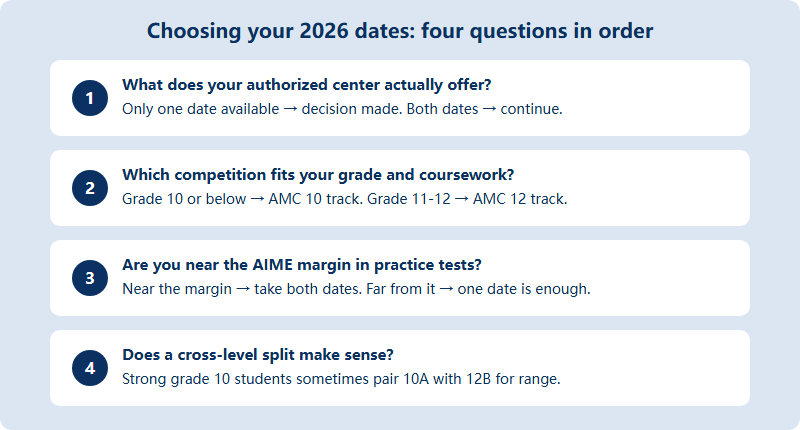
Question 1 — center availability. In the in-person-only 2026 cycle, everything downstream depends on what your authorized center runs. Ask early: centers finalise their offered dates and seat counts well before November, and the popular ones fill up. Our guide to 2026 authorized centers and registration for China-based students covers how to locate and contact one.
Question 2 — competition level. The A/B choice is secondary to the 10-vs-12 choice. If you are in grade 10 or below and have not finished precalculus-level material, the AMC 10 track is normally the right home; grade 11–12 students sit the AMC 12. (Eligibility rules are set by MAA — confirm the current wording on maa.org.)
Question 3 — your margin. If your timed practice scores land near the historical AIME qualification region for your competition, a second administration meaningfully raises your chance that at least one paper goes well. If you are comfortably above or clearly below, spend the extra week studying instead of testing.
Question 4 — the split. A strong grade-10 student who is eligible for both competitions can take 10A on November 5 and 12B on November 13. The upside is one “home turf” paper plus one stretch paper whose AIME line is reached through different math. The downside is preparing two syllabi at once — the AMC 12 adds trigonometry, logarithms, and more advanced algebra that the AMC 10 does not test. Do this only if your 12-level content is genuinely ready, not as a default.
Practical calendar notes for the eight days between papers
If you do take both dates, the week between November 5 and November 13 is a real preparation window — but only if you use it for repair, not volume. Spend the first day writing down every problem you remember struggling with on the A paper while the memory is fresh. Classify each one: content gap, method gap, or execution slip. Then spend the remaining days closing the one or two largest gaps rather than grinding new full papers. The B paper will be different in its specifics, but your personal weaknesses travel with you from one paper to the next; the between-papers week is the one time you get to fix them with a live data point in hand.
Finally, remember that scores from the two administrations are never averaged. Each paper stands alone for awards and AIME qualification, so a rough A day costs you nothing on the B day. Walk into November 13 as if November 5 never happened.
FAQ
Are the AMC 10A and 10B the same test?
No. They are two different papers written for two dates — Nov 5 and Nov 13 in 2026 — with the same format and syllabus but separate scoring and separate AIME cutoffs.
Can I take both the A and B versions in 2026?
Yes, under MAA’s standard rules you may sit both administrations, one paper per date. Confirm availability and fees with your authorized test center, since not all centers run both dates.
Is the B version easier than the A version?
Neither is designed to be easier. Difficulty drifts slightly each year in either direction, and cutoffs adjust to each paper’s own score distribution, so you cannot game the choice in advance.
Can I take AMC 10A and AMC 12A on the same day?
No. The 10A and 12A run simultaneously, as do 10B and 12B. You choose one competition per date, though cross-date splits such as 10A plus 12B are allowed.
This is an independent guide operated by Hanlin Education for China-based international-school students. It is not affiliated with, endorsed by, or sponsored by the Mathematical Association of America (MAA). Competition dates, rules, eligibility, and fees change — always confirm current details on maa.org and with your authorized test center. Factual errors reported to us are corrected within 7 working days.