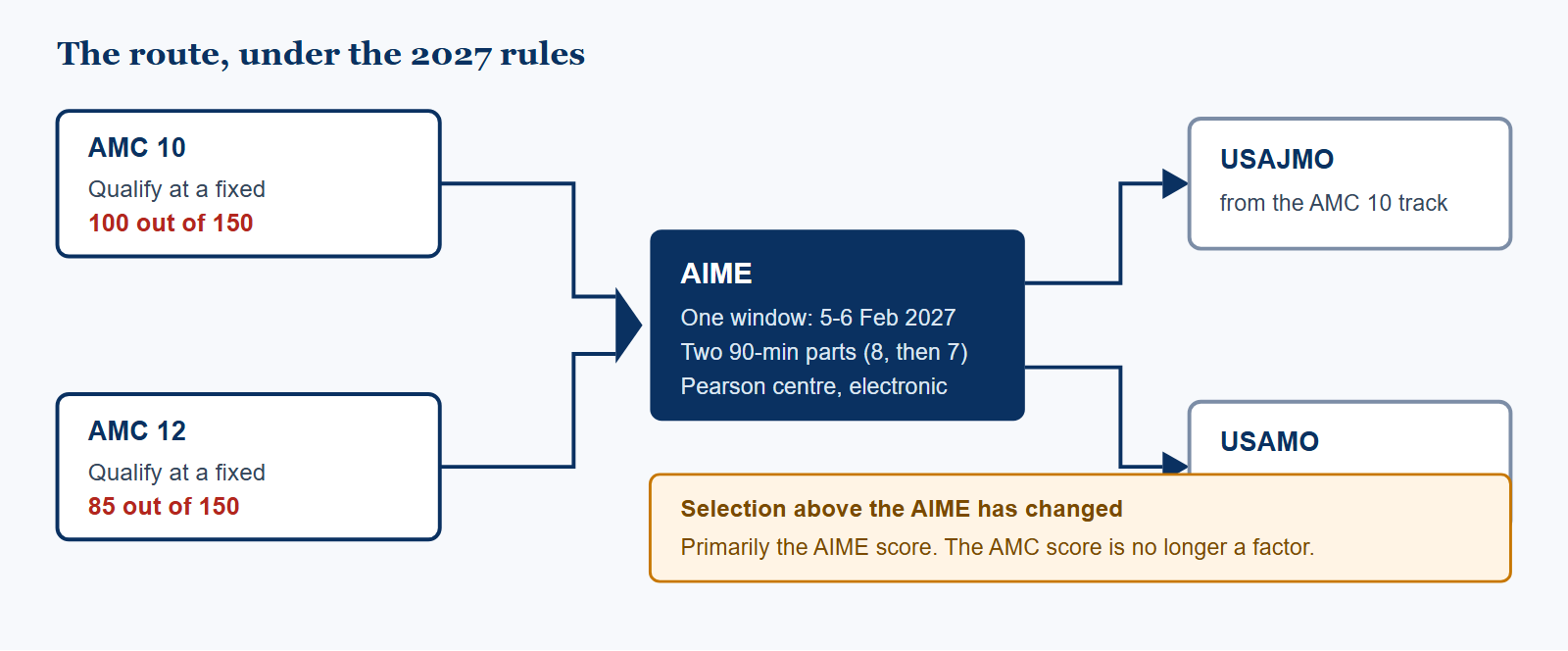
The AIME is the round between the AMC 10/12 and the proof-based USA(J)MO. You now reach it by clearing a fixed score rather than a percentile: 100 or above on the AMC 10, 85 or above on the AMC 12. The exam itself runs as two 90-minute electronic parts at a Pearson Professional Center, in a single window on 5–6 February 2027, and qualification for the olympiad above it no longer counts your AMC score at all.
This article has been rewritten from the ground up. The version that stood here described percentile bands, a three-hour paper, an AIME I / AIME II split, and a combined AMC-plus-AIME index — four mechanisms MAA has now retired. Everything below is taken from MAA’s invitational competitions page and its AIME FAQs, read on 26 August 2026. Where MAA says a policy is still to be posted, this article says so rather than filling the gap.
Who qualifies now
MAA states the change directly: “The thresholds for qualifying for AIME will be set numbers rather than based on percentages.” The numbers given are 100 or above on the AMC 10 and 85 or above on the AMC 12, subject to meeting the other eligibility requirements. MAA adds that full AIME policies “will be posted soon”, so treat those two figures as the announced thresholds rather than as a complete rule set.
One consequence deserves its own sentence, because it quietly breaks a rule of thumb that has held for years. Honor Roll and AIME qualification are no longer the same line. Honor Roll remains a percentile band — the global top 5% — published after the papers are sat. AIME qualification is now a fixed mark. A student can clear one without clearing the other, and any guidance that still treats them as a single achievement, including our own earlier articles, is describing the old system.
There is also a new eligibility floor. For 2027 the AIME is open only to students aged 13 and over. MAA is explicit that a qualifier under 13 cannot sit it and that there is no alternative arrangement — which matters for the small group of students who reach AMC 10 qualifying scores in primary or early middle school.
What the exam looks like
The AIME still asks for 15 answers, each an integer from 0 to 999, one point per correct answer with no deduction for a wrong one, so the maximum is 15. Almost everything around those 15 answers is new.
| Element | 2027, per MAA |
|---|---|
| Venue | A Pearson Professional Center; MAA counts more than 200 across the US and Canada |
| Structure | Two 90-minute parts with a short break — 8 questions, then 7 |
| Revisiting | Part one cannot be reopened once part two begins |
| Medium | Electronic: questions delivered and answers entered on centre computers |
| Materials | Nothing may be brought in. No compasses, no rulers. Laminated graph-paper booklets and fine-tip pens are provided, more on request |
| Leaving the room | Leaving during a part ends work on that part |
| When | One window, 5–6 February 2027. MAA will not say how many versions run inside it |
| Attempts | One. No alternate date, no make-up, no exceptions |
| Fee | US$85 plus taxes, with financial assistance available |
| Proctoring | Professional test administrators at the centre |
Two of these deserve more than a table row. The split into two parts you cannot move between changes how a prepared student allocates time: banking a hard problem to come back to at the end no longer works across the boundary, so the eight questions in part one have to be finished in part one. And the ban on brought-in materials removes construction tools that some students lean on for geometry — the provided graph paper and pen are what you get.
What happens after the AIME
MAA states that qualification for the 2027 USAMO and USAJMO “will be primarily based on AIME scores; AMC scores will no longer be a factor in qualification”. Complete criteria are among the documents MAA says will be posted soon.
If you have read guidance describing a combined index that weighted an AMC score alongside an AIME score — including the version of this article that stood here — that mechanism is what this sentence retires. Until MAA publishes the full criteria, the responsible statement is that the AIME score is the primary input and the AMC score is not one. It is not a specific formula, because nobody outside MAA currently has one. Our guide to the USAMO and USAJMO has been updated on the same basis.
What a fixed line changes about planning
This is the part worth sitting with, because it inverts advice that was correct for years. Under a percentile band, the qualifying score was set after the fact, against that year’s paper and that year’s field. The honest thing to tell a student was that no specific number could be trained toward. Under a fixed threshold, a specific number is exactly what you train toward.
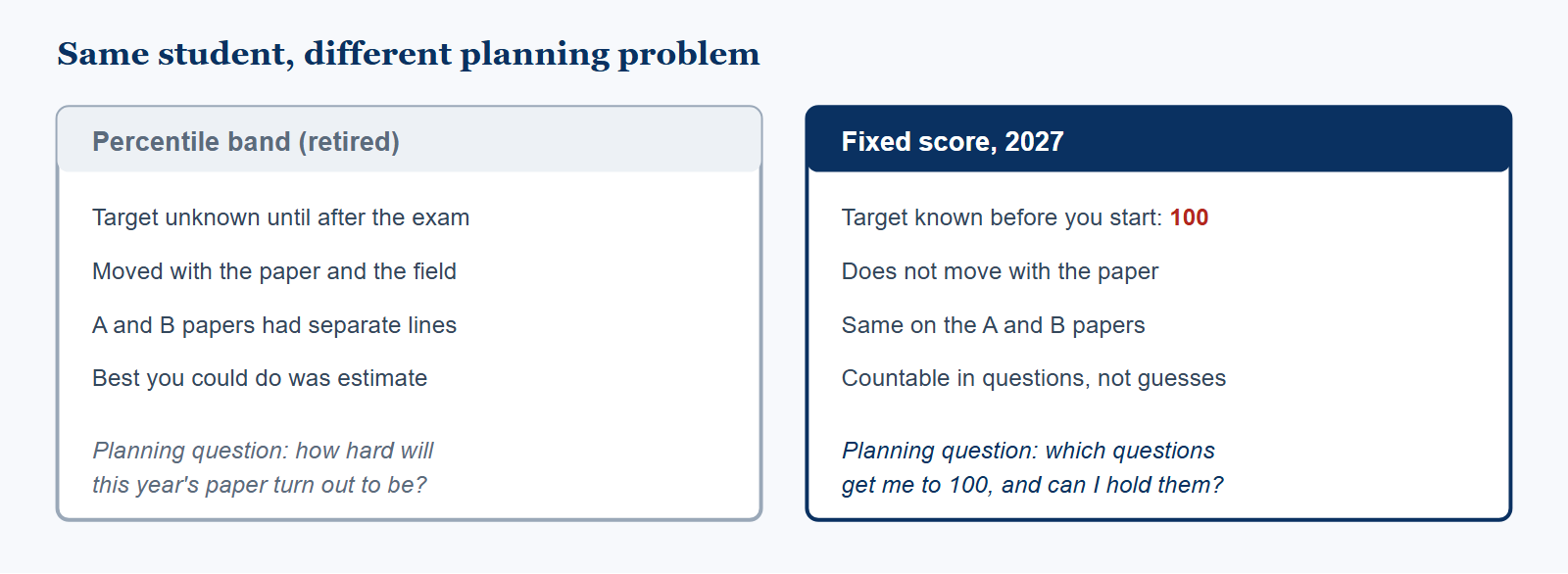
On the AMC 10, 100 out of 150 is reachable several ways under the six-correct, zero-wrong, 1.5-blank scoring. Sixteen correct and nine blank is 109.5. Sixteen correct, one wrong and eight blank is 108. Fifteen correct with ten blank is 105. What all of those have in common is blank discipline rather than heroics on the last five problems — a point our breakdown of the 1.5-point blank rule works through in detail. That arithmetic was always true; what has changed is that you can now check it against a target that will still be there on exam day.
One caution against over-correcting. A fixed line tells you what to aim at, not whether you will hit it. It also says nothing about the AIME itself, which remains a different exam from the AMC in a way that catches out students who qualify and then keep training the same way — the subject of our guide to training for the AIME rather than the AMC.
If you are sitting the AMC outside the United States
Read this part carefully, because it is the easiest thing to get wrong. Everything above about Pearson centres and self-scheduling comes from MAA’s description of the AIME. On international participants MAA says something narrower: they “should follow the policies of the International Group Leader for their country/region”.
MAA has not said that candidates based in China will book a Pearson appointment. If you sit the AMC through a centre in China, your AIME arrangements come from whoever runs the programme in your region, and they may differ from the US flow in venue, in booking, and in timing. The qualifying scores and the exam’s structure are MAA’s; the logistics around you may not be. Ask your centre rather than assuming, and see our guide to taking the US AMC from China for how the two calendars usually differ.
Frequently asked questions
What score do I need on the AMC to qualify for the AIME?
For 2027, 100 or above on the AMC 10 or 85 or above on the AMC 12, subject to the other eligibility requirements. These are fixed scores, not percentile bands. MAA says full AIME policies are still to be posted.
Is the AIME still one three-hour paper?
No. From 2027 it runs as two 90-minute parts with a short break — eight questions, then seven — taken electronically at a Pearson Professional Center. Part one cannot be reopened once part two begins.
Does my AMC score still count toward USAMO qualification?
No. MAA states that 2027 USAMO and USAJMO qualification will be primarily based on AIME scores and that AMC scores are no longer a factor. The complete criteria have not been published yet.
I am in China. Do I book a Pearson centre for the AIME?
Do not assume so. MAA directs participants in the AMC international programme to follow the policies of the International Group Leader for their country or region. Confirm your arrangements with the centre that entered you for the AMC.
Independent guide. Not affiliated with, endorsed by, or sponsored by the Mathematical Association of America. Registration, eligibility and test-day rules are set by MAA and, for international participants, by the International Group Leader for the region; confirm both before acting on any date or threshold. This article was rewritten on 27 August 2026 to reflect the changes MAA announced for the 2027 AIME; the earlier version described percentile qualification, a single three-hour paper, an AIME I / AIME II split and a combined AMC-plus-AIME index, all of which have been retired.