Most students who plateau on the US AMC do not have a topic gap — they have a technique gap. They know the algebra and geometry, but they attack every problem head-on and run out of time. The strongest contestants share a small toolkit of transferable moves that convert a hard question into an easy one. This guide covers six of them, each with a worked mini-example you can copy the pattern from, so the next time a middle question stalls you have a lever to pull.
Why technique beats raw knowledge on the AMC
The AMC 10 and AMC 12 are 25-question, 75-minute multiple-choice papers produced by the Mathematical Association of America (MAA). Because they are multiple choice with five options, the exam rewards students who exploit structure — the answer is already on the page. Scoring is +6 for a correct answer, +1.5 for a blank, and 0 for a wrong one, so a fast, reliable method that lets you clear the middle questions confidently is worth far more than grinding a single hard problem. (Confirm current-year format on maa.org.)
These techniques are not shortcuts that skip understanding — they are the understanding, applied efficiently. Below, each technique lists what it is, when to reach for it, and a small example. For where these problems sit in the overall pathway (AMC 8 → AMC 10/12 → AIME → USA(J)MO), see our US AMC guide hub.
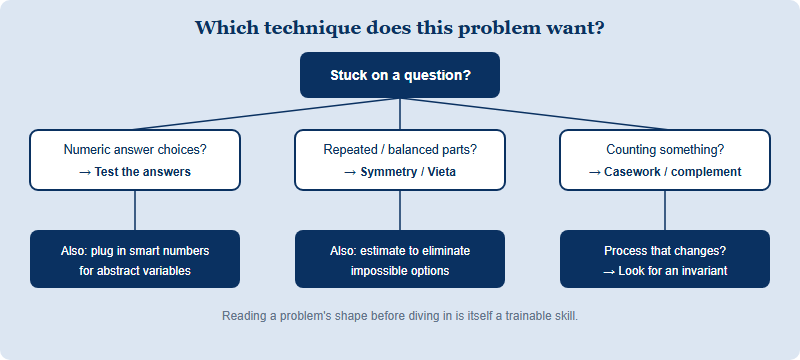
Technique 1 & 2: Exploit the answer choices
The AMC gives you five options for a reason. Two moves use them directly.
Test the answers (back-solving). When the options are specific numbers and the equation is awkward to solve forward, substitute the choices in. Because AMC options are usually ordered, you can often start from the middle and adjust. Mini-example: “Find the integer x with x + (sum of x’s digits) = 50.” Rather than build an equation, try values near 45: 45 → 45+9 = 54 (too big); 40 → 40+4 = 44; 41 → 41+5 = 46; … 42+6 = 48; 43+7 = 50. Answer 43, found in seconds by testing rather than deriving.
Plug in smart numbers. When a problem is stated with abstract variables but the answer choices are also in those variables (or are pure numbers), pick convenient values, compute the concrete answer, then see which choice matches. Mini-example: if a ratio problem says “a is 25% more than b, and b is 20% less than c,” set c = 100. Then b = 80, a = 100. Now any question about a/c, a−b, etc. is arithmetic on real numbers, and you match against the options. Choose numbers that avoid 0 and 1 (they hide errors) and that make the arithmetic clean.
Technique 3: Symmetry and Vieta’s formulas
Many AMC problems are built around balance. When variables are interchangeable, or when you see a polynomial’s roots referenced, you rarely need to find the individual values.
Symmetry. If swapping two variables leaves the problem unchanged, the answer usually depends only on symmetric combinations like their sum or product. Vieta’s formulas make this concrete: for a quadratic x² + bx + c = 0 with roots r and s, you get r + s = −b and r·s = c without solving. Mini-example: “If r and s are the roots of x² − 7x + 10 = 0, find r² + s².” Instead of factoring, use r + s = 7 and rs = 10, then r² + s² = (r + s)² − 2rs = 49 − 20 = 29. The identity turned a two-step solve into one line.
Technique 4 & 5: Counting the smart way
| Move | When to use it | The idea |
|---|---|---|
| Casework | The count splits into a few clean, non-overlapping scenarios | Break into disjoint cases, count each, add — but keep cases mutually exclusive |
| Complementary counting | “At least one,” “not all,” or the forbidden set is smaller than the allowed set | Count the total, subtract the unwanted cases: wanted = total − unwanted |
| Overcount then divide | Arrangements that are equivalent by rotation/reflection or by identical items | Count as if all distinct, then divide by the number of equivalent copies |
Complementary counting mini-example: “How many 3-digit numbers contain at least one digit 7?” Counting “at least one” directly means messy overlaps. Instead: total 3-digit numbers = 900. Those with no 7: the hundreds digit has 8 choices (1–9 except 7), tens and units each have 9 (0–9 except 7), giving 8×9×9 = 648. So “at least one 7” = 900 − 648 = 252. The complement was far easier to count than the target set — a recurring AMC pattern.
Casework discipline: the danger with casework is double-counting. The habit to build is to state each case so that no outcome can belong to two cases at once, then sanity-check that the case sizes add to a total you can verify another way.
Technique 6: Find the invariant
Some of the hardest middle and late AMC questions describe a process — a sequence of moves, swaps, or operations — and ask what is possible at the end. The key is usually an invariant: a quantity (often a parity, a remainder mod something, or a sum) that never changes no matter which moves are made.
Mini-example (parity invariant): numbers 1 through 10 are written down; each move erases two numbers and writes their sum, until one number remains. Whatever moves you make, each step replaces two numbers with their sum, so the total of all numbers on the board never changes. The sum starts at 1+2+…+10 = 55, so the final number must be 55 — no case-bashing required. Spotting “the total is conserved” collapses the whole problem. When a problem lets you do “any sequence of operations,” ask first: what stays the same?
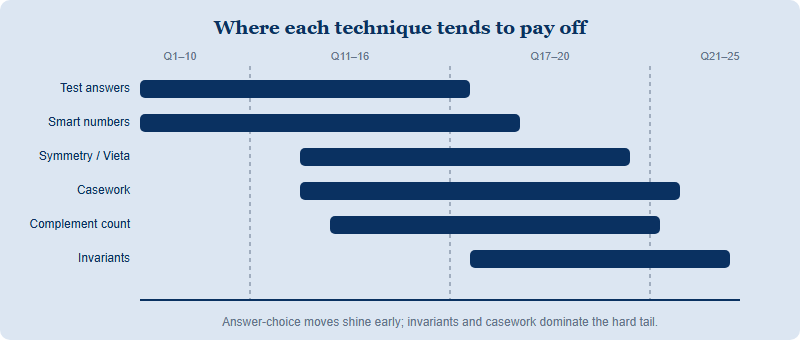
How to actually build the toolkit
Reading these techniques once does nothing; they become reflexes only through deliberate practice on official past papers. A workflow that works:
- Solve, then re-solve. After you answer a past-paper problem, ask which of the six techniques would have been fastest. Often the “clever” solution in the answer key is just one of these applied cleanly.
- Tag your misses. Keep an error log labelling each miss by technique not seen (e.g., “should have back-solved,” “missed the invariant”). Patterns emerge within a few papers.
- Drill by move, not by topic. Spend a session hunting only for complementary-counting opportunities across many problems; the pattern-recognition transfers to test day.
None of this requires content beyond the standard AMC 10/12 syllabus (no calculus, no advanced trigonometry). It is the same knowledge, wielded with sharper instincts. That is what moves a student from “solid through Q15” to “competitive for the AIME.” Remember that AIME qualification changed for 2027: MAA has replaced the old percentile bands with fixed scores of 100 on the AMC 10 and 85 on the AMC 12, so the target no longer moves with the paper. Confirm the current policy on maa.org.
Frequently asked questions
Isn’t back-solving “cheating” the real math?
No. Exploiting a multiple-choice structure is a legitimate, intended part of AMC strategy. Contest math rewards efficient reasoning, and testing answer choices is efficient reasoning.
Which technique should a beginner learn first?
Start with plugging in smart numbers and testing answer choices. They apply to the widest range of AMC 10/12 problems and give the fastest confidence boost on middle questions.
Do these techniques help on the AIME too?
The mindset transfers, but the AIME is not multiple choice (answers are integers 0–999), so answer-choice tricks fade while symmetry, casework, and invariants become even more central.
How many past papers do I need to internalise these?
There is no fixed number, but most students need repeated, reviewed practice across many official papers. Quality of review matters far more than raw volume.
This is an independent English-language guide operated by Hanlin Education for China-based international-school students. It is not affiliated with, endorsed by, or sponsored by the Mathematical Association of America (MAA). Formats, dates, scoring, and eligibility can change year to year; always confirm current details on the official site, maa.org. Any error will be corrected within 7 working days.