If you are eligible for both, the short answer is: take the AMC 12 when you have covered the high-school syllabus and want the wider AIME path (top 5%) plus the USAMO branch; take the AMC 10 when you are younger, have not yet learned trigonometry and advanced algebra, and want a syllabus that matches what you know. Both are 25-question, 75-minute exams scored the same way, and both can qualify you for the AIME — but the eligibility window, content, and downstream round differ in ways that should drive your choice.
The hard eligibility rules come first
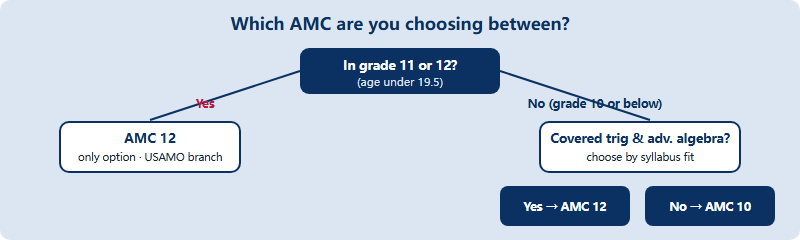
Before strategy, eligibility narrows the field. Per the MAA, the AMC 10 is open to students in grade 10 and below who are under 17.5 years on competition day; the AMC 12 is open to students in grade 12 and below who are under 19.5 years. A grade 11 or 12 student is therefore locked into the AMC 12 — the AMC 10 is simply not available. Only students in grade 10 and below sit inside the overlap where a real choice exists. Always re-check the current age and grade rules on maa.org, since they are stated per competition cycle.
| Rule | AMC 10 | AMC 12 |
|---|---|---|
| Grade eligibility | Grade 10 and below | Grade 12 and below |
| Age limit (competition day) | Under 17.5 years | Under 19.5 years |
| Questions / time | 25 / 75 min | 25 / 75 min |
| Scoring | 6 correct, 1.5 blank, 0 wrong | 6 correct, 1.5 blank, 0 wrong |
| Calculators | Not permitted | Not permitted |
| AIME qualification | Score 100 or above (MAA’s stated 2027 threshold) | Top 5% of AMC 12 scorers |
| Leads toward | USAJMO | USAMO |
Syllabus: what each exam assumes you know
The two exams are not “easy” and “hard” versions of the same paper — they test different curriculum ranges. The AMC 10 covers elementary algebra, basic geometry, number theory, and counting/probability, and deliberately excludes trigonometry and the more advanced algebra topics. The AMC 12 covers the full high-school curriculum, including trigonometry and advanced algebra, but stops short of calculus. Medium-difficulty problems often overlap between the two, so the real difference shows up in the later, harder questions.
For a China-based international-school student, the cleanest way to read this is by course progress, not by ambition. If your school year has not yet reached trigonometry, the AMC 12’s late problems will draw on tools you have not been taught, and you will spend the exam fighting unfamiliar content rather than demonstrating problem-solving. If you have already covered that material — common for strong grade 10 students on an accelerated track — the AMC 12 lets you compete on the full toolkit and opens the USAMO branch.
- AMC 10 syllabus signal: comfortable with algebra, geometry, number theory, counting; trig not yet learned. Pick AMC 10.
- AMC 12 syllabus signal: trigonometry and advanced algebra already covered; want the full-curriculum challenge. Pick AMC 12.
- Either way: calculus is not tested on either exam, so an early calculus head start does not, by itself, push you toward the 12.
The AIME line: 100 on the AMC 10, 85 on the AMC 12
Here is the strategic crux that many families miss. Both exams can qualify you for the AIME, but the thresholds differ. For the 2027 AIME, MAA has replaced the percentile bands with fixed qualifying scores: 100 or above on the AMC 10 and 85 or above on the AMC 12. MAA says the full AIME policies are still to be posted, and participants in the AMC international programme should follow the policies of the International Group Leader for their country or region. On a 150-point paper that is 100 versus 85, so the AMC 12 asks for fewer raw points. The catch is that you are ranked against a different, generally older and more experienced field on the AMC 12, and the late problems are harder. So “wider band” does not automatically mean “easier for you” — it depends on whether your syllabus coverage lets you actually reach those harder problems.
| Consideration | Favors AMC 10 | Favors AMC 12 |
|---|---|---|
| Your grade | Grade 9–10, on track | Grade 11–12 (or accelerated 10) |
| Trig / advanced algebra | Not yet covered | Already covered |
| AIME band width | Score 100 or above | Top 5% (wider) |
| Field you compete against | Younger pool | Older, stronger pool |
| Next round if you advance | USAJMO | USAMO |
| Multi-year runway | Build now, move to 12 later | Final-year students |
A common multi-year plan for a strong grade 9 or 10 student is to start on the AMC 10 to build accuracy and confidence against an age-appropriate field, then move to the AMC 12 in grade 11 or 12 as their syllabus catches up to trigonometry and advanced algebra. Our guide library collects the recurring planning questions for each stage. There is no rule that you must commit to one exam forever — eligibility resets each year by grade and age. The exact percentile-to-score translation changes annually and differs between the A and B dates, so confirm the live picture on maa.org rather than anchoring on last year’s cutoff.
The downstream branch: USAJMO vs USAMO
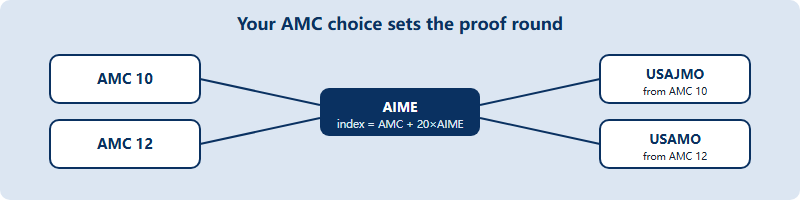
Your AMC choice also determines which proof round you can reach. The AMC 10 path feeds the USAJMO and the AMC 12 path feeds the USAMO. How you are selected has changed. For 2027, MAA states that USAMO and USAJMO qualification “will be primarily based on AIME scores; AMC scores will no longer be a factor in qualification.” The complete criteria have not been posted yet. The combined AMC-plus-AIME index described in older guidance, ours included, is what that sentence retires. Both are invitational olympiad rounds; the USAMO sits at the top of the ladder toward IMO team selection, while the USAJMO is the junior counterpart. If you are aiming that far, our AMC ladder resources walk through how the AIME index feeds each round. For most students the practical effect is small at the point of choosing — you should pick the exam that fits your syllabus and grade, and the branch follows from that. But if you are a borderline-eligible accelerated student weighing the 10 against the 12, knowing that only the AMC 12 path reaches the USAMO can tip the decision.
A simple way to decide
Pulling it together, the decision is mostly mechanical once you are honest about your syllabus. Walk these in order:
- Step 1 — Eligibility. Grade 11 or 12? Take the AMC 12; you have no choice. Grade 10 or below? Continue.
- Step 2 — Syllabus. Have you covered trigonometry and advanced algebra? If not, the AMC 10 matches what you know. If yes, the AMC 12 lets you use your full toolkit.
- Step 3 — Runway. Younger with years ahead? Starting on the AMC 10 builds a base, with the AMC 12 later. Final year? The AMC 12 is your exam.
- Step 4 — Verify. Re-check this year’s grade rules, age limits, dates, and AIME thresholds on maa.org before you register.
From working with international-school students in China, the most common avoidable mistake is a strong grade 10 student jumping to the AMC 12 for prestige before covering trigonometry — then losing the late problems to unfamiliar content. The exam that fits your syllabus, taken with full preparation, almost always produces a better outcome than the “harder” exam taken early. No exam choice guarantees AIME qualification or an olympiad invitation; the cutoffs are competitive and set against a national field each year.
FAQ
Can a grade 10 student choose between AMC 10 and AMC 12?
Yes. Grade 10 and below sits inside the overlap, so you may take either, subject to age limits. Grade 11–12 students can only take the AMC 12.
Is it easier to qualify for the AIME through AMC 10 or AMC 12?
For 2027 the AMC 12 asks for fewer raw points (85 versus 100 out of 150), but you face an older field and harder late problems. Choose by syllabus fit, not the number alone.
What is the main syllabus difference?
The AMC 10 excludes trigonometry and advanced algebra; the AMC 12 includes the full high-school curriculum but not calculus.
Does my AMC choice affect the olympiad round?
Yes. The AMC 10 path leads to the USAJMO and the AMC 12 path to the USAMO, via the AIME index. Confirm current cutoffs on maa.org.
This is an independent guide operated by Hanlin Education for China-based international-school students. It is not affiliated with, endorsed by, or sponsored by the Mathematical Association of America (MAA). The AMC ladder (AMC 8 → AMC 10/12 → AIME → USA(J)MO) is run by the MAA in the United States; the US AMC (MAA) is distinct from the Australian AMC (AMT) and from AMO (SIMCC, Singapore). Grade rules, age limits, exam dates, scoring, and AIME thresholds change every year — always confirm current details on maa.org. Any factual error will be corrected within 7 working days.