Digit problems in the AMC 10 often trap students who rely on algebraic substitution without respecting the discrete nature of base-10 arithmetic. The core difficulty lies not in complex equations, but in managing carrying (borrowing) and recognizing hidden integer constraints. With the 2026-27 season introducing fixed qualification thresholds and potential regional variations, precise reasoning is more critical than ever.
The Core Mechanism: Why Standard Algebra Fails
In many digit problems, students set variables like for the tens digit and for the units digit. They then write an equation such as . While this looks correct, it ignores the fact that digits are integers from 0 to 9, and operations like addition or multiplication can cause carries that change the structure of the number. If you solve , you get , implying . But if the problem involves adding two numbers where a carry occurs, this simple linear model breaks down. The hidden integer constraint is that digits are not real numbers; they are bounded, discrete, and subject to the mechanical rules of place value.
Teaching Illustration 1: The Simple Carry Trap
Problem: A two-digit number has digits that sum to 11. When the digits are reversed, the new number is 27 greater than the original. Find the original number.
Step-by-Step Solution:
- Let the original number be , where is the tens digit and is the units digit.
- Constraint 1: .
- Constraint 2: .
- Solving the system: Adding the two equations gives . Then .
- Check: Original 47, Reversed 74. . Sum . Correct.
This case is straightforward because no carry occurs in the subtraction logic itself when framed as difference. However, students often fail when the operation involves addition with carry, where the column-wise structure introduces constraints that pure algebra obscures.
Teaching Illustration 2: The Hidden Constraint Failure
Problem: In the addition below, each letter represents a distinct digit. What is the value of ?
  AB
+ BA
----
 SCS
Common Mistake: Students might assume and set this equal to without checking digit distinctness or carry rules. They may guess values randomly or ignore that must arise from a carry.
Correct Reasoning:
- First, note that .
- The result is a three-digit number, so .
- Since and are each at most two digits, their maximum sum is . Therefore the hundreds digit can only be 1.
- With , we have .
- The left side is a multiple of 11. We need . Since and , we need , so (the only digit solution).
- Substituting: , giving .
- Verify distinctness: and . We need with and . Valid pairs include and their reverses. All satisfy the original addition with proper carrying: for example, .
- Answer: .
The critical insight is that is forced by the magnitude of the sum, not by the units column. The units column produces a units digit of 1 (which is ) and a carry of 1 to the tens column. The tens column produces and a carry of 1 to the hundreds column, giving .
Diagnostic Table: Common Errors in Digit Problems
| Error Type | Description | Correction Strategy |
|---|---|---|
| Ignoring Carry | Assuming directly without considering if . | Always define cases: No Carry vs. Carry Occurs. |
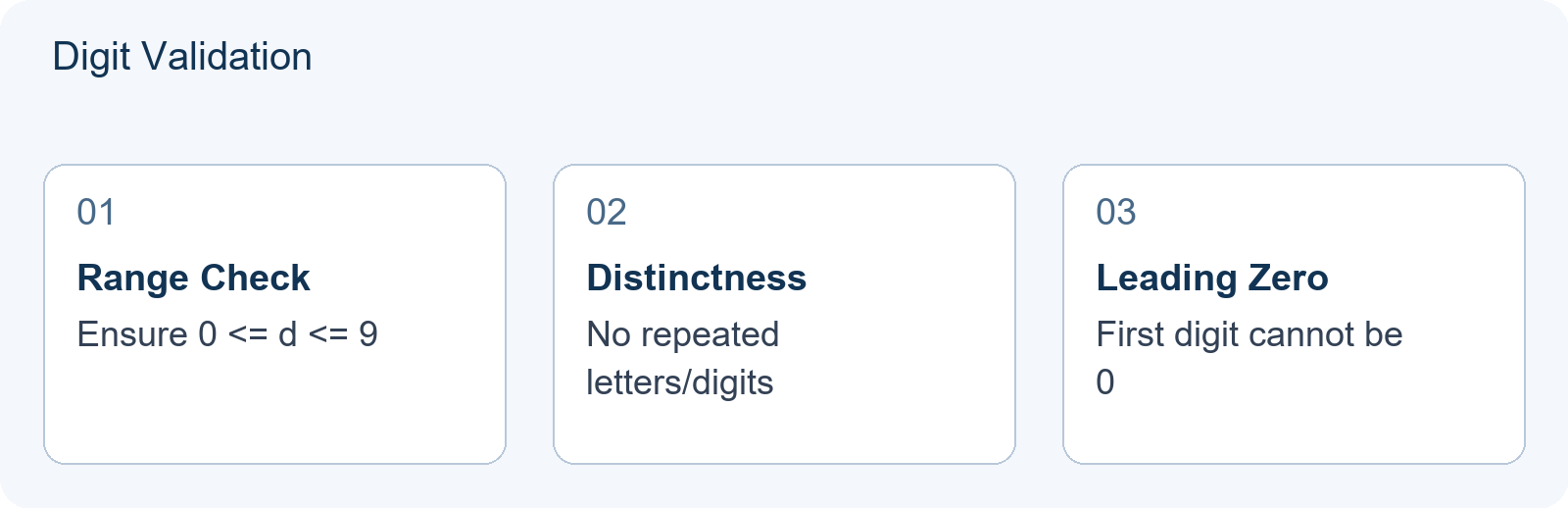
| Non-Integer Digits | Solving algebraically yields non-integers or digits . | Validate all solutions against . |
| Distinctness Violation | Assigning same digit to different letters. | Cross-check final assignment for uniqueness. |
Preparation and Practice Decision
With the 2026-27 season introducing fixed qualification thresholds and potential regional variations, accuracy under pressure is paramount. Digit problems test logical rigor rather than speed alone. For broader context on how these changes affect your strategy, see our guide on AIME 2027 Moves to Pearson Test Centres: Every Change MAA Has Announced, and What Is Still Unknown for Candidates in China.
To master these constraints, practice should focus on writing out the column-wise addition or subtraction explicitly. Do not skip steps. Ensure your preparation aligns with current rules, particularly the age and score thresholds for AIME advancement, which are detailed in our You Can Clear the AIME Line and Still Not Be Allowed to Sit It: The 2027 Age Rule and Accelerated Students.
Next time you encounter a digit problem, ask yourself: “Where could a carry happen?” This single question often unlocks the hidden integer constraint that makes the problem solvable.
Frequently Asked Questions
Do I need a calculator for digit problems?
No. Digit problems are designed to be solved logically using place value properties. Calculators can actually hinder understanding of carrying mechanics.
How does the 2026-27 reform affect digit problem difficulty?
The reform focuses on security and format, not content depth. However, fixed qualification scores mean every point counts, making error-free logic essential.
What if my algebraic solution gives a non-integer digit?
This indicates a missed constraint, usually involving a carry or borrow. Re-examine the column-wise operation to identify where the integer condition was violated.