Your last AMC score is a diagnosis, not a verdict — but only if you decode it first. A 78 earned by answering all twenty-five questions and a 78 earned by answering nine and leaving the rest blank are the same number and completely different problems. Before you buy another problem book, reconstruct what your score was actually made of, then train the one thing your band is blocked on.
This guide is for students sitting the AMC 10 or AMC 12 for a second or third season. It assumes you already know the format — twenty-five questions, seventy-five minutes, 150 points, six for a correct answer, nothing for a wrong one and 1.5 for a question left blank — and that you have a real score from a real sitting rather than a mock. If you have not yet settled where and when you sit this year, start with our guide to the 2026 in-person AMC rules and authorised test centres, because the registration decision closes long before the training decision matters.
Turn the score back into questions before you plan anything
Because a blank is worth 1.5 points and a wrong answer is worth zero, one score can be assembled in several different ways. That is not a curiosity; it is the whole diagnostic. Consider a score of 78 on a twenty-five question paper:
| Correct | Blank | Wrong | Score | What this student actually is |
|---|---|---|---|---|
| 13 | 0 | 12 | 78 | Answered everything, right about half the time — a selection and accuracy problem |
| 12 | 4 | 9 | 78 | Pushed too far down the paper before securing the top half |
| 11 | 8 | 6 | 78 | Reasonable judgement, but six errors inside their own competence |
| 10 | 12 | 3 | 78 | Careful and slow — range is the limit, not accuracy |
| 9 | 16 | 0 | 78 | Never wrong, never finished — a speed and coverage problem |
If you kept your answer sheet, or your centre returned a breakdown, count three numbers: how many you got right, how many you got wrong, and how many you left blank. If you did not keep it, reconstruct it from memory in the coarsest possible way. How far down the paper did you get before the questions stopped feeling readable? Roughly how many of your answers were guesses? That estimate is good enough to place yourself, and placing yourself is the entire purpose of this exercise.
One piece of arithmetic is worth carrying into every practice session that follows. Converting a question you would have left blank into a correct answer is worth 4.5 points, not 6, because you give up the 1.5 you already had. Converting a question you would have got wrong into a correct answer is worth the full 6. Fixing errors inside your existing range is therefore the cheapest scoring on the paper — and it is exactly the part most returning students skip past on their way to buying a harder book.
The four bands and what actually blocks each one
The bands below are our own teaching heuristic for deciding what to train next. They are not an MAA classification, and MAA’s published recognition tiers are a separate matter, covered further down. Place yourself by last year’s real score, not by the score you nearly had.
| Band (of 150) | Roughly | The bottleneck we see most often | Train first | Stop doing |
|---|---|---|---|---|
| Below 60 | Fewer than 10 secure questions | The early paper is not automatic yet; time goes on re-reading rather than solving | Questions 1–10 to near-perfect accuracy, first untimed, then at pace | Attempting the last five questions in practice at all |
| 60–90 | 10–15 secure | Avoidable errors in the top half, plus two or three untrained topic families in the middle | The middle of the paper by topic family, with every error written down and re-tested | Weekly full-paper mocks that produce a score and no information |
| 90–110 | 15–18 secure | Inconsistency in questions 16–20, and poor decisions in the last ten minutes | Timed sets built only from that band of the paper, plus a rehearsed end-of-paper protocol | Hunting the final question for the satisfaction of it |
| 110+ | 19 or more secure | Depth and selection at the hard end, not speed | Two hard problems a day, slowly, written out in full | Volume for its own sake — more papers will not move this band |
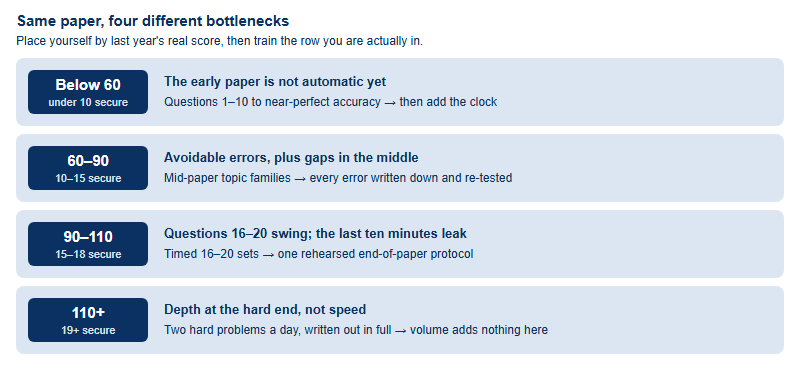
The uncomfortable column is the one on the right. Almost every returning student we meet has already decided, before any diagnosis, that the fix is harder problems. In the two lowest bands that decision costs the whole season, because the points that were genuinely available were sitting in the first two-thirds of the paper the entire time.
Pick the target before you pick the plan
Second attempts drift when the goal is simply “higher.” Pick a line — and understand that the lines are not all the same kind of thing. Some of MAA’s recognition is percentile-based: a global top 5% award and a global top 1% award, which means the score that earns them moves with the cohort and is only known after marking, plus a perfect-score award at the fixed maximum of 150. AIME qualification is now a fixed number: MAA states that the thresholds “will be set numbers rather than based on percentages,” and gives 100 or above on the AMC 10 and 85 or above on the AMC 12. Separately, there are achievement awards at 90 points and above for younger entrants — AMC 10 entrants in grade 8 or below, AMC 12 entrants in grade 10 or below.
Two cautions follow. First, a percentile award and a fixed threshold can no longer be treated as one line, so do not aim at one and assume you have cleared the other. Second, if you sit in China, your route to the AIME runs through your region’s International Group Leader rather than through MAA directly — MAA’s own wording is that participants in the AMC international program should follow the policies of the International Group Leader for their country or region, and our centres’ season briefing describes a qualifying cut-off published by the organiser after marking. Confirm which applies to you with your own centre before you write 100 or 85 on the wall.
What your target looks like in questions
Targets expressed in points are hard to train against; targets expressed in questions are not. Since a paper scores 6c + 1.5b for c correct and b blank out of twenty-five, every target has two extreme shapes: the cautious shape, where you answer only what you are sure of and leave the rest blank, and the committed shape, where you put something down for all twenty-five.
| Target score | Minimum correct if you leave the rest blank | Minimum correct if you answer all 25 |
|---|---|---|
| 85 | 11 correct, 14 blank → 87 | 15 correct → 90 |
| 90 | 12 correct, 13 blank → 91.5 | 15 correct → 90 |
| 100 | 14 correct, 11 blank → 100.5 | 17 correct → 102 |
| 120 | 19 correct, 6 blank → 123 | 20 correct → 120 |
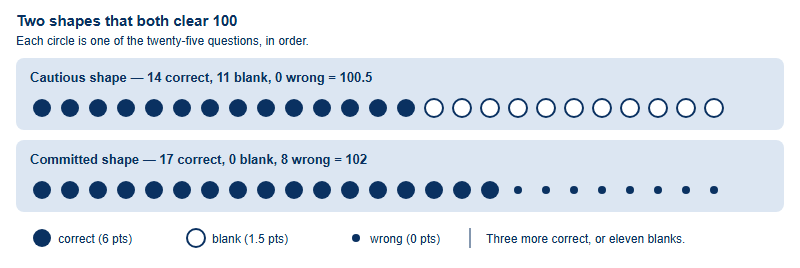
Read those two rows against the reconstruction you did in the first section. If last year you answered everything and were right about half the time, the cautious shape is a shorter walk than it looks: you may already have fourteen questions inside your competence and be handing points back below them. If you were the student who was never wrong but only finished nine, no amount of blank discipline will help — you need range, and range comes from topic work rather than exam technique.
The weeks you actually have, and the dates that fix them
Work backwards from the calendar rather than forwards from enthusiasm. MAA has published 5 November 2026 for the A papers and 13 November 2026 for the B papers, and states that the AMC 10 and AMC 12 “will be administered in 2026 as they were in 2025.” The China-region sitting our centres have briefed is a separate calendar — 6 November 2026 and 14 November 2026, 17:00 to 18:15 local time, on bilingual papers, at RMB 120 per sitting — and neither calendar corrects the other. Confirm your own date with the centre holding your seat.
The date that really governs planning is earlier than any of those. Seats lock on 10 October 2026 at our centres, after which withdrawal and no-shows are non-refundable. So the decision about whether you are sitting one paper or two, and which paper, has to be made while there is still training time on the other side of it. Read the registration and centre rules before that date rather than after it, and treat the weeks between now and mid-October as the part of the season where a change of plan is still free.
Three second-attempt habits that waste a season
These are observations from our own coaching rather than statistics, and individual results vary — but they recur often enough to be worth naming.
- Restarting the syllabus from the beginning. A student who scored 91.5 does not need to re-learn what they demonstrably already knew. Re-teaching secure material is the most comfortable way to spend a season and the least productive.
- Changing everything at once. New book, new schedule, new teacher, new practice format. If the score moves, nothing has been learned about why; if it does not, there is nothing to unwind. Change one variable at a time.
- Treating the second sitting as a rematch with the last five questions. The problems that beat you are the memorable ones. They are rarely the problems that cost you the band you are trying to leave.
A second attempt is worth taking seriously precisely because the diagnostic information from the first is better than anything a mock can give you. Decode the score into questions, aim at a named line rather than at “higher,” and give the cheap points — the ones already inside your range — the attention they deserve before you go hunting the expensive ones.
Frequently asked questions
Does it look bad if my second AMC score does not improve?
Scores are recorded per sitting and you decide what to list on an application. Treat a second attempt as training data, not as a public rematch.
How many correct answers does a score of 100 need?
Fourteen correct with the other eleven left blank reaches 100.5. If you answer all twenty-five, you need seventeen correct, which scores 102.
Are these four score bands official?
No. MAA publishes recognition tiers, not bands. The four bands here are our own teaching heuristic for deciding what to train next.
Is AIME qualification really a fixed score now?
MAA states the thresholds are set numbers — 100 on the AMC 10, 85 on the AMC 12. China-based candidates should confirm with their Group Leader.
This is an independent English-language guide to the American Mathematics Competitions, operated by Hanlin Education for China-based international-school students. We are not affiliated with, endorsed by, or sponsored by the Mathematical Association of America. Dates, thresholds, awards and policies are restated by MAA each cycle — confirm current details on maa.org and with your own authorised test centre before acting on anything here. Errors reported to our editorial desk are corrected within 7 working days.