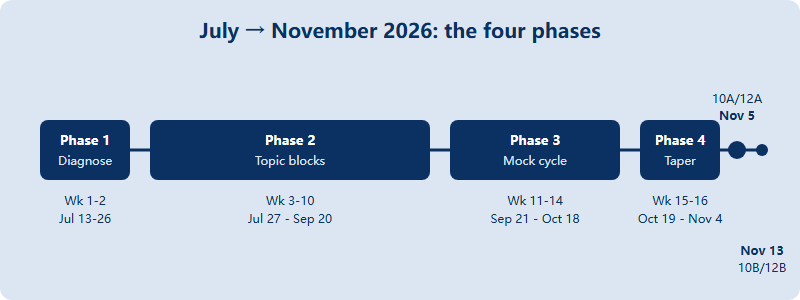
From mid-July 2026 to the AMC 10A/12A on November 5 is almost exactly sixteen weeks — and to the 10B/12B on November 13, seventeen. That is enough time to raise a score meaningfully, but only if the weeks are structured. This plan divides the countdown into four phases: a two-week diagnostic, eight weeks of topic blocks, four weeks of mock-exam cycling, and a two-week taper with logistics. Each phase has a specific job, and doing them out of order is the most common way strong students waste a summer.
The four phases at a glance
Competition prep behaves like athletic training: you build capacity first, sharpen it second, and rest into the event last. Papers written by the MAA reward exactly this progression, because the AMC’s 25-question, 75-minute format (per MAA’s long-standing rules — confirm the current format on maa.org) tests both breadth of content and speed of execution, and those two things are trained in different phases.
| Phase | Weeks | Calendar (2026) | Job of the phase | Weekly rhythm |
|---|---|---|---|---|
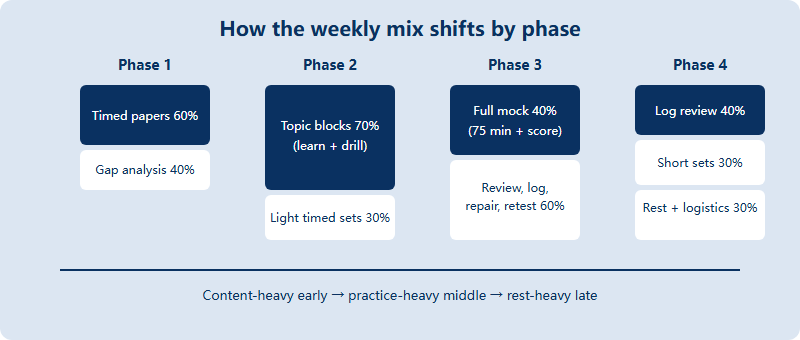
| 1 — Diagnose | 1–2 | Jul 13 – Jul 26 | Find your true baseline and topic gaps | 2 timed papers + gap analysis |
| 2 — Topic blocks | 3–10 | Jul 27 – Sep 20 | Close the two or three largest content/method gaps | 2 focused topic blocks + 1 light timed set |
| 3 — Mock cycle | 11–14 | Sep 21 – Oct 18 | Convert knowledge into timed performance | 1 full mock + full review cycle per week |
| 4 — Taper & logistics | 15–16(+) | Oct 19 – Nov 5/13 | Consolidate, rest, and handle test-day logistics | Light review, sleep schedule, center confirmation |
Phase 1 (weeks 1–2, Jul 13–26): diagnose before you train
Start with two full, timed 75-minute past papers under real conditions — one this week, one next — scored with the official scheme, blanks counted separately from wrong answers. Resist the urge to begin with content review: without a baseline, you will study the topics you enjoy rather than the topics that cost you points, and you will have no way to measure whether the next fourteen weeks worked.
From those two papers, produce three outputs. First, a baseline score range, not a single number — two papers gives you a floor and ceiling. Second, a topic gap list: sort every miss into the four AMC pillars (algebra, geometry, number theory, combinatorics) and rank the pillars by points lost, not by problem count. Third, an attempt profile: how many problems did you attempt, and what was your accuracy on attempts? A student attempting 22 problems at 65% accuracy and a student attempting 14 at 95% both need work — but opposite work.
This is also the fortnight to sort out logistics that have long lead times. The 2026 cycle is in-person only, and China-based students must register through an authorized test center, some of which finalise seats well before autumn. Read our guide to the 2026 in-person rules and how to find an authorized center and make contact now, even if registration formally opens later — knowing your center, city, and offered dates (A, B, or both) changes how you plan Phase 4.
Phase 2 (weeks 3–10, Jul 27–Sep 20): topic blocks, two per week
Eight weeks is enough for serious content repair if it is focused. Take the top two or three pillars from your gap list and divide them into fortnight-long blocks — for example: two weeks on counting fundamentals, two on similar triangles and circle geometry, two on modular arithmetic and divisibility, two on algebraic manipulation and sequences. Within each week, run two focused sessions per topic: one learning session (worked examples, technique named and written down) and one drill session (six to ten problems of climbing difficulty on that exact technique, untimed but honest).
Keep one light timed component every week — a 25-minute set of eight to ten early-paper problems — purely to keep test rhythm alive. But do not run full mocks yet. Full papers during a content phase produce discouraging scores from gaps you already know about, and they burn irreplaceable past papers that you will want fresh in Phase 3.
Two guardrails for this phase. Guardrail one: depth beats coverage. The AMC rewards a technique you can execute under pressure far more than five techniques you half-remember. If the choice is finishing the syllabus versus mastering your top-three gap topics, master the gaps. Guardrail two: log everything. Every drill miss goes into an error log with a root cause and a scheduled cold retest. By week 10, that log — not your memory — decides which topics enter the final rotation.
Phase 3 (weeks 11–14, Sep 21–Oct 18): the mock cycle
Now the training flips: one full 75-minute mock per week, each followed by a complete review cycle — same-day re-attempt of misses before reading solutions, classification into your log within 48 hours, targeted repair in midweek sessions, and cold retests of older entries. Four mocks in four weeks, each one a full rehearsal of the real event: printed paper if possible, separate answer sheet to simulate bubbling, no calculator, one sitting.
Use the four weeks to tune two competition skills that pure content study never touches:
- Pacing checkpoints. Decide in advance where you should be at 25 and 50 minutes, based on your own attempt profile — then practise honouring the checkpoints. Most students lose more points to spending eight minutes on one stubborn problem than to any content gap.
- The blank-versus-guess decision. Under the official scoring format, blanks and wrong answers are treated differently, which makes “when do I guess?” a trainable decision rather than a mood. Rehearse your personal rule in mocks — for instance, guessing only after eliminating enough choices — so that on November 5 it is a habit, not a debate. Confirm the current scoring rules on maa.org as part of your final-week checklist.
Expect the four mock scores to wobble rather than climb smoothly; individual papers differ. Track attempted-accuracy and points-lost-by-pillar across the four papers instead. If a pillar is still bleeding points in week 13, give it the final repair slot in week 14 — after that, no new topics.
Phase 4 (weeks 15–16, Oct 19–Nov 4): taper and logistics
The final fortnight is for consolidation, not construction. Halve your volume. Replace full mocks with short, confidence-building sets drawn from your error log — problems you once missed and can now solve cold are the best possible material, because they are proof of progress in problem form. Learn nothing new after the middle of week 15: a technique first seen ten days before the exam is a liability under pressure, not an asset.
The logistics checklist matters as much as the math in this phase, because 2026’s in-person format leaves no room for day-of improvisation. Confirm your registration status, exam-day address, arrival time, and what identification or materials your center requires — our 2026 in-person AMC guide walks through the test-day rules. Shift your sleep schedule so that you are fully alert at your exam’s start time for at least four days before the paper. If your center offers both dates and you are sitting both, plan the between-papers week in advance: one day of A-paper debrief, then repair on your two biggest live gaps, then rest — not seven days of panic mocks.
Adjusting the plan to your starting point
The skeleton above assumes a student aiming to compete seriously for awards or AIME qualification. Two common adjustments:
If your baseline is far from your goal, extend Phase 2 by stealing two weeks from Phase 3 — content gaps cost more points than rusty test rhythm, and two mocks with full review beat four mocks with shallow review. If your baseline is already strong, do the reverse: compress topic blocks to four weeks and run a longer mock cycle at increased difficulty, pulling more late-paper problems into your drills. In both cases the phase order stays fixed; only the widths move.
One honest caveat to close: no plan guarantees a qualifying score, and cutoffs move every year with each paper’s difficulty, so chase percentile-level skill rather than a specific number borrowed from a past season. What a structured sixteen weeks does guarantee is that on November 5 you will be taking the exam with your actual weaknesses repaired, your pacing rehearsed, and your logistics settled — which is everything within your control.
FAQ
Is 16 weeks enough to prepare for the AMC 10 or 12?
It is enough for meaningful improvement if the weeks are structured — diagnostics, then topic blocks, then mocks, then taper. It is not enough to rebuild an entire syllabus from zero.
When should I start full timed mocks?
Around week 11 — late September 2026. Earlier full papers mostly re-measure gaps you already know about and burn practice papers you will want fresh for the mock cycle.
Should I follow this plan for both the A and B dates?
Yes. Train toward November 5; if you also sit the B paper on November 13, use the extra week for debrief, two targeted repairs, and rest — not for new topics.
What if my school term starts in the middle of Phase 2?
Keep the phase order and shrink the volume: two shorter topic sessions plus one light timed set per week fits alongside coursework. Protect the weekly mock slot once Phase 3 begins.
This is an independent guide operated by Hanlin Education for China-based international-school students. It is not affiliated with, endorsed by, or sponsored by the Mathematical Association of America (MAA). Competition dates, rules, scoring, and registration procedures change — always confirm current details on maa.org and with your authorized test center. Factual errors reported to us are corrected within 7 working days.