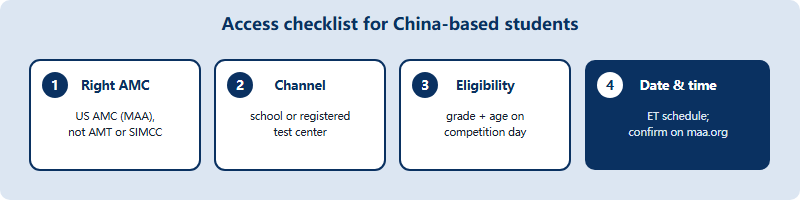
Students based in China can take the US AMC (the MAA’s American Mathematics Competitions), but not as individuals registering on their own. The AMC is administered through schools and registered test centers, and the MAA runs an AMC International track for participants outside the United States and Canada. Before anything else, you must confirm three things on the official site: where you will sit the exam, that you meet the age and grade limits, and the exact date and timing — because the AMC and AIME are scheduled in US Eastern Time.
First, make sure it is the right “AMC”
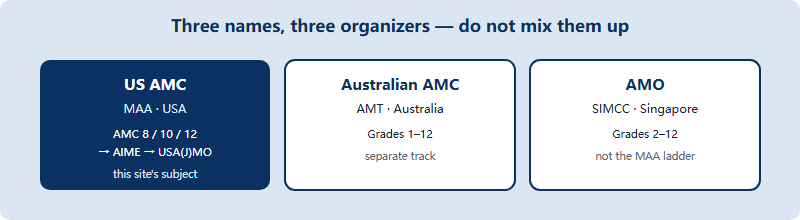
The single most common error we see from families in China is signing up for the wrong competition, because three different contests use similar names. They are run by different organizations, in different countries, with different formats. Getting this right at the start saves a wasted registration.
| Name | Organizer / country | What it is |
|---|---|---|
| US AMC (this site) | MAA · United States | American Mathematics Competitions: AMC 8 → AMC 10/12 → AIME → USA(J)MO, the US path toward IMO selection |
| Australian AMC | AMT (Australian Maths Trust) · Australia | Australian Mathematics Competition, grades 1–12; in China operated via a separate regional partner |
| AMO | SIMCC · Singapore | American Mathematics Olympiad, a SIMCC-run contest for grades 2–12; not part of the MAA ladder |
If your goal is the AIME, the USAMO/USAJMO, or a profile aligned with US-style olympiad mathematics, the US AMC (MAA) is the one you want. The Australian AMC (AMT) and AMO (SIMCC, Singapore) are legitimate competitions in their own right, but they sit on different tracks and do not feed the MAA’s AIME. When you read about “AMC results” or “AMC cutoffs” online, check which organizer is meant before drawing conclusions.
Where China-based students actually sit the AMC
The AMC is not an open public exam you book like a standardized test. It is administered by registered institutions. In practice, China-based international-school students reach it through one of these channels:
- Your own school. Many international schools in China are registered to administer the AMC. If yours is, this is the simplest route: a school coordinator handles registration, ordering, and proctoring. Ask your math department first.
- A registered test center. If your school does not offer it, the MAA’s AMC International framework allows participation through approved centers outside the US and Canada. These centers proctor the exam under MAA rules.
- A math circle or program. Some organized programs are registered to run the AMC for their students.
What you cannot do is register yourself directly with the MAA as a walk-in individual. The exact list of approved channels, registration windows, and ordering deadlines is set by the MAA and changes each cycle, so the authoritative step is always to check maa.org and ask your school coordinator. Our guide library and china-region pages collect the recurring questions, but the live registration details belong to the official site.
Eligibility: age and grade are checked on competition day
Eligibility for the US AMC is defined by grade and age, and the age cutoff is measured on competition day — a detail that catches students who are close to the limit. The MAA’s stated rules are:
| Exam | Grade eligibility | Age limit (competition day) | Format |
|---|---|---|---|
| AMC 8 | Grade 8 and below | Under 15.5 years | 25 questions, 40 minutes |
| AMC 10 | Grade 10 and below | Under 17.5 years | 25 questions, 75 minutes |
| AMC 12 | Grade 12 and below | Under 19.5 years | 25 questions, 75 minutes |
Two notes matter for China-based students. First, grade is interpreted by the MAA’s standard, so if your school uses a non-US grade naming system, confirm how your year maps before assuming eligibility. Second, the age limit is a hard ceiling on the day you sit the exam — being “in grade 10” does not help if you are over 17.5 on competition day. Calculators are not permitted on any of these exams. Because these thresholds are restated each cycle, verify them on maa.org before registering.
Timing: the exam runs on US Eastern Time
A logistics point unique to taking US competitions from China is the time zone. The AIME, for example, is administered within a US Eastern Time window (1:30–5:30 pm ET on competition day). For the AMC, your registered school or center sets the local sitting under MAA rules, but the underlying schedule is anchored to the US calendar and timing. The practical implications:
- Confirm the local sitting time with your proctor, not just the US date — China is many hours ahead of US Eastern Time, so a US “competition day” may correspond to a different local clock time.
- Watch registration deadlines in the US calendar. Ordering and registration windows are set by the MAA and can close weeks before the exam.
- For the AIME specifically, the arrangements changed for 2027: MAA has retired the AIME I / AIME II split in favour of a single competition window on 5–6 February 2027, moved the exam into Pearson Professional Centers, and still allows one sitting only. Candidates in the AMC international programme are told to follow the policies of the International Group Leader for their country or region, so do not assume the Pearson booking flow applies to you — confirm with whoever runs the programme locally.
None of these are obstacles, but they are easy to overlook when you are used to locally scheduled exams. The fix is the same in every case: confirm exact dates and times on the official site and with your coordinator.
What an AMC result signals on a US application
Many China-based families ask whether the AMC is “worth it” for admissions. An honest answer: the AMC is a widely recognized indicator of mathematical ability in US-style admissions, and reaching the AIME or beyond is a meaningful signal because the qualification bar is percentile-based and competitive. But it is one data point among many, and no competition result guarantees an outcome. The value comes from genuine problem-solving growth — the kind that also shows up in your coursework and other STEM activities — not from the line on a form alone. We never claim a result will secure admission, and you should be skeptical of anyone who does.
From coaching students through the ladder, the through-line for China-based applicants is consistency: a student who progresses from the AMC 8 in middle school to the AMC 10/12 and then the AIME demonstrates a multi-year trajectory that is hard to fake. That trajectory, plus the real mathematical maturity behind it, is the signal worth building — and it starts with getting the logistics right so you actually sit the correct exam, on time, while eligible.
FAQ
Can a student in China register for the US AMC individually?
No. The AMC is administered through schools and registered test centers; the MAA runs an AMC International track for participants outside the US and Canada. Confirm channels on maa.org.
How do I avoid taking the wrong “AMC”?
The US AMC is run by the MAA (USA). The Australian AMC (AMT) and AMO (SIMCC, Singapore) are different contests on separate tracks and do not feed the AIME.
How is AMC eligibility decided for international students?
By grade and by age on competition day — under 15.5 (AMC 8), 17.5 (AMC 10), or 19.5 (AMC 12). Map your school year to the MAA standard and verify on maa.org.
Does the time zone matter when taking the AMC from China?
Yes. The US schedule is anchored to Eastern Time, so confirm your local sitting time with your proctor and watch US-calendar registration deadlines.
This is an independent guide operated by Hanlin Education for China-based international-school students. It is not affiliated with, endorsed by, or sponsored by the Mathematical Association of America (MAA). The US AMC ladder (AMC 8 → AMC 10/12 → AIME → USA(J)MO) is run by the MAA in the United States; it is distinct from the Australian AMC (AMT) and from AMO (SIMCC, Singapore). Registration channels, eligibility rules, dates, deadlines, and timing change every year — always confirm current details on maa.org and with your school coordinator. Any factual error will be corrected within 7 working days.