On the AMC 10 and AMC 12, a correct answer is worth 6 points, an unanswered question is worth 1.5 points, and a wrong answer is worth 0. That single rule changes how you should approach the paper: because blanks carry real value, a wild guess can lower your expected score. The skill that separates a 90 from a 110 is often not extra knowledge but disciplined decision-making about when to commit, when to skip, and how to spend the 75 minutes. This guide shows the exact math.
The scoring rule, stated precisely
Both exams are 25-question, 75-minute multiple-choice papers with five answer choices (A–E). The scoring most commonly used is +6 for a correct answer, +1.5 for a blank, and 0 for an incorrect answer, giving a maximum of 150 points. Because the blank is worth a quarter of a correct answer, the AMC is deliberately built so that leaving a question empty is a legitimate strategic move, not a sign of weakness. Always re-confirm the current scoring on maa.org for your competition cycle, since the MAA states the rules per year.
| Outcome | Points | What it means for strategy |
|---|---|---|
| Correct answer | +6 | The only way to gain ground — commit when you have a real reason |
| Blank / unanswered | +1.5 | A guaranteed floor — better than a coin-flip guess on most questions |
| Incorrect answer | 0 | You forfeit the 1.5 you would have kept by leaving it blank |
| Maximum score | 150 | 25 correct × 6 |
The break-even: when does guessing beat blanking?
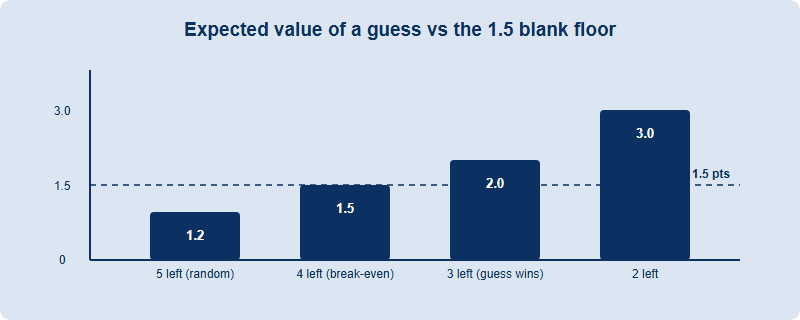
Treat it as expected value. A blank is worth a certain 1.5 points. A guess among the choices you have not eliminated is worth, on average, 6 points multiplied by your probability of being right. So guessing beats blanking only when that probability clears the break-even line:
- Pure random guess (5 choices, none eliminated): probability 1/5 = 20%. Expected value = 6 × 0.20 = 1.2 points. That is below the 1.5 you keep by leaving it blank — so a blind guess is, on average, a losing move.
- Eliminate one wrong choice (4 left): probability 1/4 = 25%. Expected value = 6 × 0.25 = 1.5 points. This is the break-even point — exactly equal to blanking, so it does not help you.
- Eliminate two wrong choices (3 left): probability 1/3 ≈ 33%. Expected value = 6 × 0.333 = 2.0 points. Now guessing is clearly worth more than the 1.5 floor.
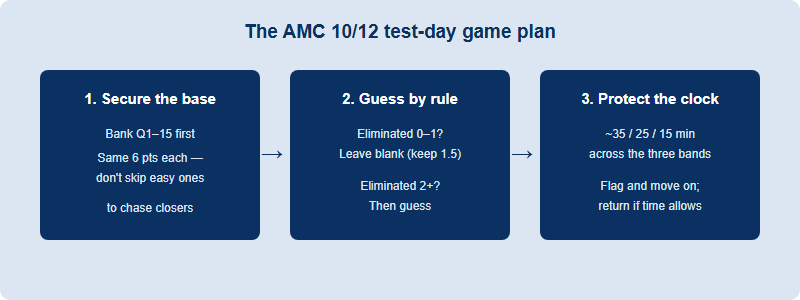
The practical rule that falls out of this math: guess only when you can confidently eliminate at least two of the five choices. If you cannot rule out two, leave it blank and protect your 1.5. This is the first-party take we drill with students — the break-even sits at “two eliminations,” and most score leaks come from students guessing when they have eliminated zero or one.
A 75-minute time budget that protects easy points
AMC papers are ordered roughly from easier to harder, and the early questions are worth exactly the same 6 points as the brutal final ones. The most common self-inflicted loss is a strong student sinking 15 minutes into question 23 and then rushing — or missing — questions 8 through 14 that they could have solved cleanly. Spend your minutes where the points are most reliable.
| Phase | Questions | Suggested time | Goal |
|---|---|---|---|
| First pass — secure the base | 1–15 | ~35 min | Answer everything you can do confidently; bank these points |
| Second pass — the mid-hard band | 16–20 | ~25 min | Push on problems where you see a path; flag the rest |
| Final pass — the closers | 21–25 | ~15 min | Attempt a couple; apply the two-elimination guess rule |
This is a starting template, not a law — adjust the splits to your own strength. The principle is non-negotiable: never leave a confidently-solvable early question on the table to chase a hard one. A clean run through questions 1–15 plus a few mid-range solves already lands many students near AIME-qualifying territory, well before they touch the final five. For how AIME qualification then works, see our guide to the AIME after the AMC 10/12.
Test-day rules and what you may bring
Two rules trip up first-time competitors, especially those preparing from outside the US who assume olympiad norms from elsewhere apply.
- No calculators. Calculators have not been permitted on the AMC 8, AMC 10, or AMC 12 since 2008. The problems are designed so that arithmetic is manageable by hand — if you find yourself wanting a calculator, you have usually missed a cleaner approach. Train without one from day one.
- Allowed materials are limited. Expect to need basic supplies (pencils, blank scratch/graph paper, ruler, compass and eraser are commonly permitted, while smartwatches, phones, and any computing aids are not). The exact permitted-materials list and any proctoring details are set by the MAA per cycle and your test center — confirm on maa.org and with your registered center before exam day.
Because these logistics differ by where and how you sit the exam, China-based students should pair this strategy with the practical sitting details in our eligibility and logistics guide. And do not confuse this exam with the unrelated Australian AMC (run by the AMT) or the AMO run by SIMCC in Singapore — the scoring and rules here apply specifically to the MAA’s American Mathematics Competitions.
Putting it together: a one-page game plan
The score-maximising approach to the AMC 10/12 is repeatable across the three pillars of this article.
Frequently asked questions
Is it ever smart to leave questions blank on the AMC?
Yes. A blank is worth 1.5 points and a random guess averages only 1.2, so blanking beats guessing unless you can eliminate two or more choices.
How many points is each correct answer worth?
Six points on the AMC 10 and AMC 12, with 1.5 for a blank and 0 for a wrong answer, for a maximum of 150. Confirm the current scoring on maa.org.
Are calculators allowed on the AMC 10 or AMC 12?
No. Calculators have not been permitted on any AMC competition since 2008, so practise entirely by hand.
How should I divide 75 minutes across 25 questions?
A common template is roughly 35 minutes on Q1–15, 25 on Q16–20, and 15 on Q21–25, adjusted to your strengths.
This is an independent English-language guide operated by Hanlin Education for China-based international-school students. It is not affiliated with, endorsed by, or sponsored by the Mathematical Association of America (MAA). Scoring, eligibility, permitted materials, and all competition rules are set by the MAA per cycle — confirm current details on maa.org. We correct any factual error within 7 working days.