Most AMC recognition moves with the field. The global Honor Roll is a top-5% band and the Distinguished Honor Roll a top-1% band. AIME qualification used to move the same way, but for 2027 MAA has fixed it at 100 on the AMC 10 and 85 on the AMC 12. One older track has never moved: younger students are recognised against a fixed score of 90 out of 150 — and that award runs on the AMC 12 as well as the AMC 10, which is the half almost nobody writes about.
This article separates the two kinds of recognition, states the grade conditions on the fixed one, works out what 90 out of 150 costs you in questions, and explains why a fixed line changes how a grade 8, 9 or 10 student should think about the season. Award names and criteria are set by the MAA and can change between cycles — confirm the current wording on maa.org.
Two recognition systems live on the same answer sheet
When students ask “what can I actually win?” they usually get one answer — the percentile bands — and stop there. But the AMC recognition structure has two mechanically different halves, and confusing them is why so much advice sounds contradictory.
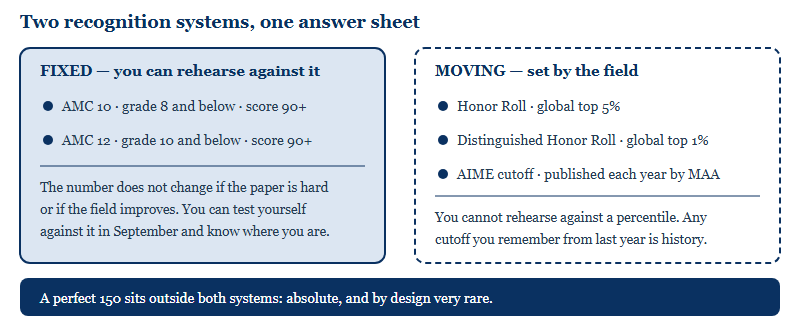
The first half is relative. The global Honor Roll recognises the top 5% of scorers; the Distinguished Honor Roll recognises the top 1%. AIME qualification used to work the same way, with a qualifying score published for each paper each year. For 2027 it does not: MAA has replaced that with fixed thresholds of 100 on the AMC 10 and 85 on the AMC 12. This corrects what this article said before.
The second half is absolute. A young-student achievement award is keyed to a fixed score of 90 or above, with a grade condition attached — grade 8 and below on the AMC 10, and grade 10 and below on the AMC 12. Nothing about it depends on how the rest of the world performed.
| Recognition | Basis | Depends on | Can you know the target in advance? |
|---|---|---|---|
| Perfect score | 150 out of 150 | Your paper only | Yes — but it is the hardest target on the sheet |
| Distinguished Honor Roll | Global top 1% | The whole field | No |
| Honor Roll | Global top 5% | The whole field | No |
| AIME qualification | A fixed score for 2027: 100 (AMC 10) or 85 (AMC 12) | The field and the MAA | No — never plan against a remembered number |
| Achievement award, AMC 10 | 90 or above, grade 8 and below | Your paper and your grade | Yes |
| Achievement award, AMC 12 | 90 or above, grade 10 and below | Your paper and your grade | Yes |
The AMC 12 half of the award that goes unwritten
Search in Chinese for AMC award structure and you will reliably find the AMC 10 version of this award: grade 8 and below, 90 or above. You will very often not find the AMC 12 version: grade 10 and below, 90 or above. The result is a large group of grade 9 and grade 10 students who never learn that a recognition band exists for them on the harder paper.
That gap has a consequence. The standard advice to a strong grade 9 or 10 student is “sit the AMC 10 — it is friendlier.” As advice about AIME qualification, that is often sound: the AMC 10 syllabus is narrower and the qualifying pathway is a real consideration. But the advice is usually delivered as if the AMC 12 offers a younger student nothing at all, and that is not accurate. On the AMC 12, a grade 10 student who reaches 90 is inside a recognition band designed for exactly that situation.
Two things this article is not saying. It is not saying you should switch papers to chase an award — that choice turns on eligibility rules, syllabus readiness and your AIME ambitions, and we have covered it separately. And it is not saying the award is easy. It is saying the ledger has an entry most students do not know is there, and you cannot decide well from an incomplete ledger.
What 90 out of 150 actually costs you in questions
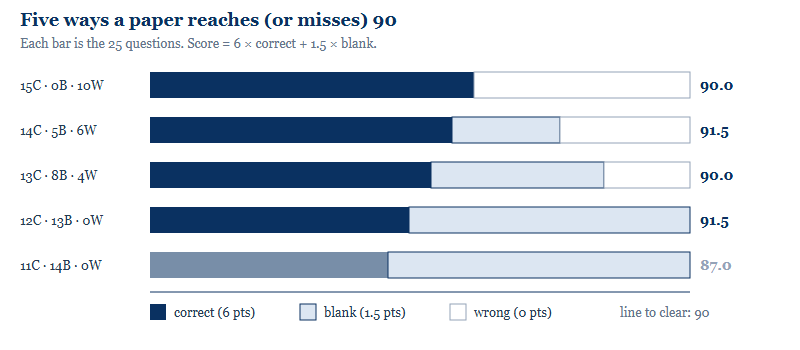
Both papers are 25 multiple-choice questions in 75 minutes. A correct answer is worth 6 points, an incorrect answer 0, and an unanswered question 1.5, for a maximum of 150. That scoring rule makes 90 a much more interesting target than it first appears, because blanks are not worthless.
Write c for correct answers and b for blanks. You clear the line when 6c + 1.5b reaches 90, subject to c + b being at most 25. Here is what that looks like in practice.
| Correct | Blank | Wrong | Score | What that paper looked like |
|---|---|---|---|---|
| 15 | 0 | 10 | 90.0 | Answered every question, converted fifteen |
| 14 | 5 | 6 | 91.5 | Guessed on six, left five alone |
| 13 | 8 | 4 | 90.0 | Disciplined: guessed only where a guess was informed |
| 12 | 13 | 0 | 91.5 | Attempted twelve, left the rest untouched, no errors |
| 11 | 14 | 0 | 87.0 | Three points short — one question in the front half |
Two conclusions fall out of that table, and they are the practically useful part of this whole article.
First, the correct-answer count sits between twelve and fifteen in every route. That is the front and middle of the paper. None of these routes requires you to solve problems 21 to 25. A student who has been told the award is for “the very strong ones” is picturing the wrong paper.
Second, blanks are load-bearing. The last two rows differ by a single question — one more conversion in the first half moves 87 to 93 — but they also show that a paper with twelve solid answers and thirteen honest blanks clears the line, while a paper with the same twelve answers plus thirteen wild guesses that all miss scores 72. The gap between those two papers is not mathematical ability. It is answering discipline.
Why a fixed line changes the calculation — and what our 2025 cohort looked like against it
Percentile targets have a psychological problem for students in grades 8 to 10: they are unfalsifiable in advance. You cannot rehearse against “top 5% of this year’s field” because you have never met this year’s field. Students respond to that either by ignoring targets entirely or by adopting a remembered cutoff from a previous year, which is the worse of the two errors.
A fixed 90 is different in kind. In September you can sit a full paper under real timing, score it honestly with the 6 / 0 / 1.5 rule, and know within a few points where you stand relative to a line that will still be in the same place in November. That is the only recognition target on the whole sheet that behaves this way, and it is the reason it belongs in a younger student’s plan even if the more glamorous bands do not.
Three honest caveats before you build a season around it:
- The grade condition on the award is not the same thing as eligibility to sit the paper. Whether a given student may enter the AMC 10 or the AMC 12 at all is a separate MAA rule with its own grade and age conditions. Confirm both on maa.org and with your authorised centre.
- 90 on a hard paper is not 90 on an easy one. The line is fixed; the difficulty of reaching it is not. Practising to exactly 92 leaves no margin for a year where the middle of the paper bites.
- Nothing here is a promise. Award structures are the MAA’s to set and revise, and results vary from student to student. Treat this as a map of how the system is built, not as an outcome you have been quoted.
Logistically, the 2026 papers are sat in person at authorised centres — the A papers on 5 November and the B papers on 13 November per the MAA’s published calendar, with your own sitting date coming from your test centre. Our summary of the 2026 in-person arrangements covers what that means for arrival, materials and identification on the day.
Because percentile bands are invisible in advance, it also helps to see a real distribution. The following is our own de-identified tally of students we worked with in the 2025 cycle. It is a count we made ourselves, not an MAA statistic, and results vary considerably between students:
- 379 AIME qualifications
- 165 students in the global top 5%
- 13 students in the global top 1%
- 5 perfect scores
- 35 students scoring 140 or above; 176 scoring 120 or above
Read that carefully, because two of those figures sit near each other for unrelated reasons. The 176 at 120-plus is an absolute score band we counted ourselves; the 165 in the global top 5% is our own count of students inside a percentile band the MAA sets. They are not interchangeable, and a great deal of commentary treats score bands and percentile bands as the same object.
The relevant observation is the shape rather than the size. In our own tally every counted band sits well above 90, though these are counts of high scorers rather than a full distribution. That tells a grade 8 or grade 9 student two things at once: the line is genuinely reachable, and it should work as a floor confirming the season was not wasted, not the ceiling you aim at. Our senior maths lead co-authored a competition guide published through Tsinghua University Press after a two-year editorial process, and the view across that work is the same — set the training target above the recognition target.
Training toward the line without training only for the line
The trap in a fixed target is obvious once stated: if 90 needs twelve to fifteen correct answers from the front and middle, why not simply drill questions 1 to 15 and ignore the rest? Because reliability at 1 to 15 is not built by practising 1 to 15. A student who has only ever seen easy problems reads an easy problem slowly, second-guesses a correct method, and burns the clock. The front half becomes automatic when the student has spent time above it.
Three habits do most of the work between now and November:
- Timed front-half sets with an accuracy target, not a speed target. Twenty minutes for questions 1 to 12, scored for errors rather than for finishing early. Speed follows accuracy; it does not lead it.
- Explicit blank discipline. Decide in advance what makes a guess worth making. A blank banks 1.5 points; a wrong answer banks nothing. On the marginal question in the late teens, that difference is real and it is the single easiest score to protect.
- An error log sorted by cause, not by topic. “Geometry” is not a cause. “Misread which quantity was asked for” is, and for students working in their second language it is frequently the largest single category.
For material, we maintain a compiled pack of past papers with answers and, for some years, worked video solutions — coverage of the worked solutions varies by year, so treat the answer keys as the reliable part and the videos as a bonus where they exist. Whatever you practise from, sit it under the real constraint: 75 minutes, 25 questions, no calculator, and the same in-person conditions described in our 2026 rules summary.
Frequently asked questions
Is the 90-point achievement award the same as the Honor Roll?
No. Honor Roll bands are percentile-based (top 5% and top 1% globally). The 90 line is a fixed score with a grade condition.
Does the AMC 12 really have a young-student award?
Per the 2026 award structure, grade 10 and below scoring 90 or above is recognised. Confirm current names and criteria on maa.org.
How many questions do I need for 90?
Between twelve and fifteen correct, depending on how many you leave blank. Blanks score 1.5 each, so they carry real weight.
Does reaching 90 qualify me for the AIME?
No. For 2027 AIME qualification sits at a fixed 100 on the AMC 10 and 85 on the AMC 12. It is a separate, higher line than the 90-point achievement award.
This is an independent English-language guide operated by Hanlin Education for China-based international-school students. We are not affiliated with, endorsed by, or sponsored by the Mathematical Association of America (MAA). Competition dates, eligibility rules, award names, award criteria and scoring are set by the MAA and can change; always confirm current details on maa.org and with your authorised test centre. Cohort figures cited here are our own de-identified tallies, not MAA statistics, and results vary. If you find an error in this article, tell us and we will correct it within 7 working days.