For the 2026 AMC 10/12 sittings in China, the AMC 10 test-day rules that matter most are administrative: the channel that issues your admission ticket, the objects you are allowed to keep on the desk, and whether the shared AMC 10/12 answer card carries your correct event, version and phone-number ID. This guide works through all three for the A paper on Friday 6 November 2026 and the B paper on Saturday 14 November 2026, 17:00–18:15, as set out in the pre-exam notice published by Hanlin Courses on 1 November 2026.
Two scope notes first. That notice is an operator report on China-region administration: it is a specific public description of the China sitting, but it is not MAA rule text, and where MAA publishes a rule the MAA version governs. Second, this site is an independent English-language guide; it is not the MAA, which is the issuer of the AMC and the AIME. The broader MAA-side policy on permitted materials and score cancellation is covered separately in The AMC Rules That Cancel a Score: Permitted Materials, Prohibited Devices, and the Policy With No Appeal; what follows is the narrower China 2026 logistics.
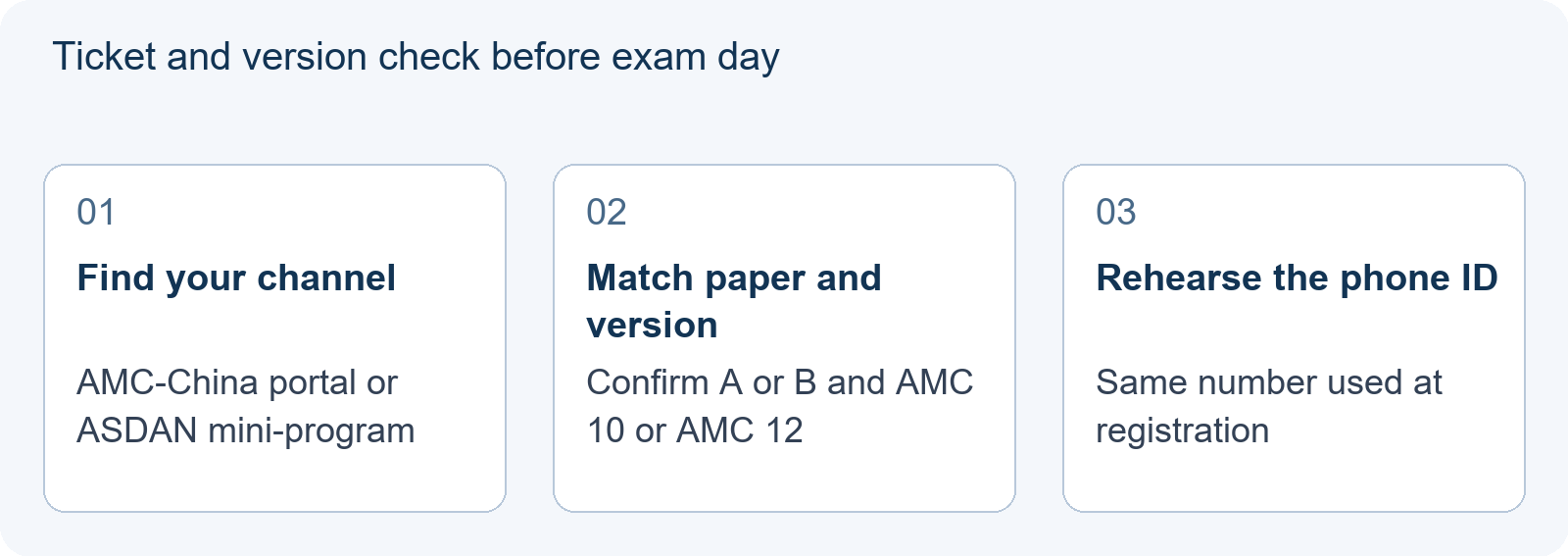
Your ticket comes from your registration channel, not from a search result
A predictable pre-exam failure is administrative rather than mathematical: a candidate registered through one channel and looks for the ticket through another. The operator notice names two groups of candidates it addresses, with two different portals and two different opening times.
| Registration channel | Where the ticket appears | First available (per notice) |
|---|---|---|
| AMC-China | www.math-table.com → “Admission Ticket”, then the registration phone number and verification | 31 October 2026, 12:00 |
| ASDAN | ASDAN mini-program: log in to query and download the updated ticket | after 3 November 2026, 18:00 |
The notice also instructs the ASDAN candidates it addresses to select Shanghai Hanlin School as the school in that flow; candidates registered elsewhere should follow the centre named on their own registration record rather than copying that step. The critical item in both rows is the same: the phone number used at registration. It unlocks the ticket, it unlocks the score query, and — as section five explains — it is also the unique identifier you write on the answer card. Losing access to that number between registration and exam day is a genuine administrative risk, so confirm now that the number is reachable and that you know it digit by digit.
Why the notice’s dates are a day after MAA’s calendar dates
MAA’s 2026 calendar places the A paper on 5 November and the B paper on 13 November. The China operator notice gives Friday 6 November and Saturday 14 November, both 17:00–18:15 local time, for the same A and B papers. The two sets of dates are a day apart. Whatever produces that offset, the practical rule is unambiguous: the date, time and centre printed on your ticket govern your sitting, not a date you read in a blog post. This is the same two-calendar problem set out in Two Calendars, One AMC Season: MAA Dates, Your Test Centre Sitting Date, and the October Deadlines (2026), and it matters most in the final fortnight, when a family may be planning travel around the wrong day.
What may be on the desk
The notice divides desk items into three groups: required, allowed-but-optional, and prohibited. The prohibited list is broader than a school geometry kit.
| Item | Status per operator notice | Action |
|---|---|---|
| Black 2B pencil | Required | Bring, plus a spare |
| Eraser | Required | Bring, clean |
| Black gel pen | Required | Bring; used for signature and phone-number writing |
| Ruler / set square | Allowed | Bring if you use one |
| Compass | Allowed | Bring if you use one |
| Scratch paper | Provided by the centre | Do not bring your own |
| Protractor | Not allowed | Leave at home |
| Graph paper | Not allowed | Leave at home |
| Calculator | Not allowed | Leave at home |
| Phones, smart watches, smart glasses, earphones, any device that can send or receive information | Not allowed | Leave outside the room |
Two details in that table are worth pausing on. First, the geometry kit is split: a ruler, a set square and a compass are permitted, a protractor is not. A candidate who carries a combined geometry set into the hall without checking its contents may be carrying a prohibited item without intending to. Second, scratch paper is supplied, so bringing a notebook is unnecessary and risks being treated as unauthorised paper; rely on the scratch paper the centre provides. The prohibition on information-capable devices is drafted as an open category, which means an unfamiliar device — a fitness band, a smart ring, a translator earpiece — should be treated as banned unless the centre tells you otherwise.
Arrival window, late cutoff and the exit rule
Three timings form a single chain. Candidates may enter 30 minutes before the start; the notice elsewhere describes the entry window as 15–30 minutes before, so the safe reading is to be at the door between 16:30 and 16:45 for a 17:00 start. A candidate who has not entered by 15 minutes after the start may not sit the paper, so 17:15 is the hard cutoff. No one may submit early, so the paper ends at 18:15 for everyone.
The exit rule is easy to misjudge. The notice states that candidates must settle personal matters before the paper begins, may not leave the room mid-exam to drink water or use the toilet, and that leaving the room is treated as cheating with the score invalid. As an operator rule for the China sitting this is deliberately blunt, and its practical consequence is simple: the 30-minute entry window is your last realistic toilet window, and arriving at 16:55 leaves no margin for a queue, a bag check or a seat search. A candidate who drinks a large bottle of water at 16:40 has created a risk that no amount of exam technique can repair.
Two further hand-in rules sit alongside this. At the end the answer card, the question paper and the scratch paper are all collected, and none of them may leave the room. The notice also prohibits discussing the questions or answers with anyone in any form for 24 hours after the paper ends.
The shared A/B answer card: three checks
The answer card is one and the same for AMC 10A, AMC 10B, AMC 12A and AMC 12B. That design saves printing and creates one specific hazard: the card cannot tell which paper you sat, so you must.
Check one: event and version
Bubble AMC 10 or AMC 12, and A or B, to match the paper physically in front of you. The notice warns that mis-filling can lead to the score being ruled invalid. It does not describe a correction or re-mark procedure, so the only safe plan is to fill it correctly once and to verify it before the paper starts, not during the last five minutes.
Check two: the phone-number identifier
Your unique identifying mark on the card is the phone number used at registration. It is written in black gel pen and bubbled in 2B pencil. Everything else on the card — signature and phone-number writing in black gel pen, all bubbles in 2B pencil — follows from the same convention, and using the wrong pen in the wrong zone is an avoidable error.
Check three: marking hygiene
No writing outside the fill and signature areas: the notice says the machine may fail to read the card, producing a void card. No correction fluid and no correction tape. Eraser residue must not be left on the card. Any wrong option must be erased completely, because a residual mark can be read as a second selection, and a multiple selection is scored as wrong.
Teaching illustration, not a real candidate. Suppose a candidate reaches question 17, is unsure, marks B lightly, then decides to leave it blank and rubs the mark out without looking. If the scanner still reads B, the question is treated as answered and wrong: 0 points instead of the 1.5 that a clean blank earns. The arithmetic cost of that smudge is 1.5. Because the notice publishes no re-mark route for a misread card, the only defence is a visual check of every erasure before hand-in.
What a blank is actually worth: a worked contrast
Scoring is 6 for a correct answer, 0 for a wrong answer and 1.5 for an unanswered question. Because a blank earns more than a wrong answer, the decision to guess is not free.
Teaching illustration, hypothetical. A candidate answers 14 questions correctly, gets 4 wrong and leaves 7 blank. Score = 14 × 6 + 4 × 0 + 7 × 1.5 = 84 + 0 + 10.5 = 94.5. Now take the same 14 correct answers and suppose those four attempted-wrong questions had been left clean instead: 14 × 6 + 11 × 1.5 = 84 + 16.5 = 100.5. The four failed attempts cost exactly 4 × 1.5 = 6 points. Under the 2027 fixed AIME thresholds published by MAA — AMC 10 at 100 and AMC 12 at 85, subject to the other eligibility conditions — that 6-point swing is the difference between 94.5, below the AMC 10 line, and 100.5, at or above it.
The same arithmetic explains when a guess is worth taking. With five options and no idea at all, a blind guess is worth (1/5) × 6 + (4/5) × 0 = 1.2 points in expectation, which is less than the 1.5 a blank earns. Eliminating one option lifts the guess to (1/4) × 6 = 1.5, exactly break-even. Eliminating two lifts it to (1/3) × 6 = 2.0, clearly better than blanking. These are expected values for one question, not a prediction about your paper; they say that a guess with no elimination is worth less than a blank, and a guess after removing two options is worth more. Whichever you choose, the card must show that choice cleanly: a question you mean to leave blank must carry no mark at all.
If the ticket, centre or version looks wrong
Act through the channel you registered with, not through an unofficial ticket-download page. For AMC-China candidates that means the query page at www.math-table.com that is keyed to the registration phone number; for ASDAN candidates it means the mini-program, where the notice says an updated ticket can be queried and downloaded after 3 November 18:00.
Before you contact anyone, assemble five items: the registration phone number; the channel you registered through; the exact paper (10A, 10B, 12A or 12B); the centre shown on the ticket; and a screenshot of the ticket page with the timestamp visible. A message that contains all five can be resolved in one exchange. If the ticket shows a different paper from the one you registered for, resolve it before exam day — the answer card cannot fix a paper mismatch, because a correctly bubbled card for the wrong paper still reports the wrong sitting.
For planning after the paper, the notice gives score queries at four to six weeks after the activity through the same portal’s “Scores” page, and certificates at six to eight weeks through “Personal Center” and “Certificates”, both keyed to the registration phone number and both subject to the official notice of the day.
A ten-minute desk audit, and how to prepare for a readiness conversation
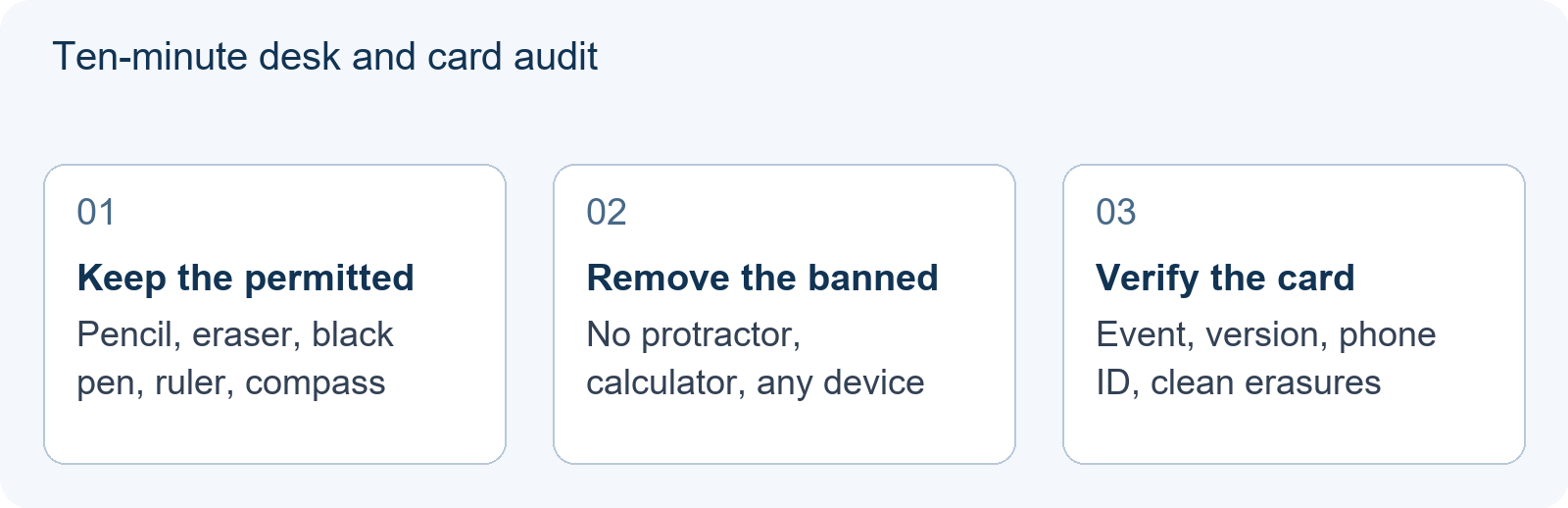
Run this once the evening before and once outside the hall; it takes about ten minutes and it targets every failure mode described above.
- Ticket located on the correct channel, screenshot saved, centre and paper confirmed.
- Registration phone number written down and memorised, not only stored on the phone you are leaving outside.
- Two black 2B pencils, sharpened.
- One clean eraser.
- One black gel pen that writes clearly.
- Ruler or set square and compass, if you use them — and the protractor removed from the case.
- No graph paper, no calculator, no notebook; scratch paper is provided.
- Smart watch, fitness band, smart ring and earphones left behind.
- Event and version rehearsed: you can say out loud which of 10A, 10B, 12A or 12B you are sitting.
- Personal matters settled before 16:30, so the mid-exam exit rule never becomes relevant.
If you want an outside check rather than another practice set, arrive at that conversation with four things: your registration channel, a screenshot showing your ticket status, the paper and version you are sitting, and one recent timed score taken under exam conditions. Those four items let a reviewer separate a logistics risk from a preparation risk, which is the distinction drawn in AMC Mock Test Review: Separate a Knowledge Gap From a Pacing Failure. If the missing piece is the timed run itself, sit one under the same materials rules — pencil, eraser, black pen, ruler, compass only, no calculator — so that the conditions and the score mean something.
Nothing described here guarantees a score, an award or an invitation. What a readiness review can do is find the ticket, desk or card problem while it is still cheap to fix, which is the only part of exam day that is fully within a family’s control.
General event background is available at Event background.
This is an independent preparation guide, not affiliated with, endorsed by, or sponsored by the Mathematical Association of America.
Frequently Asked Questions
Where do candidates sitting the AMC 10/12 in China find the 2026 admission ticket?
It depends on the registration channel. According to the operator notice of 1 November 2026, AMC-China candidates query the ticket at www.math-table.com from 31 October 2026 at 12:00 using the registration phone number, while ASDAN candidates query and download the updated ticket from the ASDAN mini-program after 3 November 2026 at 18:00. The registration phone number is also the unique identifier written on the answer card, so keep it accessible.
Can an AMC 10 candidate in China bring a protractor or a calculator to the 2026 sitting?
No, on both counts. The operator notice permits a ruler, a set square and a compass, but prohibits protractors, graph paper, calculators and any device capable of sending or receiving information, including smart watches, phones, smart glasses and earphones. Scratch paper is supplied by the centre, so it should not be brought. The permitted geometry kit is therefore narrower than a standard school set.
What happens if a candidate leaves the room during the paper, or leaves a question unanswered?
Leaving the room mid-exam to drink water or use the toilet is treated by the operator notice as cheating, and the score is invalid. An unanswered question is different: scoring is 6 for correct, 0 for wrong and 1.5 for blank, so an untouched question should be left with no mark at all on the shared answer card, and any earlier mark must be erased completely.