If you are searching for AMC 12 trigonometry help, start with the diagnosis rather than another formula list. For AMC 12 identity and equation questions, check four things in order: quadrant signs, identity route, interval restriction, and back-substitution. The AMC 10 excludes trigonometry, advanced algebra, and advanced geometry, while the AMC 12 includes the high-school curriculum except calculus (MAA American Mathematics Competitions, checked 26 October 2026). Each AMC 10/12 paper is 25 multiple-choice questions in 75 minutes (same MAA note). That format rewards fast, repeatable error checks.
Most students who freeze on these questions do not lack identities. They lose time because they begin algebra before establishing the unit-circle sign context, choose a valid but slow identity, forget the interval, or fail to verify a root that the algebra introduced. This article turns those failure points into four diagnostic checkpoints and one complete teaching illustration.
What changes when trigonometry appears on AMC 12
AMC 10 students often meet trigonometry only in school work, where a calculator, a diagram, or a stated domain can reduce pressure. On an AMC 12 paper, the same topic can appear as a multiple-choice question that expects exact values, periodicity, and sign awareness. The MAA scope note makes the boundary clear: trigonometry is not an AMC 10 topic, but it is within the AMC 12 curriculum. This is why a strong AMC 10 student can still feel unprepared for AMC 12 trigonometry.
The practical shift is not “learn every identity.” It is “learn which unit-circle decision comes next.” A useful teaching default is to treat each identity or equation question as a short diagnostic sequence. The table below summarizes the four checkpoints used in this article.
| Checkpoint | Common symptom | Correction | Timed cue |
|---|---|---|---|
| 1. Quadrant sign | Correct identity, wrong sign | Locate the angle before simplifying | Ask: which quadrant, which function is negative? |
| 2. Identity route | Long algebra, no simplification | Reduce to one function or one square | Ask: can I remove the angle or the product? |
| 3. Interval restriction | Missing periodic roots | Generate all roots inside the stated interval | Circle the domain before solving |
| 4. Back-substitution | Extraneous or out-of-domain choice | Test answer choices in the original equation | If you squared, verify before selecting |
Checkpoint 1: quadrant signs and reference angles before algebra
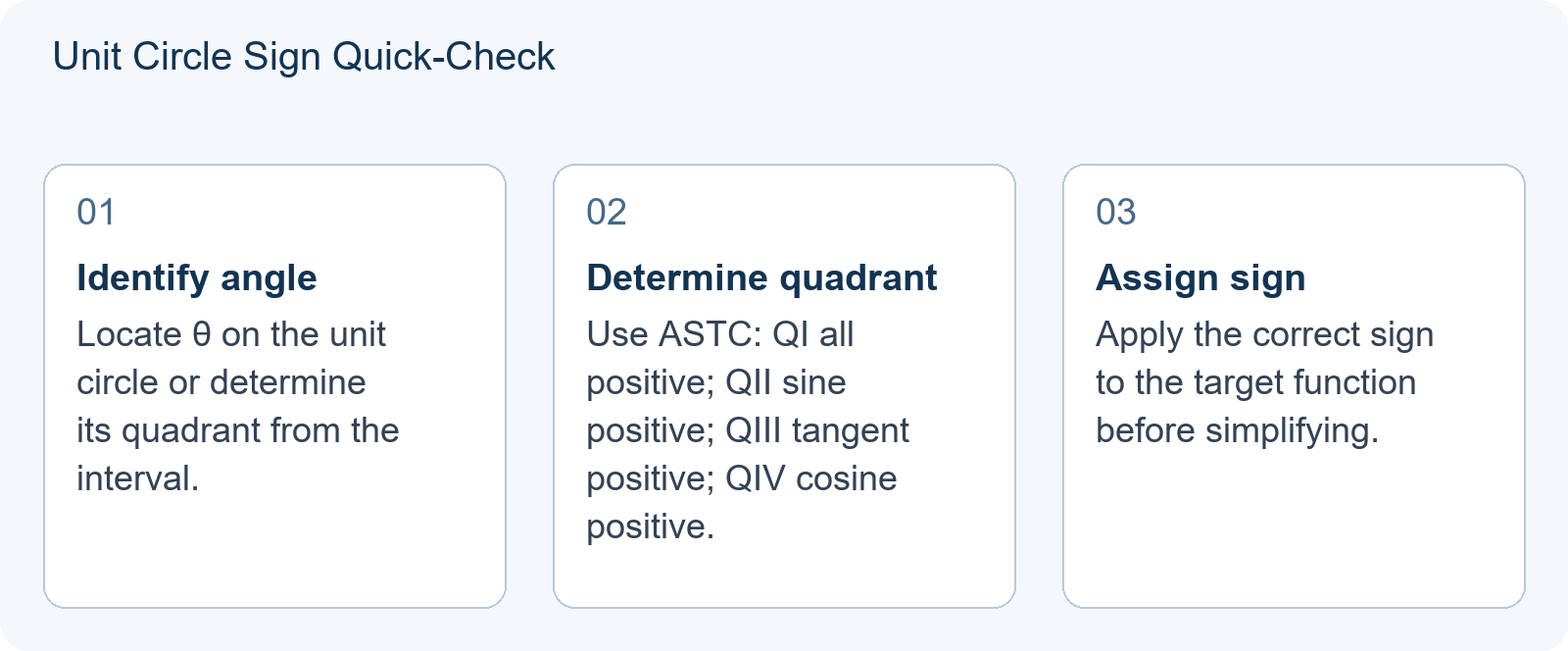
The first error is premature algebra. Many students expand or factor before they decide whether the function value should be positive or negative. On the unit circle, the quadrant determines sign. A quick memory device is ASTC: in Quadrant I all six functions are positive; in Quadrant II sine and cosecant are positive; in Quadrant III tangent and cotangent are positive; in Quadrant IV cosine and secant are positive.
Teaching illustration. Simplify if is in the second quadrant. The Pythagorean identity gives , so the square root is . Because is in Quadrant II, is negative. Therefore the simplification is . A student who writes has used the identity correctly but ignored the quadrant sign.
Diagnostic question: Before you simplify, can you state the sign of the final expression? If not, you are one step away from a sign error.
Checkpoint 2: choose the identity that reduces complexity
The second checkpoint is identity selection. A valid identity can still be the wrong tool under time pressure. The goal is to reduce the expression to one trigonometric function or to a square that cancels. If you see squared sine and cosine terms, Pythagorean or double-angle identities are usually promising. If you see products, product-to-sum formulas may help. If you see sums inside arguments, addition formulas may be necessary.
Teaching illustration. Simplify , where the expression is defined. Use and . The ratio becomes , which simplifies to . This simplification holds provided and , preserving the original domain where the denominator is non-zero. The identity route removed the double angle and reduced the expression to one function.
Diagnostic question: After choosing an identity, will the expression have fewer functions, fewer angles, or a cancellation? If not, reconsider before writing more lines.
Checkpoint 3: interval restrictions and periodicity
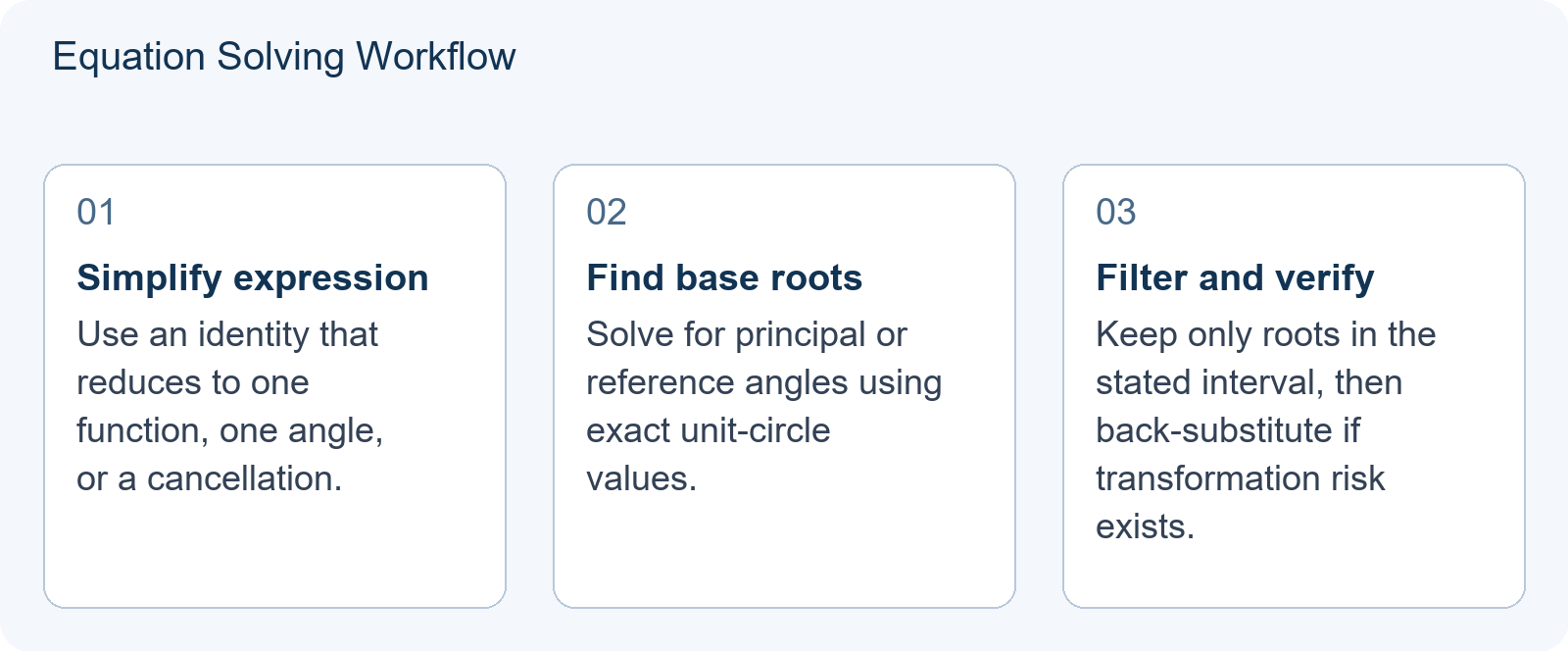
The third checkpoint is the interval. Trigonometric equations have infinitely many solutions unless a domain restricts them. AMC 12 multiple-choice questions often state an interval such as or . If you find one base angle and stop, you may miss a valid choice.
Teaching illustration. Solve on . The reference angle is . Sine is positive in Quadrants I and II, so the solutions are and . If you only write , you have found a root but not all roots in the interval.
Diagnostic question: After finding one root, ask where the same sine or cosine value appears again in the given interval. Use symmetry across the y-axis or x-axis. Note that adding or subtracting periods () may be needed even if the interval width is exactly one period, particularly if the interval is shifted (e.g., or ).
Checkpoint 4: back-substitute answer choices
The fourth checkpoint uses the multiple-choice format. Back-substitution is not a substitute for understanding, but it is a fast verification tool, especially when you squared both sides or applied a transformation that may introduce extraneous roots.
Teaching illustration. Suppose you solve on . The true solutions are and . If you square both sides, you may get additional candidates such as and . Those extra candidates satisfy but not . Testing the original equation filters them out.
Diagnostic question: Did any step change the equation’s solution set? Squaring, multiplying by an expression that could be zero, or applying a non-injective transformation should trigger a verification pass.
Worked teaching illustration: cosine equation on a full period
Note: The following is a teaching illustration created to demonstrate the diagnostic process. It is not an actual contest problem and not official scoring guidance.
Problem: Solve for in .
Step 1: Quadrant check. The interval is a full period. There is no extra sign restriction on before solving, but the equation will determine which cosine values are possible.
Step 2: Identity route. Treat the equation as a quadratic in . Then . Factor: . Therefore or .
Step 3: Interval restriction. For , the only solution in is . For , cosine is negative in Quadrants II and III. The reference angle is . The solutions are and .
Step 4: Verification. The three solutions are , , and . Substituting each back into confirms they all satisfy the original equation. A common error here is missing because is easy to overlook, or missing by stopping after the Quadrant II solution.
Timed drill template with a concrete retest cycle
Use the checkpoints in a short, repeatable drill. Select 6 trigonometry identity or equation questions from past AMC 12 papers or from a mock test. Give yourself 12 minutes total. Record the result, then classify every error by one of the four checkpoints.
After classification, do not simply redo the same six questions. The next day, retest only the failed checkpoint with 3 fresh questions in 6 minutes. For example, if your errors were mostly quadrant signs, choose 3 questions that require sign decisions before algebra. If your errors were interval misses, choose 3 equations with explicit intervals. If your errors were verification failures, choose 3 equations that can be solved by squaring or by multiplying by a potentially zero expression. This allocation keeps the retest focused on the error class rather than on general review.
This use of timed mocks is consistent with a Hanlin mock-report teaching observation from 9 October 2026: timed mocks reveal pacing failures and mock results should identify weak modules for targeted review. The trig-specific step here is to convert “weak module” into one of the four checkpoints, then retest that checkpoint with fresh questions.
Over several cycles, you should see whether your errors cluster around signs, identity choice, interval handling, or verification. That pattern is more useful than a general feeling that trigonometry is hard.
How to use this diagnostic without losing speed
Work the checkpoints in order during practice, but compress them into habits during a timed paper. Before writing algebra, glance at the quadrant or sign condition. Before expanding, ask which identity reduces the expression. Before selecting an answer, confirm the interval. After any squaring or transformation, verify by substitution. These habits take seconds once practised, and they protect the points that are lost to avoidable errors.
For a broader view of the AMC 10 and AMC 12 content split, see The AMC 12 Content the AMC 10 Never Tests: A Study Map for Trigonometry, Logarithms and Complex Numbers. For the general error-classification method, see AMC Mock Test Review: Separate a Knowledge Gap From a Pacing Failure. For algebraic patterns that often combine with trigonometry, see AMC 10/12 Algebra, Family by Family: Quadratics, Systems, Rates and the Setups Behind Them.
General event background is available at Event background.
This is an independent preparation guide, not affiliated with, endorsed by, or sponsored by the Mathematical Association of America.
Frequently Asked Questions
Does AMC 10 include trigonometry?
No. The MAA scope note checked on 26 October 2026 says AMC 10 excludes trigonometry, advanced algebra, and advanced geometry. AMC 12 includes the high-school curriculum except calculus.
How much time should I spend on an AMC 12 trigonometry question?
The paper has 25 multiple-choice questions in 75 minutes, so the average pace is 3 minutes per question. A practical teaching target is 2 to 3 minutes for a standard identity or equation question. If you exceed that, mark it and return later if time permits.
What is the most common AMC 12 trigonometry error?
A useful teaching observation, not an official statistic, is that students often lose points by missing interval restrictions or by mishandling quadrant signs. Use the four-checkpoint diagnostic: quadrant sign, identity route, interval restriction, and back-substitution.