MAA has scheduled the 2026 papers for 5 November and 13 November, and many US institutions set early-round application deadlines on or around 1 November. Line those two facts up and something awkward appears: a student sitting the AMC in their final school year produces a result after their early applications have already gone in. The season and the deadlines do not overlap the way most families assume.
This piece is about calendar arithmetic, not about how to phrase an entry once you have a result — we covered that separately. It is worth reading now, in late August, because the conclusion changes what this particular November means depending on which year group you are in. Every application deadline referenced below must be confirmed with each institution, and every competition date with maa.org and your own centre.
The arithmetic, laid out plainly
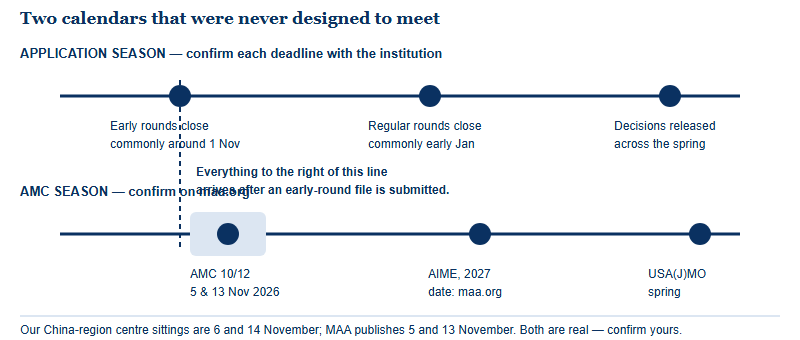
Three fixed points define the season. MAA publishes the AMC 10/12 A papers on 5 November 2026 and the B papers on 13 November 2026; our China-region centre sittings for this cycle are 6 November and 14 November, and both calendars are real without either correcting the other. The AIME follows in the next calendar year, and MAA has now published it: a single competition window on 5–6 February 2027, with no alternate date and no make-up sitting. That tightens this timeline rather than loosening it — there is no longer a second AIME date to fall back on if the first one clashes with something. MAA also rewrote how you qualify for it, which we cover in our guide to the 2027 AIME changes. The USA(J)MO sits later still, in the spring.
Against that, the application calendar has its own fixed points, which vary by institution and which you must check individually: early rounds commonly close on or around 1 November, regular rounds commonly in early January, and decisions arrive across the spring.
Put one against the other and the collisions are visible without any guesswork:
- The November papers fall after early deadlines. A 5 or 6 November sitting is several days past a 1 November submission. Whatever you score, the file has gone.
- The AIME falls after regular deadlines. If regular-round applications close in early January and the AIME sits later in the new year, the AIME result is not in the file either.
- The USA(J)MO falls around or after most decisions. The spring stage of the season lands around or after the point at which outcomes are already being released.
None of this is a criticism of either calendar. The AMC season is built around the US school year and the invitational structure that follows it; application deadlines are built around something else entirely. They simply were not designed to line up, and nobody tells students that.
What that means for each year group
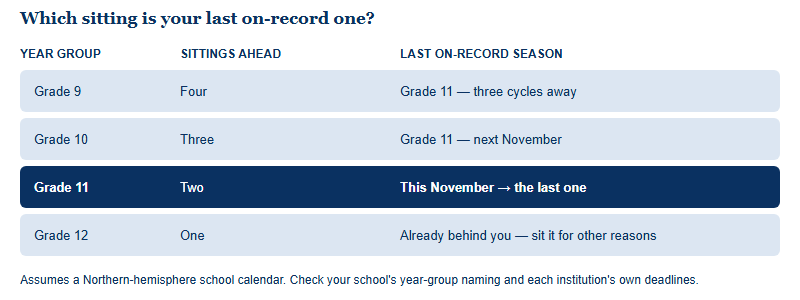
The consequence is not the same for everyone, and this is where it becomes actionable. Work backwards from the year in which you submit applications: the last competition season that finishes before you apply is the season you sit in grade 11.
| Your year group this autumn | November sittings still ahead of you | The last one that lands before applications | What that makes this November |
|---|---|---|---|
| Grade 9 | Four, through to your final year | Your grade 11 season, three cycles away | A low-stakes first exposure. This is the year to learn the format cheaply. |
| Grade 10 | Three | Your grade 11 season, next year | The last full rehearsal before the season that counts on paper. |
| Grade 11 | Two | This one | Your last on-record sitting. If you were going to take the A and B option seriously, this is the year. |
| Grade 12 | One | Already behind you | Sat for your own sake, or for a mid-year update where an institution accepts one. Confirm that individually. |
The line worth sitting with is the grade 11 row. If you are in grade 11 this autumn, the paper you sit in November is the last one whose result exists in time to be reported in the ordinary way. That is not a reason to panic, and it is certainly not a reason to cram. It is a reason to make the administrative decisions properly rather than casually: whether to sit both the A and B papers, which centre to book, and whether your seat is actually secured before the registration deadline. The practical side of all of that is in our guide to the 2026 in-person AMC rules and authorised test centres.
The real consequence: the preparation window sits earlier than people think
If the grade 11 season is the last on-record one, then the training that produces a grade 11 result happens in grade 10 and the summer between. That is a genuinely different picture from the common assumption that competition maths is something to get serious about in the year you apply.
It also explains a pattern worth naming. Students frequently arrive in grade 11 wanting a strong AMC result and discover that the skills involved — recognising configurations quickly, managing 75 minutes across 25 questions, working exactly without a calculator — are built over seasons rather than weeks. The students who look well prepared in grade 11 usually are not more talented. They started a year or two earlier because nothing was at stake then, which is exactly when the learning is cheapest.
The corollary for younger students is reassuring rather than pressuring. If you are in grade 9 or 10, this November genuinely does not need to go well. Sit it, find out what the paper feels like, keep a record of what went wrong, and treat the score as private information rather than as a result. That is the best possible use of a season that carries no external weight.
What a grade 12 sitting is still for
Nothing above says a final-year student should skip the competition, and it would be a poor conclusion to draw. Several reasons survive the timing problem intact.
- Some institutions accept mid-year or updated information. Practice varies widely: some invite updates, some accept them, some do not. This is worth checking institution by institution rather than assuming either way.
- The season continues past the application. Qualifying for the AIME, and anything beyond it, happens on its own calendar and has its own meaning regardless of where your file is.
- It is the last year you are eligible. MAA sets the AMC 12 at grade 12 or below and under 19.5 years of age on competition day, so for most final-year students a November sitting is a last opportunity in a straightforward sense.
- Wanting to do it is a sufficient reason. A student who has trained for three years and wants to see how far they get does not need an admissions justification.
Three things this argument does not license
Because timing arguments are easy to over-read, three limits are worth stating explicitly.
It does not mean a competition result produces an admission outcome. No AMC score, award tier or invitation causes an offer from any institution, and nobody should plan on that basis. What this article establishes is narrower and purely mechanical: whether a result exists at the moment a file is submitted.
It does not mean grade 11 should be overloaded. Grade 11 is already the heaviest year in most international-school programmes, and adding an intense competition push on top of it is frequently the wrong trade. The honest reading of the calendar is that it argues for starting earlier, not for compressing harder into the busiest year.
It does not mean the deadlines are fixed facts you can plan around from this article. Institutions set their own dates and change them. Everything here is arithmetic performed on dates you must confirm yourself — MAA’s competition dates on maa.org, your sitting date with your centre, and every application deadline with the institution concerned.
With those caveats in place, the practical takeaway is small and worth acting on: find out which row of the table you are in, and let that decide how carefully you handle this year’s registration. If that is the grade 11 row, treat the registration and centre arrangements as the part that deserves your attention this month.
Frequently asked questions
Will my November AMC result reach an early-round application?
Not if the deadline falls on or around 1 November, since MAA has scheduled the 2026 papers for 5 and 13 November.
Which season is my last one that lands before applying?
Working backwards from the application year, it is normally the season you sit in grade 11. Confirm your own deadlines.
Is there any point sitting the AMC in grade 12?
Yes — for the AIME route, for a mid-year update where an institution accepts one, and because it is your last eligible year.
Does a strong AMC result improve admission chances?
No result causes an admission outcome. This article addresses only whether a result exists in time to be reported.
This is an independent English-language guide to the American Mathematics Competitions, operated by Hanlin Education for China-based international-school students. We are not affiliated with, endorsed by, or sponsored by the Mathematical Association of America. Competition dates and eligibility rules are restated by MAA each cycle and application deadlines are set independently by each institution — confirm current details on maa.org, with your own authorised test centre, and with each institution before acting on anything here. Errors reported to our editorial desk are corrected within 7 working days.