A protractor, a sheet of graph paper and the smartwatch on your wrist are all prohibited at an AMC sitting, and MAA states that where a score is cancelled or disqualified there is “no opportunity to challenge the determination.” None of that is aimed at dishonest students. It is aimed at the ordinary school bag a student carries into an exam room straight from a full school day.
This article is about the administrative rules rather than the mathematics: what you may have on the desk, what is prohibited outright, what happens if the rules are not followed, and why the answer to that last question makes preparation the only lever you have. For how the sitting itself is organised in 2026, see our guide to the 2026 in-person AMC rules and authorised test centres. Every rule quoted below should be re-checked on maa.org before your own sitting, since MAA restates them each cycle.
The permitted list is shorter than the one in your head
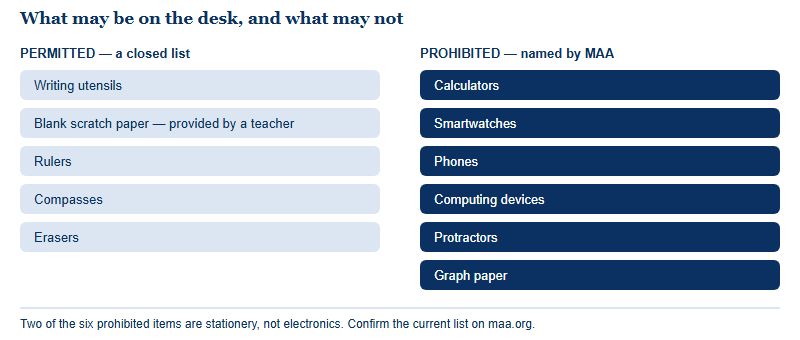
MAA’s competition policies state that “the only materials students can have during the competition are writing utensils, blank scratch paper (NOT graph paper) provided by a teacher, rulers, compasses, and erasers,” and separately that “NO CALCULATORS OR PHONES AND SIMILAR ELECTRONIC DEVICES OF ANY KIND ARE ALLOWED.” The 2025 AMC 10/12 Teacher’s Manual gives the same list in the other direction, naming prohibited materials as “calculators – smartwatches – phones – computing devices – protractors – graph paper.”
Read those two lists together and three things stand out. The permitted list is a closed list, not a set of examples. Scratch paper is described as provided by a teacher, which means the paper on your desk is not paper you brought. And the prohibited list is not confined to electronics — two of the six named items are ordinary stationery.
| Item | Status | The detail people miss |
|---|---|---|
| Writing utensils | Permitted | Bring spares; a failed pen mid-paper costs minutes you cannot recover in a 75-minute exam. |
| Blank scratch paper | Permitted, but supplied | MAA’s wording is “provided by a teacher”. Do not assume your own pad is acceptable. |
| Ruler | Permitted | Useful for straight construction lines, not for measuring an answer off a figure. |
| Compass | Permitted | Genuinely useful for re-drawing a circle configuration at a workable size. |
| Eraser | Permitted | — |
| Protractor | Prohibited | Named explicitly in the manual, and sits in almost every school geometry set. |
| Graph paper | Prohibited | Named in both documents. The parenthetical “(NOT graph paper)” is MAA’s own. |
| Calculator | Prohibited | No exception is stated for a basic or non-programmable model. |
| Smartwatch | Prohibited | Worn rather than carried, which is exactly why it survives a bag check. |
| Phone, computing devices | Prohibited | “Of any kind” — possession, not use, is the standard being described. |
Three prohibited items that catch well-prepared students
The protractor. It ships inside the standard geometry set that most students already own, alongside the compass and ruler that are permitted. Two of the three travel legally and one does not. There is also a deeper point: the AMC never asks you to measure an angle off a diagram, because diagrams are not guaranteed to be drawn to scale and every answer is an exact value. A protractor is prohibited and, separately, would not help you.
Graph paper. This is the one that most often surprises students who studied in a Chinese-curriculum classroom, where squared paper is the default in a maths exercise book. MAA writes the exclusion into the permitted clause itself — “blank scratch paper (NOT graph paper)” — and repeats it on the prohibited list. If you have spent the autumn practising coordinate geometry on squared paper, move at least your last few timed sets onto blank paper, so that the day itself is not the first time you draw a set of axes freehand.
The smartwatch. Every other prohibited electronic item lives in a bag, which means a bag check finds it. A smartwatch is on your wrist and reads, to its owner, as a watch rather than as a device. It is named explicitly on the prohibited list, so the safe rule is that the only timepiece you rely on is the clock in the room, and that you confirm anything else with your own centre in advance.
None of these three involves an intention to gain an advantage. That is precisely the argument for checking rather than assuming: the rules are written around possession, and possession is easy to get wrong without meaning anything by it.
Why a 17:00 sitting raises the risk, not the difficulty
Our China-region centre information for this cycle is that the sittings run on 6 November 2026 (a Friday) and 14 November 2026 (a Saturday), 17:00 to 18:15 local time, on bilingual papers, at RMB 120 per sitting. Those are the centre’s own arrangements rather than MAA’s published dates — MAA publishes 5 November and 13 November 2026 — and both calendars are real, with neither correcting the other. Confirm your own sitting date, start time and venue directly with the centre holding your seat.
The consequence that matters here is not academic. A 17:00 start on a Friday means most candidates walk in directly from a full school day, carrying the bag they have carried since morning: a phone, very likely a calculator from a science or maths lesson, possibly a complete geometry set with a protractor in it, and an exercise book full of squared paper. Every one of those is prohibited, and not one of them was packed with the competition in mind.
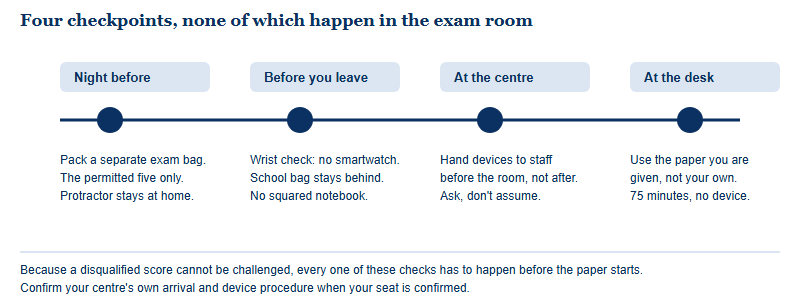
The fix is boring and effective. Pack a separate, near-empty exam bag the night before containing only the permitted items, and treat your school bag as something that stays outside the room. Candidates sitting the Saturday paper have an easier version of the same problem, but the habit is worth building either way.
One further point specific to a bilingual paper: a bilingual paper is not a licence to bring a dictionary. No dictionary appears anywhere on the permitted list. If you are worried about the English, the remedy is reading practice beforehand, not a reference book on the desk.
Remote sittings are a cancellation rule, not a logistics preference
MAA states that “remote proctoring is not permitted under any circumstances” and that “any students found to have taken the MAA AMC remotely will have their scores canceled.” The Teacher’s Manual repeats the point in the same terms.
This matters because it reframes something students often read as an inconvenience. The in-person requirement is not administrative housekeeping that a sufficiently well-organised school could work around; it is a security rule with a stated consequence attached. It is also why authorised centres, fixed seats and registration deadlines exist at all — the chain of custody around the papers is the whole point. We covered the practical side of this in our guide to the 2026 in-person sitting and authorised centres.
The practical translation for a China-based candidate is simple. If any arrangement offered to you involves sitting the paper somewhere other than an authorised centre, or involves a proctor watching over a video call, it is not a shortcut with some risk attached. It is described by MAA as producing a cancelled score.
The asymmetry that should change how you prepare
MAA’s policies also state that “whether or not academic dishonesty is proven beyond doubt, MAA, in its sole discretion, may disqualify scores tied to suspicious answers,” and that “when a student’s score is cancelled or disqualified, whether correctly or erroneously, there is no opportunity to challenge the determination.” The Teacher’s Manual puts the general case more briefly: the MAA AMC Office “reserves the right to disqualify scores if it determines the rules and procedures were not followed.”
Two observations, offered without drama. First, this structure is ordinary for a competition marked at very large scale. An appeals process built around individual answer patterns would not be workable at that volume, and most large standardised competitions arrive somewhere similar. It is not a statement about you, and not a statement about international candidates in particular.
Second, and this is the part worth acting on: because there is no route to argue afterwards, all of the available effort has to sit on the preventive side of the line. In ordinary school life, a student who accidentally carries a calculator into a room can usually explain it, hand it over and continue. That instinct is reasonable in that setting and is the wrong instinct here. Treat the rules as something checked in advance rather than negotiated on the day, and the entire issue disappears — which, for the overwhelming majority of candidates, is exactly what happens.
A ten-minute check worth running this week. None of it requires knowing any mathematics, and all of it is easier now than on the day.
- Open your geometry set and remove the protractor. Put it somewhere that is not your pencil case today, rather than on the morning of the sitting.
- Move your last few timed practice sets onto blank paper. If you have been working on squared paper, this is a small adjustment better made in October than in November.
- Decide now what happens to your phone and your watch. Ask your centre what its procedure is for handing in devices, and where school bags are stored during the paper.
- Confirm your sitting date, start time and address with the centre holding your seat, and remember that MAA’s published date and your centre’s sitting date may differ without either being wrong.
- Re-read the current policy page on maa.org. It is short, MAA restates it each cycle, and it is the only version that governs your own sitting.
Frequently asked questions
Can I bring a calculator to the AMC 10 or AMC 12?
No. MAA prohibits calculators, phones, smartwatches and computing devices of any kind at every AMC sitting.
Is graph paper allowed if the invigilator hands it out?
No. The permitted list specifies blank scratch paper provided by a teacher, and names graph paper as prohibited.
Can a cancelled or disqualified AMC score be appealed?
MAA states that where a score is cancelled or disqualified there is no opportunity to challenge the determination.
The China-region paper is bilingual. May I bring a dictionary?
No dictionary appears on the permitted list. Confirm anything not on that list with your own centre before the day.
This is an independent English-language guide to the American Mathematics Competitions, operated by Hanlin Education for China-based international-school students. We are not affiliated with, endorsed by, or sponsored by the Mathematical Association of America. Rules, dates, permitted materials and policies are restated by MAA each cycle — confirm current details on maa.org and with your own authorised test centre before acting on anything here. Errors reported to our editorial desk are corrected within 7 working days.